Share

Central African Forest Cobra
🔤 Taxonomy
Naja melanoleuca is the accepted name for the Central African forest cobra. The 2018 revision split the former wide-ranging “forest cobra” into five species: N. melanoleuca, N. guineensis, N. savannula, N. subfulva and N. peroescobari. Old labels from West or East Africa therefore cannot be accepted as N. melanoleuca without locality and expert review.
The alternative combination Boulengerina melanoleuca occurs in some literature. This guide follows the strict Central African species concept.
📌 Description
This is a large, powerful cobra, commonly 140-220 cm and exceptionally near 270 cm. It is terrestrial but climbs and swims well, using forest floor, fallen timber, dense vegetation and water margins. Adults may live 15-25 years under stable institutional care.
Envenomation can combine pain and swelling with neurotoxicity, weakness and respiratory failure. Size, reach and force make open servicing particularly hazardous. Only licensed institutions with redundant containment, protected contact and a pre-arranged clinical response should keep it.
📋 Quick reference
| Care point | Practical target |
|---|---|
| Adult enclosure | At least 300 x 150 x 180 cm with two lockable shift compartments |
| Temperature | Ambient 24-29°C; basking 31-33°C; cool retreat 22-25°C |
| Night | 21-24°C |
| Humidity | 65-85%; local 80-90% shed support with ventilation |
| Feeding | Varied moderate whole prey every 10-21 days |
| Safety | Protected contact, two trained staff, written bite and escape plans |
| Quarantine | At least 90 days with separate tools and veterinary screening |
☠️ Venom
This species is venomous. Venom exposure can cause pain, swelling or other systemic effects, and severity varies with species, locality, bite site and the amount delivered. A small wound or apparently dry bite is not proof of safety; every bite or sting requires urgent medical assessment.
If an incident occurs, move away, call emergency services or a poison centre, keep the patient still, remove rings and other constricting items, and follow dispatcher instructions. Do not use a tourniquet, cut or suck the wound, apply ice or electricity, give alcohol or medicines as a home treatment, or attempt to catch the animal. Antivenom choice and dosing are hospital decisions; verify the relevant product and local availability in advance. Sources: WHO snakebite guidance and appropriate species-specific toxinology or medical references listed below.
🌍 Distribution
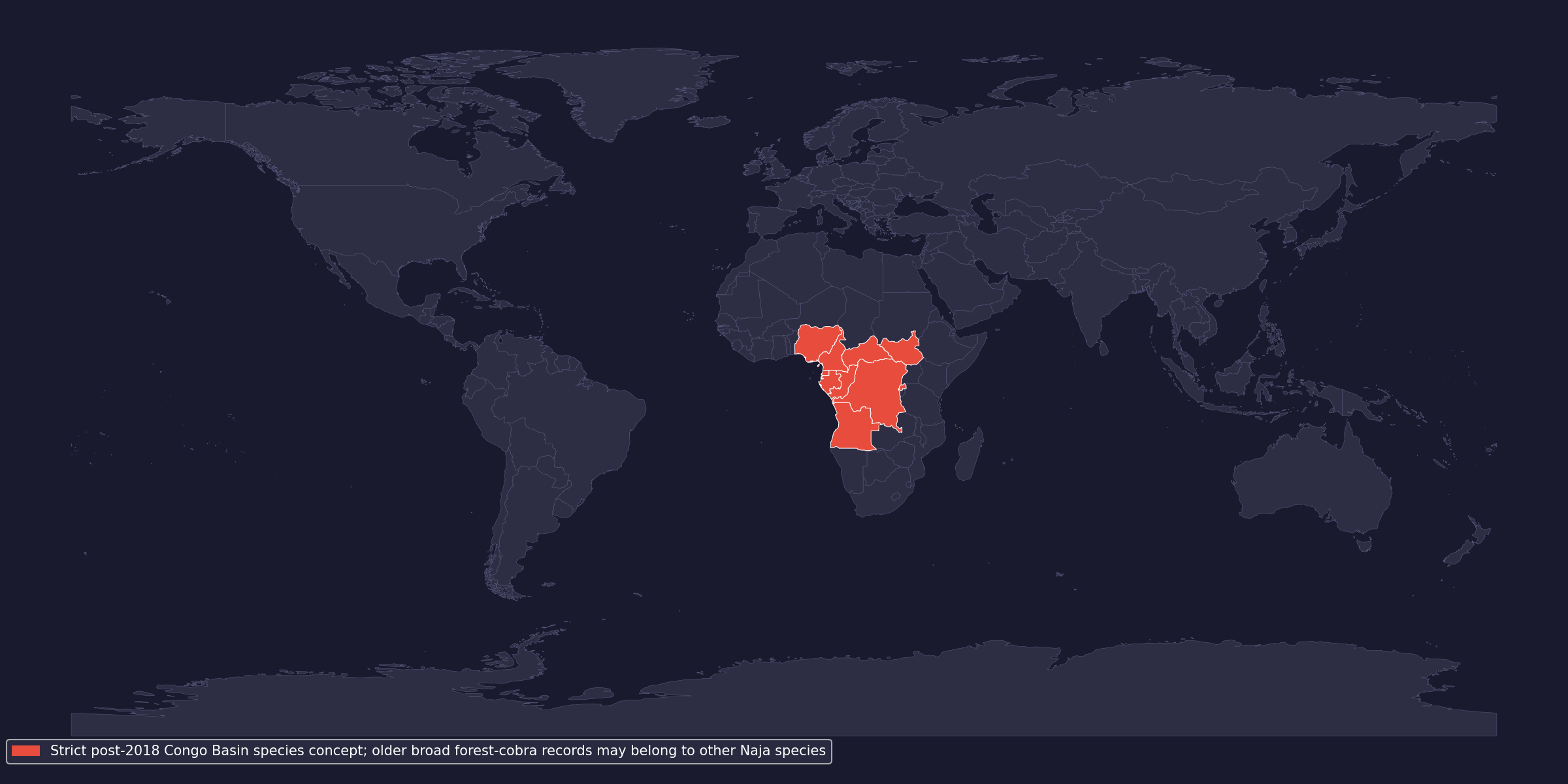
Under the post-2018 strict concept, the range is centred on the Congo Basin and extends west to southwestern Nigeria, south to northern Angola and east toward—but generally not beyond—the Albertine Rift. Current country records include Nigeria, Cameroon, Central African Republic, Equatorial Guinea, Gabon, Republic of the Congo, Democratic Republic of the Congo, northern Angola, Rwanda and South Sudan.
It occupies lowland and gallery forest, swamp forest, riparian corridors and forest-agriculture mosaics. Whole-country shading is approximate and should not be read as continuous occupancy; records outside this area often belong to another member of the former complex.
⚖️ Legal status
No species-specific entry for N. melanoleuca was found in the CITES Appendices, EU wildlife-trade annexes or Bern Convention appendices when checked on 29 August 2026. This does not remove range-state capture and export controls, nor the need to prove that an animal was identified under the revised taxonomy.
Dangerous-animal laws may require an inspected room, licence, competence records, insurance and formal bite and escape plans. Keep invoices, breeder and locality data, photographs, transfer and import documents and written authority decisions. Do not buy a generic “forest cobra” with no traceable origin.
🤌 Husbandry
House one animal alone in a locked venomous-animal room with secondary containment. Two fully furnished compartments joined by remotely operated doors must each provide a usable hide, perch and thermal choice. Water changes, cleaning and veterinary preparation occur only after positive shifting and lock confirmation.
Quarantine for at least 90 days with dedicated tools and preferably separate air. Record mass, appetite, shedding, faeces, skin and respiration. Wild-origin and uncertain animals require reptile-veterinary parasite assessment and careful review of collection and export legality.
💡 Lighting
Provide 10-12 hours of bright diffuse visible light and complete darkness overnight. Shade, opaque floor hides and elevated cover must remain available. Put lamps outside primary containment or behind rigid, moisture-resistant guards.
Low-level UVB can be offered over part of the warm zone as a measured Ferguson Zone 2 opportunity. It is optional and must not remove shade or complicate secure servicing.
🌡 Heating and temperature
Maintain ambient air at 24-29°C, a local basking surface at 31-33°C, a cool retreat at 22-25°C and nights around 21-24°C. Measure both floor and elevated surfaces because a large humid enclosure can develop hot upper layers and cool wet pockets. Thermostat every heater and use independent alarms.
Avoid a uniformly tropical-hot box. The animal needs safe movement among warm, neutral and cool cover. Any seasonal change should be gradual, locality-led and restricted to healthy adults in a documented breeding programme.
💧 Humidity and water
Maintain 65-85% relative humidity while allowing exposed surfaces to dry and air to exchange. A local retreat at 80-90% supports shedding. Persistent condensation, saturated substrate and stagnant air encourage dermatitis and respiratory disease.
Provide a large stable water bowl that can be removed from the safe side. Forest cobras often use wet habitats, but captive swimming space is not a substitute for clean drinking water, drainage and dry retreats.
🌿 Enclosure and decoration
An adult needs at least 300 x 150 x 180 cm, with more space preferable for a very large individual. Include two opaque shift boxes, heavy horizontal branches, broad shelves, anchored cork, dense visual barriers and a clear basking area. Furniture must not create blind voids or prevent staff locating the whole snake.
Use 8-12 cm of soil and leaf litter over drainage, or paper during quarantine. Avoid unstable timber, sharp mesh, adhesive décor and permanently wet mulch. Doors require two independent mechanical locks; the room needs an airlock or equivalent secondary barrier.
🐁 Feeding
Offer appropriately sized frozen-thawed rodents, with occasional birds or other suitable whole vertebrate prey under an institutional nutrition plan. Adults usually maintain condition on moderate meals every 10-21 days. Large cobras become obese quickly when feeding response replaces weight and body-condition records.
Feed through a protected port and isolate the snake before retrieving leftovers. Live prey causes avoidable injury and dangerous removal tasks. Balanced whole prey needs no routine calcium or vitamin dusting.
🛡 Operational safety and emergencies
Routine free handling, necking and manual restraint are unacceptable. Use protected contact, lockable shifts, transparent shields and long tools. Two trained staff attend every opening and complete a verbal location-and-lock check before any service door moves.
The receiving hospital and poison service must review the plan before acquisition, including identification under the revised complex, photographs, transport time and access to expert antivenom advice and ventilation. Antivenom choice is a clinical and regional decision; keeper-held stock alone is not a plan.
After a bite, withdraw and secure the room, call emergency services, remove tight items, keep the patient still and follow the regional poison centre’s immobilisation advice. Do not cut, suck, ice, shock, apply a tight tourniquet or delay transport to recapture the snake.
🥚 Breeding notes
Forest cobras are oviparous, with reported clutches commonly around 15-26 eggs. Published captive work also describes female egg attendance. A conservative monitored planning range is 27-29°C for about 60-80 days, adjusted to the documented line and calibrated egg-level readings.
Pairing very large cobras sharply increases exposure. Confirm sex, taxon, locality, permits and placements before introduction. Prepare an accessible laying box, remote separation plan and individual locked neonate units before breeding begins.
🩺 Common problems
- Rostral and facial injury: repeated pushing points to visual stress, poor cover or an inaccessible shift hide.
- Burns and overheating: guard and thermostat heaters and check shelves at several heights.
- Respiratory disease: abnormal sounds, bubbles or open-mouth breathing require urgent veterinary assessment.
- Dermatitis and dysecdysis: correct stagnant wet conditions while preserving a humid retreat.
- Obesity: weigh prey and lengthen adult feeding intervals before excess condition becomes severe.
- Parasites, mites and stomatitis: uncertain-origin animals require strict quarantine and diagnostics.
📌 Conclusion
The strict Central African forest cobra is a large, mobile animal that needs both floor area and climbable protected-contact space. Correct post-2018 identity, documented origin and a hospital-ready response are as fundamental as heat and humidity.
📚 Sources and further reading
- ReptiFiles — checked first on 29 August 2026; no species-specific care guide was found.
- The Reptile Database: Naja melanoleuca
- GBIF species record: Naja melanoleuca
- Wüster et al. 2018 — revision of the Naja melanoleuca complex
- Tryon 1979 — reproduction in captive forest cobras
- WHO: Guidelines for prevention and clinical management of snakebite in Africa
- Baines et al. — UV lighting guidance for captive reptiles
- CITES Appendices
- EU wildlife-trade annexes, Commission Regulation (EU) 2026/1383
- Bern Convention appendices