Share

Monocled Cobra
🔤 Taxonomy
Naja kaouthia is the accepted name for the monocled or monocellate cobra. Older husbandry, venom, and CITES documents frequently use Naja naja kaouthia, which refers to the same taxon.
Other useful historical names include Naja larvata and Naja tripudians var. fasciata. “Suphan cobra” or “suphanensis” appears in the colour-morph trade but is not an accepted subspecies.
The round hood mark is variable and can be incomplete or absent. Identification and medical paperwork should therefore use provenance and the scientific name, not the hood pattern alone.
📌 Description
The monocled cobra is a fast, alert, highly venomous elapid capable of severe neurotoxic envenomation and major local tissue injury. It commonly reaches 120-180 cm, occasionally more, and may live 15-20 years. It is an expert-only display animal for a dedicated venomous facility—not a beginner cobra or a snake for routine contact.
Most authorities describe N. kaouthia as a non-spitting cobra because its fang openings are not specialised for forward spraying. Nevertheless, deliberate spitting has been documented in Assam and Nepal. Behaviour may vary by locality and individual; an animal of uncertain origin must never be assumed incapable of projecting venom toward the face.
📋 Quick reference
| Care point | Practical target |
|---|---|
| Adult size and lifespan | Usually 120-180 cm; about 15-20 years |
| Adult enclosure | At least 180 x 90 x 90 cm, with locked shift hides |
| Temperature | Ambient 25-29°C; basking 30-32°C; cool retreat 23-25°C |
| Night | 22-25°C |
| Humidity | 55-75%, with a humid hide during shedding |
| Light | 10-12 hours; shaded low-level UVB may be offered |
| Feeding | Moderate frozen-thawed rodents; adults commonly every 10-14 days |
| Safety | Protected contact, full eye/face protection, bite and escape plans |
| Quarantine | At least 90 days, separate tools and veterinary parasite screening |
☠️ Venom
This species is venomous. Venom exposure can cause pain, swelling or other systemic effects, and severity varies with species, locality, bite site and the amount delivered. A small wound or apparently dry bite is not proof of safety; every bite or sting requires urgent medical assessment.
If an incident occurs, move away, call emergency services or a poison centre, keep the patient still, remove rings and other constricting items, and follow dispatcher instructions. Do not use a tourniquet, cut or suck the wound, apply ice or electricity, give alcohol or medicines as a home treatment, or attempt to catch the animal. Antivenom choice and dosing are hospital decisions; verify the relevant product and local availability in advance. Sources: WHO snakebite guidance and appropriate species-specific toxinology or medical references listed below.
🌍 Distribution
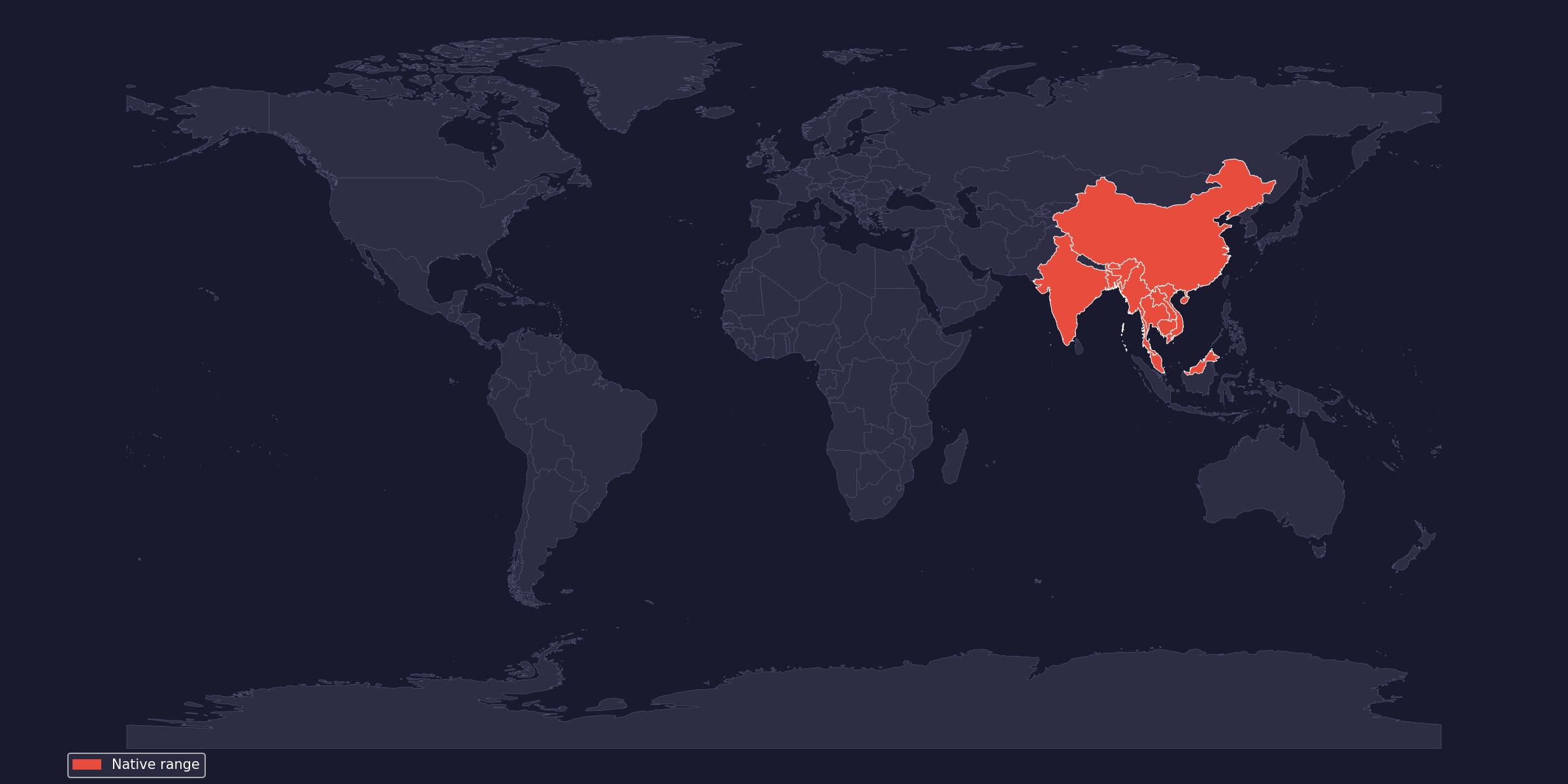
The species ranges from eastern and northeastern India and Bangladesh through Myanmar, Thailand, Laos, Cambodia, Vietnam, northern Peninsular Malaysia, southern China, and Bhutan. Published records also exist from Nepal, although older assessments disagreed about that western limit. Edge records need care because the complex contains geographically differentiated lineages and can be confused with N. naja, N. atra, N. siamensis, and the recently described N. fuxi.
Monocled cobras occupy lowland forest, scrub, wetland margins, rice fields, agricultural mosaics, and settlements with rodents and shelter. This ecological breadth argues for a choice-rich enclosure, not for copying one locality’s monsoon or winter schedule without documented provenance.
🌡 Climate across the native range
Monthly climate normals from a verified occurrence in the western part of the native range:
Chittagong — Bangladesh (verified occurrence)
| Month | Min °C | Mean °C | Max °C | RH % |
|---|---|---|---|---|
| January | 14.1 | 19.3 | 24.9 | 72 |
| February | 16.6 | 22 | 27.9 | 68 |
| March | 20.8 | 25.7 | 31 | 71 |
| April | 24.1 | 27.6 | 31.8 | 79 |
| May | 25.3 | 27.9 | 31.1 | 84 |
| June | 25.4 | 27.2 | 29.7 | 88 |
| July | 25.1 | 26.6 | 29 | 90 |
| August | 25.1 | 26.7 | 29.3 | 89 |
| September | 24.8 | 26.8 | 29.6 | 89 |
| October | 23.6 | 26.2 | 29.5 | 87 |
| November | 19.6 | 23.4 | 27.8 | 82 |
| December | 15.6 | 20.2 | 25.5 | 78 |
Weather data by Open-Meteo.com · CC BY 4.0 · Monthly normals calculated by Herpeton Academy from daily archive values.
Location references use GBIF.org occurrence data where available; original occurrence records retain their source dataset licenses.
⚖️ Legal status
Naja kaouthia is listed in CITES Appendix II and EU Annex B. Commercial international movement therefore requires the applicable CITES permits, and EU acquisition, sale, import, and re-export require traceable evidence of lawful origin and any transaction documents demanded by the competent authority. Check paperwork under both Naja kaouthia and the older name Naja naja kaouthia.
No species-specific Bern Convention listing was found; the convention is not a range-state instrument for this Asian cobra. Venomous-animal licensing, facility inspection, transport, insurance, antivenom/emergency planning, and local bans can be stricter than wildlife-trade rules. Verify the exact country and municipality in writing before purchase and keep invoices, CITES/import documents, breeder details, photographs, and the legal-check date.
🤌 Husbandry
House monocled cobras singly. The enclosure should include two lockable shift boxes, one at each end of the gradient, so all routine cleaning, water changes, and inspection can occur with the snake secured behind a closed barrier. The room itself needs controlled access, a second containment boundary, locked vents and cable ports, and no route into drains, wall voids, or public space.
Quarantine every arrival for at least 90 days in simple, auditable housing with separate tools and preferably separate airspace. Record weight, feeding, sheds, faeces, oral condition, and respiration. Wild-caught or poorly documented animals warrant faecal testing and assessment by a veterinarian experienced with venomous reptiles.
Its speed, defensive hooding, strong feeding response, and ability to turn quickly make casual hook-only servicing unsafe. The enclosure, shift system, and written standard procedure—not the animal’s apparent temperament—must control risk.
💡 Lighting
Provide a distinct 10-12 hour light period and full darkness at night. Broad visible light supports a normal day-night rhythm and allows safe remote observation. Give dense cover and shaded hides so exposure is voluntary.
UVB is not proven essential for a rodent-eating cobra, but a low-output Ferguson Zone 1 opportunity may be provided over part of the enclosure. All lamps need external mounting or guards. Do not use coloured night lamps.
🌡 Heating and temperature
Maintain ambient air at 25-29°C, a basking surface at 30-32°C, a cool hide at 23-25°C, and nights around 22-25°C. Use thermostats on every heater plus independent probes at snake level; verify surfaces with an infrared thermometer.
Do not turn the entire enclosure into a hot box. Recent physiological work shows that high ambient heat stresses N. kaouthia; the animal must always be able to leave the warm zone. Seasonal cooling varies across its wide range and should never be improvised for juveniles, new arrivals, thin animals, or routine pet care.
💧 Humidity and water
Maintain about 55-75% relative humidity with ventilation and a humid hide. During pre-shed, local humidity can rise to 70-85%, but the floor should not remain waterlogged. Constant dampness predisposes the snake to dermatitis and respiratory disease.
Provide a heavy bowl of clean water large enough for optional soaking and place it where it can be exchanged through protected service access. A water bowl is not a safe reason to enter the enclosure while the snake is loose.
🌿 Enclosure and decoration
Use at least 180 x 90 x 90 cm for a typical adult and enlarge for exceptionally long animals. Floor length matters, but low shelves and securely fixed branches add usable exercise space. Keep the layout open enough to account for the entire snake before opening any hatch.
For established animals, provide 8-12 cm of soil-based substrate, cypress mulch, or a similar low-dust mix that supports burrowing without remaining saturated. Use paper during quarantine. Avoid aromatic woods, sharp décor, unstable rock piles, and deep clutter that defeats visual checks or blocks the shift doors.
Locks should require deliberate two-step operation. Label the enclosure with scientific name, individual identity, venom risk, animal count, and emergency contacts.
🐁 Feeding
Use appropriately sized frozen-thawed rodents. Smaller moderate meals are safer than oversized prey; adults commonly eat every 10-14 days, adjusted to body condition, activity, sex, and reproductive state. Juveniles may eat more often but should not be power-fed.
Present prey with long tongs only after all service doors are closed and the keeper is in the planned feeding position. Maintain records because an abrupt refusal may reflect shed, reproductive cycling, excessive heat, stress, or illness. Routine supplements are unnecessary with balanced whole prey, and live rodents create avoidable injury and servicing risk.
🛡 Operational safety and emergencies
This species is display-only. Never free-handle, neck, pin, or manually restrain it as routine husbandry. Use protected-contact systems, shift boxes, barriers, appropriate tools, and two trained adults for any task that opens primary containment. Wear full eye and face protection during open-enclosure work because rare spitting behaviour is documented and locality is often uncertain.
Before acquisition, agree a written bite protocol with the receiving hospital or poison centre, confirm how species identification and antivenom consultation will be handled, and practise the communication and transport plan without the animal. Do not assume antivenom is locally stocked and do not privately administer it.
A bite is an immediate medical emergency. Move away from the snake, call emergency services, remove constricting items, keep the patient still, immobilize the limb, and follow the poison centre’s instructions. Do not cut, suck, ice, shock, or use a tight tourniquet. If venom reaches an eye, begin immediate prolonged irrigation with clean water or saline and obtain emergency medical and poison-centre advice; do not rub the eye.
🥚 Breeding notes
Monocled cobras are oviparous. Captive and field reports show locality-dependent breeding timing. A typical clutch is about 12-30 eggs; at approximately 29-30°C, hatching is commonly reported after 50-60 days.
Breeding is an expert institutional-scale undertaking. Pair introductions, separation, nest access, egg removal, and dozens of fully venomous hatchlings sharply increase exposure. Prepare individually secured neonatal housing, documentation, feeding capacity, and lawful recipients before pairing. Keep locality records; do not market undocumented colour animals as a geographic form or subspecies.
🩺 Common problems
- Rostral abrasion: nose rubbing and pacing indicate inadequate cover, poor layout, heat stress, or repeated disturbance.
- Respiratory disease: open-mouth breathing, bubbles, wheeze, or prolonged abnormal posture requires urgent veterinary assessment.
- Dermatitis and dysecdysis: correct wet substrate, low ventilation, hydration, and lack of textured surfaces; do not manually peel a loose cobra.
- Stomatitis: oral swelling, discharge, blood, or feeding difficulty needs professional treatment.
- Parasites: mites, abnormal faeces, weight loss, or poor sheds are especially important in imports.
- Obesity and regurgitation: prevent with moderate prey, measured heat, long enough intervals, and minimal post-feeding disturbance.
- Egg retention: a gravid female that strains, remains restless, or declines after the expected laying period needs an experienced veterinarian.
📌 Conclusion
Naja kaouthia belongs only in a licensed, escape-contained facility run by trained venomous keepers with protected-contact routines and a hospital-coordinated emergency plan. Its hood display and variable colour are compelling, but neither captive breeding nor a calm individual reduces the medical consequence of one failed procedure.
📚 Sources and further reading
- ReptiFiles — checked first on 14 August 2026; no species-specific care guide was found.
- The Reptile Database: Naja kaouthia
- GBIF species record: Naja kaouthia
- Kopczynski — breeding and exhibiting Naja kaouthia at Plock Zoo
- Das and Biswas — breeding ecology near the Sundarban
- Bhattacharjee et al. — documented spitting in Assam
- Giri et al. — documented spitting in Nepal
- Physiological responses of Naja kaouthia to high ambient temperature
- WHO: snakebite envenoming treatment and first aid
- Asclepius Snakebite Foundation: species bite protocols
- Northern Ireland government guidance on keeping venomous snakes and lizards
- CITES Appendices
- EU wildlife-trade annexes, Regulation (EC) No 338/97, consolidated 29 June 2026
- Bern Convention appendices