Share

Egyptian Cobra
🔤 Taxonomy
Naja haje is the accepted name of the Egyptian cobra, but the modern concept is narrower than many older books and collection labels. The snouted cobra N. annulifera, Anchieta’s cobra N. anchietae, Arabian cobra N. arabica and West African N. senegalensis were historically included within or confused with N. haje. A recently proposed Egyptian form, N. obscura, remains close to N. haje and its validity still needs resolution.
Do not assign a historic “Egyptian cobra” solely from colour. Retain locality, scale and hood photographs, parent records and expert identification. This guide concerns N. haje sensu stricto, not every large, non-spitting African cobra once placed under that name.
📌 Description
This is a robust, mainly terrestrial cobra commonly around 130-220 cm, with exceptional animals larger. It may be active by day, dusk or night depending on heat and disturbance and uses burrows, rock cavities, dense vegetation and human-modified cover. A 15-25-year institutional commitment is reasonable.
Envenomation can combine pain, swelling and tissue injury with ptosis, weakness, progressive neuroparalysis and respiratory failure. It does not have the specialised spitting system of African spitting cobras, but its forward strike, reach and ability to raise the forebody demand hard barriers and full isolation before servicing.
📋 Quick reference
| Care point | Practical target |
|---|---|
| Adult enclosure | At least 240 x 120 x 120 cm with two externally lockable shift hides |
| Temperature | Ambient 25-29°C; basking 31-33°C; cool refuge 23-25°C |
| Night | 20-24°C according to documented origin and season |
| Humidity | 40-60% with local 65-80% shed support |
| Feeding | Moderate frozen-thawed rodents every 10-21 days |
| Safety | Protected contact, two-person rule and ventilation-ready hospital plan |
| Quarantine | At least 90 days with separate tools and parasite screening |
☠️ Venom
This species is venomous. Venom exposure can cause pain, swelling or other systemic effects, and severity varies with species, locality, bite site and the amount delivered. A small wound or apparently dry bite is not proof of safety; every bite or sting requires urgent medical assessment.
If an incident occurs, move away, call emergency services or a poison centre, keep the patient still, remove rings and other constricting items, and follow dispatcher instructions. Do not use a tourniquet, cut or suck the wound, apply ice or electricity, give alcohol or medicines as a home treatment, or attempt to catch the animal. Antivenom choice and dosing are hospital decisions; verify the relevant product and local availability in advance. Sources: WHO snakebite guidance and appropriate species-specific toxinology or medical references listed below.
🌍 Distribution
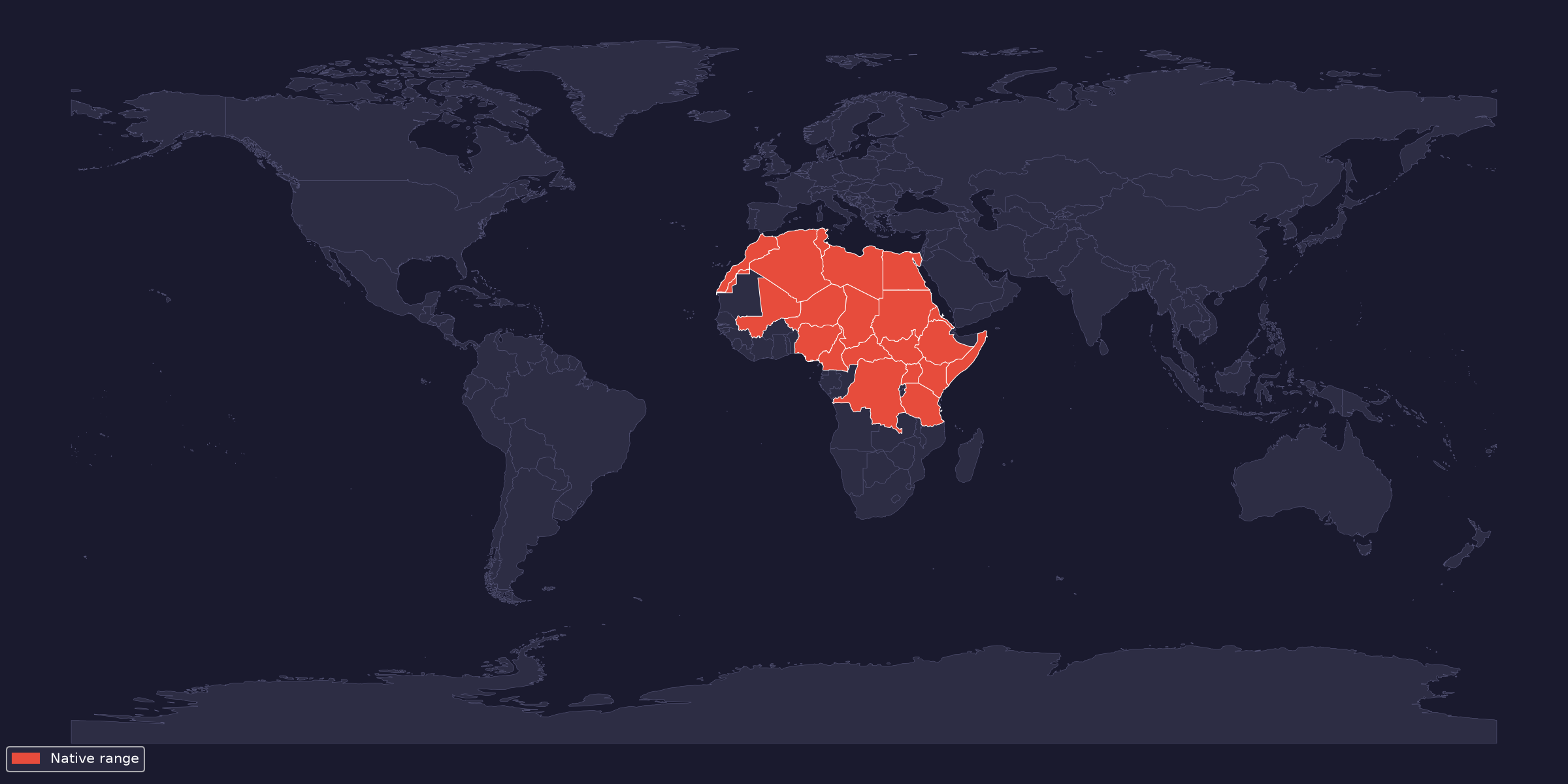
The current species concept remains geographically complex. Well-supported populations extend from parts of North Africa through the Nile and northeastern African region into East Africa as far south as central Tanzania, with additional discontinuous populations across parts of the Sahel and central Africa. Older records from southern Africa, Arabia and much of West Africa must be rechecked against N. annulifera, N. anchietae, N. arabica and N. senegalensis. Records in Egypt also need attention to the unresolved N. obscura proposal.
Habitats range from Mediterranean scrub and dry savanna to river valleys, open woodland and agricultural edges. The map colours whole countries and therefore exaggerates the occupied area, erases large desert and forest gaps and cannot resolve historical misidentifications or the status of N. obscura. The reviewed Arusha occurrence provides one East African seasonal context, not a climate average for Egypt, the Sahel or the Nile corridor.
🌡 Climate across the native range
Monthly normals from one reviewed East African occurrence within the current species concept; this point does not represent the North African or Sahelian climate:
Arusha — Tanzania (reviewed Egyptian cobra occurrence)
| Month | Min °C | Mean °C | Max °C | RH % |
|---|---|---|---|---|
| January | 10.6 | 16.3 | 21.9 | 80 |
| February | 10.8 | 16.7 | 22.6 | 78 |
| March | 12.1 | 17.2 | 22.4 | 78 |
| April | 12.2 | 16.4 | 20.7 | 84 |
| May | 11.6 | 14.9 | 18.3 | 86 |
| June | 9.6 | 13.9 | 18.2 | 82 |
| July | 8.3 | 13 | 17.7 | 80 |
| August | 8.9 | 14 | 19.1 | 76 |
| September | 9.8 | 15.2 | 20.5 | 72 |
| October | 10.8 | 16.3 | 21.9 | 70 |
| November | 11.7 | 16.4 | 21.1 | 77 |
| December | 12.5 | 16.6 | 20.6 | 78 |
Weather data by WorldClim v2.1 · Monthly normals queried by Herpeton Academy from raster values; relative humidity is derived from vapor pressure and mean temperature.
Location references use GBIF.org occurrence data where available; original occurrence records retain their source dataset licenses.
⚖️ Legal status
No species-specific entry for N. haje was found in the CITES Appendices, EU wildlife-trade annexes or Bern Convention appendices on 17 August 2026. This does not remove national wildlife protection, range-state export controls or dangerous-animal licensing. Taxonomic changes also mean an old invoice may not prove which species was legally transferred.
Local and national rules for possession, registration, transport, breeding, sale and import may require permits, inspected containment, insurance and emergency planning. Keep invoices, breeder/importer details, photographs, claimed locality, transfer papers and dated legal advice. Verify the accepted taxon and lawful route in writing before every transaction.
🤌 Husbandry
House singly in a locked venomous room with room-level secondary containment. Connect the enclosure to two tight, full-body shift hides that close and lock externally. Water, waste, heat and removable furniture are serviced only after the cobra is visually confirmed and positively secured in the other compartment. Free handling is never routine care.
Quarantine for at least 90 days with paper substrate, separate tools and preferably separate air. Record weight, meals, faeces, sheds, mouth and respiration. Wild-origin and poorly documented animals need repeated parasite testing and review of taxonomic identity before permanent housing.
💡 Lighting
Provide broad visible light for 10-13 hours according to locality and season, complete darkness at night and opaque retreats. Guard all lamps. Low-output UVB over part of the warm zone may provide Ferguson Zone 2 exposure, while cover must allow total avoidance.
🌡 Heating and temperature
Maintain ambient air at 25-29°C, a local 31-33°C warm surface, a 23-25°C cool hide and nights around 20-24°C. Measure air and surfaces at snake level and thermostat every heat source.
The large range does not support one automatic winter programme. Healthy adults of documented northern origin may receive a modest, gradual seasonal reduction, while tropical East African stock may not. Never cool juveniles, thin animals, new arrivals or snakes with respiratory signs.
💧 Humidity and water
A ventilated 40-60% baseline with a local 65-80% humid hide during shedding suits many managed animals, but exact moisture must follow origin. Dry North African stock and seasonally wetter East African stock should not be managed identically. Let most surface dry between localized wetting.
Provide a heavy bowl through protected access. Persistent wet substrate and stale warm air promote skin and respiratory disease. Track drinking, urates, body mass and sheds rather than relying on a single room hygrometer.
🌿 Enclosure and decoration
An adult requires at least 240 x 120 x 120 cm and more floor length for a very large animal. Install two lockable shifts, stable ground shelters, visual barriers, low anchored shelves and branches, and an unobstructed movement route. No cavity may prevent inspection or positive location.
Use 8-12 cm of compactable soil and washed sand with leaf patches, or paper during quarantine. Avoid aromatic wood, sharp chips, unstable stone, adhesive décor and blind service corners. Two independent locks, guarded ventilation, clear hazard labels and a rehearsed room-level escape plan are minimum features.
🐁 Feeding
Offer appropriately sized frozen-thawed rodents. Juveniles may feed every 7-14 days; established adults usually remain lean on a moderate meal every 10-21 days. Adjust for body condition, temperature and season rather than feeding whenever the cobra approaches.
Use long tongs through a protected port and shift the animal before retrieving refused prey. Live rodents can injure the snake and force dangerous recovery work. Whole prey needs no routine supplementation.
🛡 Operational safety and emergencies
Never free-handle, pin, neck or manually restrain this cobra. Use protected contact, lockable shifts, rigid shields and task-specific tools within a written two-person system. Rehearse escape and bite responses without a live animal; the second trained person holds communication, keys and the emergency file.
Before acquisition, confirm the regional poison-centre pathway, receiving hospital, transport, airway and mechanical-ventilation capability, intensive care and an appropriate antivenom strategy. Antivenoms marketed for other African or Asian cobras are not automatically effective against N. haje. The plan must carry exact photographs and locality as well as the name.
Every bite is an immediate emergency. Withdraw, call emergency services, keep the patient still and remove tight objects. Because cobra envenoming may cause local tissue injury, do not improvise pressure immobilisation, constricting wraps or tourniquets; follow the responsible regional authority. Do not cut, suck, ice, shock, apply chemicals or delay transport.
🥚 Breeding notes
Institutional series report clutches commonly around 14-26 eggs. Published zoo records produced hatching at approximately 27-29°C over about 60-80 days, with meaningful variation among clutches. Use calibrated egg-temperature logging; air-set temperature alone is not enough.
Breeding requires documented compatible taxa, remote pairing and separation, a secure laying chamber and individual locked neonatal units. Confirm permits and qualified placements before pairing. Do not manually restrain a gravid female or improvise intervention for suspected egg retention.
🩺 Common problems
- Obesity: measure prey, extend adult intervals and record weights.
- Rostral trauma: review reflections, cover, travel space and shift geometry.
- Burns or overheating: guard and thermostat heat while preserving a measured cool hide.
- Respiratory disease and dermatitis: correct damp stagnant conditions and seek reptile-veterinary diagnosis.
- Dysecdysis or dehydration: improve the local humid retreat and water access without saturating the floor.
- Parasites and stomatitis: especially important in wild-origin or uncertain animals.
- Egg retention: prolonged straining or repeated failure to settle needs remote veterinary planning, not manual examination.
📌 Conclusion
The Egyptian cobra needs exact taxonomic provenance as much as secure hardware. It belongs only in a protected-contact institution that can separate it before every task and has a hospital plan ready for both local injury and rapid respiratory paralysis.
📚 Sources and further reading
- ReptiFiles — checked first on 17 August 2026; no species-specific care guide was found.
- The Reptile Database: Naja haje
- GBIF species record: Naja haje
- Trape et al. (2009): revision of the Naja haje complex
- Vassiliev: zoo husbandry and clutch size
- WHO: Guidelines for the prevention and clinical management of snakebite in Africa
- Baines et al. — UV lighting guidance
- CITES Appendices
- EU wildlife-trade annexes, Commission Regulation (EU) 2026/1383
- Bern Convention appendices