Share

Ottoman Viper
🔤 Taxonomy
Montivipera xanthina is the accepted name for the Ottoman or coastal viper. Older books and legal lists use Vipera xanthina; still older combinations include Daboia xanthina. The species is the type of the genus Montivipera.
Named island and mainland forms remain taxonomically disputed, and the wider M. xanthina group contains several close species. Preserve exact locality and parentage records; do not use colour or an island trade label as proof of identity.
📌 Description
The Ottoman viper is a robust, medically significant viper from western Türkiye and adjacent Greek territory. Adults usually measure 70-100 cm and large females may reach about 120 cm. A lifespan of 15-20 years is plausible. Its heavy body, fast defensive strike, and seasonal Mediterranean ecology require more planning than its moderate length suggests.
This is an expert-only display species. A calm animal remains capable of serious envenomation, and no routine care should involve direct handling. Secure protected-contact housing, legal captive origin, institutional-style records, and hospital coordination are prerequisites.
📋 Quick reference
| Care point | Practical target |
|---|---|
| Adult size and lifespan | Usually 70-100 cm, occasionally about 120 cm; 15-20 years |
| Adult enclosure | At least 150 x 75 x 75 cm, with two lockable shift hides |
| Temperature | Ambient 22-27°C; basking 29-32°C; cool retreat 20-23°C |
| Night | 17-21°C; cooler seasonal nights are important |
| Humidity | 40-60%; humid hide at 60-75% during shedding |
| Feeding | Moderate frozen-thawed rodents; adults every 10-21 days |
| Safety | Protected contact, two-person rule, bite and escape plans |
| Quarantine | At least 90 days with separate equipment and parasite screening |
☠️ Venom
This species is venomous. Venom exposure can cause pain, swelling or other systemic effects, and severity varies with species, locality, bite site and the amount delivered. A small wound or apparently dry bite is not proof of safety; every bite or sting requires urgent medical assessment.
If an incident occurs, move away, call emergency services or a poison centre, keep the patient still, remove rings and other constricting items, and follow dispatcher instructions. Do not use a tourniquet, cut or suck the wound, apply ice or electricity, give alcohol or medicines as a home treatment, or attempt to catch the animal. Antivenom choice and dosing are hospital decisions; verify the relevant product and local availability in advance. Sources: WHO snakebite guidance and appropriate species-specific toxinology or medical references listed below.
🌍 Distribution
The confirmed range centres on western and southwestern Türkiye and extends to northeastern mainland Greece and several eastern Aegean islands, including Lesbos, Chios, Samos and parts of the Dodecanese. Recent Greek records have extended the known mainland range westward. Reports outside this region may involve other Montivipera species or outdated taxonomy.
Habitats range from rocky Mediterranean scrub and agricultural margins to open woodland and cool mountain slopes, from near sea level to high elevation. Provide dry, well-ventilated resting ground, broken visual cover, and a thermal gradient; do not reproduce outdoor heat by warming the entire enclosure.
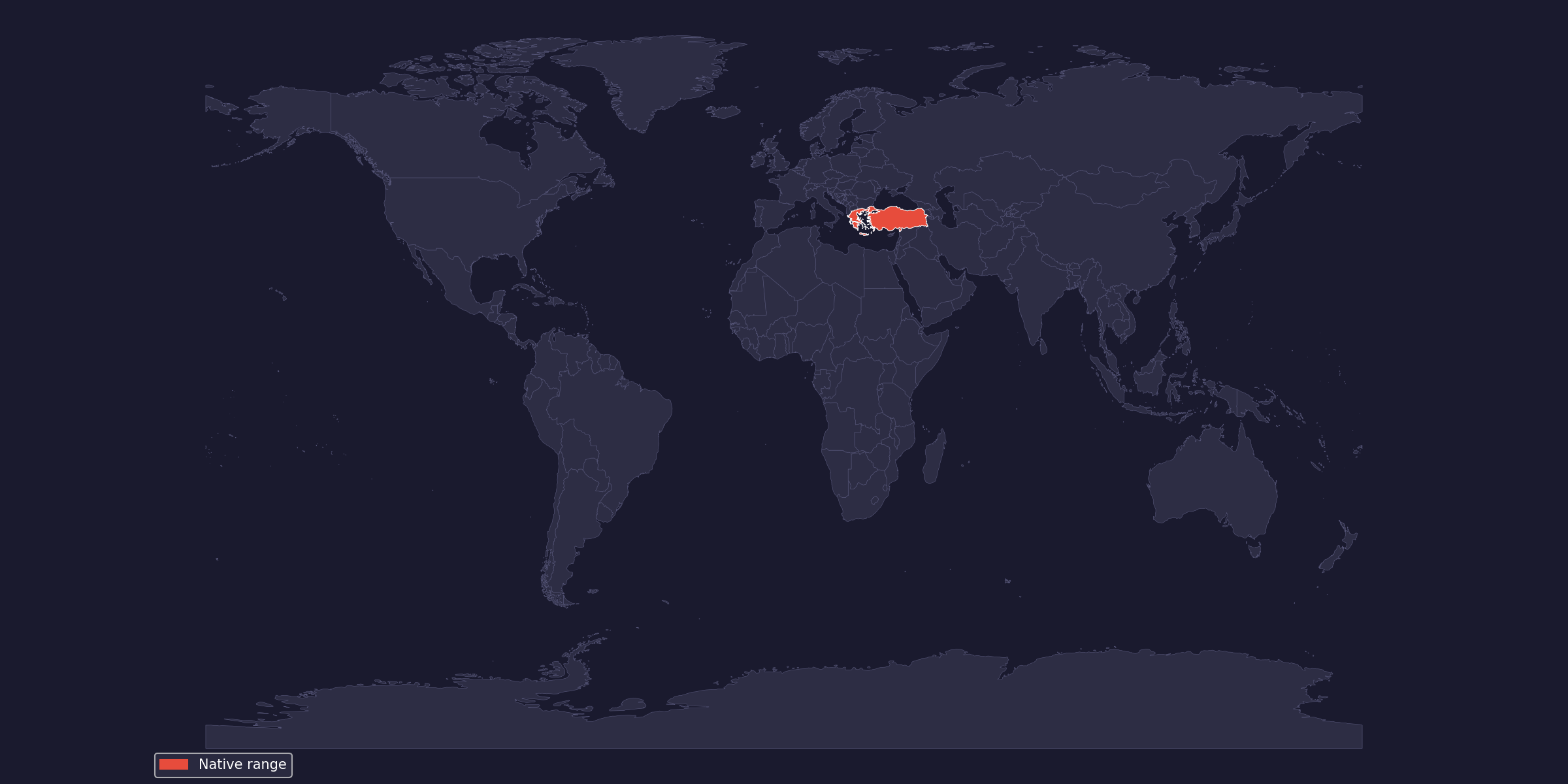
🌡 Climate across the native range
Monthly climate normals from a reviewed occurrence in southwestern Anatolia:
Muğla — Türkiye (reviewed occurrence)
| Month | Min °C | Mean °C | Max °C | RH % |
|---|---|---|---|---|
| January | 1.6 | 5.3 | 9.5 | 78 |
| February | 1.9 | 6 | 10.4 | 76 |
| March | 3.6 | 8.5 | 13.4 | 72 |
| April | 6.9 | 12.2 | 17.2 | 69 |
| May | 11.5 | 17.4 | 22.5 | 64 |
| June | 16.2 | 22.8 | 28.5 | 52 |
| July | 19.9 | 26.7 | 32.6 | 43 |
| August | 20.2 | 26.5 | 32.4 | 46 |
| September | 16.2 | 22 | 27.8 | 53 |
| October | 11.7 | 16.5 | 21.8 | 65 |
| November | 6.9 | 11 | 15.6 | 74 |
| December | 3.4 | 6.9 | 10.9 | 79 |
Weather data by Open-Meteo.com · CC BY 4.0 · Monthly normals calculated by Herpeton Academy from daily archive values.
Location references use GBIF.org occurrence data where available; original occurrence records retain their source dataset licenses.
⚖️ Legal status
The official CITES Appendices and EU wildlife-trade annexes checked on 16 August 2026 do not specifically list Montivipera xanthina. Under its older name Vipera xanthina, it is listed as strictly protected fauna in Appendix II of the Bern Convention.
Wild capture, possession, transport, breeding, and sale may be prohibited or permit-controlled in range states, while separate dangerous-animal rules can apply elsewhere. Verify both the current scientific and older legal names with the competent authority. Keep the invoice, captive-breeding and locality evidence, photographs, transfer documents, and legal-check date. Never treat a lack of CITES listing as permission to remove a protected native snake.
🤌 Husbandry
House animals singly. Use a restricted venomous room with secondary containment, two lockable shift hides across the temperature gradient, secured vents and cable ports, and an unobstructed viewing method. The keeper must be able to isolate the snake before touching water, substrate, décor, or waste.
Quarantine for at least 90 days in simple housing, preferably with separate airspace and dedicated tools. Record weight, meals, sheds, faeces, respiration, oral condition, and activity. Poorly documented animals require veterinary examination and parasite testing; imports may carry mites, endoparasites, dehydration, and transport-related respiratory disease.
Do not cohabit for display. Seasonal cycling should follow documented locality and healthy body condition, not a generic “Mediterranean viper” calendar.
💡 Lighting
Provide 12-14 hours of visible light in summer, grading toward about 10 hours in the cool season, with full darkness at night. Offer shaded hides and broken cover so basking is voluntary. All fixtures belong outside the primary enclosure or behind guards.
UVB is not proven essential for a whole-prey viper, but low-level Ferguson Zone 1 exposure may be offered over part of the basking area. Maintain ample shade and follow measured lamp distance rather than product labels alone.
🌡 Heating and temperature
During the active season, keep ambient air at 22-27°C, a basking surface at 29-32°C, a cool retreat at 20-23°C, and nights around 17-21°C. Thermostat every heater and monitor air and surfaces independently. Heat should be radiant and local; hot rocks and unguarded lamps are unsafe.
Provide a real night drop and reliable summer cooling. High-elevation or island localities differ, so use provenance rather than applying one extreme climate to all animals.
Brumation at approximately 8-12°C is reserved for established, healthy adults in a planned breeding programme. Use gradual transitions, ensure the gut is empty, maintain hydration and ventilation, and monitor continuously. Do not cool juveniles, thin, sick, recently acquired, or pregnant animals.
💧 Humidity and water
Maintain roughly 40-60% relative humidity with a humid hide reaching 60-75% during shedding. Ventilation and a dry resting surface are essential; continuously wet Mediterranean housing promotes scale damage and respiratory disease. Slightly moisten one deeper substrate corner rather than spraying the whole enclosure.
Provide a heavy bowl of clean water that can be changed through protected access. Check hydration and urates during hot weather, pregnancy, and seasonal transitions.
🌿 Enclosure and decoration
Use at least 150 x 75 x 75 cm for an adult. Include two close-fitting shift hides, firmly fixed rock-like basking shelves, cork, low branches, and vegetation or artificial screens. Retain clear service lanes and avoid structures that prevent visual confirmation or block shift doors.
A 8-12 cm compactable mix of mineral soil, washed sand, and fine clay or leaf material supports natural movement while buffering local moisture. Use paper in quarantine. Avoid pure loose sand, sharp gravel, aromatic wood, unstable rock stacks, and adhesives. Every door and service opening needs an independent mechanical lock and a complete hazard label.
🐁 Feeding
Feed appropriately sized frozen-thawed mice or rats. Adults usually need a moderate meal every 10-21 days; use weight and body condition because robust vipers become obese readily. Juveniles take smaller prey more often, while seasonal refusal may occur during cooling or reproduction.
Use long feeding tongs from a protected position and remove refused prey only after shifting the snake. Live rodents create unnecessary injury and access risk. Balanced whole prey requires no routine supplements.
🛡 Operational safety and emergencies
Never free-handle, pin, neck, or manually restrain this species for routine care. Use lockable shift compartments, appropriate hooks, transparent barriers, protected ports, and two trained adults whenever primary containment opens. Veterinary procedures require a pre-arranged professional restraint and anaesthesia plan.
Before acquisition, agree written bite and escape procedures with the receiving hospital or poison centre. Provide correct and older scientific names, photographs, emergency contacts, and a transport route. Do not assume specific antivenom is stocked, and never administer antivenom privately.
A bite requires immediate emergency care. Move away, call emergency services, remove constricting objects, keep the patient still, immobilize the limb, and follow poison-centre advice. Do not cut, suck, ice, shock, tightly tourniquet, or delay for snake capture.
🥚 Breeding notes
The Ottoman viper is viviparous and generally produces about 2-15 live young. Reproduction is seasonal, and an adult female should be bred only when body condition and recovery history are suitable. There are no eggs to incubate.
Pairing multiplies exposure and escape risk. Confirm sex, locality, legal authority, and placement for offspring before introductions. Prepare individual locked neonate enclosures in advance and avoid crossing undocumented island or mainland stocks.
🩺 Common problems
- Overheating: persistent exposure, frantic movement, or decline calls for immediate temperature review.
- Respiratory disease: bubbles, open-mouth breathing, repeated head elevation, or wheezing require urgent veterinary care.
- Dermatitis and scale rot: associated with wet surfaces, poor hygiene, and low ventilation.
- Dysecdysis and dehydration: review the humid hide, water access, temperatures, and general health; do not restrain the animal at home.
- Parasites and stomatitis: mites, abnormal faeces, weight loss, oral swelling, or discharge are important in imports.
- Obesity and regurgitation: prevent with modest prey, adequate intervals, a correct gradient, and minimal post-feeding disturbance.
📌 Conclusion
Montivipera xanthina belongs only with a licensed venomous-reptile specialist who can document lawful locality, provide seasonal but non-extreme Mediterranean conditions, and service the enclosure behind a locked barrier. Its protected status and limited distribution make undocumented animals especially inappropriate.
📚 Sources and further reading
- ReptiFiles — checked first on 16 August 2026; no species-specific care guide was found.
- The Reptile Database: Montivipera xanthina
- GBIF species record: Montivipera xanthina
- Ahmadi et al. — biogeography of mountain vipers
- Strachinis et al. — westward range extension in Greece
- Baines et al. — UV lighting guidance for captive reptiles
- WHO: snakebite envenoming treatment and first aid
- Northern Ireland government guidance on keeping venomous snakes and lizards
- CITES Appendices
- EU wildlife-trade annexes, Commission Regulation (EU) 2026/1383
- Bern Convention appendices