Share

Eastern Coral Snake
🔤 Taxonomy
Micrurus fulvius is the eastern or harlequin coral snake in the strict sense. The Texas coral snake, M. tener, was historically treated as a subspecies of M. fulvius but is now a separate species west of the Mississippi system and into Mexico. Old books and databases can therefore attach Texas, Arkansas, or Mexican localities and biological data to a broad “M. fulvius” that is not the species covered here.
📌 Description
This slender, smooth-scaled elapid is usually 45-80 cm, with large females occasionally approaching 1 m. Red and black rings are separated by narrow yellow rings, the snout is black, and the head is scarcely wider than the neck. Colour rhymes are not a safe identification method: aberrant individuals occur, harmless mimics vary, and the rhyme fails outside part of the United States.
Its fixed front fangs and small head do not make handling safe. Envenomation may begin with little pain or swelling, then progress after hours to drooping eyelids, double vision, slurred speech, weakness, paralysis, and respiratory failure. A bite need not involve prolonged “chewing” to be dangerous.
📋 Quick reference
| Care point | Practical target |
|---|---|
| Adult enclosure | At least 120 x 60 x 60 cm with 12-18 cm inspectable litter and external shift |
| Day temperatures | 23-27°C air; 28-30°C warm surface; 20-23°C cool retreat |
| Night temperatures | 18-22°C |
| Humidity | 50-70%, with local humid refuge, drainage, and dry surface choices |
| Lighting | Seasonal 10-14 hours; measured Ferguson Zone 1 UVB recommended |
| Feeding | A planned supply of frozen-thawed small snakes and lizards; rodents are not a complete default diet |
| Reproduction | Egg-laying; 2-12 eggs, with monitored incubation rather than a fixed recipe |
| Safety | Potentially fatal delayed neurotoxicity; protected contact and immediate hospital evaluation |
☠️ Venom
This species is venomous. Venom exposure can cause pain, swelling or other systemic effects, and severity varies with species, locality, bite site and the amount delivered. A small wound or apparently dry bite is not proof of safety; every bite or sting requires urgent medical assessment.
If an incident occurs, move away, call emergency services or a poison centre, keep the patient still, remove rings and other constricting items, and follow dispatcher instructions. Do not use a tourniquet, cut or suck the wound, apply ice or electricity, give alcohol or medicines as a home treatment, or attempt to catch the animal. Antivenom choice and dosing are hospital decisions; verify the relevant product and local availability in advance. Sources: WHO snakebite guidance and appropriate species-specific toxinology or medical references listed below.
🌍 Distribution
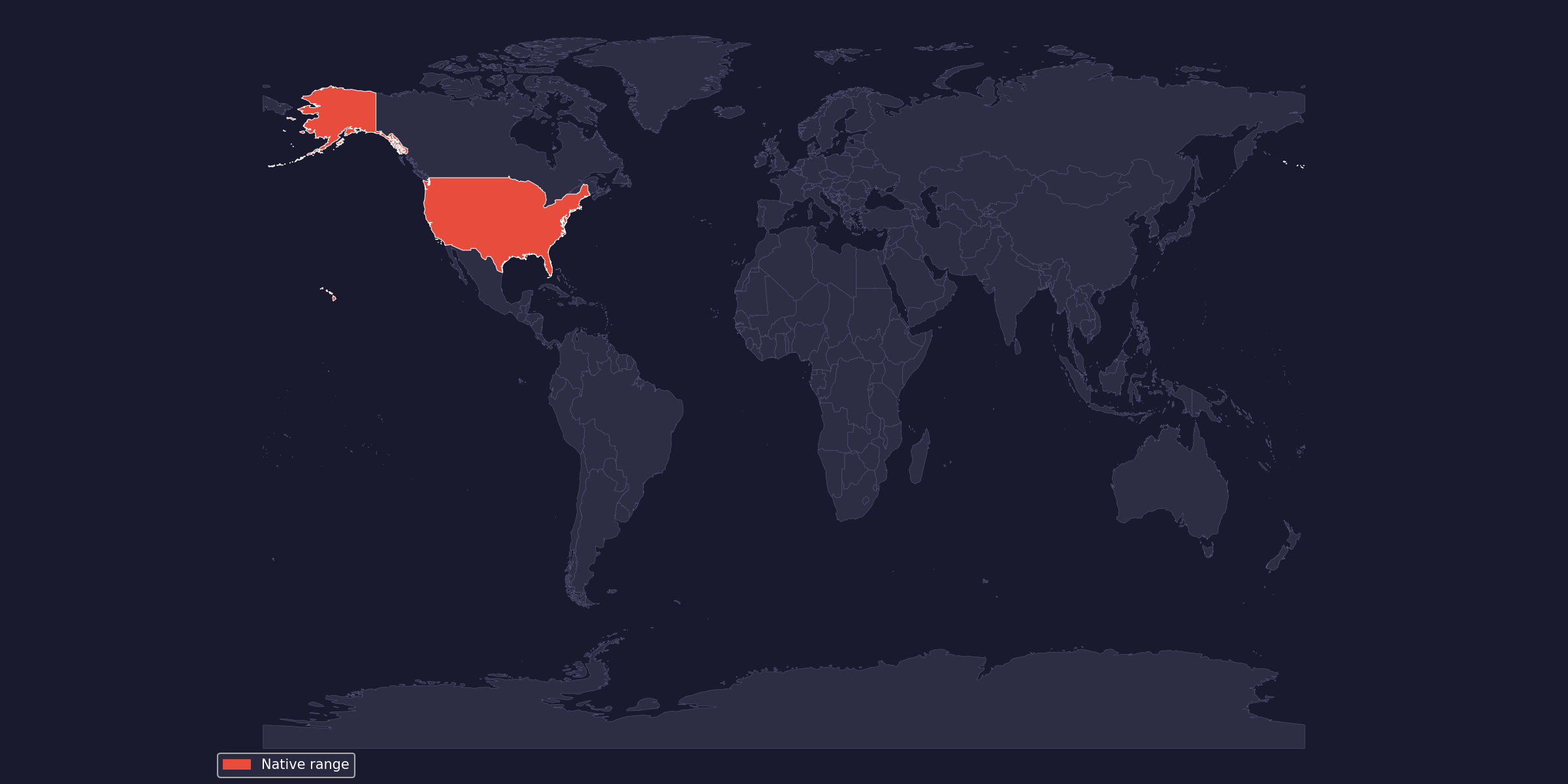
Strict M. fulvius is native to the southeastern United States Coastal Plain, from southeastern North Carolina through South Carolina, Georgia, and Florida, west through southern Alabama and Mississippi to extreme southeastern Louisiana. It occurs east of the Mississippi drainage in pine flatwoods, sandhills, scrub, hardwood hammocks, wetland margins, coastal habitat, and suburban remnants with loose soil and cover.
The map colours the whole United States because country-level geometry cannot show this narrow state-level range. It does not imply occurrence in the western or northern United States or everywhere within a named state. Texas and most Louisiana “coral snake” records refer to M. tener, not M. fulvius. Locality, voucher identification, and current taxonomy must support any origin claim.
🌡 Climate across the native range
Monthly climate normals from a verified strict-species occurrence in central Florida:
Central Florida — United States (verified occurrence)
| Month | Min °C | Mean °C | Max °C | RH % |
|---|---|---|---|---|
| January | 11.3 | 15.4 | 20.8 | 74 |
| February | 12.5 | 16.7 | 22.3 | 74 |
| March | 14.3 | 19 | 24.7 | 69 |
| April | 17 | 21.7 | 27.3 | 69 |
| May | 20 | 24.7 | 30.1 | 70 |
| June | 23.1 | 26.5 | 31.1 | 79 |
| July | 24 | 27.1 | 31.5 | 81 |
| August | 24.1 | 27 | 31.2 | 83 |
| September | 23.1 | 25.9 | 29.9 | 82 |
| October | 19.9 | 23.2 | 27.5 | 77 |
| November | 15.8 | 19.5 | 24.4 | 75 |
| December | 13 | 16.8 | 22 | 76 |
Weather data by Open-Meteo.com · CC BY 4.0 · Monthly normals calculated by Herpeton Academy from daily archive values.
Location references use GBIF.org occurrence data where available; original occurrence records retain their source dataset licenses.
⚖️ Legal status
As checked on 17 August 2026, Micrurus fulvius was not listed in CITES Appendices I-III and no species-specific entry was found in EU wildlife-trade Annexes A-D. It is not native to Europe, so the Bern Convention is not relevant. Lack of a treaty listing is not permission to collect, export, import, or possess it.
Native-wildlife protection differs by state; collection may be closed, limited, or permit-only, especially on protected land and where the species has state conservation status. Florida requires a permit for possession of any venomous reptile, 1,000 documented experience hours in the relevant family, two references, and a facility inspection. Other jurisdictions can require dangerous-animal licensing, insurance, contingency plans, or prohibit private possession. Keep the precise locality, lawful-source and transfer documents, permits, invoice, photographs, and the legal-check date.
🤌 Husbandry
Only a licensed institution with elapid experience and a sustainable specialist-prey programme should maintain this species. Prepare two physical containment barriers, a locked enclosure, fine-gap security, dedicated tools, and a small shift or removable refuge that can be closed from outside. Keep singly: ophiophagy makes casual cohabitation particularly unsafe.
Quarantine for at least 90 days on paper with inspectable hides, separate tools, and separate airspace where possible. Record weight frequently because condition changes can hide under a slender body. Document feeding response, prey species, sheds, faeces, respiration, mouth, skin, and activity. Test for parasites; both the coral snake and its reptile prey can transmit them.
💡 Lighting
Provide a gradually seasonal 10-14-hour day with bright diffuse visible light over a mosaic of cover. A small measured UVB zone around Ferguson Zone 1 is recommended, with complete shade beneath bark and litter. Guard all fittings and route cables outside the primary enclosure.
Night should be dark. The species may be active by day, at dawn, or toward evening according to season and heat; a red or blue night lamp is unnecessary. Use remote observation for behaviour without dismantling its refuge.
🌡 Heating and temperature
Maintain 23-27°C daytime air, a limited 28-30°C warm surface, a 20-23°C cool retreat, and 18-22°C nights. Measure inside the litter and hides: a surface thermometer alone misses the temperatures used by a semifossorial snake. Protect every heat source with a thermostat and guard.
Healthy established adults of documented northern provenance may receive a gradual shortened-day winter phase around 15-18°C in an institutional breeding programme. Central and southern Florida animals should not be given the same depth or duration of cooling as animals from the northern limit. Never cool a juvenile, underweight, anorexic, ill, or newly arrived snake.
💧 Humidity and water
Maintain roughly 50-70% general humidity, with a local 70-80% humid retreat for shedding and nesting. Habitat ranges from dry sandhill to wetland edge, so give a moisture gradient rather than saturating the enclosure. The lower layer can remain slightly damp while much of the leaf surface is dry; use cross-ventilation and drainage.
Provide a stable shallow water bowl that can be exchanged behind a barrier. Persistent soaking, condensation, sour substrate, blistering, or red ventral scales requires investigation. A comparative Butantan coral-snake programme improved survival after replacing water-retaining substrate and controlling blister disease.
🌿 Enclosure and decoration
Provide at least 120 x 60 x 60 cm for one adult. Use 12-18 cm of packed soil-and-sand mix with dry leaves, several flat bark refuges, an accessible humid hide, low stable woody cover, and a clear observation strip. The snake should be able to tunnel and follow cover without disappearing into an inaccessible false floor.
Coral snakes can exploit very small gaps. Use redundant keyed or tool-operated locks, pinned tracks, fine secured vents, sealed cable entries, and protected probes. Count the animal into a closed shift before servicing substrate or decor. Avoid loose foam backgrounds, hollow branches that cannot be inspected, and heavy objects that could crush a burrowing snake.
🐁 Feeding
This is a specialist predator of other snakes and elongate lizards, including skinks and glass lizards. Rodent-only feeding is not an evidence-based complete programme for M. fulvius, and reliable conversion cannot be assumed. Before acquisition, an institution needs a lawful, biosecure breeding supply of appropriately sized reptile prey; taking wild reptiles as feed is unacceptable for disease, legal, and conservation reasons.
Offer euthanised, frozen and properly thawed prey head-first with long tools, normally every 10-21 days according to age, prey mass, season, and weight trend. Published comparative work with Micrurus corallinus found disease and survival benefits from freezing reptile prey, while also documenting how difficult voluntary feeding can be. Live prey is not a routine requirement. Persistent refusal needs diagnostic review by an experienced veterinarian; force-feeding or gavage is a hazardous clinical procedure, not a keeper instruction.
🥚 Breeding
Eastern coral snakes lay elongated eggs. Field summaries report clutches of 2-12, averaging around seven, usually laid in protected moist sites in early summer; published periods span roughly 7-13 weeks. A monitored 25-27°C and 70-90-day institutional starting range is conservative, but species-specific controlled incubation data are limited and actual development must guide decisions.
Use a secure humid nest chamber and an incubator with independent temperature logging, backup control, gas exchange, and careful water-potential management. Pairing and separation are complicated by ophiophagy. Every hatchling is venomous and may refuse food for weeks; breeding is unjustifiable without individual locked containers, specialist prey for the entire clutch, documented placements, and a medical plan.
🛡️ Handling and emergency planning
Never free-handle, hand-pin, neck, or deliberately allow this snake to bite a restraint surface. Use protected shifts, small species-appropriate hooks or transparent guides, secure tubes only within an institutional protocol, and a second trained keeper for any open transfer. Gloves and the animal’s small mouth are not bite protection.
Before acquisition, coordinate emergency services, U.S. Poison Control or the relevant regional poison centre, a medical toxicologist, and the receiving hospital. The written plan must address current coral-snake antivenom access, respiratory support, transport, contacts, accepted species name, and exact location. Antivenom availability can change, so confirm the route regularly rather than relying on an old stock list.
Every suspected bite requires an immediate emergency call and hospital evaluation even if the site looks normal; neurological effects can be delayed and then progress quickly. Keep the person still, position the limb neutrally, remove rings and tight items, and follow poison-centre instructions. Do not cut, suck, ice, shock, apply chemicals or an arterial tourniquet, or wait for symptoms. Do not improvise a pressure bandage without direct regional clinical advice.
🩺 Common problems
- Chronic anorexia: verify provenance, prey type, season, security, weight trend, parasites, and disease; do not default to repeated invasive feeding.
- Malnutrition: a rodent accepted occasionally does not prove that a rodent-only diet is complete.
- Blister disease or dermatitis: overly wet contaminated substrate and poor airflow require system correction and veterinary diagnosis.
- Dysecdysis: adjust local moisture and water access; never peel an unsecured animal.
- Respiratory disease: bubbles, wheeze, gaping, or abnormal posture needs prompt assessment.
- Prey-borne infection: use legal purpose-bred prey, quarantine the prey colony, and follow veterinary freezing and screening protocols.
- Obesity or regurgitation: adjust prey mass, intervals, temperature, and post-feeding disturbance.
- Egg retention: a distended, restless, or declining female needs imaging by an equipped team.
- Escape opportunity: a gap that looks too small for the head may still be usable; inspect every service penetration.
📌 Conclusion
The eastern coral snake is small in body but large in operational demand. Deep inspectable litter, moderate seasonal temperatures, strict M. fulvius provenance, a sustainable reptile-prey colony, fine-gap containment, and a hospital plan for delayed paralysis must all exist before acquisition. Its feeding biology alone excludes it from ordinary private husbandry.
📚 Sources and further reading
- ReptiFiles was searched; no species-specific care guide was located: https://reptifiles.com/
- The Reptile Database: https://reptile-database.reptarium.cz/Micrurus/fulvius
- GBIF: https://www.gbif.org/species/9173089
- Animal Diversity Web, eastern coral snake species account: https://animaldiversity.org/accounts/Micrurus_fulvius/
- Greene (1973), The Food Habits and Feeding Behavior of New World Coral Snakes: https://mavmatrix.uta.edu/biology_theses/31/
- Mendes et al. (2019), factors influencing captive coral-snake survival: https://doi.org/10.1093/jas/sky467
- Poison Control, coral snake bites and treatment: https://www.poison.org/articles/coral-snake-bite-treatment-203
- CDC/NIOSH venomous-snake first aid: https://www.cdc.gov/niosh/outdoor-workers/about/venomous-snakes.html
- Florida venomous-reptile licensing: https://myfwc.com/license/captive-wildlife/venomous/
- Baines et al., UV-Tool: https://doi.org/10.19227/jzar.v4i1.150
- CITES Appendices: https://cites.org/eng/app/appendices.php and https://checklist.cites.org/
- Commission Regulation (EU) 2026/1383: https://eur-lex.europa.eu/eli/reg/2026/1383/oj/eng
- Bern Convention appendices: https://www.coe.int/en/web/bern-convention/appendices