Share

Levantine Viper
🔤 Taxonomy
Macrovipera lebetinus is the spelling adopted by the current Reptile Database, following the argument that Linnaeus’s epithet is a noun in apposition. Macrovipera lebetina, Vipera lebetina and Daboia lebetina remain widespread in medical, legal and husbandry literature; search both endings when planning care.
The current database recognizes M. l. lebetinus, cernovi, obtusa, schweizeri, transmediterranea and turanica. The Cycladic schweizeri is controversial: many recent sources retain it as the full species M. schweizeri, while other analyses place it within M. lebetinus. North African M. deserti and M. mauritanica are separate species. Preserve exact country, island, coordinates, parentage and the taxonomic authority.
📌 Description
The Levantine viper is a broad-headed, heavy-bodied snake, commonly 100-180 cm, with some populations smaller or larger. It uses rocky slopes, scrub, steppe, agricultural margins and river valleys; some animals climb low vegetation. Stillness should never be mistaken for limited reach.
Envenomation can cause severe pain, swelling, blistering and necrosis, bleeding and coagulation disturbance, hypotension, shock and organ injury. Venom composition and available antivenoms vary across the enormous range. This is an expert-only institutional species.
📋 Quick reference
| Care point | Practical target |
|---|---|
| Adult size and lifespan | Usually 100-180 cm; approximately 15-25 years |
| Adult enclosure | At least 200 x 100 x 100 cm with two lockable shift compartments |
| Temperature | Ambient 24-29°C; basking 31-34°C; cool retreat 21-24°C |
| Night | 18-22°C, adjusted to locality |
| Humidity | 40-65%; local 60-75% shedding support |
| Feeding | Frozen-thawed rodents every 14-28 days |
| Reproduction | Oviparous; incubation values must follow locality and a complete breeding record |
| Safety | Protected contact, two-person rule, origin-specific hospital and escape plans |
☠️ Venom
This species is venomous. Venom exposure can cause pain, swelling or other systemic effects, and severity varies with species, locality, bite site and the amount delivered. A small wound or apparently dry bite is not proof of safety; every bite or sting requires urgent medical assessment.
If an incident occurs, move away, call emergency services or a poison centre, keep the patient still, remove rings and other constricting items, and follow dispatcher instructions. Do not use a tourniquet, cut or suck the wound, apply ice or electricity, give alcohol or medicines as a home treatment, or attempt to catch the animal. Antivenom choice and dosing are hospital decisions; verify the relevant product and local availability in advance. Sources: WHO snakebite guidance and appropriate species-specific toxinology or medical references listed below.
🌍 Distribution
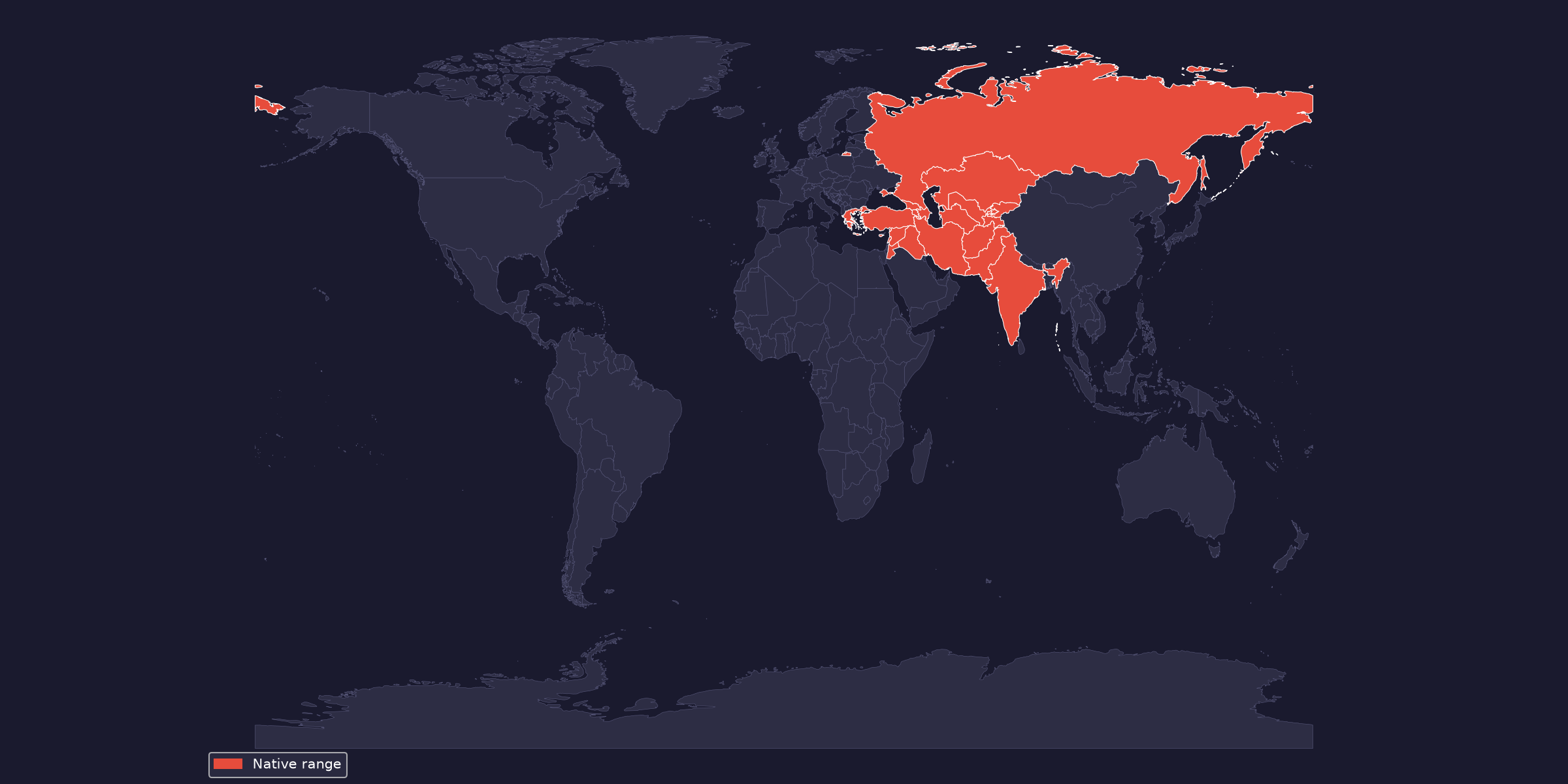
The accepted broad complex occurs from Cyprus, Türkiye, Syria, Lebanon, Jordan and Iraq through Armenia, Azerbaijan, Georgia, southern Russia, Iran, Turkmenistan, Uzbekistan, Kyrgyzstan, Tajikistan, Kazakhstan and Afghanistan to western Pakistan and northwestern India. Under the subspecies treatment, it also includes schweizeri on Milos, Kimolos, Polyaigos and Sifnos in Greece.
A 1932 Yemen specimen has uncertain data, Saudi Arabian occurrence is considered unlikely, and the species is not accepted from Israel in the current database. The Algerian transmediterranea population may have been introduced; it is therefore excluded from the native-range map. The map includes Greece under the database’s subspecies treatment but necessarily over-shades the mainland and nearly every Greek island.
Whole-country shading cannot show the western Cycladic islands, restricted Cypriot or Levantine range, mountain and desert gaps, subspecies limits or disputed records. The reviewed Famagusta point represents nominate M. l. lebetinus on Cyprus and must not be applied directly to a Caucasian, Central Asian or Cycladic animal.
🌡 Climate across the native range
WorldClim v2.1 climate normals for 1970–2000 from a reviewed nominate-lineage occurrence on Cyprus:
Famagusta — Cyprus (reviewed M. l. lebetinus occurrence)
| Month | Min °C | Mean °C | Max °C | RH % |
|---|---|---|---|---|
| January | 6.7 | 11.2 | 15.7 | 70 |
| February | 6.9 | 11.6 | 16.3 | 70 |
| March | 8.2 | 13.4 | 18.6 | 68 |
| April | 11.2 | 16.7 | 22.2 | 65 |
| May | 14.8 | 20.4 | 26 | 63 |
| June | 18.9 | 24.2 | 29.6 | 60 |
| July | 21.6 | 26.7 | 31.8 | 61 |
| August | 21.7 | 27 | 32.2 | 62 |
| September | 19.6 | 25 | 30.4 | 60 |
| October | 16.1 | 21.5 | 26.9 | 61 |
| November | 12.1 | 17.1 | 22.2 | 63 |
| December | 9.1 | 13.5 | 17.9 | 68 |
Weather data by WorldClim v2.1 · Climate-normal period: 1970–2000. Monthly normals queried by Herpeton Academy from raster values; relative humidity is derived from vapor pressure and mean temperature.
Location references use GBIF.org occurrence data where available; original occurrence records retain their source dataset licenses.
⚖️ Legal status
As checked on 17 August 2026, Macrovipera lebetinus is not listed in the CITES Appendices or EU wildlife-trade annexes. If M. schweizeri is included as a subspecies, that Cycladic lineage is listed in Appendix II of the Bern Convention and in Annexes II and IV of the EU Habitats Directive as a priority taxon. These conservation listings are separate from the EU wildlife-trade annexes and prohibit casual collection or movement of wild Greek animals.
Range-state and destination laws may strictly control native-wildlife collection, dangerous-snake possession, registration, transport, breeding, sale, export and import. Obtain written determinations that cover the exact name and provenance, especially for schweizeri. Retain permits, lawful-origin and veterinary documents, invoices, parentage and locality records, photographs and the check date.
🤌 Husbandry
House one animal in a controlled-access venomous room with secondary containment, sealed service penetrations and a written door protocol. The enclosure needs two positively lockable compartments or shift hides large enough for the entire heavy snake. Confirm and secure the animal before opening either side.
Quarantine for at least 90 days on paper with simple hides, dedicated tools and preferably separate airspace. Record weight, meals, sheds, faeces, urates, skin, mouth and respiration; imported animals need veterinary parasite and mite screening.
Keep singly. Build barriers for strength and reach, not apparent temperament. Seasonal plans must begin with provenance: a Cypriot animal, a Dagestan obtusa and a Central Asian turanica do not share one annual cycle.
💡 Lighting
Provide 9-14 hours of bright visible light, adjusted gradually through the year, and complete darkness at night. Shade both shift compartments and provide broken sight lines. All lamps and wiring belong outside primary containment or behind locked guards.
Low-output UVB may be offered as a Ferguson Zone 1 opportunity. Measure at snake level and retain a completely shaded route. UVB cannot compensate for inappropriate heat or seasonal cycling.
🌡 Heating and temperature
During the active season maintain ambient air at 24-29°C, a limited basking surface at 31-34°C, a cool retreat at 21-24°C and nights around 18-22°C. Thermostat and guard every source, monitor air and surfaces separately and alarm overheating.
Some healthy, established temperate-provenance adults undergo a controlled winter rest around 8-15°C after veterinary review and full gut clearance. Duration and target depend strongly on locality. Do not cool tropical-edge or uncertain-origin animals automatically, and never cool juveniles, thin, gravid, sick or newly acquired snakes. The Cypriot climate table is context, not a universal brumation schedule.
💧 Humidity and water
Maintain roughly 40-65% humidity with good cross-ventilation and a local 60-75% retreat for shedding. Provide both a dry resting area and slightly moisture-buffered substrate. Provenance may justify seasonal increases, but a permanently wet enclosure is inappropriate.
Provide a large, stable bowl of clean water through protected service access. Monitor drinking, urates, weight and shed quality. Review heat, health and microclimates if dehydration recurs instead of soaking or spraying the snake routinely.
🌿 Enclosure and decoration
An adult needs at least 200 x 100 x 100 cm, with greater floor area for large females. Install two lockable shift compartments, broad anchored hides, low stable climbing shelves and an unobstructed inspection route. Use two-step mechanical locks, an internal service barrier and a visible venom warning.
Provide 8-12 cm of compactable mineral soil with stone grit and limited leaf litter, varying the mix to documented locality. Paper is safer in quarantine. Avoid unstable rock, narrow crevices that prevent visual confirmation, dusty sand, aromatic wood and décor that must be lifted.
Although field animals may climb, do not build tall fall hazards. Every shelf must carry adult mass and remain serviceable from outside the occupied compartment.
🐁 Feeding
Wild diet includes mammals, birds and other vertebrates. Offer established adults appropriately sized frozen-thawed rodents every 14-28 days, adjusting to weight, season and reproductive state. Juveniles may feed more often on smaller prey.
Feed through a protected port after shifting, and confirm the animal before retrieval. Never use live rodents. Whole prey requires no routine supplementation. Reduce feeding well before any planned cooling and do not cool an animal with undigested food.
🛡 Operational safety and emergencies
Never free-handle, pin, neck or manually restrain M. lebetinus during routine work. Use lockable shifts, rated boxes, appropriate hooks, transparent barriers and protected ports. Two trained adults attend every primary opening. Veterinary procedures require a preplanned professional anaesthetic, airway and containment team.
Before acquisition, consult the receiving hospital or poison centre using the exact locality and historical synonyms. Commercial antivenoms differ by country and immunizing venom; cross-neutralization across Macrovipera, Montivipera or other vipers must not be assumed. The hospital must confirm a product, supply route, monitoring and blood-product capacity.
After a bite, move away, call emergency services, remove constricting items, keep the patient still with the limb neutrally supported and follow poison-centre instructions. Do not use a tourniquet or tight pressure bandage where severe local injury is expected; do not cut, suck, ice, shock or massage the site.
Maintain a written escape plan covering room isolation, public exclusion, accountability, defined search zones, rated containers and named decision-makers. Stop work whenever the snake cannot be positively located.
🥚 Breeding notes
Current anatomical, field and captive evidence supports oviparity. Historical descriptions of live-bearing likely reflect older errors or confusion; use oviparous in records unless a documented individual event proves otherwise. Reported clutches vary, and 6-24 eggs is a conservative planning range.
Published work on M. l. obtusa recorded eggs and approximately 40-45 days of laboratory incubation. Across the broad complex, 27-29°C and roughly 40-55 days are cautious planning values, not a universal recipe. Validate temperature, moisture and development against the exact lineage and complete breeding source.
Pair only compatible, locality-backed adults through shifts. Prepare individually lockable neonate enclosures, legal paperwork and placements before breeding. Do not cross disputed lineages or market hybrids under a simple species name.
🩺 Common problems
- Obesity: prevent with measured prey, seasonal feeding and regular weight records.
- Respiratory disease: wheezing, bubbles, open-mouth breathing or head elevation require urgent veterinary assessment.
- Dehydration or retained shed: review clean water, the humid retreat, heat and illness.
- Dermatitis: investigate wet dirty substrate, poor airflow, mites and abrasion.
- Parasites and stomatitis: especially important in imports or wild-origin animals.
- Burns and overheating: prevent with guarded thermostatic heat, alarms and a genuine cool compartment.
- Regurgitation: review prey size, disturbance, temperature, premature cooling, infection and parasites.
Do not attempt hands-on home treatment. Secure the snake in a shift compartment and arrange an experienced reptile veterinary team.
📌 Conclusion
Macrovipera lebetinus belongs only in a licensed institution that records provenance more precisely than the disputed subspecies labels, uses two-compartment protected contact and maintains an origin-specific hospital plan. Spelling, lineage, winter cycle and even conservation law change across what an old label may call “lebetina.”
📚 Sources and further reading
- ReptiFiles — checked first on 17 August 2026; no species-specific care guide was found.
- The Reptile Database: Macrovipera lebetinus
- GBIF species record: Macrovipera lebetinus
- Freitas et al. — evidence-based species delimitation in Eurasian vipers
- Di Nicola et al. — taxonomy and natural history of the Milos viper
- The biology and toxinology of blunt-nosed vipers
- Ismailova — reproduction and 40-45-day incubation in M. l. obtusa
- Baines et al. — UV lighting guidance
- Northern Ireland government venomous-reptile guidance
- CITES Appendices
- EU wildlife-trade annexes, Commission Regulation (EU) 2026/1383
- EU Habitats Directive consolidated text
- Bern Convention appendices