Share

Milk Snake Care Guide
🔤 Taxonomy
Lampropeltis triangulum is the currently accepted scientific name for the milk snake. Older hobby material may treat some regional forms differently because milk snakes and kingsnakes have a complex taxonomic history.
English common names used in the hobby:
- Milk snake
German common names used in the hobby:
- Milchschlange
📌 Description
Lampropeltis triangulum is a slender New World colubrid known for bold banding or blotching, active behavior, and generally manageable adult size. Depending on the form, adults commonly range from under 1 meter to around 1.5 meters.
Milk snakes are popular because they are hardy and attractive, but they are still excellent escape artists and need proper heating, hiding places, and prey sizing.
🌍 Distribution
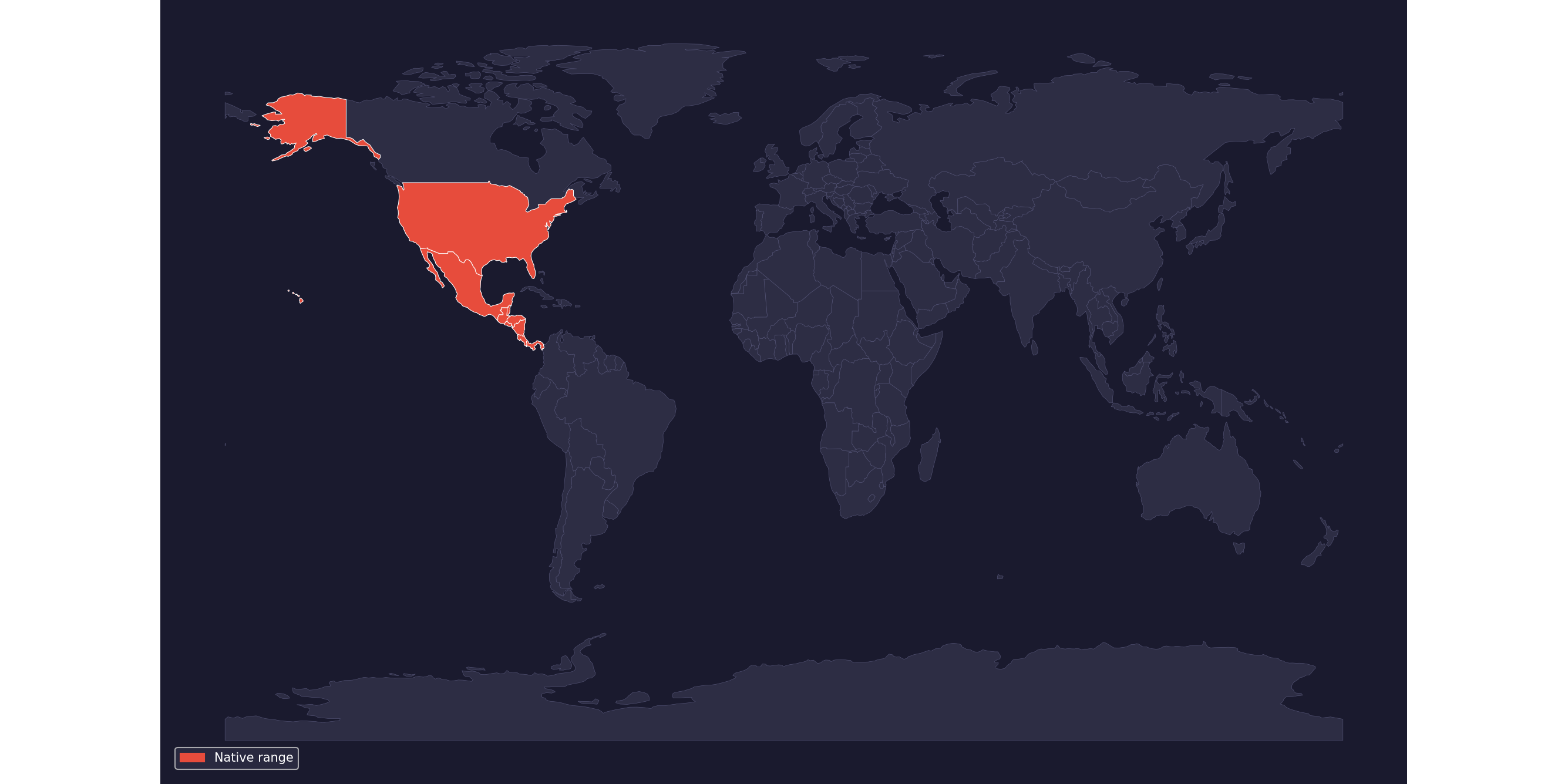
Lampropeltis triangulum is native to a broad part of North and Central America, with many regional forms and former subspecies names in older literature. In the wild it is associated with woodland edges, rocky slopes, fields, farms, forest openings and other cover-rich habitats with seasonal temperature change.
In the enclosure, that means:
- secure hides in both warm and cool parts of the enclosure
- a clear thermal gradient instead of one uniform temperature
- substrate and cover that match the species’ natural shelter use
- humidity managed by microclimates, not by keeping the whole enclosure wet
- space and enrichment that support normal movement and hunting behaviour
🌡 Climate across the native range
Monthly climate normals from reviewed GBIF occurrence locations:
New York — United States of America
| Month | Min °C | Mean °C | Max °C | RH % |
|---|---|---|---|---|
| January | -10.6 | -6.9 | -2.4 | 76 |
| February | -10.2 | -6 | -1 | 73 |
| March | -6 | -1.8 | 3.5 | 71 |
| April | 0.6 | 5 | 10.6 | 70 |
| May | 6.9 | 11.4 | 16.7 | 74 |
| June | 12 | 16.2 | 20.9 | 77 |
| July | 14.7 | 18.8 | 23.4 | 77 |
| August | 14.1 | 18 | 22.6 | 78 |
| September | 10.6 | 14.4 | 19 | 78 |
| October | 4.7 | 7.9 | 12.4 | 78 |
| November | -1.2 | 1.8 | 5.8 | 77 |
| December | -6.8 | -3.7 | 0.1 | 78 |
Maryland — United States of America
| Month | Min °C | Mean °C | Max °C | RH % |
|---|---|---|---|---|
| January | -1.8 | 1.3 | 5.4 | 67 |
| February | -1.3 | 2.2 | 7 | 67 |
| March | 2.3 | 6.3 | 11.5 | 67 |
| April | 8 | 12.3 | 17.7 | 68 |
| May | 13.5 | 17.6 | 22.5 | 71 |
| June | 18.7 | 22.7 | 27.3 | 71 |
| July | 21.5 | 25.4 | 29.8 | 71 |
| August | 20.9 | 24.5 | 28.7 | 72 |
| September | 17.5 | 21 | 25.1 | 72 |
| October | 11.2 | 14.7 | 19 | 72 |
| November | 5.4 | 8.6 | 12.8 | 70 |
| December | 0.8 | 3.7 | 7.6 | 71 |
Michigan — United States of America
| Month | Min °C | Mean °C | Max °C | RH % |
|---|---|---|---|---|
| January | -7.8 | -4.7 | -0.9 | 78 |
| February | -7.3 | -3.8 | 0.8 | 74 |
| March | -2.5 | 1.4 | 6.7 | 69 |
| April | 3.6 | 8.1 | 13.9 | 66 |
| May | 10 | 14.6 | 20.1 | 68 |
| June | 15.6 | 20 | 25 | 70 |
| July | 17.9 | 22.2 | 26.9 | 71 |
| August | 17.3 | 21.3 | 25.9 | 73 |
| September | 13.7 | 17.5 | 22.2 | 72 |
| October | 7.6 | 10.9 | 15.2 | 73 |
| November | 1.5 | 4.2 | 7.8 | 75 |
| December | -3.7 | -1.3 | 1.9 | 78 |
Weather data by Open-Meteo.com · CC BY 4.0 · Monthly normals calculated by Herpeton Academy from daily archive values.
Location references use GBIF.org occurrence data where available; original occurrence records retain their source dataset licenses.
⚖️ Legal status
As checked against current official sources in April 2026, no current CITES listing or specific EU wildlife trade Annex listing was found for Lampropeltis triangulum. The species is not relevant to the Bern Convention because it is not native to Europe.
National or local rules on keeping, sale, transport, and breeding may still apply in some places. Captive-bred animals from reliable sources remain preferable.
🤌 Husbandry
Milk snakes are solitary predators and should be housed one per enclosure. Because the name covers populations with markedly different adult lengths, choose the final enclosure from the measured snake rather than the common name alone. The enclosure should let the animal stretch out along its longest dimension; 90 × 45 × 45 cm can suit a smaller adult, while a snake approaching 1.2-1.5 m needs at least 120 × 60 × 60 cm and benefits from more room.
Useful basics include:
- Secure locks
- A warm hide and a cool hide
- Clutter and cover
- A water bowl
- Dry-to-moderate substrate
Quarantine every new snake for at least 90 days in a separate room when possible, with dedicated tongs, bowl, cleaning tools, and simple furnishings. Record arrival weight, meals, feces, sheds, and any regurgitation throughout that period. Animals of uncertain origin, or those with diarrhea, mites, weight loss, or repeated poor sheds, warrant an examination and fecal testing by a reptile veterinarian before joining the collection workflow.
💡 Lighting
No strong specialist lighting is required, but a normal day-night cycle is important. Low-level UVB can be used if it is set up correctly, though it is not strictly required.
Night lighting is unnecessary.
For UV planning, treat this species as Ferguson Zone 1. Aim for about UVI 0.5-1.0 in the upper exposed area, while leaving retreats and a gradient down to shaded areas near zero UVI. Choose a low-output UVB tube by measured exposure, not by the percentage printed on the lamp. The UV-Tool places older milk-snake taxa in Zone 1; applying that here is a conservative comparison, not a measurement for the modern species definition. Measure with a Solarmeter 6.5 at the animal’s back height. UV-Tool, Baines et al. (2016).
🌡 Heating and temperature
Suitable approximate temperatures are:
- Warm hide or basking surface: around 29-31°C
- Warm side ambient: about 25-27°C
- Cool side: around 22-24°C
- Night: usually around 20-22°C
The goal is a stable gradient rather than a hot enclosure overall.
💧 Humidity and water
Milk snakes usually do well at moderate humidity with access to fresh water.
Useful principles:
- Normal humidity around 40-60%
- Slightly higher humidity during shed if needed
- A humid hide when shedding is poor
- Dry, clean conditions with decent ventilation
🌿 Enclosure and decoration
The enclosure should encourage security and exploration.
Useful elements include:
- Cork bark or hides
- Branches or low climbing options
- Leaf litter or clutter
- Substrate suitable for burrowing lightly
- A stable water dish
Provide roughly 5-10 cm of aspen, lignocel, cypress-based bedding, or a clean soil-based mix that remains loose enough for shallow burrowing without staying wet. Paper towel is useful during quarantine or medical observation, but it does not provide sufficient enrichment as a permanent substrate. Avoid aromatic cedar or pine shavings, dusty bedding, and damp substrate spread across the whole floor.
Test every cable port, sliding-door overlap, lid corner, and ventilation gap before introducing the snake; juveniles can leave through openings that appear impossibly small. Support rocks and heavy branches from the enclosure base rather than resting them on loose bedding, so digging cannot undermine them.
🪳 Feeding
Milk snakes feed well on appropriately sized rodents in captivity.
Useful feeding principles:
- Use frozen-thawed prey as the standard approach
- Match prey size to the widest part of the snake
- Feed juveniles more often than adults
- Avoid excessive overfeeding
Hatchlings commonly take a small meal every 5-7 days. Older juveniles can move toward 7-10 days, and many adults do well every 10-14 days depending on prey size, activity, and body condition. A meal around the snake’s widest diameter is a ceiling rather than a target to exceed. Weigh growing animals monthly and lengthen the interval if the body becomes uniformly rounded or the tail base loses a clear taper.
Offer prey with tongs and thaw it safely; never leave a live rodent unattended with the snake. Avoid handling for about 48 hours after a normal meal, longer after an unusually large one. A single refusal during a seasonal change is less important than a downward weight trend, repeated regurgitation, or refusal combined with respiratory or neurological signs.
🧤 Handling and seasonal management
Allow a new milk snake to settle and take several consecutive meals before routine handling. Lift from below, support the body with both hands, and keep early sessions brief. Fast hatchlings may musk or nip, but repeated chasing usually makes defensive behavior worse. Wash hands after handling prey and before opening the enclosure so food odor does not trigger a mistaken feeding response.
Healthy northern-line adults may show lower activity and appetite as daylight shortens. Routine pets do not need forced brumation: maintain the normal gradient, verify weight, and investigate continuing weight loss rather than assuming every winter refusal is seasonal. Deliberate cooling belongs to a planned breeding program and should never be attempted with a juvenile, thin, dehydrated, newly acquired, parasitized, or unwell animal.
During maintenance, move the snake to a locked temporary tub before lifting heavy furniture or leaving doors open. Count the animal before and after cleaning, inspect the mouth and vent visually without forcing them open, and confirm that both eye caps and the tail tip came away after each shed.
🩺 Common problems
Common problems include escape, dysecdysis (retained shed), obesity, mite infestation, respiratory infection, and regurgitation associated with incorrect temperatures, oversized prey, premature handling, or disease. A persistently wet enclosure can damage scales, while chronic dryness and poor access to a humid retreat can leave retained eye caps or tail shed.
Warning signs include:
- Repeated bad sheds
- Wheezing
- Weight loss
- Regurgitation
- Persistent refusal to eat
- Nose rubbing
If problems appear, first check temperatures, prey size, humidity, water access, and enclosure security. Respiratory signs or repeated regurgitation need a reptile veterinarian.
Do not repeatedly re-feed after regurgitation. Stabilize the enclosure, leave the digestive tract undisturbed, document the event, and seek veterinary advice—especially after a second episode. Wheezing, bubbles at the nostrils, open-mouth breathing, marked weight loss, swelling, or abnormal posture also require prompt reptile-veterinary assessment rather than home medication.
📌 Conclusion
Lampropeltis triangulum is a strong choice for keepers who want an active, attractive colubrid with straightforward husbandry. The species does best in a secure enclosure with a proper thermal gradient, moderate humidity, and sensible feeding.
📚 Sources and further reading
- ReptiFiles milk snake care sheet, reviewed August 2026
- Fitch & Fleet (1970), Natural History of the Milk Snake in Northeastern Kansas
- Baines et al. (2016), UV-Tool
- Merck Veterinary Manual, reptile husbandry, quarantine, and recordkeeping
- CITES Appendices, checked April 2026
- European Commission wildlife-trade guidance, checked April 2026
- GBIF species backbone and occurrence data for taxonomy and distribution context
💬 Feedback
For questions, corrections, or practical notes, leave us a message in the forum thread.