Share

Gray-banded Kingsnake
🔤 Taxonomy
Lampropeltis alterna is the accepted species name. Older sources may use Lampropeltis mexicana alterna or L. m. blairi. “Blair’s phase” and “alterna phase” describe pattern traditions, not currently accepted subspecies, and locality information should be kept separate from colour-line marketing.
English names are gray-banded kingsnake and grey-banded kingsnake; the German name is Graugebänderte Königsnatter.
📌 Description
This is a slim, secretive kingsnake from the Chihuahuan Desert region, usually 90-130 cm long. Grey ground colour, orange or red saddles and black edging vary strongly by locality and breeding line. Lifespan can exceed 20 years.
Adults are often calm once established, but the species spends much time hidden and some hatchlings are reluctant rodent feeders. It suits a keeper who values natural behaviour and accurate locality records rather than constant display or handling.
🌍 Distribution
The native range centres on the Trans-Pecos of western Texas and adjacent northern Mexico, including Chihuahua, Coahuila and Durango; recent reviews question some older peripheral records. The snakes use limestone canyon, rocky desert slope and crevice systems, emerging mainly at night and after favourable weather.
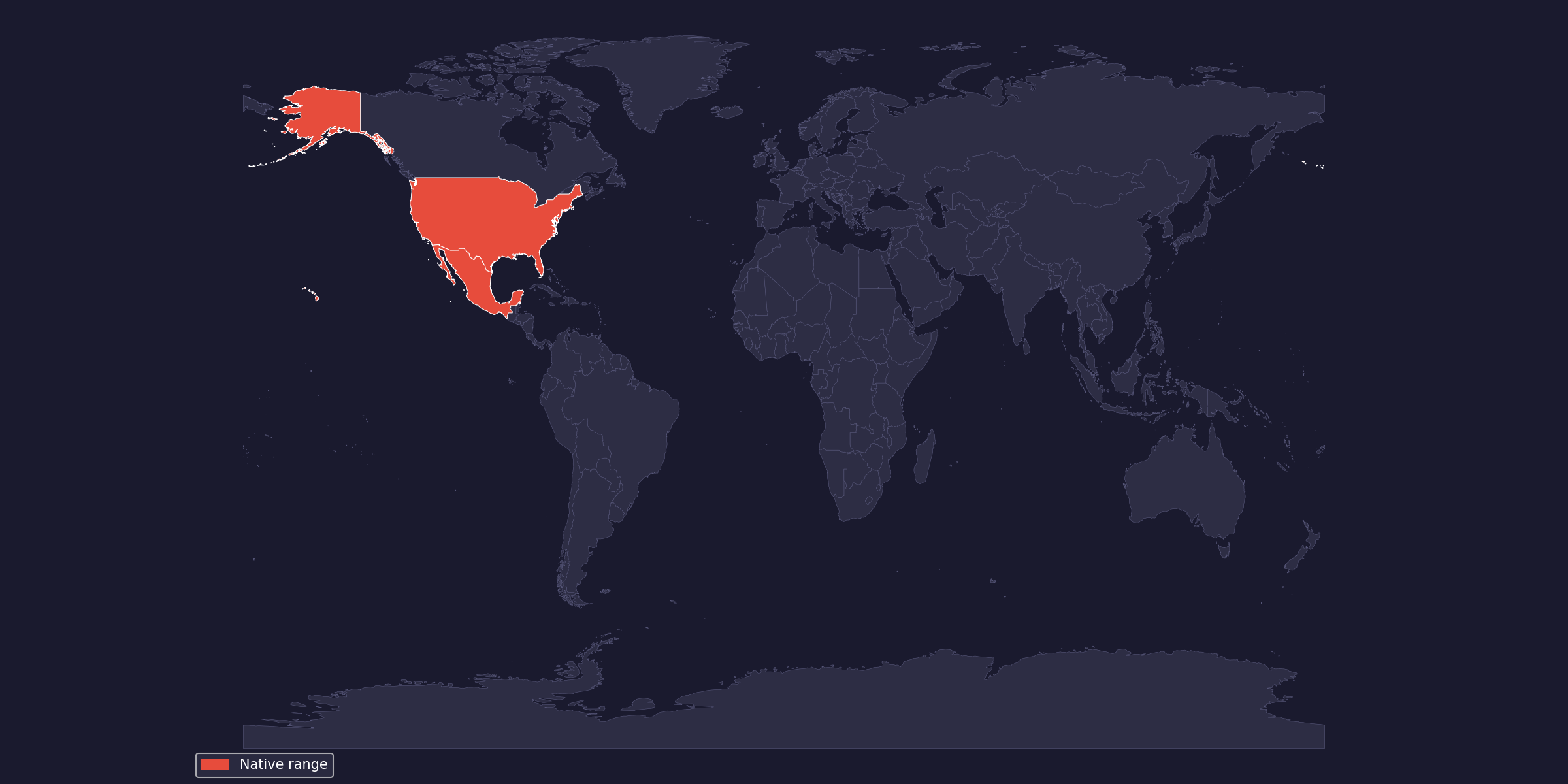
🌡 Climate across the native range
Monthly climate normals from reviewed GBIF occurrence locations:
Trans-Pecos — Texas — United States of America (regional coordinate)
| Month | Min °C | Mean °C | Max °C | RH % |
|---|---|---|---|---|
| January | -0.6 | 7.5 | 15.6 | 48 |
| February | 1.2 | 9.8 | 18.4 | 45 |
| March | 5 | 13.7 | 22.4 | 40 |
| April | 9.2 | 17.8 | 26.4 | 38 |
| May | 14 | 22.1 | 30.2 | 42 |
| June | 18.1 | 25.3 | 32.5 | 50 |
| July | 19.3 | 26.2 | 33 | 49 |
| August | 18.8 | 25.7 | 32.5 | 52 |
| September | 16.1 | 23 | 29.9 | 54 |
| October | 10.4 | 18 | 25.7 | 53 |
| November | 4.4 | 12.5 | 20.7 | 48 |
| December | 0.5 | 8.8 | 17.1 | 46 |
Coahuila — Mexico
| Month | Min °C | Mean °C | Max °C | RH % |
|---|---|---|---|---|
| January | 4.7 | 12.2 | 19.7 | 52 |
| February | 6 | 13.8 | 21.6 | 50 |
| March | 8.4 | 16.6 | 24.8 | 46 |
| April | 11.5 | 19.5 | 27.6 | 47 |
| May | 14.3 | 22.1 | 29.9 | 52 |
| June | 15.6 | 23 | 30.4 | 58 |
| July | 15.6 | 22.7 | 29.7 | 60 |
| August | 15.4 | 22.4 | 29.3 | 62 |
| September | 14 | 20.8 | 27.5 | 65 |
| October | 11.4 | 18.5 | 25.7 | 60 |
| November | 8 | 15.6 | 23.2 | 55 |
| December | 5.7 | 13.1 | 20.5 | 53 |
Durango — Mexico
| Month | Min °C | Mean °C | Max °C | RH % |
|---|---|---|---|---|
| January | 2.6 | 12.7 | 22.7 | 47 |
| February | 3.8 | 14.3 | 24.8 | 42 |
| March | 6.5 | 17.2 | 28 | 34 |
| April | 9.6 | 20.3 | 31 | 32 |
| May | 12.9 | 23.3 | 33.6 | 34 |
| June | 15.7 | 24.9 | 34 | 42 |
| July | 15.7 | 23.6 | 31.4 | 53 |
| August | 15.1 | 22.8 | 30.6 | 57 |
| September | 13.7 | 21.5 | 29.3 | 59 |
| October | 9.7 | 18.9 | 28 | 54 |
| November | 5.4 | 15.6 | 25.9 | 48 |
| December | 3.3 | 13.1 | 23 | 48 |
Weather data by WorldClim v2.1 · Monthly normals queried by Herpeton Academy from raster values; relative humidity is derived from vapor pressure and mean temperature.
Location references use GBIF.org occurrence data where available; original occurrence records retain their source dataset licenses.
⚖️ Legal status
No listing for L. alterna was found in the current CITES Appendices or EU wildlife-trade annexes, and the Bern Convention is not applicable. Collection and possession of native kingsnakes can still be restricted by US states and Mexican wildlife law; locality data does not prove legal origin.
Choose established captive-bred stock. Keep an invoice, breeder identity, hatch date and the exact wording of any locality claim. Check destination-country rules before transport, sale or breeding.
🤌 Husbandry
Keep one animal in a locked 120 × 60 × 60 cm enclosure. This species can enter very narrow gaps, and kingsnakes may eat other snakes; cohabitation is unsafe outside a closely supervised breeding introduction.
Allow a new arrival to establish regular feeding before handling. Quarantine for 60-90 days with separate equipment and records. Wild-caught or undocumented animals warrant an exotics-veterinary examination and faecal testing.
💡 Lighting
Provide 10 hours of light in winter and up to 14 in summer. Low-level UVB is recommended over part of the warm zone, with shade and crevices available at every height. A bright daytime lamp supports the day-night rhythm even though the snake is mainly nocturnal. No night lamp is necessary.
🌡 Heating and temperature
Use a modest 29-31 °C basking surface, 23-27 °C warm air, a 20-24 °C cool end and 18-22 °C nights. Desert origin does not justify a uniformly hot box: wild animals retreat deep into cool rock fissures.
Brumation at about 10-14 °C for 8-12 weeks is mainly a breeding tool. It should follow a health and body-condition check and a complete pre-cooling fast. Do not brumate juveniles, new arrivals or compromised animals.
💧 Humidity and water
Keep general humidity around 35-55%, but always offer a ventilated humid hide at 55-70% for shedding. Let the main substrate dry after light watering; avoid both bone-dry air and chronically damp bedding. Supply a small heavy bowl of fresh water.
🌿 Enclosure and decoration
Provide 8-12 cm of packed soil and sand with excavator clay or firmly anchored flat stones to create safe crevices. Every rock stack must be supported from the enclosure base so the snake cannot undermine it. Cork, low shelves, artificial plants and at least two snug hides add usable cover.
Do not use pure loose sand, calcium sand, sharp stone or heavy unsecured slabs. Feed from tongs or a clean dish to reduce swallowed substrate.
🐁 Feeding
Captive-bred adults generally accept frozen-thawed mice every 10-14 days; juveniles usually eat every 5-7 days. Select prey around the snake’s widest point and adjust to body condition. Whole prey requires no routine powder.
Some hatchlings prefer lizard-shaped or scented prey. First correct enclosure security, temperature and cover. Persistent non-feeding with weight loss needs breeder and veterinary input; routine force-feeding or offering a wild lizard introduces injury, parasite and legal risks.
🩺 Common problems
- persistent hiding with no feeding: stress, oversized enclosure with too little cover, or wrong temperature
- regurgitation: excessive heat, oversized prey, disturbance or disease
- retained shed: inadequate humid refuge or dehydration
- mouth rubbing: insecure crevice or repeated escape behaviour
- obesity: feeding too often for a secretive adult
- burns or crushing injury: unguarded heater or unstable stonework
- egg binding: missing nest site, poor condition or reproductive complication
📌 Conclusion
The gray-banded kingsnake is a strong choice for a patient keeper who can offer cool fissures, moderate heat and long periods of undisturbed hiding. Verified captive origin and honest locality records matter more than a fashionable pattern name.
📚 Sources and further reading
- ReptiFiles: Kingsnake Care Sheet
- The Reptile Database: Lampropeltis alterna
- GBIF species record
- Axelsson 2004: captive care and reproduction
- Baines et al. 2016: UV lighting for reptiles
- CITES Appendices, current EU wildlife-trade framework, and Bern Convention appendices