Share

South American Bushmaster
🔤 Taxonomy
Lachesis muta here means the South American bushmaster in the strict, current sense. A 2024 integrative revision resurrected the Atlantic Forest bushmaster as L. rhombeata; Central American L. stenophrys and L. melanocephala, and the Chocoan L. acrochorda, are also separate species. Old records, zoo labels, and medical literature may use “L. muta” for this wider complex, so locality and voucher history matter.
📌 Description
This is a huge, mostly nocturnal forest viper, commonly 2-3 m and exceptionally around 3.5 m. The tan-to-orange body carries dark rhomboid markings, strongly keeled scales, and a terminal spine rather than a rattle. It usually relies on concealment, but its acceleration and reach are easily underestimated.
Envenomation can produce severe pain, swelling, bleeding disturbance, hypotension, vomiting, diarrhoea, bradycardia, shock, kidney injury, and death. The combination of body length, a long strike, large venom yield, heat sensitivity, and high humidity makes L. muta a specialised institutional animal—not a private-room display snake.
📋 Quick reference
| Care point | Practical target |
|---|---|
| Adult enclosure | At least 360 x 180 x 180 cm for one adult, plus a full-body external shift |
| Day temperatures | 23-28°C air; broad 28-29°C warm surface; 21-23°C cool retreat |
| Night temperatures | 20-23°C |
| Humidity | 75-90% with high ventilation, drainage, and dry resting surfaces |
| Lighting | Seasonal 11-13 hours; measured Ferguson Zone 1 UVB recommended |
| Feeding | Frozen-thawed rats or rabbit by size; adults usually every 14-28 days |
| Reproduction | Egg-laying; published institutional incubation about 26-28°C for 71-76 days |
| Safety | Very large medically significant viper; protected contact and two-person procedures |
☠️ Venom
This species is venomous. Venom exposure can cause pain, swelling or other systemic effects, and severity varies with species, locality, bite site and the amount delivered. A small wound or apparently dry bite is not proof of safety; every bite or sting requires urgent medical assessment.
If an incident occurs, move away, call emergency services or a poison centre, keep the patient still, remove rings and other constricting items, and follow dispatcher instructions. Do not use a tourniquet, cut or suck the wound, apply ice or electricity, give alcohol or medicines as a home treatment, or attempt to catch the animal. Antivenom choice and dosing are hospital decisions; verify the relevant product and local availability in advance. Sources: WHO snakebite guidance and appropriate species-specific toxinology or medical references listed below.
🌍 Distribution
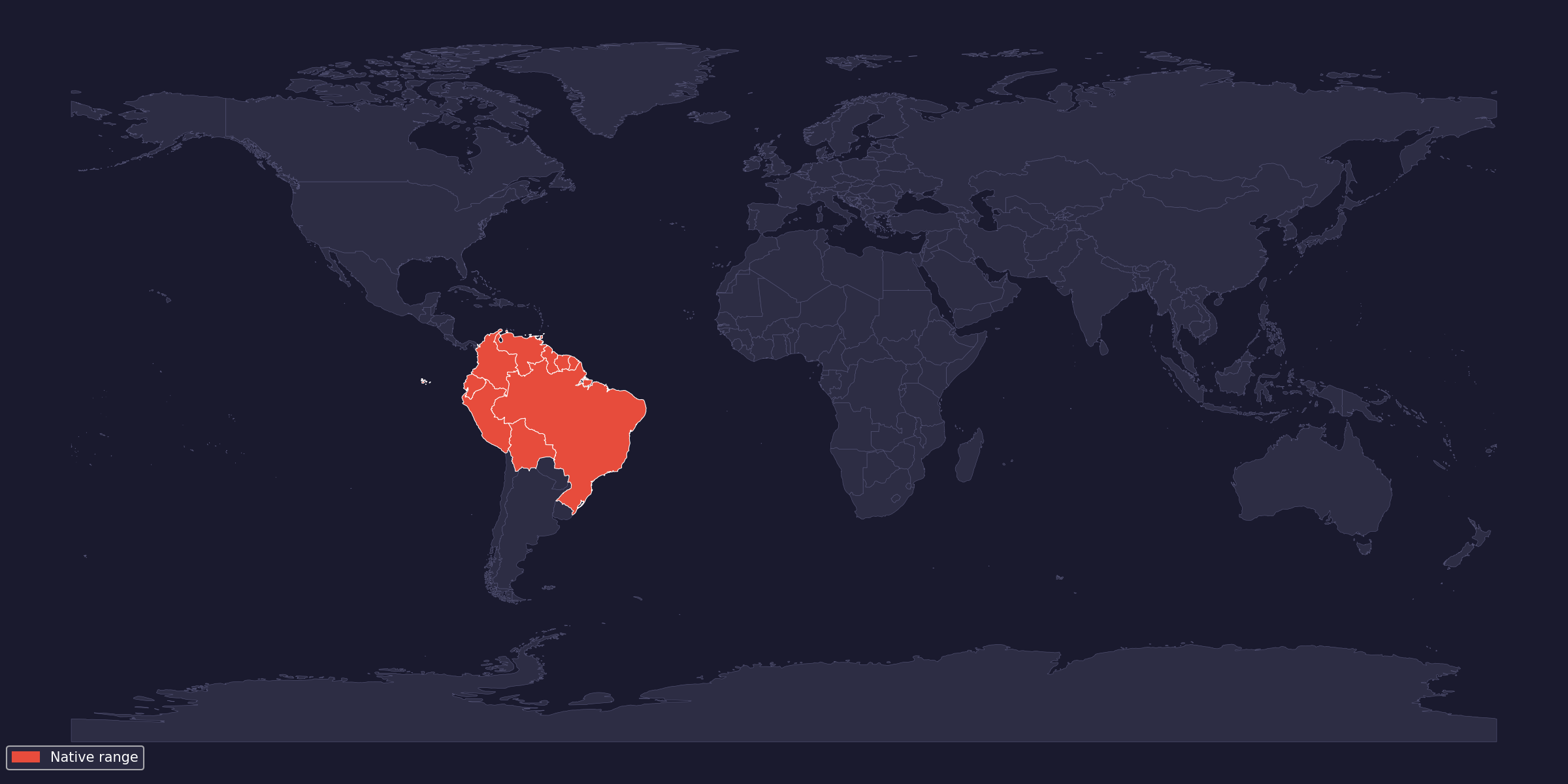
In the strict modern sense, L. muta inhabits humid lowland and foothill forests of the Amazon basin, Guianas, southern Orinoco region, and east-Andean drainage. Supported countries include Bolivia, Brazil, Colombia, Ecuador, French Guiana, Guyana, Peru, Suriname, Venezuela, and Trinidad and Tobago. It is associated with intact or well-connected forest, deep leaf litter, buttress roots, burrows, fallen timber, and small-mammal paths.
The map colours whole countries and is therefore deliberately coarse. It does not show continuous occupancy, elevation limits, islands other than confirmed Trinidad, or the divide between Amazonian and Atlantic Forest populations. Most importantly, a Brazil fill must not be read as including the Atlantic Forest bushmaster: those populations are now L. rhombeata. Central American records belong to L. stenophrys or L. melanocephala, and Chocó populations to L. acrochorda. Use locality-backed records, not the country fill, for provenance.
🌡 Climate across the native range
Monthly climate normals from a documented strict-species occurrence near Belterra in the Brazilian Amazon:
Belterra, Pará — Brazil (documented occurrence)
| Month | Min °C | Mean °C | Max °C | RH % |
|---|---|---|---|---|
| January | 23 | 25.2 | 28.4 | 84 |
| February | 22.8 | 25.1 | 28.3 | 85 |
| March | 22.8 | 25 | 28.2 | 86 |
| April | 22.8 | 24.9 | 28.1 | 87 |
| May | 22.8 | 25 | 28.2 | 87 |
| June | 22.7 | 25.1 | 28.5 | 85 |
| July | 22.7 | 25.4 | 29 | 82 |
| August | 23.4 | 26.5 | 30.5 | 77 |
| September | 24.1 | 27.3 | 31.4 | 73 |
| October | 24.3 | 27.5 | 31.5 | 73 |
| November | 24 | 26.9 | 30.7 | 76 |
| December | 23.7 | 26.3 | 29.8 | 79 |
Weather data by Open-Meteo.com · CC BY 4.0 · Monthly normals calculated by Herpeton Academy from daily archive values.
Location references use GBIF.org occurrence data where available; original occurrence records retain their source dataset licenses.
⚖️ Legal status
As checked on 17 August 2026, Lachesis muta was not listed in CITES Appendices I-III and no species-specific entry was found in EU wildlife-trade Annexes A-D. It is not native to Europe, so the Bern Convention is not relevant. These trade instruments do not create permission to collect or keep it.
Range-country wildlife, forest, protected-area, export, and access-and-benefit-sharing laws may prohibit or license removal. Destination countries commonly regulate venomous snakes as dangerous animals and may require an inspected facility, named responsible staff, insurance, emergency planning, and veterinary import documents. Accept only traceable lawful stock; retain locality, breeder or institutional transfer, invoice, permits, photographs, identification history, and the legal-check date. Recheck a label written before the L. rhombeata revision.
🤌 Husbandry
Build the operational system before receiving the snake: a locked room inside a controlled building, a locked enclosure, external water service where practical, and a full-length shift that closes without a keeper entering reach. Keep singly except for planned pairing. Two trained people should be present for transfers, enclosure entry, breeding, and veterinary work.
Quarantine for at least 90 days in a secure, drainable enclosure with paper, simple hides, dedicated tools, and separated airspace where possible. Record mass, meals, defecation, sheds, skin, mouth, respiration, posture, and water use. Investigate parasites and infection with an experienced zoo or exotics veterinarian; routine restraint for examination is not acceptable.
💡 Lighting
Provide 11-13 hours of broad-spectrum visible light, adjusted gradually through the year. Forest-floor shade does not mean darkness: use diffuse illumination over cover and a small measured UVB zone around Ferguson Zone 1, while retaining complete shaded retreats. Guard every lamp, cable, and probe.
Keep nights dark. Remote or dim observation is safer than leaving coloured lamps on. Light, rainfall, and temperature can influence breeding, but changes belong in a documented programme rather than being improvised around a newly arrived animal.
🌡 Heating and temperature
Maintain 23-28°C daytime air, a broad 28-29°C warm area, a 21-23°C cool retreat, and 20-23°C nights. A published Jacksonville Zoo programme used about 24-28.5°C with a basking maximum near 29°C. This is a humid equatorial viper, not a species for a tiny, intense 35°C hot spot.
Use redundant thermostats and multiple guarded low-intensity sources. Measure floor and hide interiors as well as air. Overheating, especially when humidity is high and airflow poor, can deteriorate rapidly. Do not brumate. Any seasonal shift should remain moderate and should follow known provenance, animal condition, staff review, and breeding objectives.
💧 Humidity and water
Maintain roughly 75-90% relative humidity while giving the surface opportunities to dry. Deep moisture below leaf litter, damp retreats, frequent rain pulses, drainage, and strong cross-ventilation are safer than continuous fog or a saturated upper layer. Provide a drier resting patch even during humid periods.
Use a heavy clean bowl large enough for drinking and partial soaking, serviced behind a barrier. Persistent immersion can signal overheating, mites, dehydration, or disease. Condensation, sour substrate, red ventral scales, and skin softening indicate that moisture exceeds ventilation or drainage capacity.
🌿 Enclosure and decoration
One adult needs at least 360 x 180 x 180 cm; a large individual benefits from more length and turning room. Give 12-20 cm of well-drained soil and leaf litter, tight warm and cool hides, broad stable cork or buttress-like cover, visual barriers, and a clear route into the shift. Low sturdy platforms add choice, but vertical volume cannot replace floor area.
Use redundant locks, pinned tracks, secured vents, protected drains, sealed cable entries, and barriers that withstand a heavy snake. Furnishings must be removable or serviceable only while the animal is positively secured. Avoid unstable rocks, deep uninspectable voids, wire, and dense planting that prevents a complete visual count.
🐁 Feeding
Wild bushmasters ambush small mammals along forest routes. Offer appropriately sized frozen-thawed rats; very large adults may take responsibly sourced rabbit prey. Present food with long tools through a protected feeding protocol and allow quiet digestion. Live mammals can injure a concealed snake and add no husbandry benefit.
Juveniles may feed every 7-10 days, growing animals every 10-14 days, and adults commonly every 14-28 days according to mass and body condition. Use prey that makes a modest body contour. Whole prey needs no routine supplement. Track weight: a long snake may lose condition unnoticed, while repeated large meals create obesity and reproductive strain.
🥚 Breeding
Bushmasters are unusual among New World pit vipers because they lay eggs. Reported clutches are approximately 5-18, and females may coil around and attend the eggs. At Jacksonville Zoo, clutches of 15 and 16 were incubated at about 25.5-27.8°C and hatched after 71-76 days. These figures are a documented reference, not a guarantee across lineages and incubators.
Provide a quiet, secure nesting chamber with stable moisture but free gas exchange. Pairing, nest access, egg transfer, maternal separation, and hatchling management expose staff to several high-risk animals. Breed only with confirmed strict-species provenance, planned legal placements, redundant incubator monitoring, individual locked neonatal containers, and a veterinary and emergency team.
🛡️ Handling and emergency planning
Never free-handle, tail, pin, neck, or manually restrain a bushmaster. Use protected shifting, long species-appropriate hooks, shields, secure tubes only under an institutional protocol, and a second trained keeper. Its length allows a strike around cover or toward a person who thinks they are outside reach.
Before acquisition, agree a written response with emergency services, the regional poison centre, a medical toxicologist, and the receiving hospital. Record the accepted species name and provenance, access route, contacts, bite time, and a current region-specific antivenom pathway. Antivenom supply and administration require clinical governance; a box in the animal room is not a response plan.
Any bite is an immediate emergency. Keep the patient still, immobilise the limb in a neutral position, remove rings and tight items, and arrange urgent transport. Because viper envenomation can cause major local tissue injury, do not apply pressure immobilisation unless the responsible poison centre specifically directs it. Do not cut, suck, ice, shock, apply chemicals or an arterial tourniquet, or delay for capture or photography.
🩺 Common problems
- Overheating: restlessness, persistent soaking, open-mouth breathing, or loss of coordination requires immediate safe environmental correction and veterinary advice.
- Dermatitis: saturated dirty litter and poor airflow cause ventral lesions; correct the system and obtain a diagnosis.
- Respiratory disease: bubbles, wheeze, gaping, or abnormal head elevation needs prompt veterinary assessment.
- Dysecdysis: provide drinking water and a humid retreat; never pull skin from an unsecured snake.
- Parasites: quarantine and test new or historic wild-origin stock rather than dosing blindly.
- Regurgitation or declining condition: review prey size, temperature, privacy, faecal results, and systemic disease.
- Egg retention: a post-oviposition female that remains distended or unwell needs imaging by an equipped team.
- Provenance drift: audit historic labels against the current four-species framework before pairing or publishing records.
- Unsafe access: if routine water or waste service requires entering strike range, redesign the enclosure.
📌 Conclusion
The South American bushmaster needs more than tropical heat and humidity: it needs room-scale floor area, dry-to-damp choices, low-intensity temperature control, external shifting, verified post-revision provenance, and a rehearsed medical chain. Only an authorised institution able to manage both a three-metre viper and an attended clutch should acquire it.
📚 Sources and further reading
- ReptiFiles was searched; no species-specific care guide was located: https://reptifiles.com/
- The Reptile Database: https://reptile-database.reptarium.cz/Lachesis/muta
- GBIF: https://www.gbif.org/species/8486323
- Costa et al. (2024), integrative revision and resurrection of Lachesis rhombeata: https://doi.org/10.1080/14772000.2024.2366215
- Eisele (2009), captive reproduction at Jacksonville Zoo and Gardens: https://doi.org/10.17161/randa.v16i3.16007
- Instituto Nacional de Salud Colombia species sheet: https://serpientes.ins.gov.co/FichasEN/03L%20muta_ENG-corregido-30102025.pdf
- WHO, Guidelines for the Management of Snakebites: https://www.who.int/publications/i/item/9789290225300
- CITES Appendices: https://cites.org/eng/app/appendices.php and https://checklist.cites.org/
- Commission Regulation (EU) 2026/1383: https://eur-lex.europa.eu/eli/reg/2026/1383/oj/eng
- Bern Convention appendices: https://www.coe.int/en/web/bern-convention/appendices