Share

Southern Rinkhals
🔤 Taxonomy
Hemachatus haemachatus is the accepted name for the southern rinkhals. The genus was long treated as monotypic, but the isolated Zimbabwean Nyanga population was described as Hemachatus nyangensis in 2023. This guide therefore uses the strict southern concept—South Africa, Lesotho and Eswatini—and does not include Nyanga animals. Older sources may use Naja haemachates, Sepedon haemachates or the spelling H. haemachates.
📌 Description
The rinkhals is a stocky, keeled-scaled, terrestrial spitting elapid, commonly 90-150 cm. It spreads a hood, can project venom toward the eyes and may remain motionless with the mouth open when severely threatened. No defensive display should ever be used as a test of responsiveness.
Unlike true Naja cobras, the species gives birth to live young. Its cool highland distribution and endogenous seasonal rhythms make it a poor candidate for permanently tropical conditions. It remains an expert-only institutional animal requiring barriers and a medical plan.
📋 Quick reference
| Care point | Practical target |
|---|---|
| Adult enclosure | At least 180 x 90 x 90 cm with two lockable shift hides |
| Temperature | Ambient 22-27°C; basking 29-31°C; cool retreat 18-22°C |
| Night | 16-20°C in the active season |
| Humidity | 50-70%; local 70-85% shed support |
| Feeding | Varied whole prey every 10-18 days |
| Safety | Protected contact, eye/face protection, two trained staff, exposure and bite plans |
| Winter cycle | Only locality-led, veterinary-approved cycling of healthy adults |
☠️ Venom
This species is venomous. Venom exposure can cause pain, swelling or other systemic effects, and severity varies with species, locality, bite site and the amount delivered. A small wound or apparently dry bite is not proof of safety; every bite or sting requires urgent medical assessment.
If an incident occurs, move away, call emergency services or a poison centre, keep the patient still, remove rings and other constricting items, and follow dispatcher instructions. Do not use a tourniquet, cut or suck the wound, apply ice or electricity, give alcohol or medicines as a home treatment, or attempt to catch the animal. Antivenom choice and dosing are hospital decisions; verify the relevant product and local availability in advance. Sources: WHO snakebite guidance and appropriate species-specific toxinology or medical references listed below.
🌍 Distribution
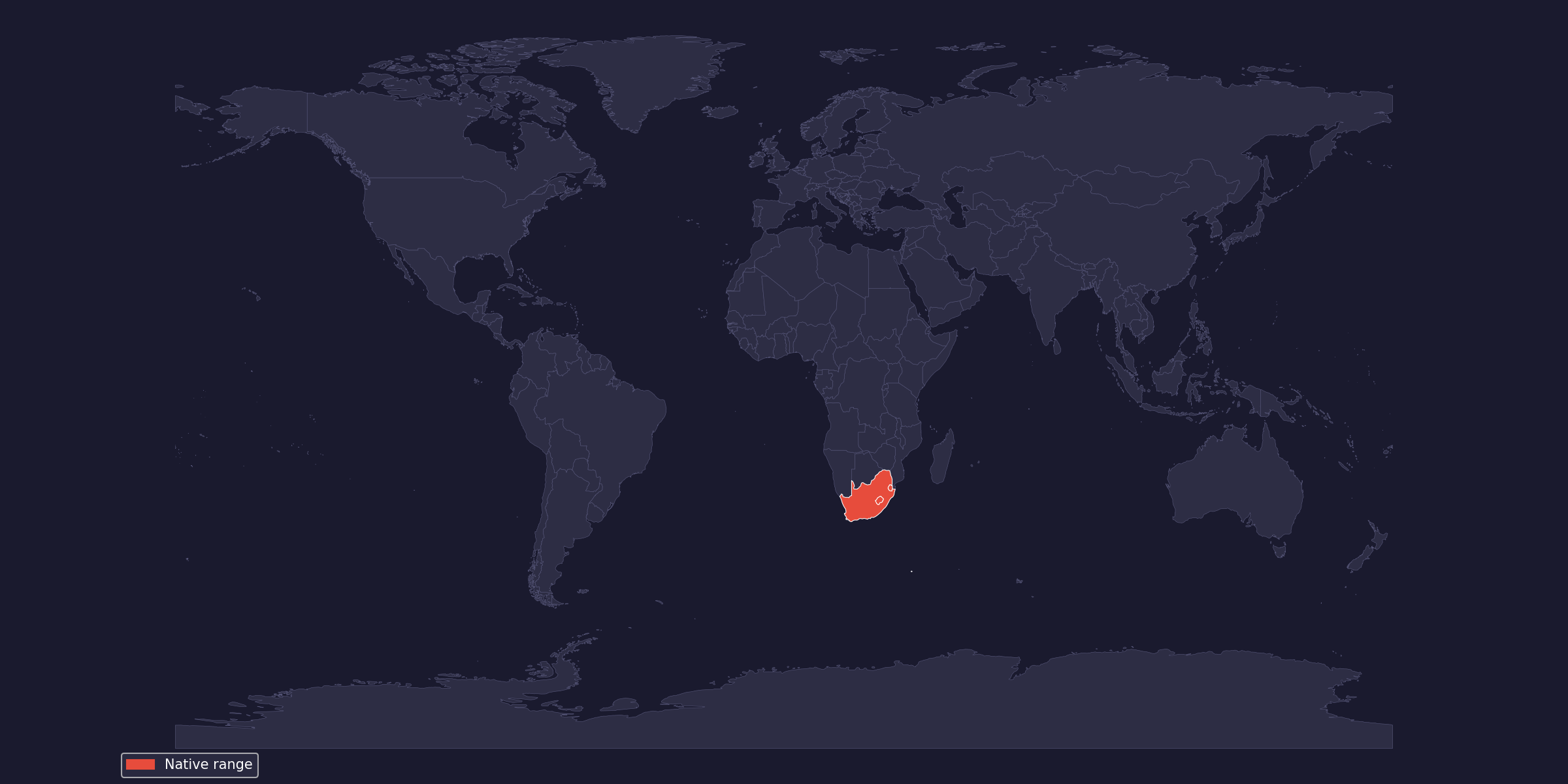
Under the post-2023 strict concept, H. haemachatus occurs in South Africa, Lesotho and Eswatini. It favours temperate grassland, montane and highveld mosaics, wetlands, farm margins and suburban open ground. Former Zimbabwean records from the Nyanga Highlands belong to H. nyangensis and are excluded from this guide and map.
Country shading still overstates occupied area, especially within South Africa, where distribution is fragmented and strongly associated with cooler, often moist grassland. The reviewed KwaZulu-Natal Midlands point represents one highland locality rather than the whole range.
🌡 Climate across the native range
Monthly normals from one reviewed highland-grassland occurrence; this point is representative context, not an average for the full range:
KwaZulu-Natal Midlands — South Africa (reviewed southern rinkhals occurrence)
| Month | Min °C | Mean °C | Max °C | RH % |
|---|---|---|---|---|
| January | 13.4 | 17.7 | 23.1 | 80 |
| February | 13.7 | 17.7 | 23.2 | 81 |
| March | 12.4 | 16.6 | 22.1 | 79 |
| April | 9.5 | 14 | 19.6 | 76 |
| May | 6.1 | 11.4 | 17.7 | 69 |
| June | 3 | 8.5 | 15.3 | 64 |
| July | 2.6 | 8.3 | 15.3 | 62 |
| August | 4.8 | 10.6 | 17.6 | 63 |
| September | 7.5 | 13.2 | 20.3 | 66 |
| October | 9.2 | 14.3 | 20.7 | 74 |
| November | 10.7 | 15.5 | 21.6 | 77 |
| December | 12.5 | 17 | 22.8 | 79 |
Weather data by Open-Meteo.com · CC BY 4.0 · Monthly normals calculated by Herpeton Academy from daily archive values.
Location references use GBIF.org occurrence data where available; original occurrence records retain their source dataset licenses.
⚖️ Legal status
No species-specific listing for H. haemachatus was found in the CITES Appendices, EU wildlife-trade annexes or Bern Convention appendices when checked on 17 August 2026. Native wildlife laws and provincial regulations in southern Africa may nevertheless prohibit collection and require permits for possession, transport or export.
Local and national rules governing possession, transport, breeding, sale and import may also class the rinkhals as a dangerous animal and require inspected containment, competence evidence, insurance and an emergency plan. Keep invoices, breeder and locality records, photographs, permits and transport papers; confirm the strict taxon and every legal step in writing.
🤌 Husbandry
House one animal per enclosure in a locked venomous room behind secondary containment. Provide two complete shift hides linked by remotely operated doors. All water, waste and heating service must occur only after positive visual confirmation that the rinkhals is locked away.
Quarantine for at least 90 days with separate tools, simple flooring and preferably separate air. Record weight, food, shedding, faeces, skin and respiration; animals of wild or uncertain origin need veterinary parasite work-up. Treat apparently immobile defensive behaviour as fully dangerous.
💡 Lighting
Provide 10-12 hours of broad visible light during the active season and full darkness overnight. Adjust the photoperiod gradually where a documented seasonal programme is used. Opaque hides and grass-like cover must remain available.
Low-output UVB may cover part of the warm zone as a Ferguson Zone 2 opportunity. Maintain shade, measure output and protect all fixtures from contact and moisture.
🌡 Heating and temperature
During the active season, maintain 22-27°C ambient air, a local 29-31°C basking surface, an 18-22°C cool hide and nights around 16-20°C. Avoid the unbroken 28-30°C conditions used for tropical cobras. Thermostat every heater and monitor surface and air temperatures independently.
Healthy, locality-documented adults in managed breeding programmes may receive a gradual winter period around 10-15°C with appropriate preparation and veterinary oversight. It is not automatic brumation advice: juveniles, thin, ill, gravid or newly acquired animals must not be cooled, and water and observation continue throughout.
💧 Humidity and water
Maintain 50-70% relative humidity with good air exchange. A local humid hide at 70-85% supports shedding, while the main floor should dry. Cold, saturated substrate is particularly hazardous during cool periods.
Provide a heavy clean water bowl through protected service. Rinkhals may use wetland edges but does not require a swimming pool. Inspect around and beneath the vessel from outside before servicing.
🌿 Enclosure and decoration
An adult needs at least 180 x 90 x 90 cm. Include two tight shift hides, clumps of robust cover, low shelves, cork and an open basking patch. Arrange everything so staff can account for the animal without entering or dismantling furniture.
Use 8-12 cm of compactable soil, washed sand and leaf/grass litter, or paper in quarantine. Avoid wet peat, aromatic wood, unstable stone and blind cavities. Doors require two independent mechanical locks, and the room needs an airlock or equivalent barrier plus venom and eye-hazard labels.
🐁 Feeding
Offer varied, appropriately sized frozen-thawed whole prey. Rodents can form the staple, with suitable amphibian- or bird-based prey only from safe, legally sourced supply under a veterinary nutrition plan. Adults commonly feed every 10-18 days, with intake falling seasonally.
Do not force food during a normal, monitored winter appetite decline, but investigate weight loss or disease. Feed through a protected port and shift before retrieving leftovers. Whole prey requires no routine supplements.
🛡 Operational safety and emergencies
No routine free handling, necking or manual restraint is acceptable. Use protected contact, shift boxes, transparent shields and splash-rated face and eye protection. Two trained staff attend every opening, and the team rehearses both escape and eye-exposure responses.
If venom enters an eye, move out of range and irrigate immediately with copious clean water or saline for at least 15 minutes. Remove contact lenses if easy, do not rub or add neutralizing chemicals, and obtain urgent medical/ophthalmic assessment.
Treat every bite as an emergency. Call services, keep the patient still, immobilize the limb and follow the regional poison centre’s instructions. Rinkhals venom may cause important local injury, so do not improvise pressure bandaging. Never cut, suck, ice, shock or tourniquet. The receiving hospital needs the post-2023 identification, locality, photographs and access to expert antivenom advice.
🐣 Breeding notes
The southern rinkhals is viviparous. Litters commonly number roughly 20-35 live young, though reports vary and larger births occur. There is no egg-incubation stage. Maternal body condition, seasonal cycling and a secure birthing compartment require close institutional oversight.
Each neonate can spit and bite immediately. Confirm lawful breeding and placements before pairing, and prepare individually locked rearing units, labels, eye irrigation and full origin records well before parturition.
🩺 Common problems
- Chronic overheating: produces persistent sheltering, poor feeding and dehydration; retain a cool night and seasonal context.
- Respiratory disease: cold damp, stagnant air or abrupt cycling can cause abnormal sounds, bubbles and open-mouth breathing.
- Rostral injury and repeated display: review cover, viewing barriers and service procedure.
- Dysecdysis: correct hydration and local humidity without saturating the enclosure.
- Obesity or seasonal weight loss: weigh regularly and distinguish excessive feeding from illness.
- Parasites, mites and stomatitis: strict quarantine is essential for uncertain-origin animals.
📌 Conclusion
The southern rinkhals combines projected venom with a cool, seasonal biology that tropical-cobra templates miss. A suitable institution must identify the post-2023 taxon correctly, provide controlled winter choices, service entirely behind barriers and have immediate eye and bite response ready.
📚 Sources and further reading
- ReptiFiles — checked first on 17 August 2026; no species-specific care guide was found.
- The Reptile Database: Hemachatus haemachatus
- GBIF species record: Hemachatus haemachatus
- Major et al. 2023 — description of Hemachatus nyangensis
- Alexander, Mitchell & Hanrahan — thermal tolerance in H. haemachatus
- Alexander & Brooks — circannual rhythms in the rinkhals
- WHO: Guidelines for snakebite in Africa
- South African National Department of Health — pre-hospital snakebite guidance
- CITES Appendices
- EU wildlife-trade annexes, Commission Regulation (EU) 2026/1383
- Bern Convention appendices