Share

Red-tailed Green Ratsnake
🔤 Taxonomy
Gonyosoma oxycephalum is the accepted name. Older husbandry literature often uses Elaphe oxycephala or the grammatically altered Gonyosoma oxycephala. A 2024 proposal to split Gonyosoma into several genera has not been adopted for this species by the Reptile Database, and the 2025 genus review retained Gonyosoma.
English names include red-tailed green ratsnake and red-tailed racer. German names include Spitzkopfnatter and Rotschwanznatter.
📌 Description
This is a large, very slender tropical climber, commonly 160-220 cm and occasionally near 240 cm. Green, grey, yellow and brown geographic forms occur, usually with a contrasting tail. The pointed head, large eyes and laterally compressed body suit movement through vegetation.
It is an advanced display snake. Captive-bred animals are considerably easier to establish than fresh imports, but even settled individuals can be fast and strongly defensive. Chronic dehydration, stagnant humidity and overheating can all lead to rapid decline.
🌍 Distribution
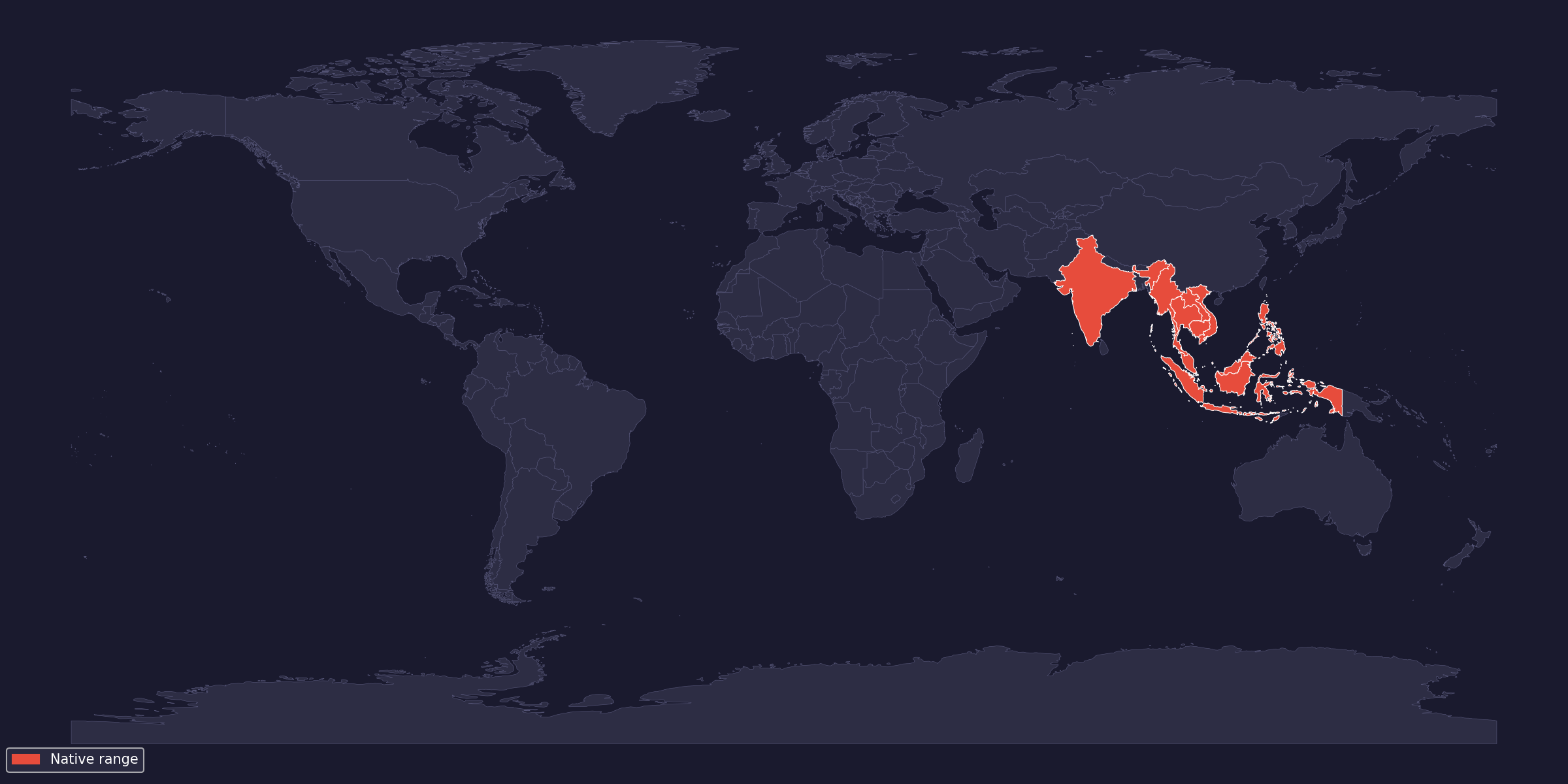
The species occurs from the Andaman Islands and mainland Southeast Asia through Malaysia and Singapore to the Greater Sunda Islands and the Philippines. Records include Myanmar, Thailand, Cambodia, Laos, Vietnam, Indonesia and the Philippines. It is primarily associated with lowland forest, riverine vegetation, mangroves and wooded agricultural edges.
🌡 Climate across the native range
Monthly climate normals from reviewed GBIF occurrence locations:
Khao Sok National Park — Surat Thani — Thailand
| Month | Min °C | Mean °C | Max °C | RH % |
|---|---|---|---|---|
| January | 20 | 25.1 | 30.3 | 75 |
| February | 20.2 | 25.8 | 31.4 | 73 |
| March | 21 | 26.5 | 32.1 | 73 |
| April | 22 | 27.1 | 32.2 | 77 |
| May | 22.3 | 26.7 | 31 | 82 |
| June | 22.4 | 26.2 | 30 | 84 |
| July | 22 | 25.9 | 29.7 | 85 |
| August | 22.1 | 25.8 | 29.5 | 85 |
| September | 21.7 | 25.5 | 29.3 | 86 |
| October | 21.4 | 25.2 | 29.1 | 86 |
| November | 21.2 | 25.1 | 29.1 | 83 |
| December | 20.5 | 24.9 | 29.2 | 78 |
Sarawak — Malaysia
| Month | Min °C | Mean °C | Max °C | RH % |
|---|---|---|---|---|
| January | 22.8 | 26.1 | 29.4 | 82 |
| February | 22.9 | 26.2 | 29.6 | 81 |
| March | 23 | 26.7 | 30.5 | 78 |
| April | 23.3 | 27.2 | 31.2 | 78 |
| May | 23.4 | 27.4 | 31.4 | 79 |
| June | 23.1 | 27.1 | 31.2 | 74 |
| July | 22.7 | 26.8 | 31 | 76 |
| August | 22.8 | 26.9 | 31.1 | 79 |
| September | 22.7 | 26.8 | 30.9 | 77 |
| October | 22.6 | 26.6 | 30.5 | 80 |
| November | 22.7 | 26.5 | 30.3 | 82 |
| December | 22.7 | 26.4 | 30 | 81 |
Riau — Sumatra — Indonesia
| Month | Min °C | Mean °C | Max °C | RH % |
|---|---|---|---|---|
| January | 22.3 | 25.8 | 29.3 | 86 |
| February | 22.5 | 26.3 | 30.2 | 85 |
| March | 22.7 | 26.7 | 30.7 | 86 |
| April | 22.9 | 26.9 | 30.9 | 88 |
| May | 23.2 | 27.2 | 31.2 | 87 |
| June | 23 | 27 | 31.1 | 86 |
| July | 22.7 | 26.6 | 30.6 | 86 |
| August | 22.5 | 26.5 | 30.6 | 86 |
| September | 22.6 | 26.5 | 30.5 | 86 |
| October | 22.7 | 26.6 | 30.5 | 86 |
| November | 22.6 | 26.2 | 29.9 | 87 |
| December | 22.5 | 26 | 29.4 | 87 |
Weather data by WorldClim v2.1 · Monthly normals queried by Herpeton Academy from raster values; relative humidity is derived from vapor pressure and mean temperature.
Location references use GBIF.org occurrence data where available; original occurrence records retain their source dataset licenses.
⚖️ Legal status
No listing for G. oxycephalum was found in the current CITES Appendices or EU wildlife-trade annexes, and the Bern Convention is not applicable. Range-state wildlife, export and protected-area laws can still prohibit collection or require permits. Local and national keeping, import and transport rules may also apply.
The trade has historically included wild-caught snakes. Prefer verifiably captive-bred stock, retain the invoice and breeder details, and check import and transport rules before purchase. Lack of a CITES listing is not proof of legal export.
🤌 Husbandry
Provide one adult with at least 150 × 75 × 150 cm, increasing size for a 2 m-plus female. Use a lock, sealed service holes and strong branches. Dense visual cover is essential at ground, middle and canopy levels.
Handling should be limited to necessary care. Work in a closed room and use a removable perch or snake hook to guide the animal. Quarantine for at least 90 days; imported stock needs an exotics-veterinary examination, repeated faecal testing where indicated, hydration review and careful respiratory observation. Keep tools and drainage separate from the established collection.
💡 Lighting
Use an 11-13 hour day with bright full-spectrum visible light over planted areas. Low-level UVB is recommended, with a shaded UVI gradient around 0-1.5 and abundant retreats. Position lamps outside or behind guards because this strong climber will coil around reachable equipment.
🌡 Heating and temperature
Aim for 24-28 °C by day, a broad 29-30 °C basking branch, a 23-25 °C cool retreat and nights around 23-25 °C. The forest canopy is cooler than exposed tropical weather; prolonged air temperatures above 30 °C are unsafe.
Use a thermostat and multiple probes at different heights. Warm, stagnant air is not an acceptable way to raise humidity. Do not apply temperate brumation.
💧 Humidity and water
Maintain a ventilated daily cycle around 65-85%, rising after evening misting and drying modestly by day. Offer humid hides with clean damp sphagnum at more than one height. Constantly saturated substrate, condensation without airflow and dry heated air are all problematic.
Supply a large stable water bowl and droplets on clean leaves after misting. Replace water daily. Dehydration, incomplete sheds and respiratory signs should prompt a full review rather than ever-wetter housing.
🌿 Enclosure and decoration
Build a network of thick horizontal and diagonal branches, cork tubes, elevated shelves and dense foliage. Provide snug hides on the floor and high in the enclosure; some females choose elevated nest sites. All supports must be fixed against the weight and speed of an adult.
For established captive-bred snakes, use 5-8 cm of clean soil/coir and bark with leaf litter, kept only lightly moist. Paper is safer for quarantine. Avoid dusty aspen, aromatic wood and continuously wet bark. A ventilated moss box supplies local moisture without turning the entire floor into a swamp.
🐁 Feeding
Adults usually accept frozen-thawed mice or small rats every 10-14 days; juveniles are offered appropriately sized prey weekly. Birds are natural prey and occasional captive-bred quail can provide variety. A meal near the snake’s widest body section is sufficient; very large meals increase regurgitation risk.
Newly hatched or imported animals may refuse rodents. Reduce disturbance, verify hydration and temperatures, and offer food near a secure elevated hide. Do not repeatedly provoke-feed or force-feed without veterinary direction, and never use wild birds or lizards.
🩺 Common problems
- wheezing, excess mucus or open-mouth breathing: respiratory disease, often linked with stress or poor ventilation
- incomplete shed and sunken eyes: dehydration or inadequate humid retreats
- blisters or discoloured ventral scales: wet contaminated substrate
- persistent refusal with weight loss: import stress, parasites, infection or unsuitable security
- regurgitation: oversized meal, excessive heat, handling or systemic disease
- nose injury: repeated collision with exposed glass or an insecure setup
- egg loss: overheated, over-wet or poorly monitored incubation
📌 Conclusion
The red-tailed green ratsnake is appropriate only when a tall, densely covered enclosure and a strict quarantine plan are ready before purchase. Captive-bred origin, moderate temperatures and moving humid air are more important than chasing a single high humidity number.
📚 Sources and further reading
- ReptiFiles was checked; no species-specific G. oxycephalum guide was available on 30 August 2026.
- The Reptile Database: Gonyosoma oxycephalum
- GBIF species record
- British Herpetological Society: captive breeding and incubation
- Specialist husbandry: housing, temperatures and feeding
- Baines et al. 2016: UV lighting for reptiles
- CITES Appendices, current EU wildlife-trade framework, and Bern Convention appendices