Share

Eunectes murinus Care Guide
🔤 Taxonomy
Eunectes murinus is the green anaconda. Keep records carefully because anacondas are large boids, legally sensitive, and sometimes confused in trade with other Eunectes species.
English common names used in the hobby:
- Green anaconda
- Common anaconda
Older names and trade labels to know:
- Boa murina
📌 Description
The green anaconda (Eunectes murinus) is an extreme specialist, not a normal private-collection snake. Its size, strength, water needs, feeding risk, and legal restrictions make it suitable only for institutions or highly equipped expert keepers.
🌍 Distribution
Northern and central South America, especially Amazon and Orinoco drainage wetlands, seasonally flooded forest, marshes, swamps, and slow water systems.
Captive relevance is stark: this is not a large display python with a water bowl. It needs a structurally engineered room-sized enclosure, a warm filtered pool, safe draining, and a two-person or institutional handling protocol.
Range information should be used as a care clue, not copied into unstable enclosure weather. The useful question is how the animal finds shelter, warmth, water, and seasonal security.
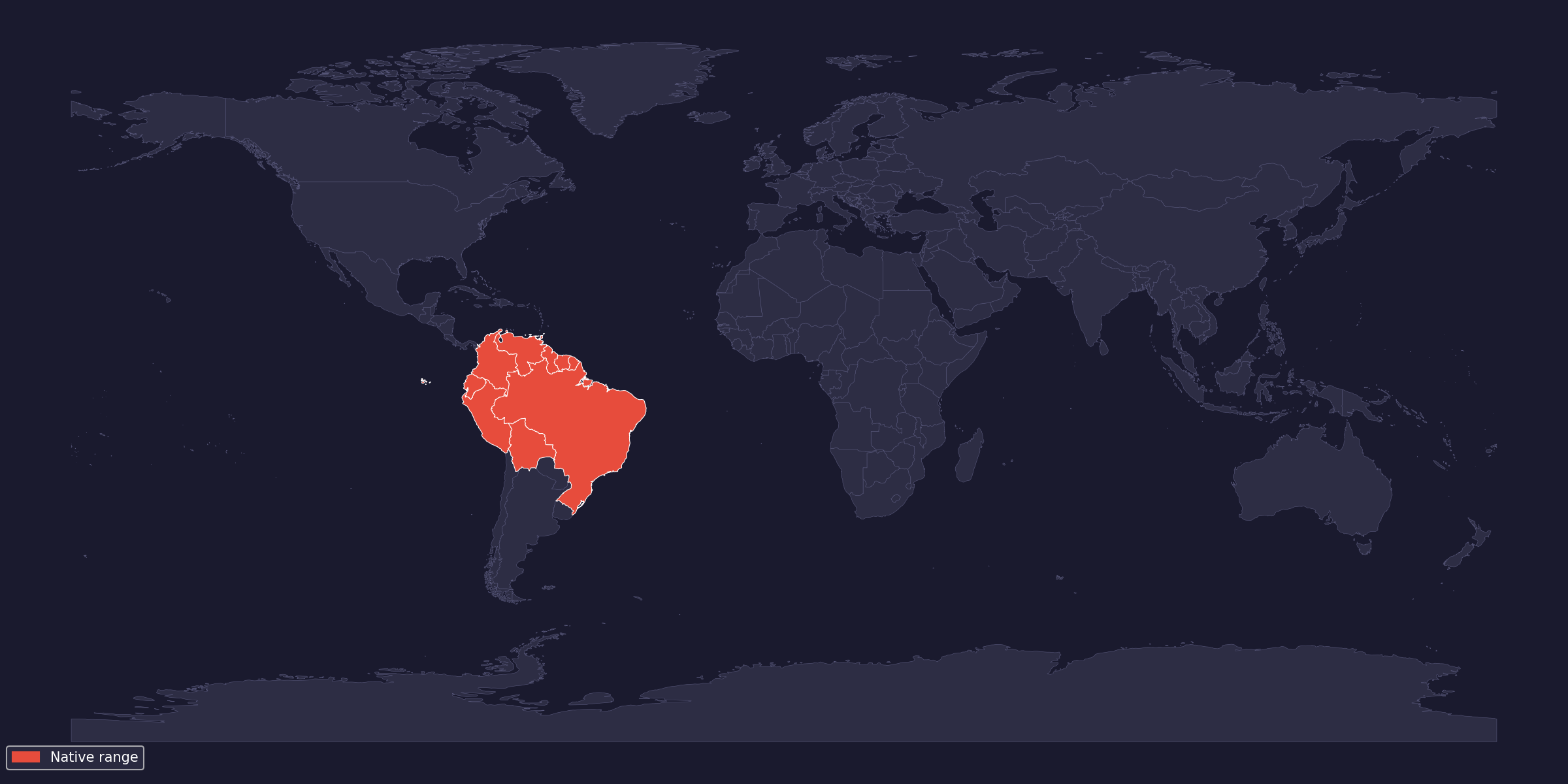
🌡 Climate across the native range
Monthly climate normals from reviewed GBIF occurrence locations:
Casanare — Colombia
| Month | Min °C | Mean °C | Max °C | RH % |
|---|---|---|---|---|
| January | 21.2 | 27.1 | 33 | 67 |
| February | 21.7 | 27.9 | 34.1 | 64 |
| March | 22.3 | 28.2 | 34 | 65 |
| April | 22.2 | 27.2 | 32.2 | 74 |
| May | 22 | 26.3 | 30.6 | 81 |
| June | 21.6 | 25.4 | 29.3 | 84 |
| July | 21.2 | 25.3 | 29.3 | 83 |
| August | 21.3 | 25.8 | 30.2 | 82 |
| September | 21.4 | 26.1 | 30.8 | 81 |
| October | 21.8 | 26.5 | 31.3 | 79 |
| November | 21.9 | 26.7 | 31.5 | 79 |
| December | 21.5 | 26.7 | 31.8 | 74 |
Amazonas — Brazil
| Month | Min °C | Mean °C | Max °C | RH % |
|---|---|---|---|---|
| January | 22.9 | 26.6 | 30.4 | 85 |
| February | 22.8 | 26.7 | 30.5 | 84 |
| March | 22.9 | 26.7 | 30.5 | 84 |
| April | 23.2 | 26.7 | 30.1 | 85 |
| May | 22.6 | 26.4 | 30.2 | 85 |
| June | 22 | 25.9 | 29.8 | 85 |
| July | 21.3 | 25.7 | 30.2 | 83 |
| August | 21.7 | 26.4 | 31.1 | 81 |
| September | 22.3 | 26.8 | 31.4 | 80 |
| October | 22.7 | 27.1 | 31.5 | 81 |
| November | 23 | 27.1 | 31.2 | 82 |
| December | 22.9 | 26.8 | 30.7 | 84 |
Loreto — Peru
| Month | Min °C | Mean °C | Max °C | RH % |
|---|---|---|---|---|
| January | 23.1 | 26.7 | 30.3 | 85 |
| February | 23 | 26.7 | 30.5 | 84 |
| March | 23.1 | 26.8 | 30.4 | 84 |
| April | 23.5 | 26.8 | 30.1 | 84 |
| May | 22.9 | 26.5 | 30.1 | 84 |
| June | 22.3 | 26 | 29.8 | 84 |
| July | 21.7 | 25.9 | 30.2 | 82 |
| August | 22.1 | 26.6 | 31.2 | 80 |
| September | 22.6 | 27 | 31.4 | 80 |
| October | 23 | 27.2 | 31.5 | 81 |
| November | 23.3 | 27.2 | 31.2 | 82 |
| December | 23 | 26.9 | 30.7 | 84 |
Weather data by WorldClim v2.1 · Monthly normals queried by Herpeton Academy from raster values; relative humidity is derived from vapor pressure and mean temperature.
Location references use GBIF.org occurrence data where available; original occurrence records retain their source dataset licenses.
⚖️ Legal status
As checked against current official sources in April 2026, Eunectes murinus is covered by CITES Appendix II through the Boidae higher-taxon listing. Under EU wildlife-trade rules, Appendix II snakes are normally treated as Annex B unless a stricter listing applies. The species is not relevant to the Bern Convention because it is not native to Europe. Local rules on ownership, import, sale, transport, breeding, dangerous-animal registration, and proof of legal origin may still apply; keep purchase and breeding records.
🧭 Life stage differences
Hatchlings should start in smaller secure enclosures such as 90 x 45 x 45 cm for neonates, upgraded quickly as growth and strength increase. Smaller starter housing makes feeding, shedding, hydration, and waste easier to monitor. Adults need the full planned enclosure, stronger locks or lids, and more stable environmental zones. Do not buy a young animal unless the adult housing, food supply, and legal responsibilities are already realistic.
Green anacondas should be treated as facility animals, not large beginner boas. A workable enclosure needs waterproof construction, safe drains, heat-protected electrics, a warm pool, a dry haul-out area, and space for the keeper to service it without entering a trap.
Juveniles grow into a completely different management problem. A small anaconda may fit a standard enclosure for a short time, but the adult female plan must exist before purchase, including help for moving, cleaning, veterinary transport, and emergency restraint.
Feeding and cleaning are safety-critical. Use a second competent adult for large animals, never feed by hand, remove shed and waste promptly from the water system, and design the pool so it can be drained without wrestling the snake.
🤌 Husbandry
House one animal per enclosure. A practical adult enclosure is 300 x 180 x 120 cm is only a starting point for a manageable adult; large females require room-sized custom housing with a pool. Larger is useful when it creates more usable movement, better gradients, and safer maintenance. Use secure ventilation, stable furnishings, and a written log for feeding, sheds, weight changes, and behaviour. Quarantine new animals and avoid mixing species or uncertain locality lines.
💡 Lighting
Use a predictable light cycle for inspection and routine. UVB is optional; if used, keep fixtures protected and provide shaded water and dry retreats. Do not use visible night lights. Avoid lamps that dry small enclosures or overheat retreats.
🌡 Heating and temperature
Practical target range: basking 31-33 °C, ambient 26-29 °C, water 25-28 °C, night 24-26 °C. Measure with digital probes and, for basking or warm surfaces, an infrared thermometer. All heat sources must be controlled by thermostats or suitable dimming controllers and guarded so the snake cannot burn itself.
💧 Humidity and water
Target humidity and water: 70-90% with strong ventilation, warm clean water, and dry haul-out areas. Fresh water should always be available in a stable dish appropriate to the animal’s size. Avoid stagnant wet air. Chronic dryness causes bad sheds or dehydration; chronic wet substrate causes skin, scale, mold, or respiratory problems depending on the animal.
🌿 Enclosure and decoration
Provide a warm retreat, cooler retreat, water, safe rough surfaces for shedding, and enough cover that the snake can move without feeling exposed. Juvenile setups should be simple enough to inspect but not bare. Adult enclosures must be built for strength, stable furniture, secure doors or lids, and safe cleaning access. All cable ports, sliding doors, lid corners, and ventilation gaps must be escape-proof. Heavy furnishings should be stable and unable to shift onto the snake.
🪳 Feeding
Feed appropriately sized frozen-thawed rodents, rabbits, poultry, or other whole prey under a strict safety plan. Size meals to the animal, not to appetite alone. Hatchlings eat smaller meals more often; adults usually eat less often and should be kept in lean, muscular condition. Offer appropriately sized prey, remove uneaten prey promptly, and avoid handling snakes for at least 48 hours after meals.
🥚 Breeding
Breeding should be left to advanced, legally compliant facilities. The species is live-bearing, produces many large young, and creates serious placement, record, and safety obligations. Breeding should use healthy mature animals with known identity and lawful origin. Keep dates, pairings, offspring numbers, and transfer records, and do not produce more young than can be housed and placed responsibly.
🩺 Common problems
Common problems include dehydration, retained shed, burns or overheating, mites or parasites, injuries from escapes or unstable furnishings, refusal to feed with weight loss, and stress from exposure or poor security. Warning signs include wheezing, bubbles at the nostrils, open-mouth breathing, repeated regurgitation, retained shed, swelling, twisting posture, sudden lethargy, or repeated escape attempts. Consult a reptile- or exotic-animal veterinarian for severe weakness, injury, breathing signs, swelling, repeated regurgitation, retained shed, or prolonged refusal to feed.
📌 Conclusion
Eunectes murinus does best when the keeper plans for the adult animal and not only the attractive juvenile. Secure housing, measured conditions, appropriate feeding, and honest records are the foundation of responsible care.
📚 Sources and further reading
- CITES Appendices, checked 2026-05-04
- ReptiFiles species search and related snake husbandry references, checked April 2026
- GBIF species backbone entry for taxonomy and distribution context
- EU wildlife-trade references, checked April 2026
💬 Feedback
For questions, corrections, or practical notes, leave us a message in the forum thread.