Share

West African Saw-scaled Viper
🔤 Taxonomy
Echis ocellatus is the accepted West African saw-scaled or carpet viper. The historical combination Echis carinatus ocellatus reflects an older broad treatment; it is not a West African subspecies of the Asian E. carinatus under current taxonomy. Molecular work places E. ocellatus as a distinct lineage within Echis.
Records once assigned to E. ocellatus in Cameroon, Chad and the Central African Republic are now placed in Echis romani. E. leucogaster, E. jogeri and other African carpet vipers are also separate. Retain a verified locality, photographs and parentage because an old trade name or generic “carpet viper” label is inadequate for legal and medical planning.
📌 Description
This is a compact, strongly keeled viper, usually 40-70 cm. It can remain nearly invisible in leaf litter, then sidewind or strike rapidly. When threatened, opposing scale rows may produce a rasping warning; that sound is not a safe distance indicator.
Envenomation can cause painful swelling and local tissue injury together with venom-induced consumption coagulopathy, spontaneous bleeding, shock and secondary kidney injury. Size does not predict consequence. This is an expert-only institutional species for protected contact, never routine handling.
📋 Quick reference
| Care point | Practical target |
|---|---|
| Adult size and lifespan | Usually 40-70 cm; approximately 10-15 years |
| Adult enclosure | At least 100 x 50 x 50 cm with two lockable shift hides |
| Temperature | Ambient 25-29°C; basking 31-34°C; cool hide 23-25°C |
| Night | 20-24°C |
| Humidity | 35-60%; local 55-70% support during shedding |
| Feeding | Appropriately sized frozen-thawed prey every 7-14 days |
| Safety | Protected contact, two-person rule, non-constricting bite plan and escape plan |
| Quarantine | At least 90 days with dedicated tools and veterinary screening |
☠️ Venom
This species is venomous. Venom exposure can cause pain, swelling or other systemic effects, and severity varies with species, locality, bite site and the amount delivered. A small wound or apparently dry bite is not proof of safety; every bite or sting requires urgent medical assessment.
If an incident occurs, move away, call emergency services or a poison centre, keep the patient still, remove rings and other constricting items, and follow dispatcher instructions. Do not use a tourniquet, cut or suck the wound, apply ice or electricity, give alcohol or medicines as a home treatment, or attempt to catch the animal. Antivenom choice and dosing are hospital decisions; verify the relevant product and local availability in advance. Sources: WHO snakebite guidance and appropriate species-specific toxinology or medical references listed below.
🌍 Distribution
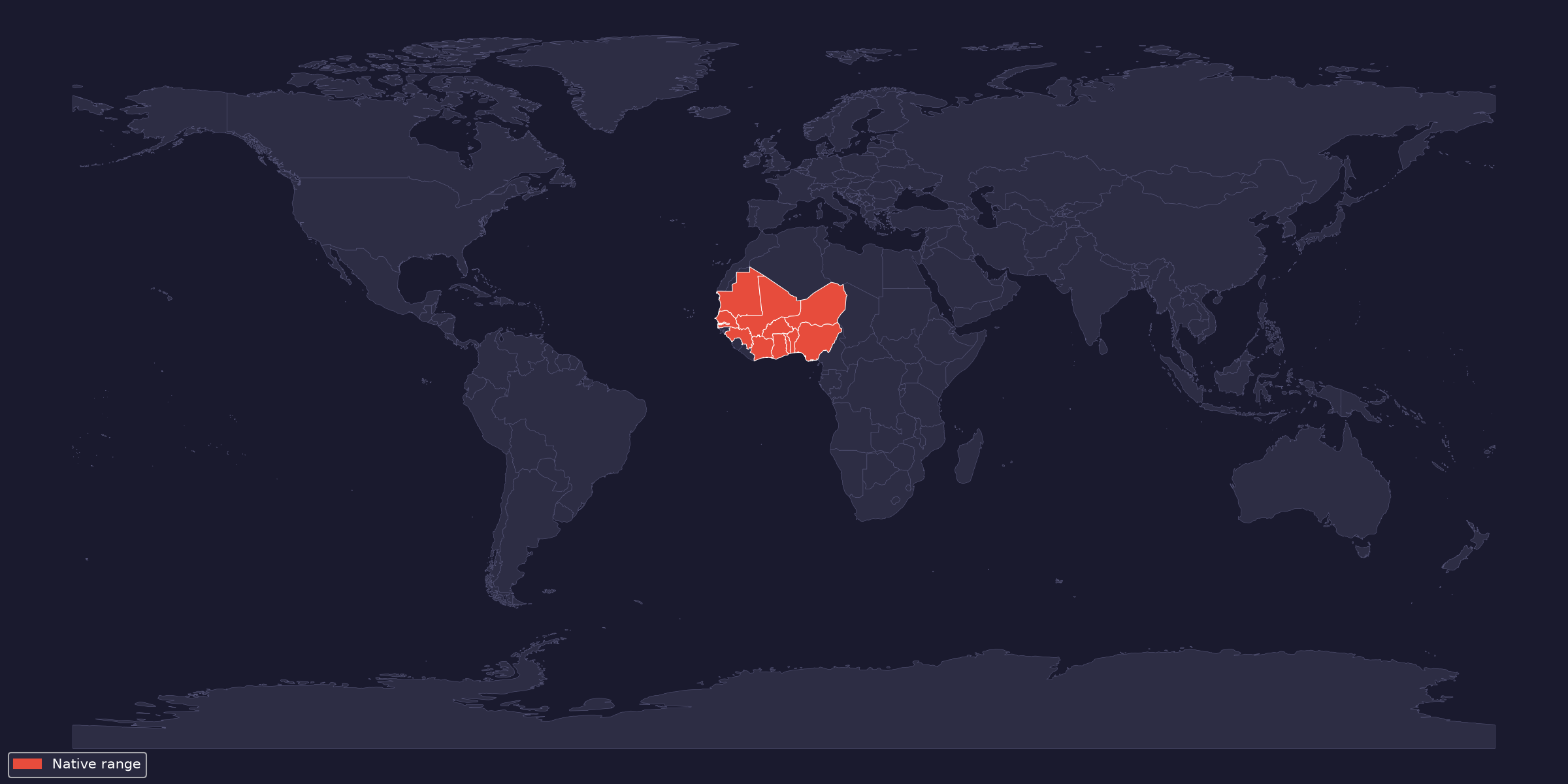
The strict current range covers the West African savanna belt in Mauritania, Senegal, The Gambia, Guinea, Mali, Burkina Faso, Côte d’Ivoire, Ghana, Togo, Benin, Niger and Nigeria. It uses seasonally dry savanna, open woodland, rocky or cultivated mosaics and rodent-rich settlement edges. It is not the Asian E. carinatus, and reports east of Nigeria need reassessment against E. romani and other Echis.
The whole-country map necessarily overstates occupation. It cannot show the savanna corridors and unsuitable forest or desert gaps inside each country, the southern forest limit, sparse northern records, or the revised E. romani boundary. Do not use the map alone to identify a specimen or choose antivenom.
The reviewed Atakora occurrence represents one northern Benin savanna locality. Its sharp dry season and humid rains demonstrate why an annual cycle matters, but they do not describe every coastal, Sahelian or western locality.
🌡 Climate across the native range
Monthly normals from a reviewed northern Benin occurrence in the West African savanna:
Atakora — Benin (reviewed northern savanna occurrence)
| Month | Min °C | Mean °C | Max °C | RH % |
|---|---|---|---|---|
| January | 19.8 | 25.9 | 33.4 | 23 |
| February | 21.3 | 27.8 | 35.3 | 25 |
| March | 23.0 | 29.3 | 36.3 | 41 |
| April | 24.0 | 28.7 | 34.9 | 64 |
| May | 23.5 | 27.2 | 32.4 | 77 |
| June | 22.3 | 25.6 | 30.1 | 82 |
| July | 21.4 | 24.1 | 28.0 | 87 |
| August | 21.0 | 23.5 | 27.3 | 89 |
| September | 21.0 | 24.1 | 28.6 | 89 |
| October | 21.2 | 25.1 | 30.6 | 82 |
| November | 20.2 | 26.1 | 32.8 | 52 |
| December | 19.9 | 25.9 | 33.2 | 29 |
Weather data by Open-Meteo.com · CC BY 4.0 · Monthly normals calculated by Herpeton Academy from daily archive values for 1991-2020.
Location references use GBIF.org occurrence data where available; original occurrence records retain their source dataset licenses.
⚖️ Legal status
As checked on 17 August 2026, Echis ocellatus is not listed in the CITES Appendices or EU wildlife-trade annexes. The Bern Convention is not relevant to its West African range. Absence from those lists is not permission to keep, collect or move the species.
National and local laws may regulate or prohibit collection, possession, registration, transport, breeding, sale and import of native wildlife or medically significant snakes. Export and veterinary-health documents may also apply. Obtain written confirmation from every competent origin, transit and destination authority; retain permits, lawful-origin evidence, invoices, locality and parentage records, photographs and the check date.
🤌 Husbandry
House one snake in a controlled-access venomous room with secondary containment, sealed service penetrations and a written door protocol. The enclosure needs two positively lockable shift hides so the animal can be confirmed and secured before any primary door opens. Its small size and camouflage demand especially narrow tolerances at vents, tracks and tool ports.
Quarantine for at least 90 days with paper, simple removable furniture, dedicated tools and preferably separate airspace. Record weight, meals, sheds, faeces, mouth, skin and respiration; screen imports for dehydration, parasites, mites, stomatitis and respiratory disease.
Never cohabit for display. Sidewinding movement, a rapid strike and concealment beneath shallow cover make a physical protected-contact system more reliable than any judgement about temperament.
💡 Lighting
Provide 10-12 hours of bright visible light and complete darkness. Shade both shift hides and break sight lines with low anchored cover. Put lamps outside primary containment or behind locked mesh guards.
Low-output UVB may be offered as a Ferguson Zone 1 opportunity. Measure at snake level and preserve a fully shaded route. Whole prey provides the diet; UVB does not compensate for poor feeding or inaccessible shade.
🌡 Heating and temperature
Maintain ambient air at 25-29°C, a basking surface at 31-34°C, a cool hide at 23-25°C and nights around 20-24°C. Thermostat and guard every source, measure air and surfaces independently and alarm high temperatures. Field maxima do not justify exposing a captive snake to an entire enclosure above its preferred range.
Provide a real gradient and allow a modest seasonal change in photoperiod, night temperature and humidity according to documented provenance. The Atakora record has hot dry months and cooler humid rains; do not translate that into prolonged cold brumation or a uniformly hot, arid box.
💧 Humidity and water
Maintain a dry surface and strong cross-ventilation. A practical ambient range is 35-60%, allowing seasonal rises without keeping the floor wet; one shift hide may reach 55-70% during shedding. The climate table shows high rainy-season outdoor humidity, but air exchange and dry refuges remain essential.
Provide a shallow, stable bowl of clean water through a protected port. Track weight, urates, drinking and shed quality. Correct dehydration with measured environmental and veterinary assessment, not routine spraying of the snake or permanent saturation.
🌿 Enclosure and decoration
An adult needs at least 100 x 50 x 50 cm, with more floor space preferred. Install two lockable shift hides, low anchored cork, visual barriers and an unobstructed inspection lane. Every track, cable port and vent must exclude a slender neonate as well as an adult.
Use 5-8 cm of compactable mineral soil with limited leaf litter and a dry top. Paper is safer in quarantine. Avoid deep loose sand, unstable rock, aromatic wood, wet mulch and décor that must be lifted. Use two-step mechanical locks, an internal service barrier and a visible venom warning.
🐁 Feeding
Wild prey includes small mammals, lizards, amphibians and arthropods, with diet changing by age and locality. Established adults can take appropriately sized frozen-thawed mice every 7-14 days, adjusted by weight and condition. Juveniles may need very small, scent-assisted whole prey under a documented institutional protocol.
Feed with long tongs through a protected port and shift before recovering refused prey. Do not use live rodents; their injury risk and retrieval hazard are avoidable. Balanced whole vertebrate prey needs no routine calcium or vitamin powder.
🛡 Operational safety and emergencies
Never free-handle, pin, neck or manually restrain this snake in routine work. Use lockable shift boxes, species-appropriate hooks, transparent shields and protected ports. Two trained adults attend every primary opening. Veterinary procedures require a preplanned professional anaesthetic and containment team.
Before acquisition, consult the receiving hospital or poison centre using the exact species and West African origin. Clinical evidence shows that antivenom effectiveness is product- and region-specific; a product for E. carinatus, another African Echis or an unspecified “viper” must not be assumed suitable. Antivenom belongs in hospital protocols, never private administration.
A bite is an immediate emergency with potential bleeding and tissue injury. Move away, call emergency services, remove rings and other constricting items, keep the patient still and the limb in a neutral supported position, and follow poison-centre instructions. Do not apply a tourniquet or tight pressure bandage, cut, suck, ice, shock or massage the site. Do not delay transport to capture the snake.
Maintain a written escape plan covering room isolation, public exclusion, accountability, search zones, secure containers and named decision-makers. Stop work whenever the snake cannot be positively located.
🥚 Breeding notes
E. ocellatus is oviparous. Captive reports describe variable clutches, commonly several to a few dozen eggs; 6-25 is a conservative planning range. Published specialist husbandry describes successful breeding and rearing, but provenance and full facility records must guide any cycle.
For artificial incubation, 28-30°C and roughly 30-50 days are cautious planning values rather than universal constants. Incubate only intact, correctly oriented eggs in a monitored medium that is humid but not wet; validate the protocol against the complete breeding source and the laying history.
Confirm sex, lawful breeding authority and placements first. Prepare individually lockable, neonate-proof enclosures and complete parentage, medical and escape records before pairing. Hatchlings are tiny, fully venomous and exceptionally easy to lose through a service gap.
🩺 Common problems
- Obesity: use small measured prey, condition scoring and regular weighing.
- Dehydration or retained shed: review water access, the humid retreat, ventilation, temperatures and illness.
- Respiratory disease: wheezing, bubbles, open-mouth breathing or head elevation need urgent veterinary care.
- Dermatitis: investigate wet dirty substrate, poor airflow, mites and abrasion.
- Parasites and stomatitis: weight loss, abnormal faeces or oral swelling are especially concerning in imports.
- Burns and overheating: prevent with guarded thermostatic heat, alarms and a genuine cool hide.
- Regurgitation: review prey size, temperature, disturbance, infection and parasites with a veterinarian.
Do not attempt hands-on home treatment. Secure the animal in a shift compartment and arrange examination by an experienced reptile veterinarian.
📌 Conclusion
Echis ocellatus belongs only in a licensed institution able to separate it taxonomically from E. carinatus, E. romani and other Echis, reproduce its seasonal savanna choices, work entirely through locked barriers and maintain a regionally valid hospital plan. Small size never reduces the required containment or medical preparation.
📚 Sources and further reading
- ReptiFiles — checked first on 17 August 2026; no species-specific care guide was found.
- The Reptile Database: Echis ocellatus
- GBIF species record: Echis ocellatus
- Pook et al. — phylogeny and systematics of Echis
- Trape — partition of E. ocellatus and description of E. romani
- Gimmel — captive care, husbandry and breeding of E. ocellatus
- WHO Africa: Guidelines for prevention and clinical management of snakebite
- Abubakar et al. — controlled trial of two antivenoms for E. ocellatus envenoming
- Visser et al. — failure of a non-specific antivenom in Ghana
- Baines et al. — UV lighting guidance
- Northern Ireland government venomous-reptile guidance
- CITES Appendices
- EU wildlife-trade annexes, Commission Regulation (EU) 2026/1383
- Bern Convention appendices