Share

Painted Saw-scaled Viper
🔤 Taxonomy
Echis coloratus is the accepted name for the painted saw-scaled viper. The older spelling Echis colorata and the forgotten combination Echis froenata occur in historical literature. Animals from the UAE and northern Oman formerly assigned here are now generally treated as E. omanensis, so precise locality records matter.
📌 Description
This is a compact, highly venomous desert viper, usually 50-80 cm and occasionally larger. It moves quickly, can launch repeated strikes, and produces the rasping warning sound typical of Echis by rubbing its strongly keeled lateral scales together. Stillness must never be read as tolerance.
Envenomation can cause serious local injury, bleeding and systemic coagulopathy. The species is suitable only for licensed institutions or keepers with supervised venomous-snake training, purpose-built containment and a hospital-coordinated bite plan. Plan for 12-18 years of care.
| Quick reference | Practical target |
|---|---|
| Adult size | Usually 50-80 cm; allow for about 90 cm |
| Adult enclosure | At least 90 x 45 x 45 cm with a lockable shift compartment |
| Temperature | Air 24-29°C; warm surface 31-33°C; cool retreat 21-24°C |
| Night | 19-23°C; optional locality-based winter reduction only for healthy adults |
| Humidity | 30-50%; humid hide 50-65% around shedding |
| Feeding | Modest whole vertebrate prey every 10-21 days according to condition |
| Safety | Double containment, protected contact, written bite and escape plans |
☠️ Venom
This species is venomous. Venom exposure can cause pain, swelling or other systemic effects, and severity varies with species, locality, bite site and the amount delivered. A small wound or apparently dry bite is not proof of safety; every bite or sting requires urgent medical assessment.
If an incident occurs, move away, call emergency services or a poison centre, keep the patient still, remove rings and other constricting items, and follow dispatcher instructions. Do not use a tourniquet, cut or suck the wound, apply ice or electricity, give alcohol or medicines as a home treatment, or attempt to catch the animal. Antivenom choice and dosing are hospital decisions; verify the relevant product and local availability in advance. Sources: WHO snakebite guidance and appropriate species-specific toxinology or medical references listed below.
🌍 Distribution
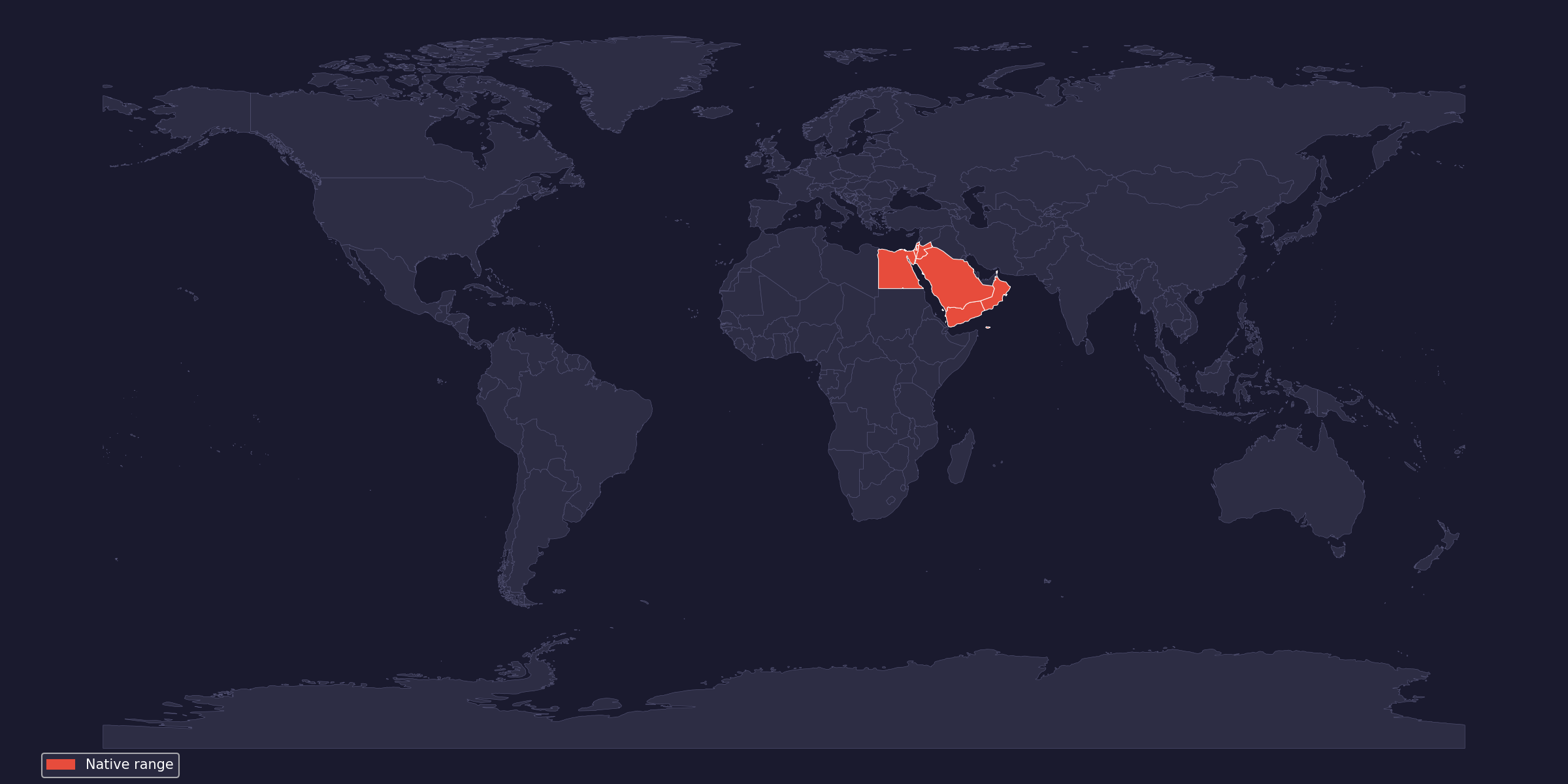
The conservative range includes eastern Egypt and Sinai, Israel and Palestine, Jordan, western and north-western Saudi Arabia, Yemen and southern Oman. It occupies rocky wadis, dry mountain slopes, gravel plains, oasis margins and irrigated sites rather than being a specialist of loose dune sand.
That distinction matters in a terrarium: provide firm, broken ground, narrow cover and a dry surface, not a deep featureless sand box. Native-country shading is only a broad overview and does not imply that every part of each country is occupied.
⚖️ Legal status
Checked on 29 August 2026: Echis coloratus is not listed in the current CITES Appendices or in Annexes A-D of Commission Regulation (EU) 2026/1383. The Bern Convention is not the relevant regional instrument for this Middle Eastern and north-east African range.
Trade status does not authorize possession. National and local dangerous-animal rules may prohibit private keeping or require permits, inspected premises, insurance, transport approval and emergency arrangements. Verify every jurisdiction in writing before acquisition or movement and retain the invoice, breeder or importer identity, legal-origin documents, locality, photographs and transfer record.
🤌 Husbandry
House one snake per enclosure in a restricted, locked and escape-resistant room that acts as the second barrier. The primary enclosure needs independent mechanical locks, protected vents and cable routes, and a lockable shift hide operated without putting hands into the occupied compartment. Identify and count the animal before and after every task.
Quarantine new arrivals for at least 90 days in simple housing with separate tools. Record weight, meals, sheds, faeces and respiration, and arrange parasite testing and examination by a veterinarian experienced with venomous reptiles. Wild-caught imports often arrive dehydrated or parasitized; apparent activity is not proof of health.
💡 Lighting
Provide 10-12 hours of broad visible light and complete darkness at night. A measured low-level UVB area in Ferguson Zone 1 may be offered with full shade, although whole-prey snakes are not known to require it. Guard or externally mount every lamp.
Seasonal changes should follow documented provenance, not a generic desert calendar. Never combine intense light with an enclosure that offers no shaded retreat.
🌡 Heating and temperature
Maintain general air at 24-29°C, a small warm surface at 31-33°C and a cool hide at 21-24°C. Nights may fall to 19-23°C. Control every heater with a thermostat and measure air and substrate independently; a floor that looks harmless can become dangerously hot.
A mild winter reduction to roughly 15-18°C is relevant only to a planned breeding cycle for healthy, established adults from an appropriate locality. Do not cool juveniles, thin, sick, gravid or newly imported snakes. Hot rocks and exposed lamps are unacceptable.
💧 Humidity and water
Keep most of the enclosure dry and well ventilated at about 30-50% RH. Offer one snug humid retreat at roughly 50-65% during shedding rather than wetting the whole cage. Persistent dampness predisposes the skin and respiratory tract to disease; extremely dry air without drinking water promotes dehydration and retained shed.
Provide a small, stable bowl of clean water at all times. Position it where it can be removed only after the snake is secured in the shift compartment.
🌿 Enclosure and decoration
For one adult, use at least 90 x 45 x 45 cm. Lay 6-10 cm of compactable mineral soil mixed with washed sand and fine clay, with flat stones, cork and two tight hides. Anchor all rockwork to the enclosure base before adding substrate. Include both an open warm route and a cooler broken-rock retreat.
Avoid calcium sand, dusty powder, sharp gravel, unstable rock piles and décor that prevents a full visual count. Use paper during quarantine. Every service port must exclude a neonate, and the label should show scientific name, individual identity, venom hazard, number of animals and emergency contacts.
🐁 Feeding
Wild diets include small mammals, lizards, frogs and occasionally arthropods. An established adult can be maintained on appropriately sized frozen-thawed rodents offered every 10-21 days, adjusted by weight and body condition. Juveniles may require smaller varied vertebrate prey under an experienced breeding programme.
Use long tongs only after the snake is in a predictable position; never hand-feed or leave live rodents unattended. Routine dusting is unnecessary with balanced whole prey. Overfeeding shortens the useful thermal gradient because an obese snake becomes less mobile and is harder to shift safely.
🛡 Operational safety and emergencies
Routine care must use protected contact; free handling has no place. Non-routine opening of primary containment requires a second trained adult, appropriate barriers and a written door sequence. Clinical restraint and chemical immobilization belong to a veterinarian and an agreed professional team.
Before acquisition, confirm an emergency number, receiving hospital, transport route and current species/venom information sheet. Do not assume that appropriate antivenom is locally stocked and never store or administer it privately as a substitute for hospital care.
A bite is an immediate emergency even before symptoms appear. Call emergency services, keep the patient still, remove rings and constricting items, immobilize the limb and follow the poison centre. Do not cut, suck, ice, shock or tightly tourniquet the bite, and do not delay transport to catch the snake.
🥚 Breeding notes
The species lays eggs; a field study reported an average of 7.6 eggs, with females not necessarily reproducing annually. The metadata range of 4-10 eggs and 27-29°C for approximately 45-60 days is a conservative planning window, not a promise for every locality. Breeding belongs only in a documented legal programme with secure neonate housing ready before pairing.
🩺 Common problems
Repeated retained shed, sunken eyes or hard urates indicate dehydration or an inadequate humid retreat. Wheezing, mucus or open-mouth breathing suggests respiratory disease, often after cold or damp conditions. Blistering and discoloured ventral scales point to wet or contaminated substrate. Regurgitation commonly follows oversized prey, handling, low digestive heat or systemic illness.
Move no sick venomous snake by improvisation. Secure the enclosure, record temperatures and recent events, and coordinate a contact-free examination with an experienced reptile veterinarian.
📌 Conclusion
Echis coloratus suits only a trained, legally authorized team with dry rocky housing, protected servicing and a hospital-ready emergency plan. Its small size reduces neither the speed of a servicing error nor the medical consequences.
📚 Sources and further reading
- The Reptile Database — Echis coloratus
- Mendelssohn (1965), biology of the venomous snakes of Israel
- GBIF species record
- WHO snakebite-envenoming resources
- CITES Appendices
- Commission Regulation (EU) 2026/1383