Share

Saw-scaled Viper
🔤 Taxonomy
Echis carinatus is the accepted species used here. Its limits remain debated: many current databases retain E. c. carinatus and E. c. sochureki, whereas some authors elevate E. sochureki. E. multisquamatus is also treated either as a distinct Central Asian species or as part of E. carinatus; molecular work has supported conspecificity. The names E. c. astolae and E. c. sinhaleyus are generally considered invalid or doubtful.
These are operationally important disagreements. Preserve the exact collection or breeder locality, scale and photographic records, the name used on every permit, and any venom-line information. A label based only on appearance is inadequate for medical consultation or movement paperwork.
📌 Description
The saw-scaled viper is a small, stout Asian viper with strongly keeled lateral scales. When threatened it may form tight coils and rub those scales together to produce a dry rasping sound. It is extremely quick over short distances and can sidewind across loose substrate.
Its small size does not reduce the consequence of a mistake. Envenomation may cause severe coagulopathy, bleeding, shock, kidney injury, and local tissue damage. This is an expert-only display species for a licensed institution with protected contact, redundant containment, and a hospital-coordinated response plan.
📋 Quick reference
| Care point | Practical target |
|---|---|
| Adult size and lifespan | Usually 30-60 cm; approximately 8-15 years |
| Adult enclosure | At least 90 x 45 x 45 cm, with two lockable shift hides |
| Temperature | Ambient 25-29°C; basking 31-34°C; cool retreat 23-25°C |
| Night | 20-24°C |
| Humidity | 30-50%; local 50-65% support during shedding |
| Feeding | Small frozen-thawed rodents every 7-14 days, adjusted to condition |
| Safety | Protected contact, two-person rule, hospital bite plan and escape plan |
| Quarantine | At least 90 days with dedicated equipment and veterinary screening |
☠️ Venom
This species is venomous. Venom exposure can cause pain, swelling or other systemic effects, and severity varies with species, locality, bite site and the amount delivered. A small wound or apparently dry bite is not proof of safety; every bite or sting requires urgent medical assessment.
If an incident occurs, move away, call emergency services or a poison centre, keep the patient still, remove rings and other constricting items, and follow dispatcher instructions. Do not use a tourniquet, cut or suck the wound, apply ice or electricity, give alcohol or medicines as a home treatment, or attempt to catch the animal. Antivenom choice and dosing are hospital decisions; verify the relevant product and local availability in advance. Sources: WHO snakebite guidance and appropriate species-specific toxinology or medical references listed below.
🌍 Distribution
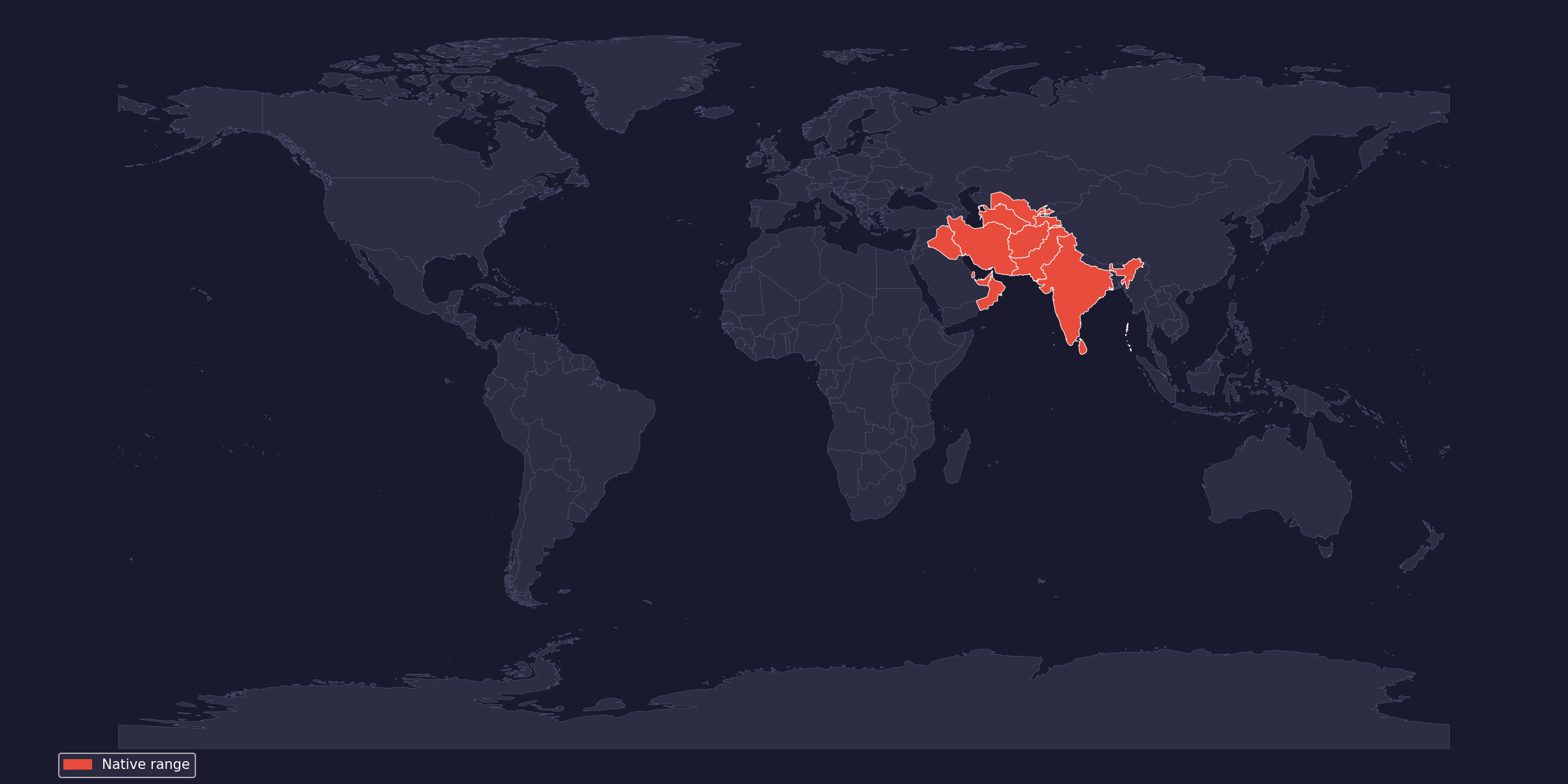
Under the broad database treatment, E. carinatus occurs from parts of Iraq, Iran and southern Central Asia through Afghanistan and Pakistan to India and Sri Lanka, with populations in the United Arab Emirates, Oman and Qatar. The nominal E. c. carinatus is centred on peninsular India and Sri Lanka; western, northern and Central Asian populations are often assigned to sochureki or multisquamatus.
The country-level map follows that broad current database concept. It cannot resolve disputed taxon boundaries, isolated populations, or the large unsuitable areas within each country, and should not be read as proof that all mapped animals are the same lineage. Habitats include dry scrub, rocky slopes, sandy or clay plains, agricultural margins, and sparse coastal or desert vegetation. The climate table represents western peninsular India only.
🌡 Climate across the native range
Monthly climate normals from a reviewed dry-habitat occurrence in western India:
Maharashtra — India (reviewed occurrence)
| Month | Min °C | Mean °C | Max °C | RH % |
|---|---|---|---|---|
| January | 16.7 | 22.7 | 29.9 | 53 |
| February | 17.3 | 23.8 | 31.4 | 51 |
| March | 19.2 | 25.1 | 32.5 | 59 |
| April | 20.8 | 25.8 | 32.4 | 67 |
| May | 21.8 | 25.5 | 31 | 75 |
| June | 21.2 | 22.7 | 25.4 | 92 |
| July | 20.4 | 21.4 | 23.4 | 95 |
| August | 20.1 | 21.3 | 23.5 | 94 |
| September | 20 | 22 | 25.1 | 91 |
| October | 19.9 | 23.1 | 27.6 | 82 |
| November | 18.9 | 23.5 | 29.2 | 66 |
| December | 17.4 | 22.8 | 29.5 | 55 |
Weather data by Open-Meteo.com · CC BY 4.0 · Monthly normals calculated by Herpeton Academy from daily archive values.
Location references use GBIF.org occurrence data where available; original occurrence records retain their source dataset licenses.
⚖️ Legal status
Echis carinatus is not listed in the CITES Appendices or EU wildlife-trade annexes checked on 16 August 2026. The Bern Convention is not relevant to its Asian range. Absence from those lists does not authorize collection, ownership, breeding, transport, or import.
Range-state wildlife laws and local dangerous-animal regimes may prohibit collection or require licences, inspected premises, training evidence, insurance, inventory records, and emergency plans. Taxonomic disagreements can also make permits and veterinary paperwork inconsistent. Obtain written confirmation from each competent authority and retain lawful-origin documents, locality records, photographs, invoices, and the legal-check date.
🤌 Husbandry
House one animal per enclosure in a controlled-access venomous room with secondary containment, sealed vents and cable ports, and a door protocol. Provide two compact shift hides across the thermal gradient so the entire snake can be seen and secured before any service panel opens.
Quarantine for at least 90 days using simple furniture and dedicated tools, preferably in separate airspace. Record weight, meals, sheds, faeces, breathing, mouth condition, and behaviour. Wild-origin or poorly documented animals need specialist veterinary screening for dehydration, mites, internal parasites, respiratory disease, and stomatitis.
Never cohabit for display. Small body size, rapid acceleration, and an ability to disappear beneath light décor make protected servicing and escape prevention more difficult, not less important.
💡 Lighting
Provide 10-12 hours of bright visible light followed by full darkness. Shade both hides and include partial cover so the snake controls exposure. Lamps must sit outside primary containment or behind a secure guard.
Low-level UVB can be offered as a Ferguson Zone 1 opportunity over part of the warm area, although it is not established as essential for a whole-prey snake. Maintain a shaded route and confirm irradiance at snake level.
🌡 Heating and temperature
Maintain ambient air at 25-29°C, a local basking surface at 31-34°C, a cool hide at 23-25°C, and nights around 20-24°C. Control every heater with a thermostat and check both surface and air temperature using independent instruments.
Do not turn the enclosure into uniformly hot desert housing. Rocky and arid-range vipers use deep shade, crevices, and seasonal activity to avoid lethal heat. Guard heat sources, avoid heat rocks, and install high-temperature alarms and room cooling where summer conditions can erase the gradient.
💧 Humidity and water
Use 30-50% relative humidity as a practical baseline for a dry, well-ventilated enclosure. During shedding, offer one humid hide at 50-65% rather than wetting the entire floor. Locality and season matter: monsoon-affected Indian animals experience different moisture cycles from interior Iranian or Central Asian populations.
Provide a small, heavy bowl of clean water that can be serviced through protected access. Monitor hydration through body mass, skin, sheds, and urates. Chronically dusty desiccation is as inappropriate as a damp unventilated substrate.
🌿 Enclosure and decoration
An adult needs at least 90 x 45 x 45 cm. Use two lockable shift hides, fixed low cover, a clear inspection route, and stable rock-like or cork surfaces. Décor must not create a gap where this small snake can remain unseen outside the shift system.
Provide 5-8 cm of compactable soil, fine clay, and washed sand rather than pure loose sand. Paper is appropriate in quarantine. Avoid aromatic wood, sharp chips, unstable stone piles, adhesives, mesh gaps, and clutter that has to be lifted during routine care. Use two-step mechanical locks and an unambiguous venom warning label.
🐁 Feeding
Wild diets include small mammals, lizards, frogs, and arthropods, with regional and age-related variation. Captive-established adults can usually take appropriately small frozen-thawed rodents every 7-14 days. Track weight and body condition; the meal should not produce an extreme bulge.
Offer prey with long tongs from a protected service position. Shift the snake before retrieving refused prey. Live rodents and invertebrates create avoidable injury and retrieval risk. Routine vitamin or calcium supplements are unnecessary with balanced whole prey.
🛡 Operational safety and emergencies
Never free-handle, pin, neck, or manually restrain this species in routine care. Use lockable shift boxes, appropriately sized hooks, transparent barriers, protected feeding ports, and two trained adults whenever primary containment opens. Clinical restraint requires a veterinarian and a planned professional anaesthesia and containment team.
Before acquisition, agree a written bite protocol with the receiving hospital or poison centre. Include photographs, exact locality, all current and historical taxon names, transport arrangements, and a route to specialist antivenom advice. Venom and antivenom effectiveness can vary geographically; never assume that a product labelled for “Echis” is appropriate, and never administer antivenom privately.
A bite is an immediate medical emergency. Move away, call emergency services, remove constricting objects, keep the patient still, immobilize the limb, and follow poison-centre guidance. Do not cut, suck, ice, shock, tightly tourniquet, or delay transport to capture the snake.
Maintain a written escape plan with room isolation, accountability, search zones, capture containers, public exclusion, and named decision-makers. Stop work if the animal cannot be positively accounted for.
🥚 Breeding notes
Indian E. carinatus is commonly documented as live-bearing, with typical litters of about 3-15 young; larger litters have been reported. Historical literature also describes reproductive bimodality, but some records arose under a much broader taxonomic concept that included African populations now assigned to other species. Establish the lineage and documented reproductive history rather than assuming one schedule for every animal labelled E. carinatus.
Breeding creates numerous tiny, fast, medically significant neonates. Confirm sex, locality, lawful breeding authority, and future placement before pairing. Individually locked, labelled neonate enclosures, an updated bite plan, and complete birth and parentage records must be ready before parturition or any possible egg deposition.
🩺 Common problems
- Dehydration and poor sheds: review water access, humid-hide use, temperatures, and systemic disease.
- Overheating and burns: prevent with local guarded heat, thermostats, alarms, and a genuine cool retreat.
- Respiratory disease: abnormal sounds, bubbles, open-mouth breathing, or head elevation require urgent veterinary care.
- Dermatitis: investigate wet dirty substrate, poor ventilation, abrasive décor, and mites.
- Parasites and stomatitis: weight loss, abnormal faeces, mites, oral swelling, or discharge are especially concerning in wild-origin animals.
- Obesity or poor growth: weigh regularly and review prey size, interval, digestion temperature, and taxon-appropriate diet.
- Regurgitation: requires review of meal size, temperature, disturbance, infection, and parasites with a veterinarian.
Do not attempt hands-on home treatment. Move the snake into a shift container and coordinate examination with an experienced reptile veterinarian.
📌 Conclusion
Echis carinatus is suitable only for a licensed, professionally managed facility that can keep a tiny rapid viper behind redundant locked barriers and coordinate locality-aware medical care. Disagreement over sochureki and multisquamatus makes provenance central to husbandry, law, and emergency planning.
📚 Sources and further reading
- ReptiFiles — checked first on 16 August 2026; no species-specific care guide was found.
- The Reptile Database: Echis carinatus
- GBIF species record: Echis carinatus
- Pook et al. — phylogeny, biogeography and systematics of Echis
- Sengupta et al. — ecology and distribution in Maharashtra
- Whittington et al. — variation in reptile reproductive mode
- WHO South-East Asia: Guidelines for the management of snakebites
- Baines et al. — UV lighting guidance for captive reptiles
- Northern Ireland government guidance on keeping venomous snakes and lizards
- CITES Appendices
- EU wildlife-trade annexes, Commission Regulation (EU) 2026/1383
- Bern Convention appendices