Share

Boomslang
🔤 Taxonomy
This guide uses Dispholidus typus for the broadly treated boomslang, but the genus still needs a modern range-wide revision. The Reptile Database recognizes D. punctatus, formerly D. typus punctatus, while other recent sources retain a broader D. typus treatment; D. pembae has also been described from Pemba. Older subspecies names and colour-based identifications remain in literature, but colour varies strongly by sex, age, and region and does not establish origin.
📌 Description
The boomslang is a long, light-bodied, diurnal tree snake with large eyes, excellent vision, and enlarged grooved rear teeth. Males are often green or black-edged, females commonly brown or olive, and juveniles differ again. Adults are usually 100-160 cm and may approach 180 cm.
Its relatively shy field behaviour must not be confused with low risk. The highly procoagulant venom can produce delayed venom-induced consumption coagulopathy and spontaneous haemorrhage. A bite may look trivial for hours before systemic illness becomes evident. This is an expert institutional display animal, not a handling species.
📋 Quick reference
| Care point | Practical target |
|---|---|
| Adult enclosure | At least 180 x 90 x 180 cm, locked, with two safe shift options |
| Day temperatures | 23-28°C ambient; 30-32°C limited basking branch; 21-24°C cool retreat |
| Night temperatures | 18-22°C, adjusted to locality and season |
| Humidity | Usually 50-70%, with humid retreat and good air exchange |
| Lighting | 10-13 hours, bright visible light, optional low-level UVB and shade |
| Feeding | Varied frozen-thawed whole vertebrate prey; adults often every 10-14 days |
| Housing | Solitary |
| Safety | Delayed life-threatening coagulopathy; protected contact only |
☠️ Venom
This species is venomous. Venom exposure can cause pain, swelling or other systemic effects, and severity varies with species, locality, bite site and the amount delivered. A small wound or apparently dry bite is not proof of safety; every bite or sting requires urgent medical assessment.
If an incident occurs, move away, call emergency services or a poison centre, keep the patient still, remove rings and other constricting items, and follow dispatcher instructions. Do not use a tourniquet, cut or suck the wound, apply ice or electricity, give alcohol or medicines as a home treatment, or attempt to catch the animal. Antivenom choice and dosing are hospital decisions; verify the relevant product and local availability in advance. Sources: WHO snakebite guidance and appropriate species-specific toxinology or medical references listed below.
🌍 Distribution
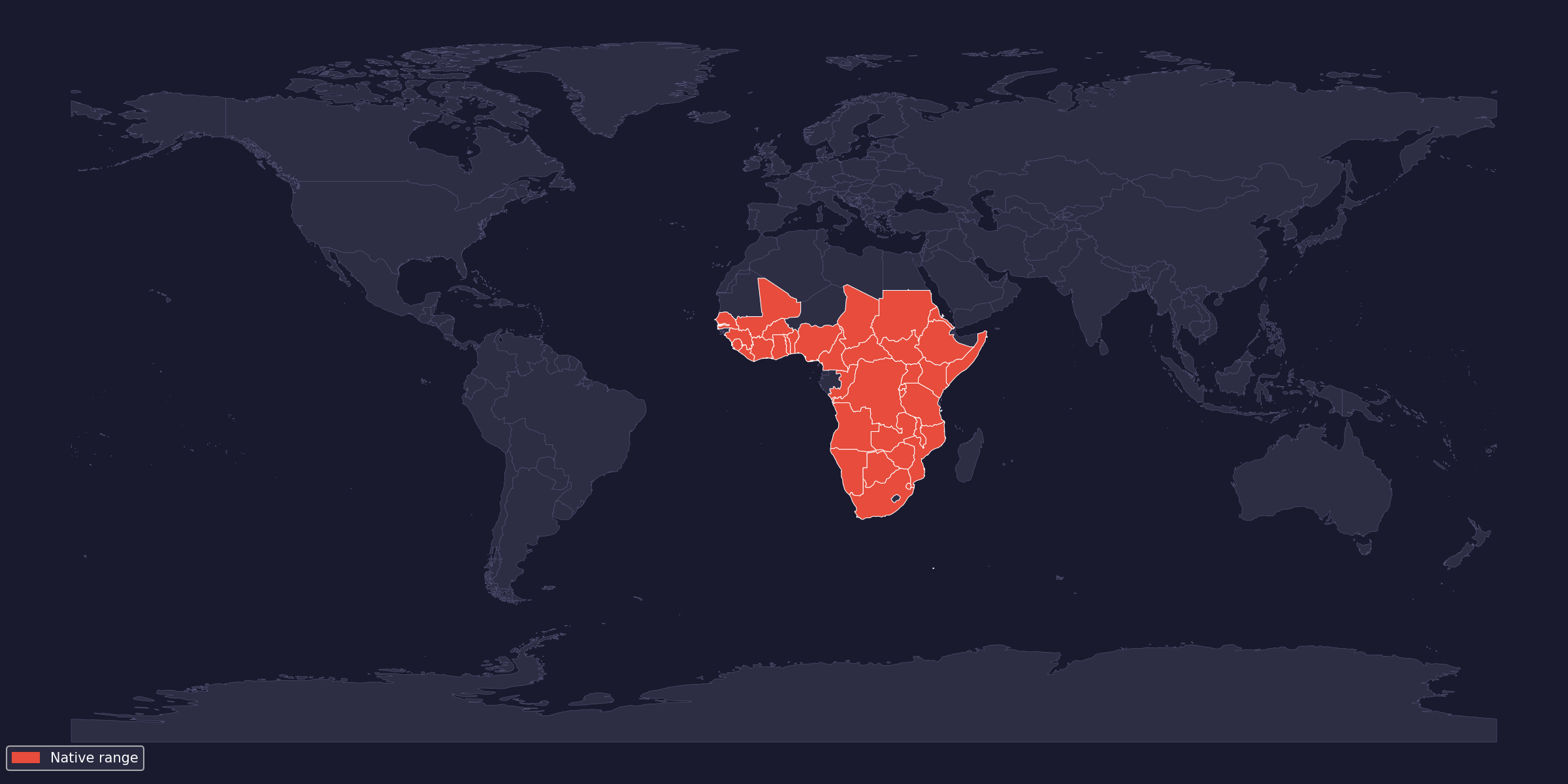
Boomslangs range widely through sub-Saharan Africa, from parts of West and East Africa through Central Africa to southern Africa. They are absent from the most arid deserts and depend on trees, shrubs, or tall vegetation. Woodland, savanna, coastal thicket, forest edge, gardens, and riparian vegetation may all be used.
That traditional broad range includes tropical, subtropical, and seasonally cool climates. Provenance should guide seasonal temperatures and humidity. The country-level map follows the broad historic D. typus treatment and may overstate the strict-sense range where D. punctatus or other separated taxa are recognized. Captive design must prioritize dense but inspectable climbing structure, sunlight choices, and safe shifting rather than treating every African locality alike.
🌡 Climate across the native range
Monthly climate normals from a verified subtropical occurrence in eastern South Africa:
KwaZulu-Natal — South Africa (verified occurrence)
| Month | Min °C | Mean °C | Max °C | RH % |
|---|---|---|---|---|
| January | 22.9 | 25.1 | 27.4 | 77 |
| February | 23.1 | 25.3 | 27.7 | 77 |
| March | 22.4 | 24.7 | 27.2 | 77 |
| April | 20.6 | 23 | 25.6 | 76 |
| May | 18.8 | 21.3 | 24.3 | 75 |
| June | 16.7 | 19.7 | 22.9 | 72 |
| July | 16.2 | 19.1 | 22.2 | 71 |
| August | 17 | 19.8 | 23.1 | 71 |
| September | 18.3 | 21 | 24.1 | 73 |
| October | 19.2 | 21.7 | 24.4 | 75 |
| November | 20.6 | 22.9 | 25.6 | 76 |
| December | 22 | 24.3 | 26.8 | 77 |
Weather data by Open-Meteo.com · CC BY 4.0 · Monthly normals calculated by Herpeton Academy from daily archive values.
Location references use GBIF.org occurrence data where available; original occurrence records retain their source dataset licenses.
⚖️ Legal status
As checked on 16 August 2026, Dispholidus typus is not listed in CITES Appendices I-III and no species-specific entry was found in EU wildlife-trade Annexes A-D. The Bern Convention is not relevant because the species is not native to Europe.
National dangerous-animal law remains decisive. Licensing, an inspected venomous room, redundant containment, insurance, transport permits, a documented antivenom/emergency arrangement, or prohibition may apply. Verify rules before acquisition and keep invoice, breeder, locality, import/transfer, photographic, and legal-check records.
🤌 Husbandry
Build and test the complete protected-contact system first: locked enclosure and room, clear hazard labelling, dedicated tools, and two shift boxes or a divided enclosure so the snake can choose a retreat at either end of the thermal gradient. House singly. Its reach, speed, visual awareness, and ability to reverse on branches make an improvised hook-only routine unacceptable.
Quarantine for at least 90 days with simple furniture, paper, separate airspace and tools where practical. Record weight, meals, sheds, faeces, oral condition, and respiration. Imported or poorly documented animals need reptile-veterinary examination and parasite testing.
💡 Lighting
Provide bright full-spectrum visible light for 10-13 hours, adjusted mildly by season. A measured low-level UVB area in Ferguson Zone 1 is reasonable, with dense shaded foliage and retreats. All lamps, cables, and probes must be guarded or external.
Boomslangs are visually oriented and use sunlit vegetation, but display lighting must not turn the enclosure into an exposed hot box. Night is dark; use thermostatic lightless heat only when room temperature requires it.
🌡 Heating and temperature
Use 23-28°C ambient air, a restricted 30-32°C basking branch, a 21-24°C cool retreat, and 18-22°C nights. Some provenances experience cooler dry-season nights, but deep cooling is not a universal recipe and is inappropriate for juveniles, thin animals, new arrivals, or sick snakes.
Measure at several heights and both shift positions. Thermostat every heater and secure probes. A boomslang must be able to leave direct radiant heat without descending into a wet or exposed floor.
💧 Humidity and water
Maintain about 50-70% relative humidity with a humid hide and short increases to 65-80% during shedding. Mist selectively and allow foliage and the upper substrate to dry. Tropical provenances may need the upper end; southern seasonal animals should not be kept continuously saturated.
Provide fresh water in a stable bowl placed for protected-access changing. Persistent condensation, mould, or respiratory signs indicate that moisture has outrun ventilation.
🌿 Enclosure and decoration
Provide at least 180 x 90 x 180 cm for one adult, larger where possible. Install multiple rigid horizontal and diagonal branches, elevated hides, dense visual barriers, a ground retreat, and open routes between warm, cool, and shift areas. Vegetation must not prevent a full visual count before a door opens.
Use 6-10 cm of drainage-aware soil and leaf litter for an established display; paper is safer in quarantine. Keyed or tool-operated locks, secured vents, guarded heat, blocked cable gaps, and an escape-resistant room are mandatory. Audit door tracks, foliage anchors, drains, and shift closures regularly.
🐁 Feeding
Wild boomslangs take chameleons and other lizards, birds and eggs, frogs, and small mammals. Offer varied appropriately sized frozen-thawed whole prey: mice, chicks or quail, and suitable whole items where legally available. Avoid an unbalanced diet of muscle meat or eggs alone.
Juveniles usually need a small meal every 7 days; established adults often every 10-14 days and less when inactive. Track weight and body shape. Whole vertebrate prey needs no routine supplements, and live prey creates avoidable injury and escape risk.
🥚 Breeding
Boomslangs are oviparous. Females lay about 8-14 eggs commonly, with reports up to 27, in decaying vegetation or sheltered sites. Captive planning values of 27-29°C and 65-90 days reflect the published two-to-three-month range; locality and validated breeding records should refine them.
Pairing, nest access, egg removal, and multiple venomous hatchlings are institutional-level operations. Prepare individual locked containers and lawful placements before breeding. Never enter for eggs while an adult remains unshifted.
🛡️ Handling and emergency planning
This is a display-only species. Do not free-handle, tail, pin, neck, or manually restrain it. Use protected contact, external-closing shifts, appropriate barriers, and two trained adults for open-primary-barrier work. This guide does not provide capture or restraint instructions.
Before acquisition, coordinate a written bite plan with emergency services, a poison centre or toxicologist, and a receiving hospital. Confirm how boomslang-specific antivenom consultation and transfer will be handled; do not assume local stock and never self-administer antivenom.
Every bite is an immediate emergency even without pain or swelling. Keep the patient still, immobilize the limb, remove tight objects, call emergency services, and explicitly report the risk of delayed coagulopathy. Do not cut, suck, ice, use electricity or chemicals, apply an arterial tourniquet, or wait for bleeding.
🩺 Common problems
- Trauma and rostral abrasion: exposed glass, poor cover, overheating, or unsuitable branch geometry can cause frantic movement and rubbing.
- Respiratory disease: bubbles, wheeze, gaping, or unusual head elevation requires prompt reptile-veterinary care; cold damp stagnation is a common contributor.
- Dysecdysis and dehydration: review water, humid retreat, temperature, and the mist-dry cycle; do not peel the snake.
- Obesity or regurgitation: excessive feeding, oversized prey, heat, and disturbance after meals are preventable factors.
- Parasites: imports require quarantine and evidence-led treatment.
- Unsafe visibility: if staff cannot locate the snake before access, the planting and shift design have failed.
- Delayed envenomation: apparent early wellbeing after a bite is not reassuring; only medical monitoring can assess coagulopathy.
📌 Conclusion
The boomslang requires a large inspectable canopy, moderate seasonal climate, diverse whole prey, and a genuinely institutional safety system. Only a legally authorized expert facility with protected-contact training and a hospital-coordinated plan for delayed coagulopathy should keep it.
📚 Sources and further reading
- ReptiFiles was searched; no species-specific care guide was located: https://reptifiles.com/
- GBIF: https://www.gbif.org/species/2452959
- The Reptile Database, Dispholidus typus and its taxonomic comments: https://reptile-database.reptarium.cz/Dispholidus/typus
- SANBI, boomslang account: https://www.sanbi.org/animal-of-the-week/boomslang/
- SANBI Biodiversity Advisor: https://biodiversityadvisor.sanbi.org/search/detail/80886
- Animal Diversity Web, natural history and reproduction: https://animaldiversity.org/accounts/Dispholidus_typus/
- Pla et al., boomslang venomics and antivenomics: https://pmc.ncbi.nlm.nih.gov/articles/PMC5335903/
- Coagulating colubrids: https://pmc.ncbi.nlm.nih.gov/articles/PMC5450719/
- Clinical case of subclinical coagulopathy: https://pmc.ncbi.nlm.nih.gov/articles/PMC8424712/
- WHO Africa snakebite guidelines: https://iris.who.int/bitstream/handle/10665/204458/9789290231684.pdf
- Baines et al., UV-Tool: https://doi.org/10.19227/jzar.v4i1.150
- CITES: https://cites.org/eng/app/appendices.php and https://checklist.cites.org/
- Commission Regulation (EU) 2026/1383: https://eur-lex.europa.eu/eli/reg/2026/1383/oj/eng
- Bern Convention: https://www.coe.int/en/web/bern-convention/appendices