Share

Western Green Mamba
🔤 Taxonomy
Dendroaspis viridis is the western green mamba of West African forests. It is not the eastern green mamba D. angusticeps, which occurs on the opposite side of the continent, nor Jameson’s mamba D. jamesoni of Central African forests. Recent genus-wide work still recognises these as distinct lineages.
Green colour alone is unsafe identification. Preserve exact locality, parent records, full-body and head-scale photographs and the identifier’s name. The questionable Central African Republic record lies near the boundary with D. jamesoni and needs specimen-level confirmation.
📌 Description
This slender, fully arboreal, mainly diurnal elapid is commonly 140-210 cm. It travels rapidly through connected foliage and branches and may hold the forebody well above keeper waist or shoulder height. A managed lifespan of 15-20 years is a reasonable commitment.
Envenomation can progress through pain and swelling to ptosis, bulbar weakness, generalized paralysis and respiratory failure. Clinical severity is variable and an initially well patient may deteriorate. Speed, reach and three-dimensional movement make an open-door hook routine unacceptable.
📋 Quick reference
| Care point | Practical target |
|---|---|
| Adult enclosure | At least 240 x 120 x 240 cm, with two elevated lockable shift boxes |
| Temperature | Ambient 24-28°C; basking 30-32°C; cool refuge 22-24°C |
| Night | 20-23°C with no cold, wet draught |
| Humidity | Ventilated 65-80%; local 80-90% shed support |
| Feeding | Appropriately sized frozen-thawed rodents every 7-14 days |
| Safety | Protected contact, two-person rule and ventilation-ready hospital plan |
| Quarantine | At least 90 days with separate tools and parasite screening |
☠️ Venom
This species is venomous. Venom exposure can cause pain, swelling or other systemic effects, and severity varies with species, locality, bite site and the amount delivered. A small wound or apparently dry bite is not proof of safety; every bite or sting requires urgent medical assessment.
If an incident occurs, move away, call emergency services or a poison centre, keep the patient still, remove rings and other constricting items, and follow dispatcher instructions. Do not use a tourniquet, cut or suck the wound, apply ice or electricity, give alcohol or medicines as a home treatment, or attempt to catch the animal. Antivenom choice and dosing are hospital decisions; verify the relevant product and local availability in advance. Sources: WHO snakebite guidance and appropriate species-specific toxinology or medical references listed below.
🌍 Distribution
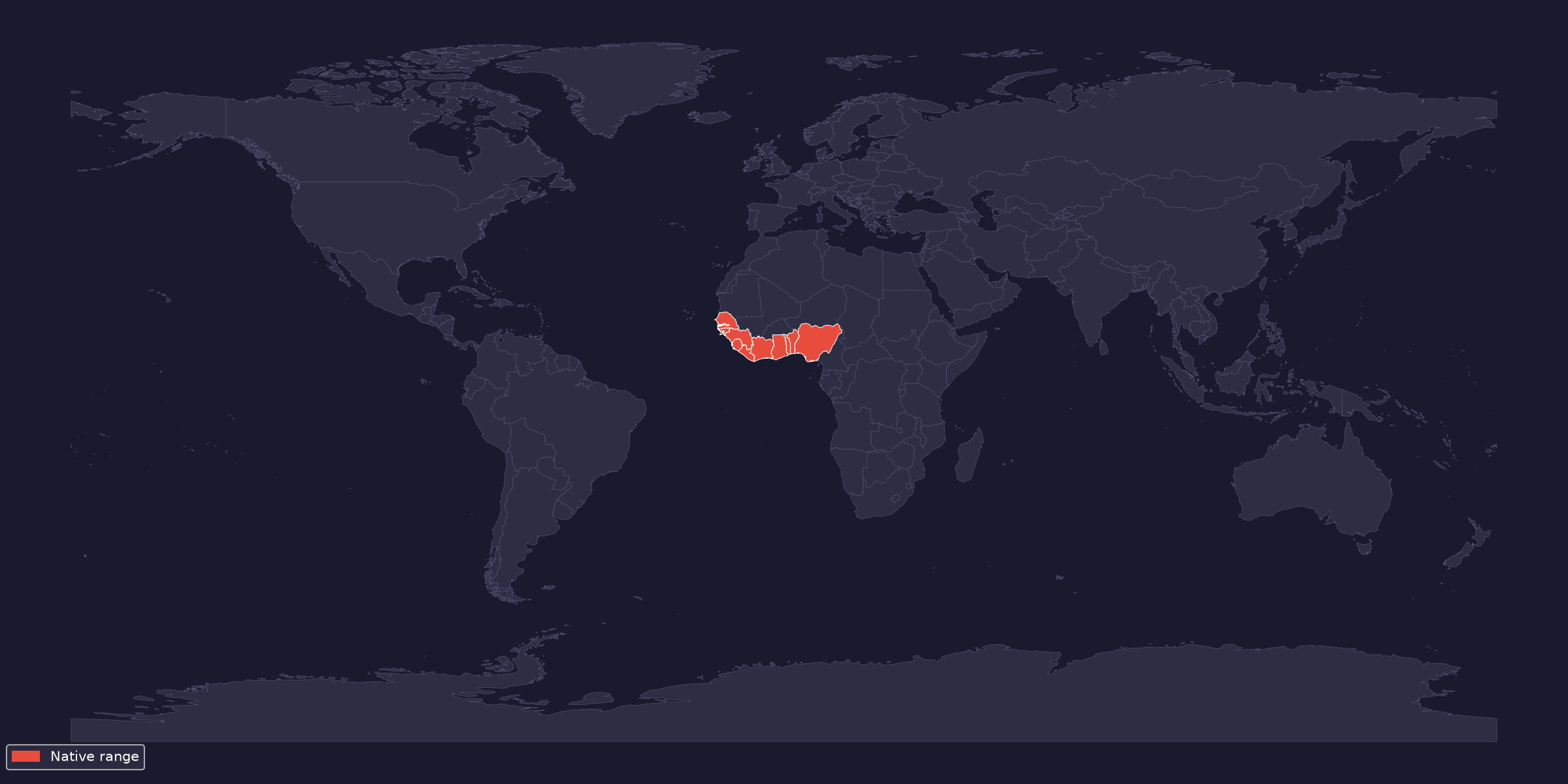
The core range follows the Upper Guinea forest belt from Senegal and The Gambia through Guinea-Bissau, Guinea, Sierra Leone, Liberia and Côte d’Ivoire, continuing east through Ghana, Togo and Benin into southern Nigeria. The Central African Republic report is questionable and is deliberately not shaded; records beyond the West African belt require review against D. jamesoni.
Habitats include humid forest, gallery forest, forest edge and established wooded mosaics, with substantial coastal-to-inland rainfall variation and fragmentation. The map colours whole countries, exaggerating northern savanna and dry interiors and hiding forest gaps. The reviewed southern Ghana occurrence supplies one climate context, not a mean for Senegal, Liberia or Nigeria.
🌡 Climate across the native range
Monthly normals from one reviewed occurrence in southern Ghana; this point does not represent the full coastal-to-inland or western-to-eastern climatic range:
Central — Ghana (reviewed western green mamba occurrence)
| Month | Min °C | Mean °C | Max °C | RH % |
|---|---|---|---|---|
| January | 22 | 26.6 | 31.2 | 78 |
| February | 22.9 | 27.5 | 32 | 78 |
| March | 23.2 | 27.6 | 32 | 80 |
| April | 23.3 | 27.5 | 31.7 | 81 |
| May | 23.3 | 27.2 | 31.1 | 82 |
| June | 22.8 | 26 | 29.2 | 85 |
| July | 22.2 | 25 | 27.8 | 86 |
| August | 21.8 | 24.5 | 27.3 | 86 |
| September | 22.3 | 25.4 | 28.5 | 84 |
| October | 22.6 | 26.1 | 29.6 | 83 |
| November | 22.8 | 26.8 | 30.8 | 82 |
| December | 22.7 | 26.8 | 30.9 | 81 |
Weather data by WorldClim v2.1 · Monthly normals queried by Herpeton Academy from raster values; relative humidity is derived from vapor pressure and mean temperature.
Location references use GBIF.org occurrence data where available; original occurrence records retain their source dataset licenses.
⚖️ Legal status
No species-specific entry for D. viridis was found in the CITES Appendices, EU wildlife-trade annexes or Bern Convention appendices on 17 August 2026. Range-state wildlife and export controls and domestic dangerous-animal law still apply independently.
Local and national rules for possession, registration, transport, breeding, sale and import may require permits, inspected containment, insurance or a named emergency plan. Verify them in writing before acquisition or transfer. Retain invoices, lawful-origin papers, locality and parent records, identification evidence and dated authority advice.
🤌 Husbandry
House singly in a locked venomous room with secondary room containment. The enclosure must connect to two full-body, elevated shift boxes that close and lock externally while preserving continuous branch routes. Service only after the animal is visually located and positively secured in the other compartment. Protected contact is mandatory; free handling and open-door hook work are not routine care.
Quarantine for at least 90 days on paper with disposable or separately disinfected perches, separate tools and preferably separate air. Record weight, meals, faeces, sheds, mouth and respiration. Wild-origin and poorly documented animals need repeated parasite testing and taxonomic review.
💡 Lighting
Provide bright broad-spectrum visible light for 11-13 hours, complete darkness at night and dense shaded retreats. Guard all lamps. Low-output UVB through part of the upper canopy can provide Ferguson Zone 2 exposure, while foliage and opaque boxes must permit complete avoidance.
🌡 Heating and temperature
Maintain 24-28°C ambient air, an upper-branch warm zone at 30-32°C, a shaded 22-24°C retreat and nights around 20-23°C. Measure at several heights because the ceiling and lower foliage can differ sharply. Guard and thermostat every source.
Avoid constant enclosure-wide heat. The snake must move horizontally between warm and cool cover without descending to an exposed floor. Any seasonal reduction should be modest, gradual and tied to documented origin; do not cool young, thin, new or symptomatic animals.
💧 Humidity and water
Target a well-ventilated 65-80% baseline with local 80-90% shed support and daily drying of leaves and branches. High humidity is not stagnant saturation. Use drainage and cross-ventilation to avoid chronically wet perches and warm still air.
Provide both a stable elevated drinking cup and a heavy floor bowl, each replaceable from behind a barrier. Gentle rain-style wetting may prompt drinking, but nozzles and drains must be serviced from the safe side. Track hydration, urates, skin and respiration.
🌿 Enclosure and decoration
At least 240 x 120 x 240 cm gives an adult the minimum three-dimensional operational space; larger connected modules are preferable. Install load-tested horizontal and diagonal branches at several heights, dense visual cover, two elevated opaque shifts and a few stable lower refuges. Branch routes must end inside shifts, not above doors or keeper access.
Fasten every branch and plant base, seal cable openings, shield vents and use redundant tamper-resistant locks. Keep doors and service ports outside the snake’s primary routes. Removable perch modules and drainable plant trays allow cleaning from the empty section.
🐁 Feeding
Offer appropriately sized frozen-thawed rodents or captive-produced avian prey with long tongs, usually every 7-10 days for growing animals and 10-14 days for adults according to body condition. Avoid overweight prey and do not leave live prey in dense foliage.
Present food only after the animal is secured behind a barrier, using a hatch or shift-side access. Remove remains without opening the occupied compartment. Repeated refusal or regurgitation needs review of temperature, visual security, parasites and disease.
🛡 Operational safety and emergencies
Use trained named staff, controlled access, a two-person rule, lock and inventory logs, species cards, escape equipment and rehearsed bite and escape plans. Before acquisition, the receiving hospital and poison service must confirm the current locally appropriate antivenom pathway, transport time and ability to provide rapid intubation, mechanical ventilation and intensive care. Antivenom availability and species coverage change; keeper-held stock is not a substitute for clinician-led planning.
Never work beneath an unlocated animal or assume it remains on the visible perch. Close and positively lock a shift door before any service port opens; verify location again after every branch movement. Tools are for remote guidance into the shift, not pinning or free handling. A loose arboreal mamba requires room isolation, clearance of uninvolved people and the rehearsed specialist response, not pursuit.
After any suspected bite, leave and secure the room, call emergency services, keep the patient still and transport urgently with the species card. Do not wait for ptosis or breathing difficulty, do not cut, suck, ice, shock or apply a tourniquet, and do not recapture the snake. Staff follow the pre-agreed regional clinical protocol; airway failure may develop despite limited early signs.
🥚 Breeding notes
Published summaries report 6-14 eggs. Incubation near 27-29°C commonly requires roughly 80-90 days, but verified data are limited and clutch-specific variation matters. Log calibrated egg-level temperature, substrate water potential, mass change and hatch timing rather than copying an air thermostat setting.
Breeding demands documented compatible identities, remote introduction and separation through connected compartments, an accessible lockable laying box and individual secure neonate units. Confirm permits, staff capacity and qualified placements before pairing. Never manually restrain a gravid female or improvise treatment for suspected retention.
🩺 Common problems
- Rostral injury: correct reflections, exposed traffic routes, inadequate cover or poor shift alignment.
- Falls and branch injury: load-test, texture and rigidly anchor all routes.
- Obesity: weigh prey, lengthen adult intervals and trend mass without hand restraint.
- Burns or overheating: shield and thermostat overhead heat and retain a measured cool canopy.
- Respiratory disease and dermatitis: correct stagnant humid air or perpetually wet perches and seek reptile-veterinary diagnosis.
- Parasites and stomatitis: particularly important in wild-origin or uncertain-history animals.
- Egg retention: prolonged restless climbing or straining requires a remote veterinary plan, not manual examination.
📌 Conclusion
The western green mamba requires a tall protected-contact system built around elevated lockable shifts, continuous branches and service from empty compartments. Accurate West African provenance and a hospital pathway ready for rapid respiratory support are as fundamental as heat and humidity.
📚 Sources and further reading
- ReptiFiles — checked first on 17 August 2026; no species-specific care guide was found.
- The Reptile Database: Dendroaspis viridis
- GBIF: Dendroaspis viridis
- Tolley et al.: phylogeny and species delimitation in African mambas
- Harrington et al.: large elapids and arboreality
- Eidenbenz et al.: western green mamba envenomation with respiratory failure
- WHO: Guidelines for prevention and clinical management of snakebite in Africa
- Baines et al. — UV lighting guidance
- CITES Appendices
- EU annexes, Regulation (EU) 2026/1383
- Bern Convention appendices