Share

Black Mamba
🔤 Taxonomy
Dendroaspis polylepis is the accepted name for the black mamba. The sometimes-used D. p. antinorii is generally treated as a synonym rather than a valid subspecies. The black mamba must not be confused with the smaller, greener and more arboreal D. angusticeps, D. jamesoni or D. viridis; locality and species identification are medically important.
📌 Description
The black mamba is a long, fast African elapid, commonly 200-300 cm, with a terrestrial-to-semi-arboreal lifestyle and a strong requirement for uninterrupted movement space. Adults may live 15-20 years. The name refers to the dark lining of the mouth, not the usually grey, olive or brown body.
Envenomation can cause rapidly progressive neurotoxicity, paralysis and respiratory failure. This is not a private-keeper challenge animal. It belongs only in licensed institutions with trained staff, redundant containment, protected contact, and a hospital plan agreed before acquisition.
📋 Quick reference
| Care point | Practical target |
|---|---|
| Adult size | Usually 200-300 cm |
| Adult enclosure | At least 300 x 150 x 200 cm with two lockable shift compartments |
| Temperature | Ambient 25-29°C; basking 31-33°C; cool retreat 23-25°C |
| Night | 21-24°C |
| Humidity | 40-60%; local 60-75% shed support |
| Feeding | Moderate frozen-thawed rodents every 10-21 days |
| Safety | Protected contact, two trained staff, written bite and escape plans |
| Quarantine | At least 90 days with dedicated equipment and veterinary screening |
☠️ Venom
This species is venomous. Venom exposure can cause pain, swelling or other systemic effects, and severity varies with species, locality, bite site and the amount delivered. A small wound or apparently dry bite is not proof of safety; every bite or sting requires urgent medical assessment.
If an incident occurs, move away, call emergency services or a poison centre, keep the patient still, remove rings and other constricting items, and follow dispatcher instructions. Do not use a tourniquet, cut or suck the wound, apply ice or electricity, give alcohol or medicines as a home treatment, or attempt to catch the animal. Antivenom choice and dosing are hospital decisions; verify the relevant product and local availability in advance. Sources: WHO snakebite guidance and appropriate species-specific toxinology or medical references listed below.
🌍 Distribution
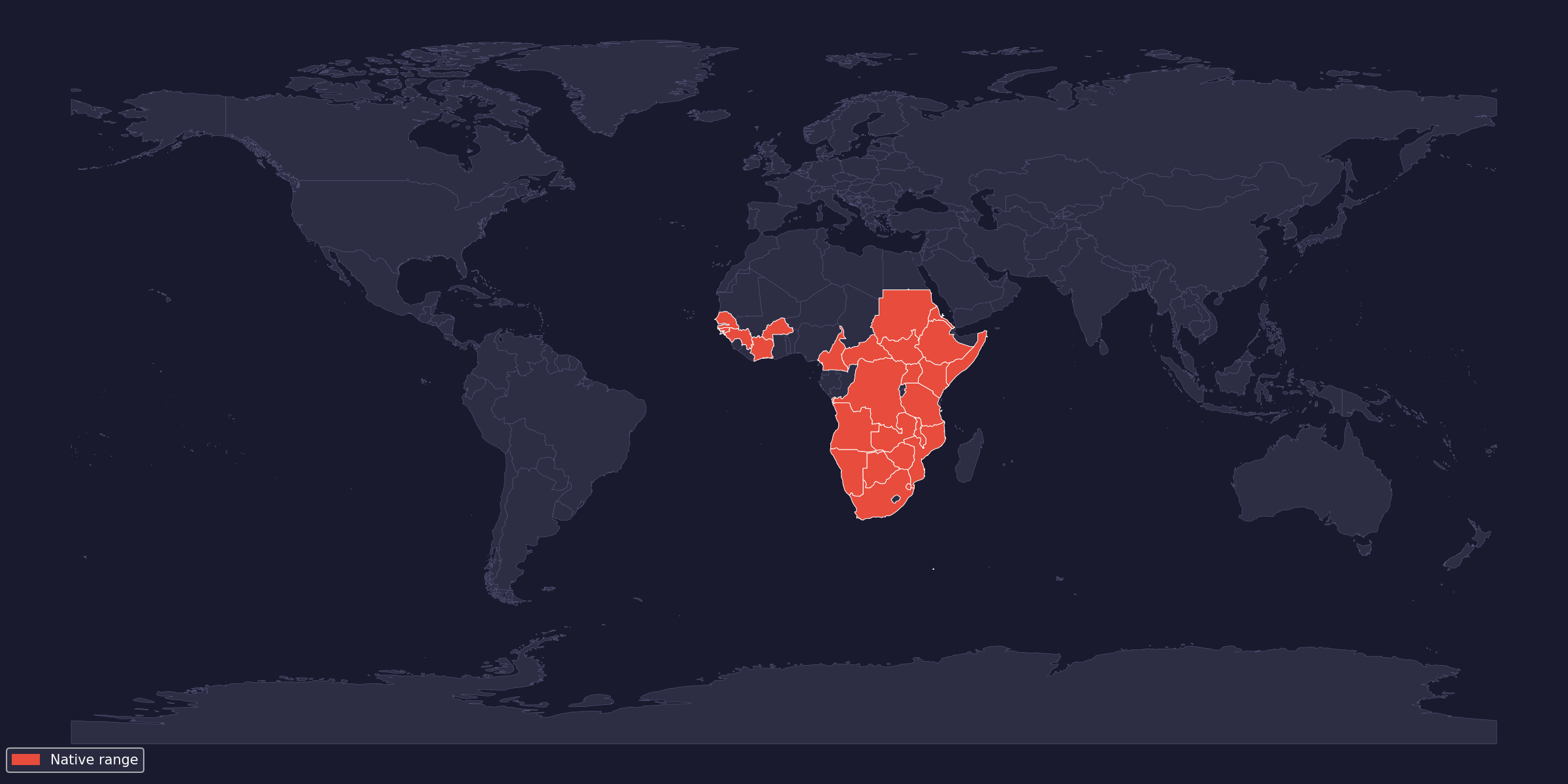
The species occupies a broad but discontinuous belt of sub-Saharan Africa, from parts of West and Central Africa through East Africa to Angola, Namibia, Botswana, Mozambique, South Africa and neighbouring countries. Records are concentrated in warm savanna, open woodland, rocky slopes, riverine thickets and agricultural mosaics; dense rainforest and true desert are not typical habitat.
The country-level map will necessarily overstate occupied area and cannot show isolated records, unsuitable forest, or high-altitude gaps. The climate station represents a warm South African savanna locality, not the whole continental range.
🌡 Climate across the native range
Monthly normals from a reviewed occurrence in the warm savanna portion of the range:
Limpopo — South Africa (reviewed black mamba occurrence)
| Month | Min °C | Mean °C | Max °C | RH % |
|---|---|---|---|---|
| January | 20.4 | 25 | 30.1 | 65 |
| February | 20.4 | 25.1 | 30.3 | 65 |
| March | 19.4 | 24.2 | 29.4 | 65 |
| April | 16.5 | 21.8 | 27.4 | 64 |
| May | 12.6 | 19.1 | 25.8 | 60 |
| June | 9.4 | 16.4 | 23.6 | 58 |
| July | 8.8 | 16 | 23.2 | 57 |
| August | 11 | 18.3 | 25.5 | 53 |
| September | 14.3 | 21.3 | 28 | 53 |
| October | 16.7 | 22.7 | 28.7 | 57 |
| November | 18.3 | 23.7 | 29.2 | 62 |
| December | 19.8 | 24.8 | 30.1 | 64 |
Weather data by Open-Meteo.com · CC BY 4.0 · Monthly normals calculated by Herpeton Academy from daily archive values.
Location references use GBIF.org occurrence data where available; original occurrence records retain their source dataset licenses.
⚖️ Legal status
No species-specific entry for D. polylepis was found in the CITES Appendices, the EU wildlife-trade annexes, or the Bern Convention appendices when checked on 17 August 2026. That does not make possession unregulated. Local and national rules may still class mambas as dangerous wild animals and require a licence, inspected premises, secure-room standards, insurance, staff competence and an emergency plan; native range states also regulate collection and export.
Keep invoices, breeder and importer details, origin records, photographs, transport documents, permits and the date of each legal check. Confirm written permission with every relevant authority before purchase, breeding, sale or movement.
🤌 Husbandry
House one animal alone in a locked venomous-animal room with secondary containment. The enclosure must include two full-size shift compartments connected by closable doors, so feeding, cleaning, water changes and veterinary preparation occur only after the snake is positively secured. All vents, drains and cable penetrations need tamper-resistant fasteners.
Quarantine for at least 90 days in simple, observable housing with separate tools and preferably separate air. Track weight, meals, sheds, faeces and breathing, and arrange parasite and health screening with a venomous-reptile veterinarian. Do not rely on apparent calmness: a long mamba can cross several metres before a person can react.
💡 Lighting
Provide 10-12 hours of bright visible light and complete darkness at night. Use broad shaded retreats and visual barriers so the animal can leave illumination. All lamps must sit outside primary containment or behind rigid guards.
Low-level UVB may be offered across part of the upper warm zone, with Ferguson Zone 2 exposure and easy access to shade. UVB is an enrichment and physiological opportunity, not a substitute for whole-prey nutrition.
🌡 Heating and temperature
Maintain 25-29°C ambient air, a local 31-33°C basking surface, a 23-25°C cool retreat and nights around 21-24°C. Large rooms stratify, so measure air and surfaces at several heights and at both shift hides. Thermostat every heat source and use independent high-temperature alarms.
Do not heat the entire enclosure to the basking temperature. The snake must be able to travel between warm, neutral and cool zones without leaving cover. Seasonal cycling is for locality-documented breeding programmes only, never for thin, sick, juvenile or newly imported animals.
💧 Humidity and water
A ventilated baseline of 40-60% relative humidity suits many savanna localities. Offer a localized humid retreat at 60-75% during shedding rather than wetting the entire room. Persistent damp substrate and stale air encourage dermatitis and respiratory disease.
Provide a heavy clean water bowl accessible through protected service. It need not be large enough for routine soaking, but must not tip when a large snake passes. Record unusual drinking because it may precede shedding, dehydration or illness.
🌿 Enclosure and decoration
An adult enclosure should be no smaller than 300 x 150 x 200 cm, and larger is preferable. Add broad fixed shelves and branches capable of bearing the full animal, low visual cover, two tight shift hides and unobstructed floor routes. Furniture must not form blind pockets outside the shift path.
Use 6-10 cm of compactable soil, washed sand and leaf material, or paper during quarantine. Avoid aromatic wood, sharp chips, unstable rockwork, adhesive décor and deep clutter. Doors require two independent mechanical locks; the room needs an airlock or equivalent secondary barrier and a clearly visible venom hazard label.
🐁 Feeding
Offer appropriately sized frozen-thawed rodents, with occasional suitable avian prey only where a veterinary nutrition plan supports it. Most adults maintain lean condition on moderate meals every 10-21 days. Monitor body condition rather than interpreting a rapid feeding response as hunger.
Feed from a protected port with long tongs and secure the snake before retrieving refused prey. Live rodents add bite injuries and unsafe removal work. Balanced whole prey needs no routine supplements.
🛡 Operational safety and emergencies
Routine free handling, pinning and manual restraint are unacceptable. Use protected contact, shift boxes, transparent shields and equipment rated for a very long, fast elapid. Two trained staff must be present whenever primary containment is opened, with roles agreed before work begins.
The receiving hospital or poison centre must review the written bite plan in advance. Give it the current and older taxonomic names, locality, photographs, transport route and a pathway to expert antivenom advice. Antivenom choice and availability are regional clinical decisions; private stock is not a treatment plan.
Treat every bite as an immediate emergency. Withdraw to safety, call emergency services, remove rings and tight items, keep the patient still, immobilize the bitten limb and follow poison-centre instructions. Do not cut, suck, ice, shock, apply a tight tourniquet or delay transport to catch the snake.
🥚 Breeding notes
Black mambas are oviparous. Reported clutches are commonly about 6-17 eggs. Institutional programmes generally incubate viable eggs near 27-29°C for roughly 80-90 days, but development varies with maternal and incubation conditions.
Breeding multiplies the highest-risk tasks and produces fast venomous neonates. Confirm sex and provenance, lawful placement and staffing before pairing. Prepare individually lockable rearing units, labels and origin records before eggs hatch; never improvise group housing.
🩺 Common problems
- Obesity: prevent with measured prey, long intervals, regular weighing and enough locomotor space.
- Rostral injury: repeated rubbing usually signals poor retreat design, visual stress or an unsuitable barrier.
- Burns and overheating: guard and thermostat all heaters; provide a real cool route and alarmed room cooling.
- Respiratory disease: open-mouth breathing, abnormal sounds, bubbles or prolonged head elevation require urgent veterinary care.
- Dysecdysis: review hydration, the humid retreat and systemic health; do not attempt manual restraint.
- Mites, parasites and stomatitis: imports and poorly documented animals need strict quarantine and veterinary diagnostics.
📌 Conclusion
The black mamba requires zoo-scale space and a safety system designed around its speed, reach and rapidly neurotoxic bite. Acquisition is defensible only when lawful origin, trained staffing, protected-contact service and a hospital-coordinated response are already operational.
📚 Sources and further reading
- ReptiFiles — checked first on 17 August 2026; no species-specific care guide was found.
- The Reptile Database: Dendroaspis polylepis
- GBIF species record: Dendroaspis polylepis
- Phelps — black mamba refugia and natural history in KwaZulu-Natal
- van der Ploeg et al. — clinical course and treatment of black mamba envenomation
- WHO: Guidelines for the prevention and clinical management of snakebite in Africa
- Baines et al. — UV lighting guidance for captive reptiles
- Northern Ireland government guidance on keeping venomous snakes and lizards
- CITES Appendices
- EU wildlife-trade annexes, Commission Regulation (EU) 2026/1383
- Bern Convention appendices