Share

Jameson's Mamba
🔤 Taxonomy
Dendroaspis jamesoni is the accepted name for Jameson’s mamba. Older collection material often separates western D. j. jamesoni from the black-tailed eastern form D. j. kaimosae, but the 2025 genus analysis found too little differentiation to retain that subspecies. Historic labels may also contain the misspelling D. jamesonii.
Locality remains important even when no subspecies is used. It helps distinguish this animal from D. viridis in western Africa and supports an appropriate medical identification card.
📌 Description
Jameson’s mamba is a slender, fast and strongly arboreal elapid, usually 150-250 cm long. Adults are green to yellow-green with dark-edged scales; eastern animals often have a conspicuously black tail. In managed collections a 15-20-year commitment is realistic.
Its venom can cause rapidly progressive neurotoxicity, weakness and respiratory paralysis. Green colour, daytime activity and a tendency to remain still in foliage do not make the animal predictable. This guide is for licensed zoos, research collections and equivalently equipped institutions only.
📋 Quick reference
| Care point | Practical target |
|---|---|
| Adult enclosure | At least 240 x 120 x 240 cm with two lockable full-height compartments |
| Temperature | Ambient 24-28°C; basking 30-32°C; cool retreat 22-24°C |
| Night | 20-23°C |
| Humidity | 60-80%; local 75-90% shed support with strong ventilation |
| Feeding | Moderate frozen-thawed rodents every 10-21 days |
| Safety | Protected contact, two trained staff, written bite and escape plans |
| Quarantine | At least 90 days with separate tools and veterinary screening |
☠️ Venom
This species is venomous. Venom exposure can cause pain, swelling or other systemic effects, and severity varies with species, locality, bite site and the amount delivered. A small wound or apparently dry bite is not proof of safety; every bite or sting requires urgent medical assessment.
If an incident occurs, move away, call emergency services or a poison centre, keep the patient still, remove rings and other constricting items, and follow dispatcher instructions. Do not use a tourniquet, cut or suck the wound, apply ice or electricity, give alcohol or medicines as a home treatment, or attempt to catch the animal. Antivenom choice and dosing are hospital decisions; verify the relevant product and local availability in advance. Sources: WHO snakebite guidance and appropriate species-specific toxinology or medical references listed below.
🌍 Distribution
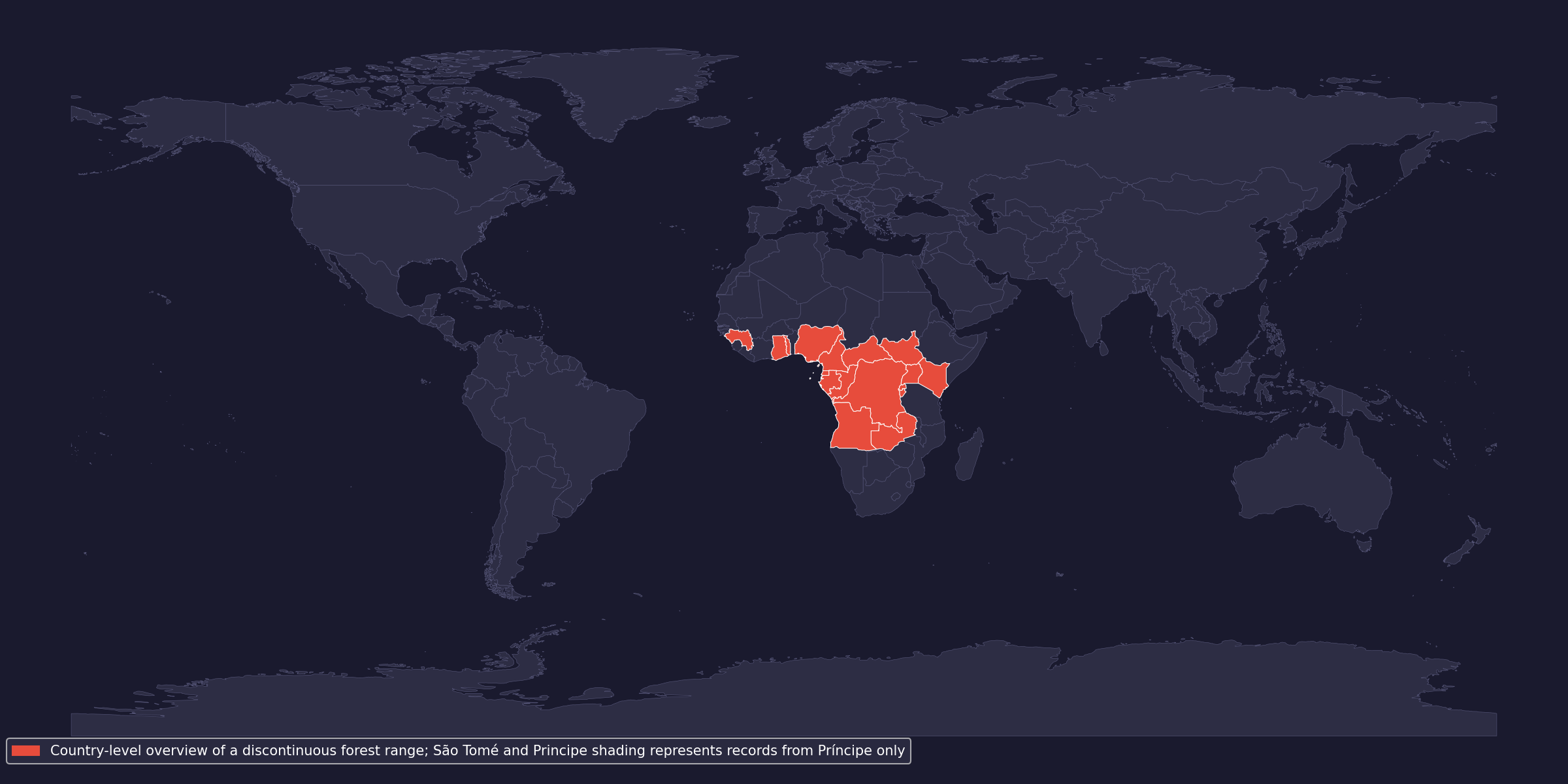
The species occupies equatorial forest and forest-agriculture mosaics from parts of West Africa through the Congo Basin to western Kenya and neighbouring countries. Confirmed records include Guinea, Ghana, Togo, Nigeria, Cameroon, Equatorial Guinea, Gabon, the Republic of the Congo, Central African Republic, Democratic Republic of the Congo, South Sudan, Uganda, Kenya, Rwanda, Burundi, Angola, Zambia and Príncipe. Published Benin records are disputed, so Benin is omitted from this map.
Country shading greatly overstates actual occupancy. Jameson’s mamba is associated with forest, secondary growth, plantations and wooded riparian corridors and is absent from large dry or open parts of several range states.
⚖️ Legal status
No species-specific entry for D. jamesoni was found in the CITES Appendices, the EU wildlife-trade annexes or the Bern Convention appendices when checked on 29 August 2026. Range states nevertheless regulate wildlife capture and export, and an animal without traceable origin should not enter a collection.
Dangerous-animal rules may require a licence, inspected room, competence evidence, insurance and a written emergency plan. Keep the invoice, breeder and locality records, photographs, import or transfer papers and written authority decisions. Treaty non-listing does not make possession or transport automatically lawful.
🤌 Husbandry
House one snake alone in a locked venomous-animal room behind secondary containment. Two tall furnished compartments connected by remotely closable shift doors allow feeding and cleaning only after the animal is positively secured. Vents, drains, cable entries and door tracks must resist both escape and unauthorised opening.
Quarantine for at least 90 days in simple, observable housing with dedicated tools and preferably separate air. Record weight, food, sheds, faeces and breathing. Wild-origin or uncertain animals need reptile-veterinary parasite assessment; imported mambas should never be added directly to an established collection.
💡 Lighting
Provide 10-12 hours of bright, diffuse visible light and full darkness overnight. Opaque elevated retreats and dense foliage must allow the snake to leave the illuminated area. Fit lamps outside primary containment or behind rigid guards.
Measured low-level UVB over part of the upper warm zone may be offered as a Ferguson Zone 2 opportunity. It is optional enrichment, not a substitute for secure furniture, shade or whole-prey nutrition.
🌡 Heating and temperature
Maintain ambient air at 24-28°C, an upper basking surface at 30-32°C, a shaded retreat at 22-24°C and nights around 20-23°C. Measure air and perch surfaces at several heights; warm air can produce an unseen overheated ceiling layer. Every heater needs a thermostat and an independent high-temperature alarm.
Do not heat the entire canopy uniformly. A usable gradient must connect warm, neutral and cool perches without forcing the snake onto the floor. Seasonal cycling belongs only to a documented breeding programme and is inappropriate for juveniles, thin, ill or newly arrived animals.
💧 Humidity and water
Keep relative humidity mostly at 60-80%, with regular drying of exposed branches and continuous air exchange. During shedding, provide a local retreat at 75-90% instead of making the entire enclosure wet. Condensation, saturated substrate and stale air increase skin and respiratory problems.
Supply a stable clean water bowl through protected service. Some individuals drink readily from leaves after light spraying, but a dripper needs drainage and never replaces a disinfected bowl.
🌿 Enclosure and decoration
An adult enclosure should be at least 240 x 120 x 240 cm. Use thick fixed branches, broad shelves, dense visual barriers and two elevated shift boxes. Every perch must support the whole animal, and staff must be able to account for its head and body before operating a service door.
Use 6-10 cm of compactable soil and leaf litter over drainage, or paper during quarantine. Avoid unstable branches, adhesive décor, sharp wire and inaccessible cavities. Doors need two independent mechanical locks; the room needs an airlock or equivalent barrier and clear venom warnings.
🐁 Feeding
Offer appropriately sized frozen-thawed rodents, with occasional suitable birds only within an institutional nutrition plan. Most adults stay lean on moderate meals every 10-21 days. Use body condition and recorded weight rather than the force of the feeding response.
Feed through a protected port and shift the animal before removing refused prey. Live rodents create avoidable injuries and unsafe retrieval tasks. Balanced whole prey requires no routine supplement dusting.
🛡 Operational safety and emergencies
Routine free handling, pinning and manual restraint are unacceptable. Use protected contact, shift boxes, transparent shields and equipment intended for fast arboreal elapids. Two trained staff must attend whenever primary containment opens, with roles and abort criteria agreed before work begins.
Before acquisition, the receiving hospital or poison centre must review the bite plan, likely transport time, species card and route to expert antivenom advice. Product coverage differs by region; private possession of antivenom is not a treatment system.
Treat every bite as an immediate emergency. Withdraw safely, call emergency services, remove rings and tight items, keep the patient still and follow the regional poison centre’s immobilisation advice. Do not cut, suck, ice, shock, apply a tight tourniquet or delay transport to catch the snake.
🥚 Breeding notes
The species is oviparous; reported clutches commonly contain about 5-16 eggs. A conservative institutional planning range is 27-29°C and roughly 80-90 days, with calibrated egg-level monitoring and adjustment to the documented line.
Pairing creates additional exposure and produces fast, arboreal venomous neonates. Verify identity, sex, locality, permits and placements before introduction. Individual locked rearing units and complete origin records must be ready before hatching.
🩺 Common problems
- Rostral injury: repeated rubbing usually indicates poor cover, visual stress or an unusable retreat.
- Burns and overheating: thermostat and guard every heater; check upper perches independently.
- Respiratory disease: abnormal sounds, bubbles or open-mouth breathing require urgent reptile-veterinary evaluation.
- Dysecdysis: correct hydration, airflow and the local humid retreat without manual restraint.
- Obesity: use measured meals, longer adult intervals and usable climbing routes.
- Mites, internal parasites and stomatitis: strict quarantine and diagnostics are essential for uncertain-origin animals.
📌 Conclusion
Jameson’s mamba requires a tall enclosure that can be serviced entirely by shifting and barriers. Acquisition is defensible only when legal provenance, two-person protected contact and a hospital-coordinated response are already functioning.
📚 Sources and further reading
- ReptiFiles — checked first on 29 August 2026; no species-specific care guide was found.
- The Reptile Database: Dendroaspis jamesoni
- GBIF species record: Dendroaspis jamesoni
- Tolley et al. 2025 — phylogeny and species delimitation in Dendroaspis
- Luiselli et al. — ecology and arboreality of Jameson’s mamba
- WHO: Guidelines for prevention and clinical management of snakebite in Africa
- Baines et al. — UV lighting guidance for captive reptiles
- CITES Appendices
- EU wildlife-trade annexes, Commission Regulation (EU) 2026/1383
- Bern Convention appendices