Share

Eastern Russell's Viper
🔤 Taxonomy
Daboia siamensis is the accepted name for the eastern Russell’s viper. Older labels commonly use Vipera russelli siamensis, Daboia russelii siamensis, V. r. formosensis, V. r. limitis or V. r. sublimitis. It was elevated from the broad Daboia russelii complex using geographic, pattern, molecular and envenomation evidence.
Strict D. russelii is the South Asian western species; D. siamensis covers eastern mainland and island populations. DNA barcode work suggests additional structure, and Chinese, Taiwanese and Indonesian records are not interchangeable with Thai or Myanmar animals. Preserve country, island, coordinates, parentage and the exact name in every permit and medical file.
📌 Description
The eastern Russell’s viper is a large, heavy-bodied viper, generally 100-150 cm. It may remain still under cover, hiss loudly and strike with exceptional speed. A purpose-built shift system is essential for an animal of this mass and reach.
Envenomation can produce coagulopathy, bleeding, local tissue injury, shock, kidney injury and neurological effects; clinical patterns and antivenom effectiveness vary by region. This is an expert-only institutional species. It is a counterpart to, not a husbandry synonym for, D. russelii.
📋 Quick reference
| Care point | Practical target |
|---|---|
| Adult size and lifespan | Usually 100-150 cm; approximately 15-20 years |
| Adult enclosure | At least 180 x 90 x 75 cm with two lockable shift hides |
| Temperature | Ambient 25-29°C; basking 31-33°C; cool hide 23-25°C |
| Night | 21-25°C |
| Humidity | 55-75%; local 70-85% support during shedding |
| Feeding | Frozen-thawed rodents every 10-21 days, adjusted to condition |
| Safety | Protected contact, two-person rule, locality-aware bite and escape plans |
| Quarantine | At least 90 days with dedicated equipment and veterinary screening |
☠️ Venom
This species is venomous. Venom exposure can cause pain, swelling or other systemic effects, and severity varies with species, locality, bite site and the amount delivered. A small wound or apparently dry bite is not proof of safety; every bite or sting requires urgent medical assessment.
If an incident occurs, move away, call emergency services or a poison centre, keep the patient still, remove rings and other constricting items, and follow dispatcher instructions. Do not use a tourniquet, cut or suck the wound, apply ice or electricity, give alcohol or medicines as a home treatment, or attempt to catch the animal. Antivenom choice and dosing are hospital decisions; verify the relevant product and local availability in advance. Sources: WHO snakebite guidance and appropriate species-specific toxinology or medical references listed below.
🌍 Distribution
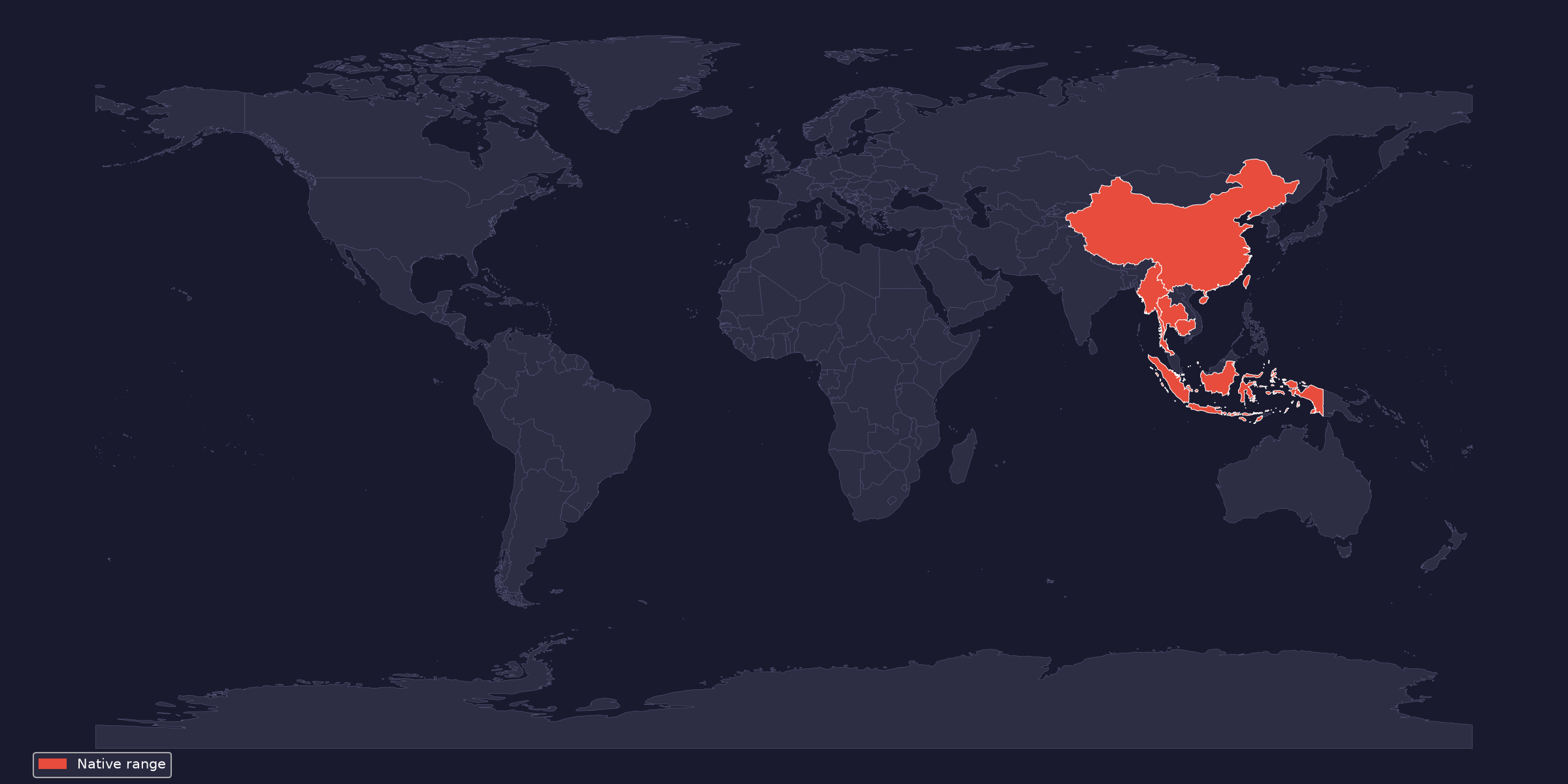
Current database records place D. siamensis in Myanmar, Thailand, Cambodia, southern China—especially Guangdong and Fujian—Taiwan, and Indonesia from eastern Java through several Lesser Sunda islands including Komodo, Flores, Lembata/Lomblen and the Ende region. Records from Yunnan remain questioned. Apparent gaps, particularly between mainland and island populations, are real biogeographic and documentation issues rather than proof of one uniform lineage.
The whole-country map necessarily overstates occupation and cannot show the restricted Chinese provinces, Taiwanese distribution, Myanmar and Thai gaps, individual Indonesian islands, questionable Yunnan records or possible cryptic lineages. Treat every Myanmar, Thai, Chinese, Taiwanese or Indonesian specimen as provenance-specific; do not infer origin from pattern.
The Nakhon Nayok climate point falls within the uncertainty area of a reviewed Thai occurrence. It represents one monsoonal mainland setting only and says nothing about Taiwan or the seasonally drier Indonesian islands.
🌡 Climate across the native range
Monthly normals from a Nakhon Nayok climate point within the uncertainty area of a reviewed Thai occurrence:
Nakhon Nayok — Thailand (within reviewed occurrence uncertainty)
| Month | Min °C | Mean °C | Max °C | RH % |
|---|---|---|---|---|
| January | 17.0 | 21.4 | 26.3 | 69 |
| February | 18.2 | 22.7 | 27.7 | 70 |
| March | 20.0 | 24.0 | 28.9 | 76 |
| April | 21.3 | 24.7 | 29.3 | 81 |
| May | 21.8 | 24.3 | 28.3 | 87 |
| June | 21.5 | 23.7 | 27.3 | 89 |
| July | 21.2 | 23.2 | 26.7 | 90 |
| August | 21.0 | 23.0 | 26.5 | 91 |
| September | 20.8 | 22.9 | 26.5 | 91 |
| October | 20.1 | 22.7 | 26.4 | 86 |
| November | 18.8 | 22.2 | 26.3 | 75 |
| December | 16.8 | 21.0 | 25.7 | 69 |
Weather data by Open-Meteo.com · CC BY 4.0 · Monthly normals calculated by Herpeton Academy from daily archive values for 1991-2020.
Location references use GBIF.org occurrence data where available; original occurrence records retain their source dataset licenses.
⚖️ Legal status
CITES currently lists Daboia russelii in Appendix III at India’s request, and the EU places that entry in Annex C. The adopted CITES nomenclature has historically treated eastern D. siamensis within the broader D. russelii concept; current CITES Animals Committee documents discuss removing D. siamensis from that synonymy, but the taxonomic effect remains unresolved as checked on 17 August 2026. Treat Appendix III/Annex C documents as potentially required until the competent import and export authorities confirm otherwise in writing.
The Bern Convention is not relevant to this Asian species. National and local wildlife laws and dangerous-animal rules may separately govern collection, possession, registration, transport, breeding, sale and import. Keep permits, certificates of origin, invoices, island or province provenance, photographs and the legal-check date.
🤌 Husbandry
House one snake in a controlled-access venomous room with secondary containment, sealed penetrations and a door protocol. Two robust lockable shift hides across the thermal gradient must contain the entire animal and allow confirmation before the primary enclosure opens.
Quarantine for at least 90 days with simple furniture, dedicated tools and preferably separate airspace. Record weight, meals, sheds, faeces, mouth, skin and breathing. Imported or poorly documented animals need reptile-veterinary screening for dehydration, parasites, mites, respiratory disease and stomatitis.
Never cohabit for display. Mainland and island animals can differ biologically and legally, and powerful feeding responses make protected solitary housing the safe default.
💡 Lighting
Provide 10-12 hours of bright visible light and full darkness. Shade both hides and provide partial overhead cover. Lamps belong outside primary containment or behind locked guards.
Low-output UVB may be offered as a Ferguson Zone 1 opportunity. Measure at snake level and preserve a completely shaded route. Whole prey, not supplements or UVB alone, supplies the diet.
🌡 Heating and temperature
Maintain ambient air at 25-29°C, basking surface at 31-33°C, cool hide at 23-25°C and nights around 21-25°C. Thermostat and guard every heat source; use independent probes and high-temperature alarms.
Do not make the enclosure uniformly hot. Mainland monsoon localities, subtropical Taiwan and dry-season Indonesian islands are not thermally identical. Use provenance and measured seasonal records for any breeding cycle; do not impose cold brumation on this tropical-subtropical species.
💧 Humidity and water
Use 55-75% humidity with strong ventilation and a dry surface as a practical mainland baseline. During shedding, one hide can reach 70-85%. Indonesian provenance may require a more pronounced wet-dry cycle, while stagnant saturated housing remains harmful to every lineage.
Provide a heavy bowl of clean water through protected access. Watch body mass, urates and sheds. Correct dehydration with environmental and veterinary assessment, not by making the enclosure permanently wet.
🌿 Enclosure and decoration
An adult needs at least 180 x 90 x 75 cm. Install two lockable shift hides, anchored cork or rock-like cover, visual barriers and a wide unobstructed inspection route. The floor and door hardware must withstand a heavy, forceful snake.
Use 6-10 cm of compactable soil and leaf litter with a dry top layer; paper suits quarantine. Avoid unstable stone, aromatic wood, waterlogged mulch and décor that must be lifted. Seal vents and cable ports and use two-step mechanical locks and a venom warning.
🐁 Feeding
Wild diets are dominated by rodents and other small vertebrates. Captive-established adults usually accept appropriately sized frozen-thawed rats or mice every 10-21 days. Large vipers become obese readily; use weight and body shape, not feeding response, to set the interval.
Feed with long tongs from a protected port and shift before recovering refused prey. Live rodents create avoidable injury and servicing danger. Balanced whole prey needs no routine calcium or vitamin dusting.
🛡 Operational safety and emergencies
Never free-handle, pin, neck or manually restrain in routine care. Use lockable shift boxes, heavy-specification hooks, transparent barriers and protected ports. Two trained adults attend every primary opening; veterinary work requires a planned professional anaesthetic and containment team.
Before acquisition, consult the receiving hospital or poison centre using the exact country, island and lineage. Products intended for South Asian D. russelii must not be assumed effective for every D. siamensis population. Antivenom is selected and administered in hospital, never privately.
A bite is an immediate emergency. Move away, call emergency services, remove constricting objects, keep still, immobilize the limb and follow poison-centre advice. Do not cut, suck, ice, shock or tightly tourniquet, and do not delay to capture the snake.
Maintain an escape plan with room isolation, public exclusion, accountability, search zones, secure containers and named decision-makers. Stop work whenever the snake cannot be positively located.
🥚 Breeding notes
D. siamensis is viviparous. Litters commonly contain several to several dozen young, with roughly 5-40 a practical documented range. Timing varies among mainland, Taiwanese and Indonesian populations and should not be extrapolated from D. russelii without provenance evidence.
Confirm sex, lineage, lawful breeding authority and placement before pairing. Prepare individually locked neonate enclosures and complete parentage, medical and escape records before birth. Never merge undocumented country or island lines.
🩺 Common problems
- Obesity: use measured prey, long intervals and regular weighing.
- Dehydration or retained shed: review water, humidity retreat, ventilation and disease.
- Respiratory disease: wheezing, bubbles, open-mouth breathing or head elevation need urgent veterinary care.
- Dermatitis: investigate saturated dirty substrate, poor ventilation, mites and abrasion.
- Parasites and stomatitis: weight loss, abnormal faeces or oral swelling are especially concerning in imports.
- Burns and overheating: prevent with guarded thermostatic heat and a genuine cool hide.
- Regurgitation: review meal size, temperature, disturbance, infection and parasites with a veterinarian.
Do not attempt hands-on home treatment. Secure the snake in a shift compartment and arrange an experienced reptile-veterinary examination.
📌 Conclusion
Daboia siamensis requires a licensed institution that treats each mainland or island provenance as medically, legally and biologically meaningful. The split from D. russelii must be reflected in labels and hospital planning even while CITES nomenclature remains unsettled.
📚 Sources and further reading
- ReptiFiles — checked first on 17 August 2026; no species-specific care guide was found.
- The Reptile Database: Daboia siamensis
- GBIF species record: Daboia siamensis
- Thorpe, Pook & Malhotra — phylogeography of the Russell’s viper complex
- Laopichienpong et al. — DNA barcoding and diversity in Thai venomous snakes
- WHO South-East Asia: Guidelines for the management of snakebites
- CITES Animals Committee taxonomic review: Daboia russelii / D. siamensis
- Baines et al. — UV lighting guidance
- Northern Ireland government venomous-reptile guidance
- CITES Appendices
- EU wildlife-trade annexes, Commission Regulation (EU) 2026/1383
- Bern Convention appendices