Share

Russell's Viper
🔤 Taxonomy
Daboia russelii is the accepted name for the western Russell’s viper. Older literature and paperwork often use Vipera russelli, Vipera russelii, Daboia russelli, or Daboia russelii russelii. The single-l spelling in russelii is the accepted species spelling.
Southeast Asian populations formerly included in this taxon are now generally treated as Daboia siamensis, the eastern Russell’s viper. This split matters for range, venom, antivenom consultation, and CITES paperwork. Do not label a Southeast Asian animal D. russelii without current taxonomic and provenance evidence.
📌 Description
Russell’s viper is a large, heavy South Asian viper responsible for severe coagulopathy, bleeding, tissue injury, shock, kidney injury, and neurological effects in human envenomation. Adults commonly measure 100-150 cm and may live 15-20 years. Its loud hiss, fast strike, and strong feeding response demand a purpose-designed system.
This is an expert-only display animal. Its enormous medical significance does not make a hospital response simple: clinical syndromes and effective antivenom products vary geographically. Lawful origin, protected contact, species and locality records, and a hospital-coordinated plan are mandatory.
📋 Quick reference
| Care point | Practical target |
|---|---|
| Adult size and lifespan | Usually 100-150 cm; about 15-20 years |
| Adult enclosure | At least 180 x 90 x 75 cm, with two lockable shift hides |
| Temperature | Ambient 25-29°C; basking 31-33°C; cool retreat 23-25°C |
| Night | 22-25°C |
| Humidity | 45-65%; local 65-80% support during shedding |
| Feeding | Moderate frozen-thawed rodents every 10-21 days |
| Safety | Protected contact, two-person rule, hospital bite plan and escape plan |
| Quarantine | At least 90 days with dedicated equipment and veterinary screening |
☠️ Venom
This species is venomous. Venom exposure can cause pain, swelling or other systemic effects, and severity varies with species, locality, bite site and the amount delivered. A small wound or apparently dry bite is not proof of safety; every bite or sting requires urgent medical assessment.
If an incident occurs, move away, call emergency services or a poison centre, keep the patient still, remove rings and other constricting items, and follow dispatcher instructions. Do not use a tourniquet, cut or suck the wound, apply ice or electricity, give alcohol or medicines as a home treatment, or attempt to catch the animal. Antivenom choice and dosing are hospital decisions; verify the relevant product and local availability in advance. Sources: WHO snakebite guidance and appropriate species-specific toxinology or medical references listed below.
🌍 Distribution
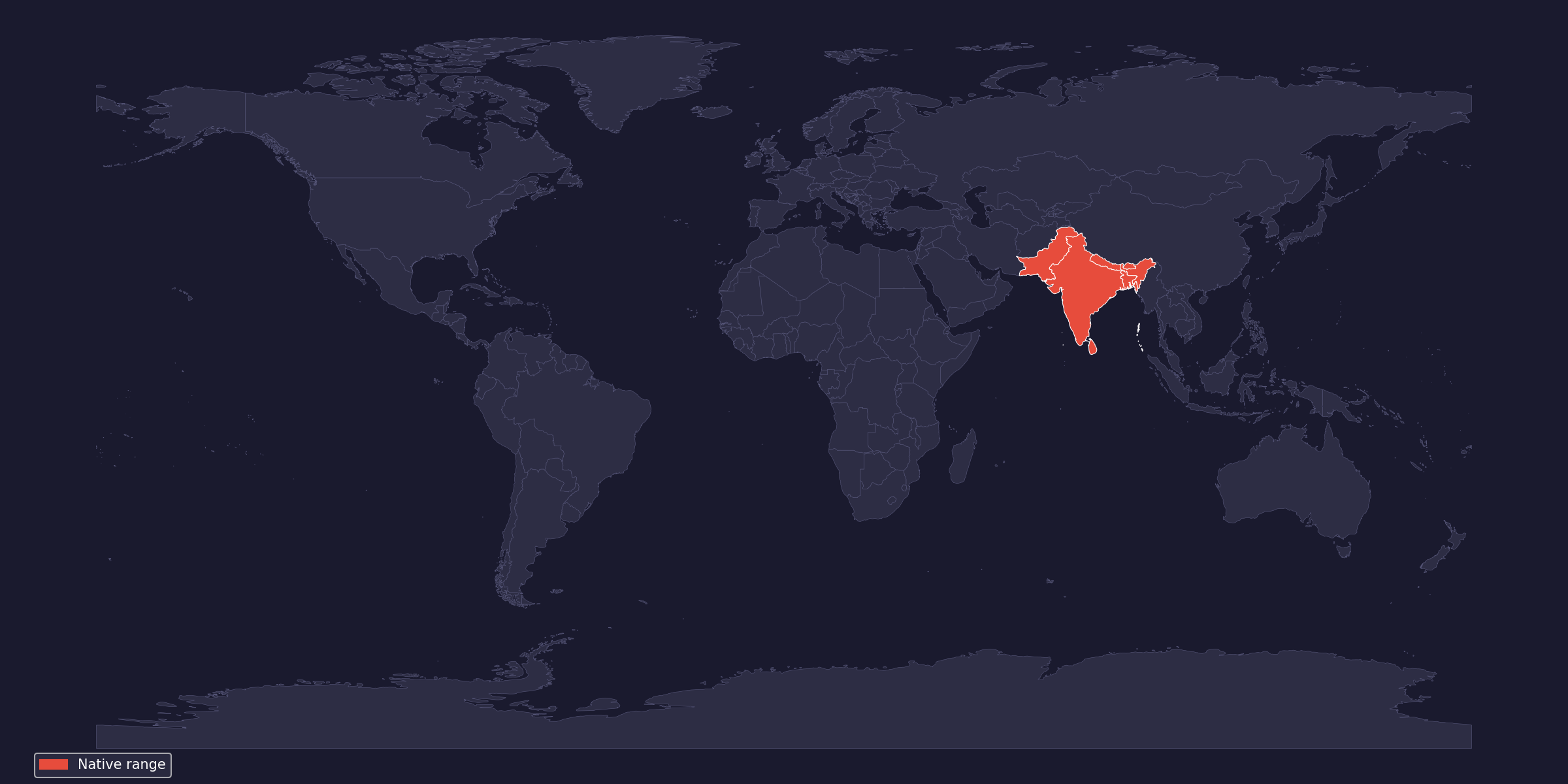
Under the current split, D. russelii occurs in Pakistan, India, Nepal, Sri Lanka, Bangladesh and probably Bhutan. D. siamensis occupies Myanmar and parts of Southeast and East Asia. Older records often combine both species, so maps and legal documents may show the former broad concept.
The country-level range map follows the restricted western species but cannot show its patchy absence from dense forest, extreme desert, or unsuitable highland within each country. Russell’s vipers use grassland, scrub, dry and open forest, agricultural mosaics, plantations, and settlement edges rich in rodents. The climate table represents peninsular India, not all locality conditions.
🌡 Climate across the native range
Monthly climate normals from a reviewed occurrence in peninsular India:
Andhra Pradesh — India (reviewed occurrence)
| Month | Min °C | Mean °C | Max °C | RH % |
|---|---|---|---|---|
| January | 18.6 | 23.6 | 29.5 | 71 |
| February | 20 | 25.9 | 32.8 | 63 |
| March | 22.3 | 29 | 36.5 | 57 |
| April | 25.3 | 31.6 | 38.6 | 56 |
| May | 28.1 | 33.3 | 39.3 | 49 |
| June | 27.1 | 31.2 | 36 | 56 |
| July | 26 | 29.5 | 33.8 | 61 |
| August | 25.4 | 28.9 | 32.9 | 64 |
| September | 25 | 28.6 | 32.8 | 68 |
| October | 23.6 | 27.1 | 31.5 | 75 |
| November | 21.2 | 24.9 | 29.2 | 79 |
| December | 18.9 | 23.2 | 28.1 | 77 |
Weather data by Open-Meteo.com · CC BY 4.0 · Monthly normals calculated by Herpeton Academy from daily archive values.
Location references use GBIF.org occurrence data where available; original occurrence records retain their source dataset licenses.
⚖️ Legal status
Daboia russelii is listed in CITES Appendix III at the request of India and in EU Annex C. For international trade, an export from India needs the appropriate Appendix III export permit; exports from other range states require the applicable certificate of origin, while re-exports require the relevant documentation. The taxonomic split from D. siamensis has created interpretation issues, so confirm the name, origin country, and current CITES treatment with the authorities before movement.
The Bern Convention is not relevant to the South Asian range. National law can be much stricter: India lists D. russelii under its domestic wildlife legislation, and venomous-animal licensing, collection bans, import rules, inspection, insurance, and emergency planning apply independently elsewhere. Retain CITES documents, certificates of origin, invoices, importer and breeder data, photographs, and the legal-check date.
🤌 Husbandry
House one animal per enclosure. The venomous room needs controlled access, secondary containment, locked vents and cable ports, and two shift hides across the gradient. Water, waste, and décor must be reachable only after the animal is visibly secured behind a closed barrier.
Quarantine at least 90 days in simple housing with separate tools and preferably separate air. Record weight, girth, meals, sheds, faeces, respiration, mouth, and behaviour. Imports and poorly documented animals require veterinary assessment for parasites, mites, dehydration, stomatitis, and respiratory disease.
Do not cohabit for display. This species may remain still and then accelerate abruptly; safety must depend on physical design, not perceived temperament.
💡 Lighting
Provide 10-12 hours of broad visible light and full darkness at night. Break up exposure with two shaded hides and vegetation or screens. Mount or guard lamps outside primary containment.
Low-level UVB may be offered as a Ferguson Zone 1 opportunity over part of the warm area, although it is not established as essential for a whole-prey snake. Shade must remain freely available.
🌡 Heating and temperature
Maintain ambient air at 25-29°C, a local basking surface at 31-33°C, a cool hide at 23-25°C, and nights around 22-25°C. Thermostat every heater and verify air and surface readings independently at snake level.
Do not maintain the whole enclosure above 29°C. Field research shows activity can fall during the hottest dry period; captive animals also need a true cool retreat. Protect lamps, avoid heat rocks, and use room cooling and alarms where summer heat can overwhelm the gradient. Seasonal rain or temperature manipulation belongs only in a locality-informed breeding programme.
💧 Humidity and water
Use 45-65% relative humidity as a practical baseline, with a local humid hide at 65-80% during shedding. Sri Lankan, coastal, and monsoonal localities may experience higher seasonal humidity, but a wet floor with stagnant air is unsafe. Allow the surface to dry while one deeper zone buffers moisture.
Provide a stable bowl of clean water that can be changed through protected access. Monitor drinking, urates, and weight through hot periods and pregnancy.
🌿 Enclosure and decoration
An adult needs at least 180 x 90 x 75 cm. Provide two secure shift hides, broad low cover, fixed cork or stone-like surfaces, and enough open floor for locomotion and complete visual checks. Do not create narrow service corners where the snake can remain outside the shift route.
Use 6-10 cm of compactable soil, washed sand, and fine clay or leaf mix. Paper is appropriate during quarantine. Avoid pure loose sand, aromatic wood, sharp chips, unstable rocks, adhesive materials, and deep clutter. Every opening needs a two-step mechanical lock and a complete venom hazard label.
🐁 Feeding
Feed appropriately sized frozen-thawed rodents. Adults usually take moderate meals every 10-21 days; weigh the animal and avoid oversized prey. Russell’s vipers can become obese, and a forceful feeding response is not evidence of need.
Present prey with long tongs from the protected service position. Shift the snake before removing refused food. Live rodents cause avoidable injuries and unsafe retrieval. Routine supplements are unnecessary with balanced whole prey.
🛡 Operational safety and emergencies
Never free-handle, pin, neck, or manually restrain this species in routine care. Use lockable shift boxes, hooks and transparent barriers appropriate to a heavy fast viper, protected ports, and two trained adults whenever primary containment opens. Clinical handling requires a veterinarian and a planned professional anaesthesia and restraint team.
Before acquisition, agree a written bite protocol with the receiving hospital or poison centre. Include photographs, the exact locality if known, both current and older names, transport arrangements, and a route to expert antivenom advice. Antivenom is region- and product-dependent; never assume availability or administer it privately.
A bite is an immediate medical emergency. Move away, call emergency services, remove constricting objects, keep the patient still, immobilize the limb, and follow poison-centre guidance. Do not cut, suck, ice, shock, tightly tourniquet, or delay transport to capture the snake.
🥚 Breeding notes
The species is viviparous and produces approximately 5-50 live young, with litter size strongly related to female size and condition. There are no eggs to incubate. Females require generous recovery after pregnancy.
Breeding creates many dangerous neonates and increases open-containment work. Confirm sex, locality, lawful breeding authority, and future placement before pairing. Prepare individually locked labelled enclosures and CITES or origin documentation before births.
🩺 Common problems
- Obesity: prevent with moderate prey, long intervals, weighing, and space for locomotion.
- Overheating and burns: use local guarded heat, thermostats, alarms, and a genuine cool hide.
- Respiratory disease: bubbles, open-mouth breathing, abnormal sounds, or head elevation require urgent veterinary care.
- Dermatitis and scale rot: associated with wet dirty floors and insufficient ventilation.
- Dysecdysis and dehydration: review water, humid hide, temperatures, and systemic health; do not restrain at home.
- Parasites and stomatitis: mites, abnormal faeces, weight loss, oral swelling, or discharge are major concerns in imports.
- Regurgitation: review prey size, temperature, post-feeding disturbance, infection, and parasites with a veterinarian.
📌 Conclusion
Daboia russelii belongs only in a licensed facility that can document the correct species, locality and CITES chain, service a large fast viper behind locked barriers, and coordinate region-aware medical response. Confusion with D. siamensis is a legal and medical risk, not merely a label problem.
📚 Sources and further reading
- ReptiFiles — checked first on 16 August 2026; no species-specific care guide was found.
- The Reptile Database: Daboia russelii
- GBIF species record: Daboia russelii
- Marya et al. — natural history in an Indian agricultural landscape
- WHO South-East Asia: Guidelines for the management of snakebites
- Baines et al. — UV lighting guidance for captive reptiles
- Northern Ireland government guidance on keeping venomous snakes and lizards
- CITES Appendices
- CITES Animals Committee: nomenclature of Daboia russelii and D. siamensis
- EU wildlife-trade annexes, Commission Regulation (EU) 2026/1383
- Bern Convention appendices