Share

Uracoan Rattlesnake
🔤 Taxonomy
Crotalus vegrandis Klauber, 1941 is accepted as a species by GBIF, NCBI and the current Reptile Database, but its rank remains disputed. It has repeatedly been treated as C. durissus vegrandis, and recent molecular delimitation studies have not consistently recovered it as distinct from C. durissus. Record both names, the authority used, parents, photographs and exact lawful locality; never relabel an undocumented durissus-complex snake by appearance alone.
📌 Description
The Uracoan rattlesnake is a small, stout eastern Venezuelan rattlesnake, usually roughly 55-80 cm and rarely approaching 90 cm. Its compact size is not a safety advantage. Published venom work identifies neurotoxic, myotoxic and haemorrhagic components, so a bite may cause progressive weakness, muscle injury, coagulation disturbance, kidney injury, bleeding and respiratory failure even when early local swelling seems limited. Avoid simplistic potency rankings: the operational fact is that every bite can become a severe systemic emergency.
📋 Quick reference
| Care point | Practical target |
|---|---|
| Adult enclosure | At least 120 x 60 x 60 cm with two externally lockable sections |
| Day temperatures | 24-28°C ambient; 30-32°C basking; 22-24°C cool retreat |
| Night | 20-24°C |
| Humidity | 50-70%; local 70-80% shed support, with a dry surface available |
| Lighting | 10-13 hours; optional measured Ferguson Zone 1 UVB |
| Feeding | Modest frozen-thawed rodents; adults commonly every 14-21 days |
| Safety | Protected contact, double containment, trained backup and Venezuela-specific hospital plan |
☠️ Venom
This species is venomous. Venom exposure can cause pain, swelling or other systemic effects, and severity varies with species, locality, bite site and the amount delivered. A small wound or apparently dry bite is not proof of safety; every bite or sting requires urgent medical assessment.
If an incident occurs, move away, call emergency services or a poison centre, keep the patient still, remove rings and other constricting items, and follow dispatcher instructions. Do not use a tourniquet, cut or suck the wound, apply ice or electricity, give alcohol or medicines as a home treatment, or attempt to catch the animal. Antivenom choice and dosing are hospital decisions; verify the relevant product and local availability in advance. Sources: WHO snakebite guidance and appropriate species-specific toxinology or medical references listed below.
🌍 Distribution
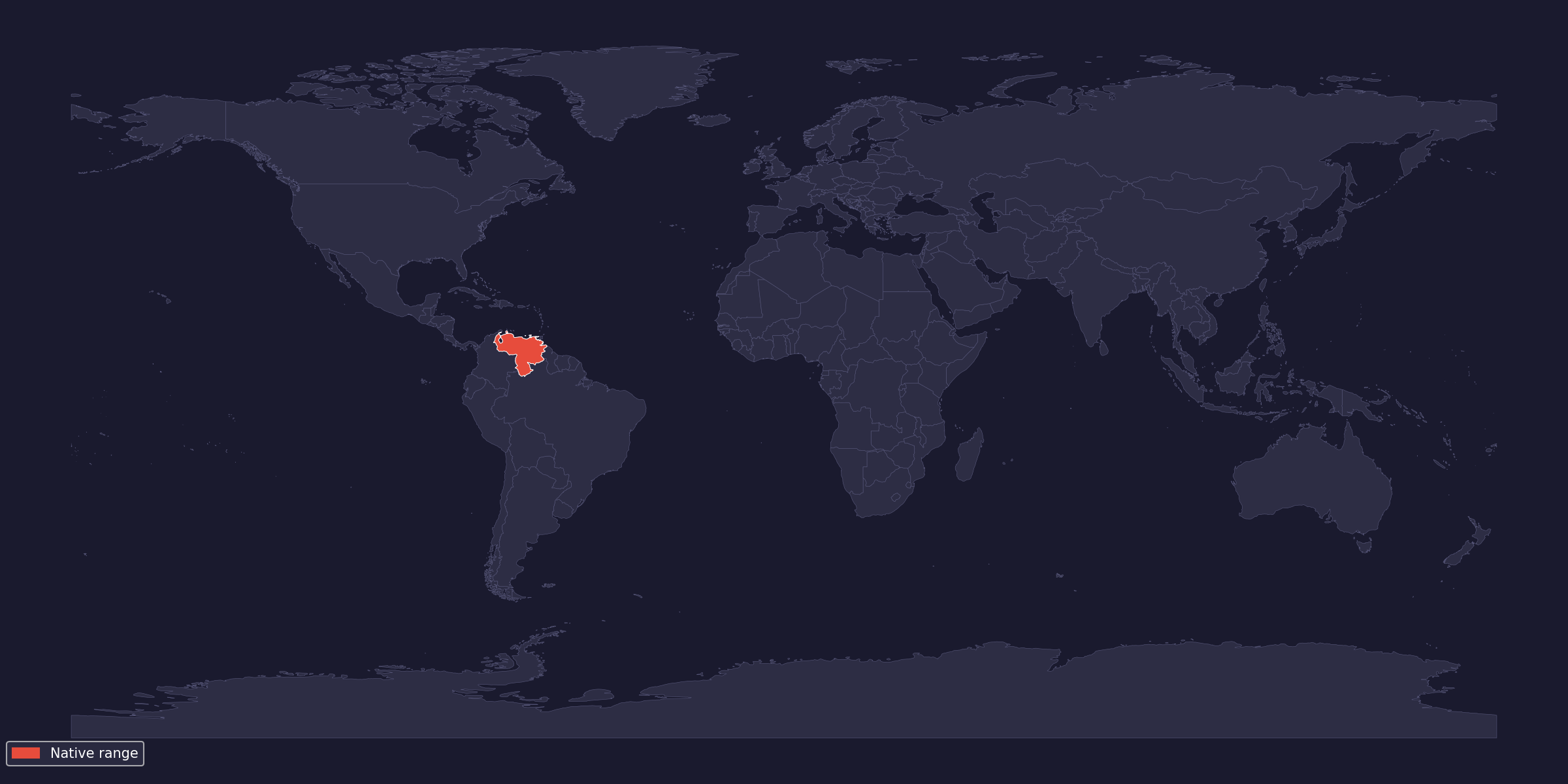
The species is endemic to eastern Venezuela, centred on the seasonally flooded and seasonally dry savannas around Uracoa in Monagas and adjacent lowlands. Records are limited and the exact boundary depends partly on the taxonomic treatment used. Open savanna, scrub islands, gallery vegetation and raised, better-drained refuges create a mosaic rather than a uniformly wet tropical habitat.
Country-level mapping greatly overstates this narrow range and cannot resolve C. vegrandis from neighbouring C. durissus records. Locality documentation is therefore essential for identification, climate planning and medical records.
⚖️ Legal status
Checked on 21 August 2026: Crotalus vegrandis is not listed in CITES Appendices I-III. Commission Regulation (EU) 2026/1383 includes Crotalus spp. in EU Annex D, so current EU import-reporting procedures apply. The Bern Convention is not relevant.
The historic name C. durissus vegrandis can create confusion with the separate CITES Appendix III entry for C. durissus. It does not make the accepted species automatically Appendix III, but international movements should carry a written nomenclatural determination from the relevant authorities. Venezuelan native-wildlife and export law, and destination-country venomous-animal rules, may prohibit or license collection, possession, transfer and transport. Never encourage field collection; retain permits, invoices, export/import records, parentage, locality, photographs and every legal check.
🤌 Husbandry
Use a locked, escape-resistant room as secondary containment around the locked primary enclosure. Seal penetrations, control keys and label both barriers with the accepted and historic names, locality and animal count. The enclosure needs two positive-lock compartments or a full-body shift; water, cleaning and inspection occur only with the snake visually confirmed behind a closed barrier.
Only staff with documented supervised venomous-snake training should work the animal. Never free-handle, tail, pin, neck or manually restrain during routine care. A second trained adult with communications and the written plan attends every primary opening. Quarantine for at least 90 days with paper, simple shifts, dedicated tools and veterinary parasite and disease assessment where indicated. House singly.
💡 Lighting
Provide bright visible light for 10-13 hours, adjusted modestly to the documented seasonal cycle, and full darkness at night. Low-output UVB around Ferguson Zone 1 may be offered over part of the warm side, with complete shade. Keep lamps, cables and probes outside containment or behind locked guards.
🌡 Heating and temperature
Maintain 24-28°C daytime air, a 30-32°C basking surface, a 22-24°C cool retreat and 20-24°C nights. Use guarded overhead heat on a thermostat with independent air and surface measurements. Its tropical origin does not justify a uniformly hot enclosure.
Do not brumate. Seasonal management is better expressed through modest day-length, rainfall and feeding changes while maintaining safe thermal choice. New, thin, gravid or ill animals should not be subjected to experimental seasonal reductions.
💧 Humidity and water
Maintain roughly 50-70% general humidity with strong ventilation, then provide a local 70-80% humid shift during shed. Seasonal rain can be represented by periodically moistening part of the deeper substrate and increasing drinking-water checks, not by flooding or keeping the entire floor wet.
Provide a stable bowl of clean water through protected access. Persistent wet belly scales, condensation, stale air or prolonged soaking require correction and veterinary review. Preserve a dry surface and dry refuge in every season.
🌿 Enclosure and decoration
One adult needs at least 120 x 60 x 60 cm despite the species’ small size. Use 8-12 cm of compactable mineral soil with limited leaf litter, anchored cork and flat rock, warm and cool hides, low cover and a clear inspection lane. Quarantine on paper.
Avoid deep planting that prevents a full visual count, unstable stone, aromatic wood and furnishings that must be lifted while the section is occupied. Every vent and cable gap must contain neonates.
🐁 Feeding
Offer appropriately sized frozen-thawed mice or small rats that produce only a modest contour. Juveniles may feed every 7-10 days; established adults commonly every 14-21 days according to weight, activity and reproductive state. Whole prey requires no routine supplement.
Feed through a protected port or after shifting. Do not use live rodents or move the snake to an open feeding tub. Record serial weight because a small sedentary rattlesnake can become obese quickly.
🛡 Operational safety and emergencies
Maintain and rehearse written opening, escape, bite, fire and transport procedures without a live animal. Any lost visual contact stops work. The escape response isolates the room, excludes the public, accounts for people and animals and assigns one trained decision-maker.
Before acquisition, coordinate with emergency services, a poison centre, medical toxicologist and receiving hospital. Provide both taxonomic names and Venezuelan locality. Do not assume that a generic North American rattlesnake product is appropriate; antivenom selection, storage and administration belong to the treating hospital.
Every bite requires immediate emergency transport, even with little early swelling. Withdraw safely, call emergency services, keep the patient still and remove constricting items. Do not cut, suck, ice, shock, massage, apply chemicals or use a tourniquet. Never attempt home treatment or delay transport to catch the snake.
🐍 Breeding notes
The species is viviparous, but published reproductive data are sparse. A planning range of 4-12 neonates is deliberately conservative rather than a promise of litter size. Breed only verified localities and keep vegrandis separate from other durissus-complex lineages while taxonomy remains disputed.
Prepare individual locked neonate housing, legal placements and records before pairing. Every neonate is fully venomous and requires adult-standard containment gaps and emergency planning.
🩺 Common problems
- Obesity: extend intervals and follow weight and body contour.
- Respiratory disease: wheeze, bubbles, open mouth or raised head needs urgent assessment.
- Dermatitis: red or blistered belly scales point to wet substrate, abrasion or poor airflow.
- Dysecdysis: review water, local humidity, mites and systemic illness.
- Parasites or stomatitis: weight loss, abnormal faeces, saliva or oral swelling require diagnosis.
- Overheating: verify thermostat, guards and a true cool retreat.
Shift and lock the snake before an experienced reptile veterinarian assesses it; no hands-on home treatment.
📌 Conclusion
Crotalus vegrandis belongs only in an authorised expert programme with documented Venezuelan provenance, two-barrier protected contact and a hospital plan that accounts for serious systemic South American crotalic envenoming. Small size and uncertain taxonomy increase the need for discipline; they do not reduce risk.
📚 Sources and further reading
- ReptiFiles — searched first on 21 August 2026; no species-specific guide was found.
- The Reptile Database: Crotalus vegrandis
- GBIF: Crotalus vegrandis
- Viala et al. — venom proteome
- Crotoxin B pharmacology from C. vegrandis
- Reyes-Velasco et al. — durissus complex delimitation
- CDC/NIOSH — venomous-snake first aid
- UK Standards of Modern Zoo Practice
- CITES Appendices
- Commission Regulation (EU) 2026/1383
- Bern Convention appendices