Share

Mojave Rattlesnake
🔤 Taxonomy
Crotalus scutulatus is the accepted species name for the Mojave rattlesnake. The spelling “Mohave” is also established in North American specialist usage. The Reptile Database retains C. s. scutulatus and the Huamantlan form C. s. salvini, whereas other modern lists treat the species without subspecies. Preserve the exact Mexican state or U.S. county and the name used in permits.
It overlaps or approaches western diamondback (C. atrox), prairie (C. viridis), southern Pacific (C. oreganus helleri) and sidewinder (C. cerastes) rattlesnakes. Head scales, tail rings and greenish colour can help only in context; never identify an animal for medical or legal purposes from a single visible character.
📌 Description
This is a medium-sized desert and grassland rattlesnake, commonly 60-100 cm. It may remain motionless, retreat, rattle or strike; the rattle is not a dependable warning. Adults can live beyond 20 years under controlled care.
Venom composition varies geographically and among lineages. Some populations express Mojave toxin with predominantly neurotoxic effects, others have more metalloproteinase-rich, haemorrhagic and tissue-damaging venom, and mixed phenotypes occur. None is a basis for sensational potency rankings, and appearance does not predict phenotype. Every bite needs urgent specialist care.
📋 Quick reference
| Care point | Practical target |
|---|---|
| Adult size and lifespan | Usually 60-110 cm; approximately 18-25 years |
| Adult enclosure | At least 120 x 60 x 60 cm with two lockable shift hides |
| Temperature | Ambient 25-29°C; basking 32-35°C; cool hide 22-25°C |
| Night | 18-23°C |
| Humidity | 25-45%; local 45-60% shedding retreat |
| Feeding | Frozen-thawed rodents every 10-21 days, adjusted to condition |
| Safety | Protected contact, two-person rule, bite plan and escape plan |
| Quarantine | At least 90 days with dedicated tools and veterinary screening |
☠️ Venom
This species is venomous. Venom exposure can cause pain, swelling or other systemic effects, and severity varies with species, locality, bite site and the amount delivered. A small wound or apparently dry bite is not proof of safety; every bite or sting requires urgent medical assessment.
If an incident occurs, move away, call emergency services or a poison centre, keep the patient still, remove rings and other constricting items, and follow dispatcher instructions. Do not use a tourniquet, cut or suck the wound, apply ice or electricity, give alcohol or medicines as a home treatment, or attempt to catch the animal. Antivenom choice and dosing are hospital decisions; verify the relevant product and local availability in advance. Sources: WHO snakebite guidance and appropriate species-specific toxinology or medical references listed below.
🌍 Distribution
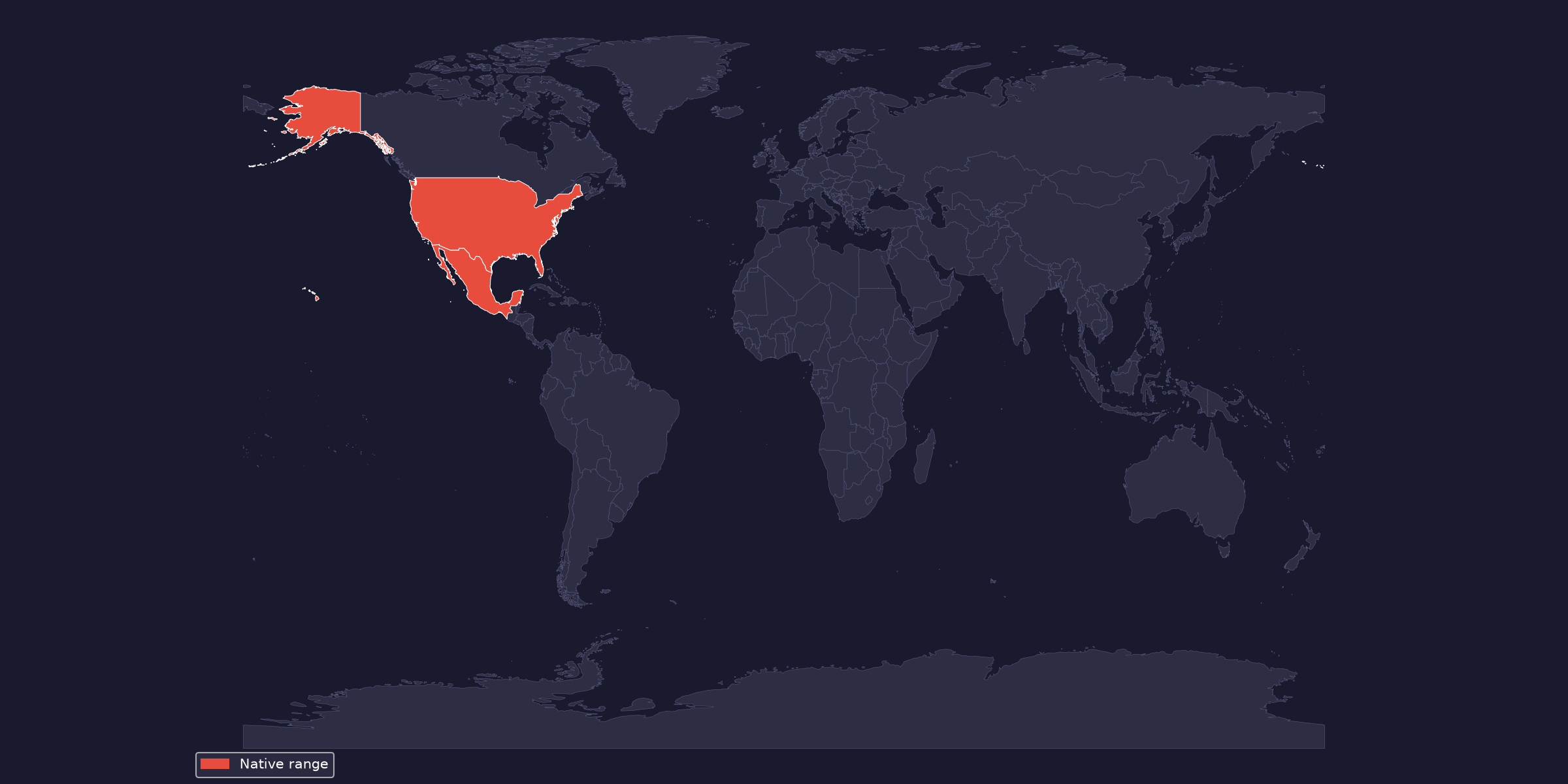
C. scutulatus occurs in the southwestern United States—southern California and Nevada, Arizona, southwestern Utah, southern New Mexico and western Texas—and through northern and central Mexico from Sonora, Chihuahua and Coahuila south through several plateau states to parts of Puebla, Veracruz and neighbouring regions under the broader treatment that includes salvini.
Distribution and subspecies limits differ among authorities. Salvini is associated with highland central Mexico, including Tlaxcala, Puebla, Hidalgo and west-central Veracruz. The whole-country map highlights the United States and Mexico but cannot show scattered habitat, elevation, lineage boundaries, contact zones or venom phenotype. It must never substitute for locality records.
Habitats include desert scrub, open grassland, rocky bajadas and dry agricultural margins. The climate point near Tucson is close to a reviewed Arizona occurrence and represents one Sonoran Desert setting, not the cooler Mexican highlands or the entire venom mosaic.
🌡 Climate across the native range
Monthly normals from a Sonoran Desert climate point near a reviewed Arizona occurrence:
Near Tucson, Arizona — United States (near reviewed occurrence)
| Month | Min °C | Mean °C | Max °C | RH % |
|---|---|---|---|---|
| January | 3.9 | 10.0 | 17.1 | 52 |
| February | 5.1 | 11.6 | 18.9 | 48 |
| March | 8.0 | 15.4 | 22.8 | 38 |
| April | 11.7 | 19.5 | 27.0 | 25 |
| May | 16.6 | 24.6 | 31.6 | 21 |
| June | 22.0 | 29.8 | 36.5 | 19 |
| July | 24.1 | 29.9 | 35.8 | 41 |
| August | 23.2 | 29.0 | 34.9 | 47 |
| September | 20.4 | 26.8 | 33.0 | 42 |
| October | 14.3 | 21.4 | 28.2 | 36 |
| November | 8.2 | 14.9 | 22.0 | 41 |
| December | 3.9 | 9.7 | 16.6 | 53 |
Weather data by Open-Meteo.com · CC BY 4.0 · Monthly normals calculated by Herpeton Academy from daily archive values for 1991-2020.
Location references use GBIF.org occurrence data where available; original occurrence records retain their source dataset licenses.
⚖️ Legal status
Crotalus scutulatus was not found in the CITES Appendices or EU wildlife-trade annexes checked on 17 August 2026. The Bern Convention is not relevant to this North American species. Non-listing does not authorize collection, possession or international movement.
U.S. state and local rules and Mexican federal and state wildlife laws may protect native snakes or require collection, dangerous-animal, transport, breeding, sale or import permits. Subspecies and locality disagreement can affect paperwork. Obtain written decisions from competent authorities and retain invoices, transfers, photographs and precise lawful provenance.
🤌 Husbandry
House one snake per enclosure in a restricted venomous room with secondary containment, sealed vents and a controlled-door protocol. Two lockable shift hides across the gradient must let staff locate and isolate the entire animal before opening primary containment.
Quarantine for at least 90 days with simple furniture, separate tools and preferably separate airspace. Record weight, meals, sheds, faeces, mouth, breathing and rattle condition. Wild-origin animals require reptile-veterinary parasite and disease screening.
Do not normalize hook display or cohabitation. The animal’s acceleration, cryptic posture and variable willingness to rattle require barrier-based routine work at all times.
💡 Lighting
Provide a seasonally adjusted 10-14-hour visible-light cycle and full darkness. Offer shaded hides and partial cover across both thermal zones. Lamps belong outside primary containment or behind locked guards.
Low-level UVB may be offered as a Ferguson Zone 1 opportunity. Measure at snake level and retain a fully shaded route. It is optional support, not a replacement for thermal choice or balanced whole prey.
🌡 Heating and temperature
Maintain ambient air at 25-29°C, a local basking surface at 32-35°C, a cool hide at 22-25°C and nights around 18-23°C. Guard and thermostat all heat sources and use independent probes and high-temperature alarms.
Desert air can be extremely hot, but wild snakes avoid lethal surfaces in burrows and deep shade. Never heat the entire floor. A monitored 10-16°C cool period is only for healthy, known-locality adults in a planned breeding programme; do not cool juveniles, thin, sick or new animals.
💧 Humidity and water
Maintain 25-45% relative humidity with strong ventilation and dry retreats. Provide a local humid hide around 45-60% during shedding. Summer monsoon pulses do not justify a permanently damp enclosure.
Offer a small, heavy bowl of fresh water through protected access. Track hydration through weight, urates and sheds. Persistent wet substrate promotes skin disease, while chronic desiccation causes dehydration and dysecdysis.
🌿 Enclosure and decoration
An adult requires at least 120 x 60 x 60 cm. Add two shift hides, anchored low cover, stable rock-like surfaces, a low branch and a clear inspection corridor. Décor must not conceal an animal outside the shift system.
Use 6-10 cm of compactable sandy soil with clay and gravel rather than pure loose sand; use paper in quarantine. Avoid unstable rocks, aromatic wood, sharp mesh, deep clutter and heat rocks. Fit two-step locks and a clear venom warning.
🐁 Feeding
Wild prey is dominated by small mammals, with lizards and other vertebrates used especially by younger animals. Captive-established adults usually accept an appropriately sized frozen-thawed rodent every 10-21 days. Track weight; avoid exaggerated prey bulges and obesity.
Feed with long tongs through a protected port and shift before retrieving refused prey. Live rodents create avoidable injury and servicing risk. Balanced whole prey requires no routine calcium or vitamin dusting.
🛡 Operational safety and emergencies
Never free-handle, pin, neck or manually restrain in routine care. Use lockable shift boxes, correct hooks, clear shields and protected feeding ports. Two trained adults should attend any primary opening; veterinary restraint needs a planned professional anaesthetic team.
Before acquisition, consult the receiving hospital or poison centre about regional rattlesnake antivenom and transport. Provide exact locality and explain that venom phenotype cannot be inferred confidently from appearance or broad region. Antivenom is hospital treatment, not private self-treatment.
A bite is an immediate emergency even if swelling or neurological signs are initially absent. Move away, call emergency services, remove constricting objects, keep still and follow poison-centre guidance. Do not cut, suck, ice, shock, tightly tourniquet or delay for capture.
Maintain an escape plan with room isolation, public exclusion, accountability, search zones, secure capture vessels and decision-makers. Stop all work if the snake cannot be positively located.
🥚 Breeding notes
The species is viviparous, with roughly 2-17 young reported. Breeding timing differs between desert lowlands and Mexican highlands. Cooling and pairing must therefore follow documented locality, body condition and veterinary assessment.
Confirm sex, lineage, legal authority and future placement before cycling. Prepare individually locked neonate boxes and complete parentage, bite and escape records before birth. Never mix unidentified scutulatus and salvini lines.
🩺 Common problems
- Dehydration and retained shed: review water, humid retreat, temperature and illness.
- Overheating and burns: prevent with guarded thermostatic heat and a true cool hide.
- Respiratory disease: abnormal sounds, bubbles or open-mouth breathing need urgent veterinary care.
- Dermatitis: investigate wet substrate, poor ventilation, abrasion and mites.
- Parasites and stomatitis: weight loss, abnormal faeces or oral swelling are especially concerning in wild-origin animals.
- Obesity: adjust prey size and interval to measured condition.
- Regurgitation: review meal size, heat, disturbance, infection and parasites with a veterinarian.
Do not attempt hands-on home treatment. Secure the snake in a shift compartment and coordinate an experienced reptile-veterinary examination.
📌 Conclusion
Crotalus scutulatus is suitable only for a licensed institution that can preserve precise provenance and plan for more than one possible clinical syndrome. Geographic venom variation strengthens the need for disciplined records and hospital consultation; it is not a reason for rankings or casual identification.
📚 Sources and further reading
- ReptiFiles — checked first on 17 August 2026; no species-specific care guide was found.
- The Reptile Database: Crotalus scutulatus
- GBIF species record: Crotalus scutulatus
- Strickland et al. — local selection and Mojave rattlesnake venom variation
- Geographic variation in clinical features reported to the North American Snakebite Registry
- Cardwell et al. — Mojave rattlesnake identification revisited
- CDC/NIOSH — venomous-snake first aid
- Baines et al. — UV lighting guidance for captive reptiles
- Northern Ireland government guidance on keeping venomous snakes and lizards
- CITES Appendices
- EU wildlife-trade annexes, Commission Regulation (EU) 2026/1383
- Bern Convention appendices