Share

Ornate black-tailed rattlesnake
🔤 Taxonomy
Crotalus ornatus is the ornate black-tailed rattlesnake. This monotypic species was revalidated from C. molossus in 2012. Older literature and captive records often call eastern black-tailed rattlesnakes C. molossus; colour alone cannot resolve the boundary. Keep exact locality, parentage, photographs and the taxonomic reference with every animal.
📌 Description
Adults are robust, dark-tailed rattlesnakes, usually 70-110 cm and rarely approaching 130 cm. They use Chihuahuan Desert slopes, rocky canyons, woodland edges and low vegetation and climb confidently. This is a medically significant venomous animal for licensed institutional or specialist display only. Apparent calmness, captive breeding and small body size never reduce the protected-contact standard.
📋 Quick reference
| Care point | Practical target |
|---|---|
| Adult size and lifespan | 70-130 cm; approximately 18-25 years |
| Adult enclosure | At least 150 x 75 x 90 cm with two lockable shifts |
| Temperature | Ambient 23-28°C; basking 30-33°C; cool 19-23°C; night 15-21°C |
| Humidity | 35-55%; local 55-70% shedding support |
| Feeding | Frozen-thawed whole prey every 14-21 days |
| Safety | Double containment, protected contact, trained backup, bite and escape plans |
☠️ Venom
This species is venomous. Venom exposure can cause pain, swelling or other systemic effects, and severity varies with species, locality, bite site and the amount delivered. A small wound or apparently dry bite is not proof of safety; every bite or sting requires urgent medical assessment.
If an incident occurs, move away, call emergency services or a poison centre, keep the patient still, remove rings and other constricting items, and follow dispatcher instructions. Do not use a tourniquet, cut or suck the wound, apply ice or electricity, give alcohol or medicines as a home treatment, or attempt to catch the animal. Antivenom choice and dosing are hospital decisions; verify the relevant product and local availability in advance. Sources: WHO snakebite guidance and appropriate species-specific toxinology or medical references listed below.
🌍 Distribution
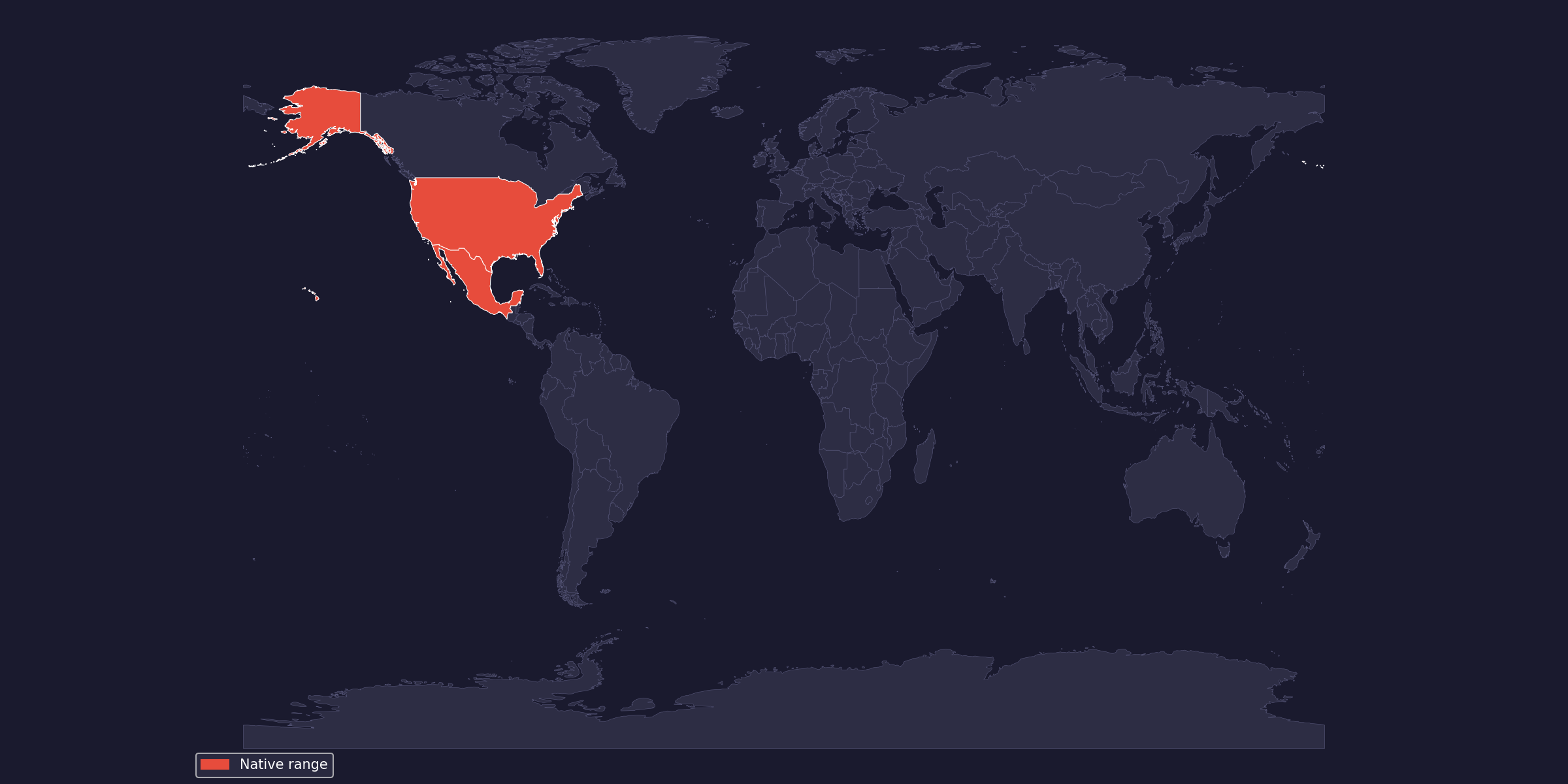
C. ornatus occurs in Texas and New Mexico in the United States and Chihuahua, Coahuila, Nuevo León and Zacatecas in Mexico. Its western contact with C. molossus makes exact locality more useful than an old trade label. Country- or state-level maps cannot resolve habitat patches or revised taxonomic boundaries. Husbandry must follow documented locality rather than colour or a broad trade name.
⚖️ Legal status
Checked 21 August 2026: C. ornatus is not listed in CITES, but the whole genus Crotalus is in EU Annex D under Regulation (EU) 2026/1383; Bern is not relevant to its native range. CoP20 Proposal 25 to list most rattlesnakes was rejected in 2025, but that does not override national conservation, collection or dangerous-animal law. Mexico’s operative NOM-059 list uses the older name C. molossus (Pr) for black-tailed rattlesnakes; confirm with SEMARNAT how a documented C. ornatus is recorded. US state and local venomous/native-wildlife rules also apply.
Confirm possession, premises, transport, breeding, sale, import and emergency-notification rules in writing for every origin, transit and destination jurisdiction. Retain permits, invoices, lawful-origin documents, locality, parentage, photographs and the check date.
🤌 Husbandry
House one snake in a restricted venomous room behind a locked secondary barrier. The primary enclosure needs two positively lockable shift hides and protected service access. Follow a written door sequence and isolate and visually confirm the entire animal before opening. A visible tail or rattle does not confirm the head position.
Quarantine for at least 90 days in a robust, simple, fully inspectable enclosure with dedicated tools. Record weight, meals, sheds, faeces, respiration and mouth condition; arrange reptile-veterinary parasite testing according to provenance. House singly except for controlled, professionally planned breeding introductions.
💡 Lighting
Provide 10-14 hours of bright visible light with gradual seasonal adjustment and complete darkness at night. Create a lit basking surface and continuous shaded retreat. All lamps, guards and wiring stay outside primary containment or behind a locked barrier.
Low-output UVB may be offered as a measured Ferguson Zone 1 opportunity. Measure at the highest accessible surface, preserve full shade and prevent contact with a hot guard.
🌡 Heating and temperature
Maintain ambient air at 23-28°C, a limited basking surface at 30-33°C, a cool retreat at 19-23°C and nights around 15-21°C. Measure air and surfaces separately, thermostat and guard every heater and use an independent high-temperature alarm.
Do not heat the entire enclosure or copy exposed field-surface maxima. Seasonal cooling is appropriate only to healthy, established, locality-documented adults where the native climate supports it; never cool juveniles, thin, ill or newly acquired snakes. Tropical or uncertain stock receives no generic brumation.
💧 Humidity and water
Maintain 35-55% ambient humidity with strong cross-ventilation and one ventilated retreat at 55-70% during shedding. Allow surfaces to dry; condensation and stagnant wet substrate require correction.
Provide a stable bowl of clean water through protected access. Monitor drinking, body mass, urates and shed quality. Repeated soaking or dehydration needs a microclimate and veterinary review, not indiscriminate misting.
🌿 Enclosure and decoration
An adult needs at least 150 x 75 x 90 cm. Fit two lockable shifts, clear inspection lanes and an anchored rock/branch structure appropriate to locality. Support heavy décor from the enclosure base and remove fall, crush, pinch and blind-service hazards. Every vent, track and cable hole must contain neonates.
Use 8 cm of low-dust mineral soil with coarse sand and locality-appropriate leaf litter. Avoid loose rock stacks, sharp gravel or wire, aromatic wood and permanently wet substrate. Cleaning must not require dismantling structure around an unconfirmed snake.
🐁 Feeding
Offer appropriately sized frozen-thawed whole prey every 14-21 days, adjusted to weight, build, age, season and provenance. Do not power-feed; ambush predators readily become obese. Whole vertebrate prey needs no routine supplementation.
Feed through a protected port with long tongs and never use live rodents. Confirm the animal behind a locked barrier before retrieving refused prey. Keep permanent weight and feeding records.
🛡 Operational safety and emergencies
Never free-handle, pin, neck or manually restrain for routine work. Use lockable shifts, suitable hooks, transparent shields and protected ports. Two trained adults with assigned roles attend every primary opening. Veterinary procedures require a pre-arranged professional anaesthetic and containment plan.
Before acquisition, give the receiving hospital or poison centre the exact species, locality, facility address and expected adult size. Confirm the regional crotalid antivenom and monitoring pathway. Do not rank risk by reported venom potency, head size or yield: composition and clinical effect vary, and every bite requires urgent hospital assessment. Private antivenom and home administration are unsafe.
After a bite, withdraw, call emergency services, remove constricting items, keep the patient still with the limb neutrally supported and follow poison-centre instructions. Do not cut, suck, ice, shock, massage or apply a tourniquet. Maintain a written escape plan for room isolation, public exclusion, accountability, search zones, secure containers and named decision-makers.
🥚 Breeding notes
The species is viviparous. Plan for approximately 3-12 young. Never cross it with C. molossus or breed animals whose old labels cannot be reconciled with locality. Pair only documented, locality-compatible adults through shift compartments. Prepare labelled, individual neonate-proof housing and lawful placements before introduction; neonates require the same venom protocol as adults.
🩺 Common problems
- Obesity and fatty-liver risk from large or frequent meals.
- Dehydration, retained spectacles or incomplete sheds.
- Burns and chronic overheating where the cool retreat fails.
- Respiratory disease after stagnant moisture or inappropriate cooling.
- Falls, crushing or abrasion from unstable décor.
- Mites, internal parasites and stomatitis, especially in wild-origin stock.
- Taxonomic or provenance loss that compromises legal, medical and breeding decisions.
Hands-on home treatment is unsafe. Lock the animal into a shift and use an experienced reptile veterinarian.
📌 Conclusion
The ornate black-tailed rattlesnake belongs only in a licensed programme able to preserve locality, engineer secure shifts, work entirely through protected contact and maintain rehearsed hospital and escape responses.
📚 Sources and further reading
- ReptiFiles — checked first on 21 August 2026; no species-specific care guide was found.
- The Reptile Database: Crotalus ornatus
- GBIF species record: Crotalus ornatus
- Anderson & Greenbaum 2012 — revalidation of C. ornatus
- Mexico NOM-059-SEMARNAT-2010, 2019 amended list
- CITES CoP20 Proposal 25 and supporting statement
- CDC/NIOSH — venomous-snake first aid
- Northern Ireland government venomous-reptile guidance
- CITES Appendices
- EU wildlife-trade annexes, Regulation (EU) 2026/1383
- Bern Convention appendices