Share

San Lucan Speckled Rattlesnake
🔤 Taxonomy
Crotalus mitchellii is used here in the modern restricted sense for the San Lucan speckled rattlesnake of the southern Baja California peninsula and associated islands. Older literature used C. mitchellii broadly for several western speckled rattlesnakes.
Do not apply this guide uncritically to C. pyrrhus or C. stephensi, both now accepted as separate species. Several island populations formerly assigned subspecies have also been revised or remain debated. Record exact island or peninsula locality, parentage, photographs and identification authority.
📌 Description
Most mainland adults are about 50-90 cm and large animals approach 100 cm, but island populations show striking dwarfism or gigantism. Pattern and background colour often match local rock, from pale granite to pink, brown or dark volcanic tones. Colour is camouflage, not proof of lineage.
The species occupies arid rocky slopes, canyons, desert scrub and thornscrub in Baja California Sur and nearby islands. It is usually crepuscular or nocturnal in hot weather. Its bite is a medical emergency; this is a display-only animal for licensed specialist or institutional programmes.
📋 Quick reference
| Care point | Practical target |
|---|---|
| Adult enclosure | At least 150 x 75 x 75 cm; adapt floor area to documented island body size |
| Day temperatures | 24-29°C air; 32-35°C basking surface; 20-24°C cool refuge |
| Night | 17-22°C; winter change only by locality |
| Humidity | 30-50%; one ventilated 50-65% shed refuge |
| Lighting | Seasonal 10-14 hours; measured Ferguson Zone 2 UVB recommended |
| Feeding | Small frozen-thawed rodents, generally every 14-28 days for adults |
| Provenance | Essential: old names may actually denote pyrrhus, stephensi or island taxa |
| Safety | Double containment, full-body shift, two trained operators, hospital plan |
☠️ Venom
This species is venomous. Venom exposure can cause pain, swelling or other systemic effects, and severity varies with species, locality, bite site and the amount delivered. A small wound or apparently dry bite is not proof of safety; every bite or sting requires urgent medical assessment.
If an incident occurs, move away, call emergency services or a poison centre, keep the patient still, remove rings and other constricting items, and follow dispatcher instructions. Do not use a tourniquet, cut or suck the wound, apply ice or electricity, give alcohol or medicines as a home treatment, or attempt to catch the animal. Antivenom choice and dosing are hospital decisions; verify the relevant product and local availability in advance. Sources: WHO snakebite guidance and appropriate species-specific toxinology or medical references listed below.
🌍 Distribution
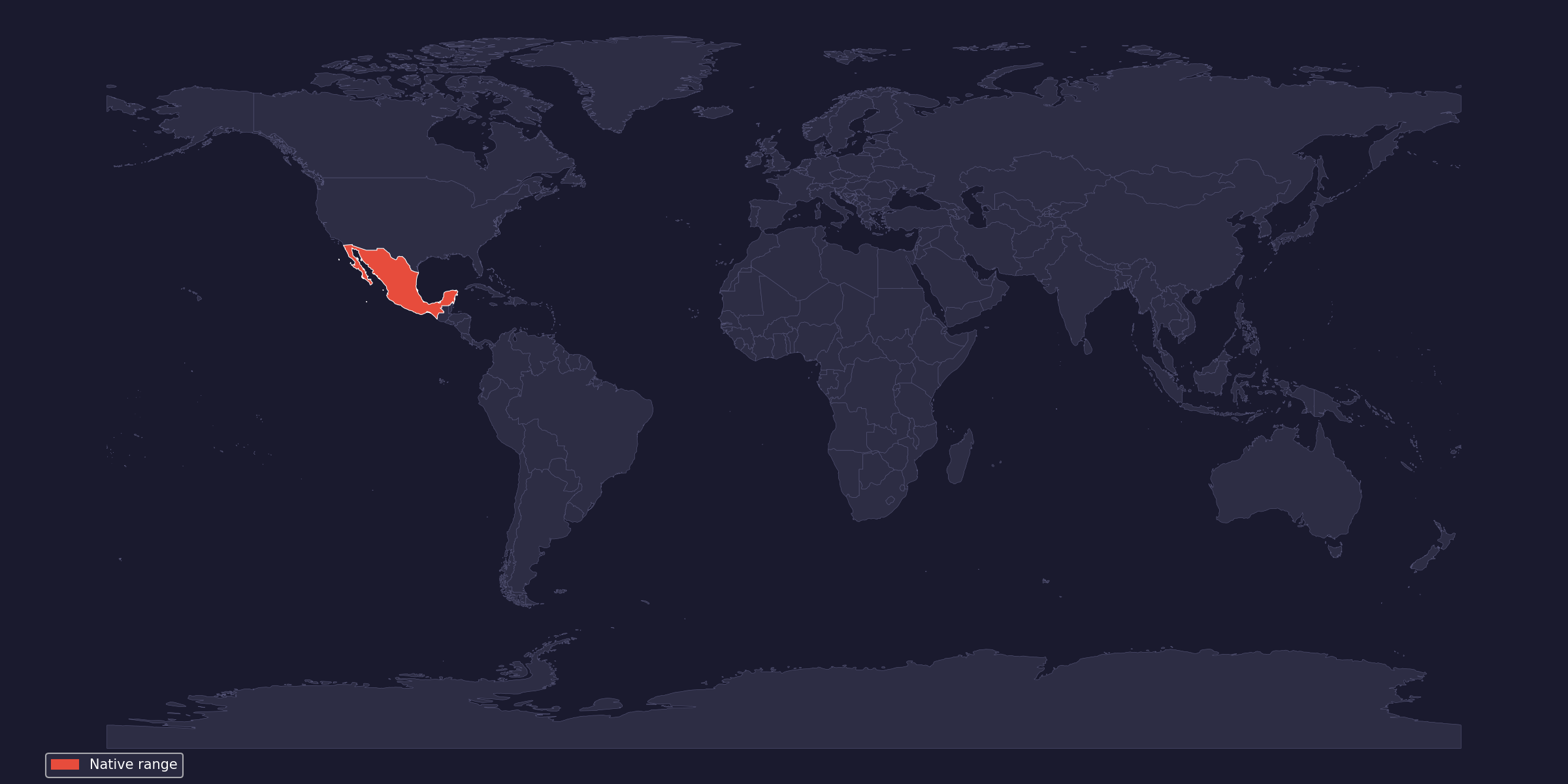
Under the restricted concept, C. mitchellii occurs in southern Baja California, Mexico, principally Baja California Sur, with populations on several Pacific and Gulf of California islands. Older maps extending through the south-western United States combine taxa now recognised as C. pyrrhus and C. stephensi and must not be reproduced as the current range.
Island isolation has produced major body-size and genetic differences. A broad peninsula polygon conceals these units; keep locality evidence even when an older import document uses C. m. mitchellii or another historical subspecies name.
⚖️ Legal status
Checked on 21 August 2026: C. mitchellii is not in CITES. It falls under the genus-level Crotalus spp. entry in EU Annex D in Regulation (EU) 2026/1383. The Bern Convention is not relevant. The rejected CoP20 proposal must not be reported as an adopted CITES listing.
Mexico lists C. mitchellii as Sujeta a protección especial (Special Protection, Pr) under NOM-059-SEMARNAT. This is not a private possession licence: collection, transport, breeding, export and access to islands or protected areas require the applicable federal authorisations and lawful-origin evidence. Destination venomous-animal law may require licensing, inspection or prohibition. Preserve permits, export records, locality, parentage and taxonomic history.
🤌 Husbandry
House one animal in a locked primary enclosure inside an access-controlled escape-resistant room. Provide two compartments or a full-body shift that closes positively from outside. Confirm the complete snake behind the barrier before service access opens; camouflage among rock makes partial sightings especially unreliable.
Use protected contact only. Two trained adults attend every primary opening with assigned roles and communications. No routine free-handling, tailing, pinning, necking or manual restraint is acceptable. Veterinary work needs pre-arranged anaesthesia, containment and transport.
Quarantine for at least 90 days in separate airspace where possible. Use paper or shallow disposable mineral substrate, simple lockable hides and dedicated tools; record weight, meals, sheds, faeces, respiration and mouth condition. Request targeted veterinary screening for wild-origin or poorly documented stock. House singly and keep lineages separate.
💡 Lighting
Provide bright visible light for 10-14 hours, adjusted gradually with season, and full darkness at night. A measured UVB opportunity around Ferguson Zone 2 is recommended across part of the warm zone, with complete shade and a dark shift retreat.
All lamps and wiring stay outside primary containment or behind locked guards. Light rock can reflect intense heat, so measure the animal-level surface rather than relying on lamp wattage.
🌡 Heating and temperature
Maintain daytime air at 24-29°C, a limited 32-35°C basking surface, a 20-24°C cool retreat and nights around 17-22°C. Thermostat and guard every heater and use separate air, surface and high-temperature monitoring. Never warm the full rockwork or floor.
Do not prescribe one deep brumation to all C. mitchellii. Peninsula latitude, elevation and island maritime influence differ. Healthy, established, locality-documented adults may receive a gradual mild winter reduction for managed breeding, but juveniles, new arrivals, gravid, thin, dehydrated or ill animals should not be cooled.
💧 Humidity and water
Keep well-ventilated ambient humidity near 30-50%, with one ventilated 50-65% refuge during pre-shed. Seasonal fog or storm moisture at some localities should be represented by access to a microclimate, not permanently wet rock and substrate.
Provide a stable bowl of fresh water through protected access. Desert origin does not justify withholding water. Persistent soaking, poor sheds or concentrated urates warrant review of heat, hydration, parasites and illness.
🌿 Enclosure and decoration
Provide at least 150 x 75 x 75 cm for a typical adult, increasing floor area for a large documented lineage. Use snug hides in both thermal zones, anchored low ledges or cork, low scrub cover and a clear inspection lane. Make every door track, vent and cable gap neonate-proof.
Use 8-12 cm of compactable mineral soil with sand and clay. Avoid sharp or unstable stone, deep rubble that makes a complete count impossible, fine dust, calcium sand and décor that must be moved during service. Permanent rockwork must be anchored before the snake enters.
🐁 Feeding
Wild speckled rattlesnakes take mammals and lizards, with prey availability varying by island. Established captives can receive appropriately small frozen-thawed mice; adults generally every 14-28 days and juveniles every 7-14 days. A dwarf island line must not receive a mainland prey schedule by default.
Feed through a protected port or after a confirmed shift. Never use live rodents or a loose feeding tub. Whole vertebrate prey requires no routine supplements. Use serial weights and photographs because overfeeding can erase naturally lean island proportions.
🛡 Operational safety and emergencies
Maintain rehearsed opening, bite, escape, transport, fire and power-loss procedures. Stop whenever the snake cannot be positively located. The escape plan must isolate the room, exclude the public, account for people and animals, assign search sectors and name the incident controller.
Before acquisition, coordinate with emergency services, poison control, a medical toxicologist and the receiving hospital. Give the accepted restricted species name, exact locality and former names on the paperwork so the medical team does not confuse it with C. pyrrhus or C. stephensi. Antivenom and monitoring are hospital decisions.
After a bite, move safely away, call emergency services, remove constricting items, keep still with the limb neutrally supported and follow poison-centre instructions. Do not cut, suck, ice, massage, shock or tourniquet the limb, and never delay transport to catch the snake. There is no home treatment.
🥚 Breeding notes
C. mitchellii is viviparous; two to eleven young is a cautious planning range across historical reports, but locality and current taxon identity must accompany any number. Breeding anonymous stock further destroys the distinction among southern peninsula and island lines.
Pair only healthy, compatible adults through shift compartments. Prepare separate neonate-proof housing and lawful placements before introduction. Neonates are medically significant from birth and require full inventory, escape and hospital controls.
🩺 Common problems
- Taxonomic misidentification: old “mitchellii” paperwork may refer to C. pyrrhus, C. stephensi or a revised island taxon.
- Overheating: exposed rock temperatures are not the animal’s chosen retreat temperature.
- Obesity: a serious risk when small or dwarf lines receive frequent large rodents.
- Dehydration or retained shed: review water, local humidity, heat and illness without wetting the full enclosure.
- Respiratory disease, mites, parasites or stomatitis: require prompt, protected veterinary management.
- Burns or crushing: prevent with guarded heat and permanently anchored furnishings.
Never attempt hands-on home treatment; secure the snake behind its shift and use an experienced reptile veterinarian.
📌 Conclusion
Modern C. mitchellii care begins with correct identification and exact Baja provenance. Only a licensed programme able to preserve island lines, provide redundant containment and maintain a hospital-ready venom protocol should hold it.
📚 Sources and further reading
- ReptiFiles — checked first on 21 August 2026; no species-specific care guide was found.
- The Reptile Database: Crotalus mitchellii
- GBIF species record: Crotalus mitchellii
- Douglas et al. 2007 — recognition of the Panamint rattlesnake
- Meik et al. 2010 — body-size evolution in insular speckled rattlesnakes
- Meik et al. 2015 — diversification of Baja California rattlesnakes
- Mexico NOM-059 official publication
- Baines et al. — UV lighting guidance for reptiles
- UK Standards of Modern Zoo Practice
- CDC/NIOSH venomous-snake first aid
- CITES CoP20 species-proposal outcomes
- CITES Appendices
- EU wildlife-trade annexes, Commission Regulation (EU) 2026/1383
- Bern Convention appendices