Share

Rock rattlesnake
🔤 Taxonomy
Crotalus lepidus is the rock rattlesnake. The Reptile Database currently retains C. l. lepidus, C. l. klauberi and C. l. maculosus. Former C. l. morulus is treated as Crotalus morulus by current work, so an old subspecies label is not enough for identification.
Keep collection locality, parentage, photographs and the taxonomic reference used with every animal. Colour varies exceptionally and can resemble the surrounding rock; it is not reliable evidence of subspecies or origin.
📌 Description
This is a small, stout rattlesnake, usually 45-75 cm and recorded to about 83 cm. It uses crevices, talus, canyon walls and rocky woodland edges, and may climb low ledges or vegetation. Camouflage and a small rattle can make an animal difficult to confirm before a door is opened.
The venom is medically significant. A short body and often quiet defence do not reduce the consequences of a bite. This guide is for licensed institutional or specialist facilities using protected contact; the species is not a handling animal.
📋 Quick reference
| Care point | Practical target |
|---|---|
| Adult size and lifespan | 45-83 cm; approximately 15-25 years |
| Adult enclosure | At least 120 x 60 x 75 cm, with two lockable shift hides |
| Temperature | Ambient 22-27°C; basking surface 29-32°C; cool zone 18-22°C |
| Night | 14-20°C, adjusted to documented locality |
| Humidity | 35-55%; local 55-70% shedding support |
| Habitat | Stable rock-like structure, narrow secure retreats and open inspection lanes |
| Feeding | Appropriately small frozen-thawed rodents every 14-21 days |
| Safety | Double containment, protected contact, trained backup, bite and escape plans |
☠️ Venom
This species is venomous. Venom exposure can cause pain, swelling or other systemic effects, and severity varies with species, locality, bite site and the amount delivered. A small wound or apparently dry bite is not proof of safety; every bite or sting requires urgent medical assessment.
If an incident occurs, move away, call emergency services or a poison centre, keep the patient still, remove rings and other constricting items, and follow dispatcher instructions. Do not use a tourniquet, cut or suck the wound, apply ice or electricity, give alcohol or medicines as a home treatment, or attempt to catch the animal. Antivenom choice and dosing are hospital decisions; verify the relevant product and local availability in advance. Sources: WHO snakebite guidance and appropriate species-specific toxinology or medical references listed below.
🌍 Distribution
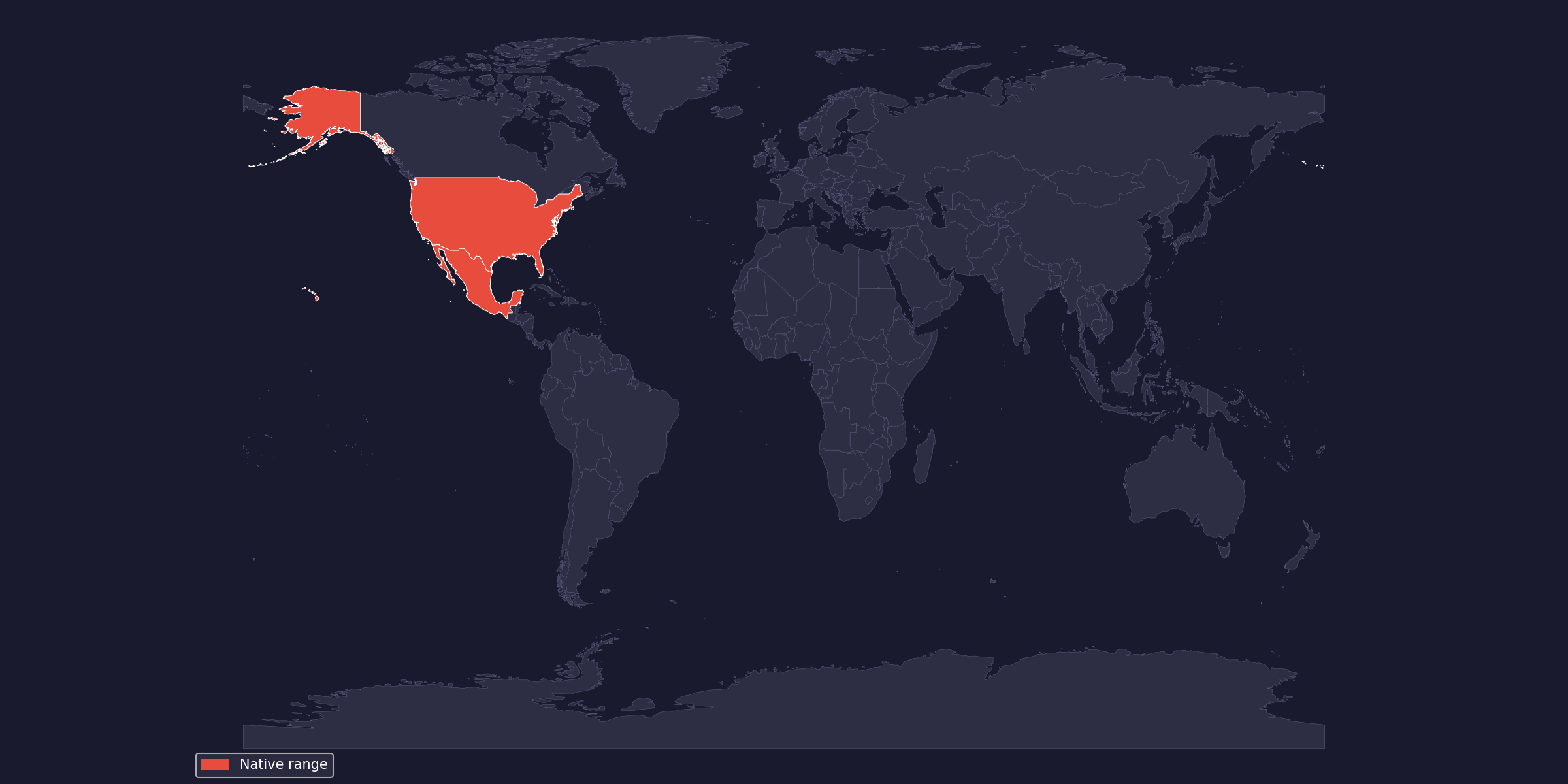
The species occurs in the southeastern United States—southeastern Arizona, southern New Mexico and western Texas—and across rocky regions of northern and west-central Mexico. Current records include Chihuahua, Coahuila, Sonora, Durango, Sinaloa, Nayarit, Jalisco, Zacatecas, Aguascalientes, San Luis Potosí, Nuevo León and Tamaulipas, but subspecies and species boundaries are not interchangeable with state borders.
A broad map overstates occupancy because populations follow separated mountain ranges, canyon systems and rock formations. Husbandry should follow verified locality rather than a generic “Mexican” or “desert” label.
⚖️ Legal status
Checked on 21 August 2026: C. lepidus is not in the CITES Appendices, but the whole genus Crotalus is listed in EU Annex D under Regulation (EU) 2026/1383; the Bern Convention is not relevant to its native range. Mexico lists it as Pr (subject to special protection) under NOM-059-SEMARNAT-2010. US state, tribal, county, municipal and protected-area rules can separately restrict collection, venomous-animal possession and transport.
The failed 2025 CITES proposal does not show that trade or collection is harmless. Its supporting assessment described local scarcity, persecution, habitat pressure and documented but limited international trade; the independent analysis found little recent international trade. Treat those as evidence with limits, not as a global population estimate. Obtain captive-bred stock with invoice, lawful-origin documentation, precise locality and parentage, and verify every origin, transit and destination rule in writing.
🤌 Husbandry
House one snake in a restricted venomous room behind a secondary locked barrier. Use a locked primary enclosure with two positively lockable shift hides; isolate and visually confirm the animal before any service opening. Never place fingers into a crevice or rely on the rattle to locate it.
Quarantine for at least 90 days in a simple, fully inspectable enclosure with dedicated tools. Record weight, meals, sheds, faeces and respiratory or oral signs; arrange reptile-veterinary parasite testing for wild-origin or poorly documented animals. House singly. Reproductive introduction is a planned procedure, not routine cohabitation.
💡 Lighting
Provide 10-14 hours of bright visible light, changed gradually with season, and complete darkness at night. Shade both retreats and create sunlit ledges without illuminating every crevice. Lamps and cables remain outside primary containment or behind locked guards.
Low-output UVB can be offered as a Ferguson Zone 1 opportunity. Measure it at the highest accessible ledge and retain a fully shaded route. UVB does not compensate for poor diet, ventilation or thermal choice.
🌡 Heating and temperature
Provide ambient air of 22-27°C, a limited basking surface of 29-32°C, a cool retreat of 18-22°C and nights around 14-20°C. Measure rock surfaces and air separately. Guard and thermostat every heater, add an independent high-temperature alarm and keep a usable cool crevice at all times.
Northern mountain populations experience winter dormancy; southern populations can follow different seasons. Brumation at roughly 8-14°C is only for healthy, established, locality-documented adults under an expert breeding or institutional plan. Never cool a new, thin, juvenile or sick snake, and never copy exposed-rock summer maxima into an enclosure.
💧 Humidity and water
Maintain 35-55% ambient humidity with strong cross-ventilation. During shedding, offer one ventilated retreat at 55-70% rather than wetting the entire rocky enclosure. Persistent condensation, wet crevices or musty substrate call for correction.
Provide clean water in a stable bowl accessible through protected contact. Follow body mass, urates and shed quality. A mountain species still dehydrates; correct recurrent problems through veterinary and microclimate review, not routine soaking or saturation.
🌿 Enclosure and decoration
An adult needs at least 120 x 60 x 75 cm. Build height with shelves or sealed artificial rock fixed to the enclosure, not loose stacked stone. Include several tight but fully inspectable retreats, two lockable shifts, a clear floor lane and a protected service port. All vents, door tracks and cable holes must exclude neonates.
Use 5-8 cm of low-dust mineral soil with coarse sand and flat stone firmly supported from below. Provide both firm walking surfaces and crevices without pinch points. Avoid unstable slabs, sharp gravel, dusty powder, aromatic wood and a permanently wet substrate. The keeper must be able to clean without dismantling a rock pile around an unconfirmed snake.
🐁 Feeding
Wild diets contain many lizards, especially in smaller animals, plus small mammals and occasionally centipedes, frogs, birds or snakes. Established captives generally accept small frozen-thawed rodents. Offer a modest meal every 14-21 days and adjust by weight and body condition; this small ambush predator becomes obese quickly.
Feed through a protected port with long tongs. Do not use live rodents or routine supplements with whole vertebrate prey. Confirm the snake in a locked compartment before retrieving refused food.
🛡 Operational safety and emergencies
No free handling, pinning, necking or routine manual restraint. Use lockable shifts, appropriate hooks, transparent shields and protected ports. Two trained adults attend every primary opening. Veterinary work requires a pre-arranged anaesthesia and containment plan with an experienced reptile veterinarian.
Before acquisition, give the receiving hospital or poison centre the exact species, locality and facility address, and confirm its regional North American crotalid antivenom and monitoring pathway. Private antivenom ownership is not a treatment plan; home administration is unsafe.
After a bite, retreat, call emergency services, remove constricting items, keep the person still with the limb neutrally supported and follow poison-centre instructions. Do not cut, suck, ice, shock, massage or apply a tourniquet, and do not delay transport to catch the snake. Maintain a written escape plan covering room isolation, public exclusion, accountability, secure capture containers and named decision-makers.
🥚 Breeding notes
The species is viviparous. Published field summaries report 1-8 young in the United States and adjacent northern Mexico and 3-11 in Mexico. Prepare individual, escape-proof neonate enclosures and lawful placements before pairing. Use only locality-compatible, fully documented adults, and do not hybridise lineages or breed animals of uncertain identity.
🩺 Common problems
- Obesity from oversized prey or short feeding intervals.
- Dehydration, retained spectacles or incomplete sheds from unsuitable microclimates or disease.
- Burns and chronic heat stress from unguarded heat or lack of a cool crevice.
- Respiratory disease associated with damp, stagnant conditions or inappropriate cooling.
- Rostral or scale injuries from sharp or unstable décor.
- Mites, internal parasites and stomatitis, especially in wild-origin animals.
- Regurgitation after large prey, low temperature, disturbance or illness.
Hands-on home treatment is unsafe. Secure the animal in a shift compartment and use a qualified reptile veterinarian.
📌 Conclusion
The rock rattlesnake requires less floor area than a large rattlesnake but no reduction in containment or medical planning. It belongs only in a licensed specialist programme able to preserve locality, provide secure inspectable rock structure and work entirely through protected contact.
📚 Sources and further reading
- ReptiFiles — checked first on 21 August 2026; no species-specific care guide was found.
- The Reptile Database: Crotalus lepidus
- GBIF species record: Crotalus lepidus
- NatureServe Explorer: Crotalus lepidus
- CITES CoP20 Proposal 25 and supporting statement
- IUCN/TRAFFIC analysis of CITES CoP20 Proposal 25
- Mexico NOM-059-SEMARNAT-2010, 2019 amended list
- Baines et al. — UV lighting guidance
- CDC/NIOSH — venomous-snake first aid
- Northern Ireland government venomous-reptile guidance
- CITES Appendices
- EU wildlife-trade annexes, Commission Regulation (EU) 2026/1383
- Bern Convention appendices