Share

Timber Rattlesnake
🔤 Taxonomy
Crotalus horridus is the accepted name for the timber rattlesnake. “Canebrake rattlesnake” remains useful as a southeastern common name, but the old subspecies C. h. atricaudatus is not currently accepted; canebrake and northern timber forms belong to one variable species. Historical combinations include Crotalus atricaudatus and Caudisona horrida.
Do not infer provenance from a dark tail, dorsal stripe or common name. Institutional records should retain state, county and, where lawful to disclose, lineage locality because climate, brumation and conservation rules vary across the broad range.
📌 Description
This is a heavy-bodied pit viper, usually 90-150 cm but occasionally approaching 180 cm. Activity is often crepuscular or nocturnal in warm months and more diurnal in cool weather. Properly managed animals can live 20-30 years.
Envenomation may produce progressive swelling, pain, tissue injury, coagulopathy, hypotension and systemic effects. A rattle is a warning structure, not a reliable predictor of behaviour; some animals remain still or do not rattle. This is an institutional display species requiring barrier-based work throughout its long life.
📋 Quick reference
| Care point | Practical target |
|---|---|
| Adult enclosure | At least 180 x 90 x 90 cm with two lockable shift hides |
| Temperature | Ambient 23-27°C; basking 29-32°C; cool retreat 19-23°C |
| Night | 15-20°C outside controlled seasonal programmes |
| Humidity | 45-65%; local 65-80% shed support |
| Feeding | Moderate frozen-thawed rodents every 14-28 days |
| Safety | Protected contact, two-person rule, U.S. poison-centre plan |
| Brumation | Only for locality-backed, healthy adults under a measured programme |
☠️ Venom
This species is venomous. Venom exposure can cause pain, swelling or other systemic effects, and severity varies with species, locality, bite site and the amount delivered. A small wound or apparently dry bite is not proof of safety; every bite or sting requires urgent medical assessment.
If an incident occurs, move away, call emergency services or a poison centre, keep the patient still, remove rings and other constricting items, and follow dispatcher instructions. Do not use a tourniquet, cut or suck the wound, apply ice or electricity, give alcohol or medicines as a home treatment, or attempt to catch the animal. Antivenom choice and dosing are hospital decisions; verify the relevant product and local availability in advance. Sources: WHO snakebite guidance and appropriate species-specific toxinology or medical references listed below.
🌍 Distribution
The extant United States range is fragmented. It runs from southern New Hampshire and Vermont through Massachusetts, Connecticut, New York, New Jersey, Pennsylvania and Maryland; along Virginia, West Virginia and the Appalachians; through Kentucky, Tennessee, North and South Carolina, Georgia, Alabama, Mississippi, northern Florida and Louisiana; and west through Ohio, Indiana, Illinois, Wisconsin, Minnesota, Iowa, Missouri, Arkansas, eastern Kansas, eastern Oklahoma, eastern Texas and southeastern Nebraska. Local presence is far patchier than that state list suggests. Maine and Rhode Island are generally treated as extirpated.
Canada is historical range only. The species once occurred in southern Ontario, but the last confirmed Canadian record was in 1941. COSEWIC reconfirmed it as Extirpated in 2023, Ontario lists it Extirpated, and it is listed as Extirpated under federal SARA Schedule 1. Unconfirmed Quebec reports do not establish an extant population. The country map includes the United States and Canada, so it greatly overstates occupied U.S. area and must not be read as showing a current Canadian population.
Habitats include deciduous and mixed forest, rocky ridges, talus, ledges, cane thickets and wooded bottomlands. Northern populations depend on traditional communal hibernacula; southern animals may have shorter, milder winter inactivity. The Georgia climate point represents the warm southeastern range, not a full-range average and not a brumation prescription for northern stock.
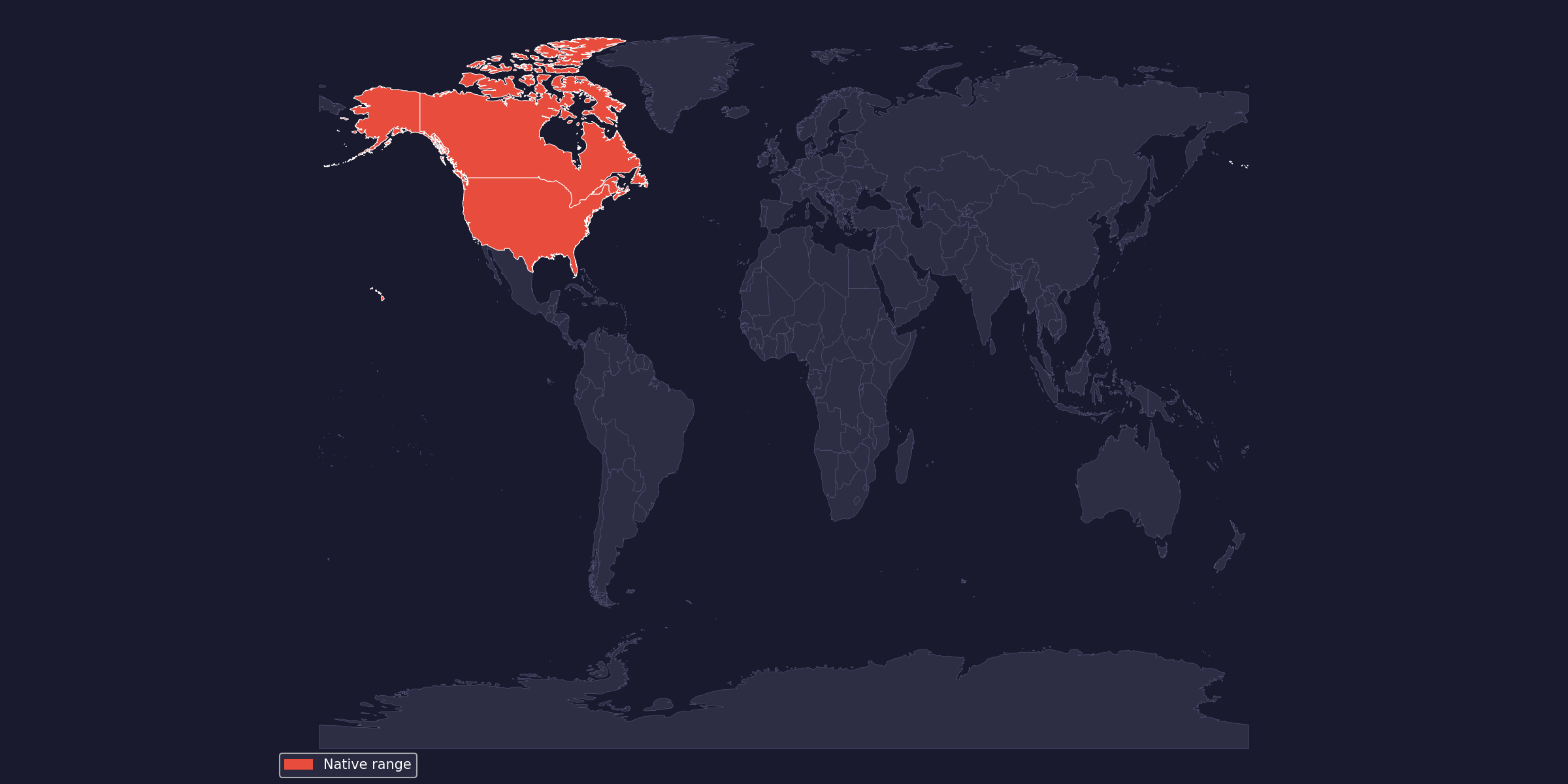
🌡 Climate across the native range
Monthly normals from a reviewed occurrence in the warm southeastern part of the extant United States range:
Central Georgia — United States (reviewed timber rattlesnake occurrence)
| Month | Min °C | Mean °C | Max °C | RH % |
|---|---|---|---|---|
| January | 5.2 | 9.1 | 14.4 | 70 |
| February | 6.6 | 10.9 | 16.6 | 69 |
| March | 9.7 | 14.6 | 20.5 | 65 |
| April | 13.5 | 18.8 | 24.9 | 62 |
| May | 18 | 23.2 | 28.9 | 63 |
| June | 21.8 | 26.2 | 31.4 | 71 |
| July | 23.6 | 27.8 | 33 | 71 |
| August | 23.1 | 27 | 32 | 74 |
| September | 20.6 | 24.6 | 29.6 | 72 |
| October | 15.2 | 19.6 | 24.9 | 69 |
| November | 9.9 | 14.1 | 19.6 | 68 |
| December | 6.7 | 10.5 | 15.7 | 72 |
Weather data by Open-Meteo.com · CC BY 4.0 · Monthly normals calculated by Herpeton Academy from daily archive values.
Location references use GBIF.org occurrence data where available; original occurrence records retain their source dataset licenses.
⚖️ Legal status
On 21 August 2026, no listing was found in CITES Appendices I-III; Commission Regulation (EU) 2026/1383 instead includes the genus Crotalus in EU Annex D, so current import-reporting procedures must be checked. The Bern Convention is not relevant. A U.S. Fish and Wildlife Service review states that the species is not federally listed under the Endangered Species Act, but state rules differ sharply. New York, for example, lists it as Threatened; other states prohibit possession, require dangerous-animal permits, protect wild individuals or regulate collection and transfer.
In Canada the species is Extirpated under SARA Schedule 1 and in Ontario; collection from historical habitat is not an option. Keep permits, invoices, captive-lineage and transfer records, photographs and legal-check dates. Local, state/provincial and national rules governing possession, transport, breeding, sale and import may apply even without a trade-treaty listing.
🤌 Husbandry
House singly. Seasonal den aggregation in nature is not a recommendation for captive cohabitation. Use a locked venomous room, secondary room containment, two independently closable shift hides and a primary enclosure that can be serviced without sharing open space with the snake. Confirm the animal visually behind a closed door before every routine task.
Quarantine for at least 90 days with paper, separate tools and preferably separate air. Record weight, meals, sheds, faeces, respiration and oral condition; arrange veterinary and faecal screening for uncertain-origin stock. Never cool a new, thin, sick or parasite-positive animal.
💡 Lighting
Use a locality-informed photoperiod, broadly 10 hours in winter to 14 in summer for temperate stock, with complete darkness at night. Guard every fitting and provide deep shade. Low-level UVB across part of the warm zone can offer Ferguson Zone 2 exposure, provided the snake can retreat fully.
🌡 Heating and temperature
Maintain 23-27°C ambient air, a local 29-32°C basking surface, a 19-23°C cool hide and nights around 15-20°C during the active season. Large-bodied vipers heat slowly; measure the actual coil-level surface and air, not only the thermostat probe.
Brumation is provenance-dependent. A northern breeding programme may gradually cool healthy established adults to approximately 5-12°C under continuous monitoring, while Gulf and southeastern stock may need only a mild seasonal reduction. Brumation is not routine for display-only animals and must never be improvised from outdoor weather or the Georgia table.
💧 Humidity and water
Maintain roughly 45-65% relative humidity with airflow, plus a localized 65-80% humid retreat for shedding. Appalachian, floodplain and Gulf stock may use moister microhabitats, but stagnant saturated substrate promotes scale damage and respiratory disease.
Provide a heavy bowl of clean water through protected access. A bowl large enough for partial soaking may be useful during shedding, but routine soaking is unnecessary. Monitor hydration through drinking, urates, mass and skin elasticity.
🌿 Enclosure and decoration
An adult needs at least 180 x 90 x 90 cm; large individuals benefit from 240 cm length. Include two externally operated shift hides, anchored low cover, visual barriers, a stable basking shelf and limited sturdy climbing structure. Staff must see the snake and rattle before reaching any service point.
Use 10-15 cm of compactable soil, leaf mould and washed sand with dry leaf litter, or paper during quarantine. Avoid unstable rock piles, hidden cavities, aromatic wood, sharp chips and tape. Provide two independent locks, guarded ventilation, perimeter checks and a written escape plan that coordinates facility security and emergency services.
🐁 Feeding
Wild prey is mainly small mammals, with birds and other vertebrates also taken. Offer appropriate frozen-thawed rodents. Juveniles may eat every 10-14 days; established adults generally need a modest meal every 14-28 days, adjusted by season and body condition. Obesity masks body contours and increases reproductive and anaesthetic risk.
Feed with long tongs through a protected port. Shift the snake before retrieving refused food. Do not use live rodents or enter to manipulate prey. Whole prey needs no routine supplements.
🛡 Operational safety and emergencies
Never free-handle, pin, neck or manually restrain. Use protected contact, lockable shifts, transparent shields and purpose-selected hooks only within a written institutional procedure. Two trained adults attend every opening; one remains outside the immediate operation with communications and the emergency plan.
Before acquisition, confirm the receiving emergency department, Poison Control pathway (United States: 1-800-222-1222), transport, antivenom stock strategy and specialist consultation. Rehearse escape and bite responses without a live snake.
Every bite is an emergency: withdraw safely, call emergency services, keep the patient calm and still, remove rings and tight clothing, and follow the poison centre. For North American pit-viper bites do not apply pressure immobilisation or a tight wrap unless a regional medical authority specifically directs it. Do not cut, suck, ice, shock, use a tourniquet, drink alcohol or wait for symptoms.
🐍 Breeding notes
Timber rattlesnakes are viviparous and often produce about 5-20 young. Females mature slowly and may reproduce only every few years, making body condition and recovery more important than annual production. Locality-informed seasonal cycling may support reproduction, but breeding is not a reason to brumate unsuitable animals.
Pairing and neonatal work require remotely closable compartments. Prepare individual locked juvenile housing, lineage documentation, permits and lawful placements before introduction. Do not market southeastern stock under the obsolete atricaudatus subspecies as though it were an accepted taxon.
🩺 Common problems
- Obesity: long-lived adults need conservative prey and seasonal weight records.
- Rostral trauma: investigate visibility, reflections, cover and shift routines.
- Burns or overheating: guard and thermostat all heat while preserving a cool refuge.
- Respiratory infection: wheeze, bubbles, open-mouth breathing or persistent elevation of the head needs urgent veterinary assessment.
- Dysecdysis and scale damage: correct hydration and substrate ventilation; never restrain manually to remove shed.
- Brumation loss: weight decline or respiratory signs during cooling require the programme veterinarian, not abrupt unplanned warming.
📌 Conclusion
The timber rattlesnake requires decades of protected-contact care and a seasonal plan based on documented locality, not the rejected atricaudatus split or a whole-country map. A programme should acquire one only after legal protection, safe shifting and regional antivenom access have been resolved.
📚 Sources and further reading
- ReptiFiles — checked first on 21 August 2026; no species-specific care guide was found.
- The Reptile Database: Crotalus horridus
- GBIF species record: Crotalus horridus
- U.S. Fish and Wildlife Service: timber rattlesnake
- U.S. Fish and Wildlife Service CoP20 review: not ESA-listed
- Canada COSEWIC 2023 status review
- New York DEC: Timber Rattlesnake
- Poison Control: rattlesnake bites
- CDC/NIOSH: venomous-snake first aid
- Baines et al. — UV lighting guidance
- CITES Appendices
- EU wildlife-trade annexes, Commission Regulation (EU) 2026/1383
- Bern Convention appendices