Share

South American Rattlesnake
🔤 Taxonomy
Crotalus durissus is the accepted South American rattlesnake, also called the tropical rattlesnake or cascabel. The current Reptile Database treatment recognizes C. d. durissus, cumanensis, marajoensis, ruruima, terrificus and trigonicus. Older labels such as cascavella, collilineatus and dryinas remain common in collections and medical literature but are not all accepted as current subspecies.
The broader C. durissus complex also contains several lineages now treated as species, including C. simus, C. culminatus, C. tzabcan, C. unicolor, C. vegrandis, C. ehecatl and C. mictlantecuhtli. Strict C. durissus is South American. Preserve country, coordinates, parentage, photographs and the identification authority; a generic “cascabel” label is inadequate for climate, legal or antivenom planning.
📌 Description
This is a robust rattlesnake, commonly 120-180 cm, with a raised vertebral ridge, rhomboid dorsal pattern and terminal rattle. It uses open and seasonally dry habitats more often than closed rainforest, but behaviour and build vary across its enormous range. A quiet animal can still turn and strike faster than an operator can withdraw.
Envenomation may produce neuromuscular weakness, drooping eyelids, blurred vision, muscle injury, dark urine, kidney injury and coagulation abnormalities; local swelling can be less dramatic than the systemic illness. Venom composition and clinical expression vary geographically. This is an expert-only institutional species, never an animal for direct handling.
📋 Quick reference
| Care point | Practical target |
|---|---|
| Adult size and lifespan | Usually 120-180 cm; approximately 15-25 years |
| Adult enclosure | At least 200 x 100 x 100 cm with two lockable shift compartments |
| Temperature | Ambient 24-29°C; basking 31-33°C; cool retreat 22-25°C |
| Night | 20-24°C, adjusted to documented locality |
| Humidity | 45-70%; local 65-80% shedding support |
| Feeding | Measured frozen-thawed rodents every 14-28 days |
| Safety | Protected contact, two-person rule, locality-specific hospital and escape plans |
| Quarantine | At least 90 days with separate tools, records and veterinary screening |
☠️ Venom
This species is venomous. Venom exposure can cause pain, swelling or other systemic effects, and severity varies with species, locality, bite site and the amount delivered. A small wound or apparently dry bite is not proof of safety; every bite or sting requires urgent medical assessment.
If an incident occurs, move away, call emergency services or a poison centre, keep the patient still, remove rings and other constricting items, and follow dispatcher instructions. Do not use a tourniquet, cut or suck the wound, apply ice or electricity, give alcohol or medicines as a home treatment, or attempt to catch the animal. Antivenom choice and dosing are hospital decisions; verify the relevant product and local availability in advance. Sources: WHO snakebite guidance and appropriate species-specific toxinology or medical references listed below.
🌍 Distribution
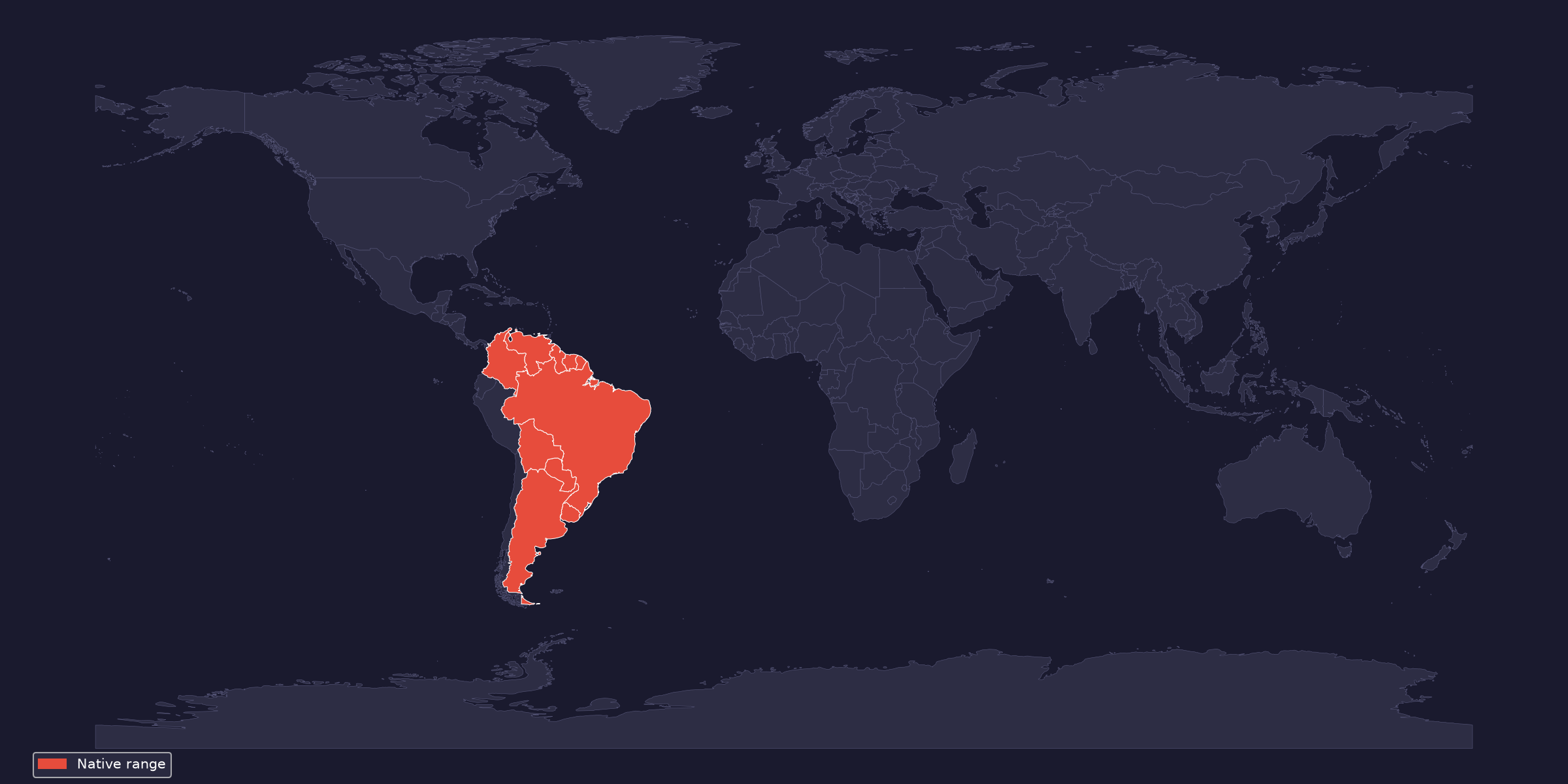
Under the current restricted concept, C. durissus occurs in South America: Brazil, Venezuela, Colombia, Guyana, Suriname, French Guiana, Argentina, Paraguay, Bolivia and Uruguay. It occupies separated savannas, cerrado, caatinga, grassland, scrub and open forest mosaics rather than one continuous habitat. Central American reports belong principally to species split from the old complex, and Aruba animals are C. unicolor.
The country map is deliberately coarse. It cannot show disjunct open-habitat corridors, rainforest gaps, isolated northern lineages, Brazilian subspecies boundaries or the restricted Colombian records. French Guiana is shaded as a separate Natural Earth territory, but the map still cannot show its habitat gaps or boundaries with neighbouring lineages. Never infer provenance or venom phenotype from the map or colour pattern.
The reviewed Bahia climate occurrence represents a warm, seasonally dry caatinga-margin setting. It does not stand for the humid Guianas, highland Venezuela or the cooler southern grasslands.
🌡 Climate across the native range
WorldClim v2.1 climate normals for 1970–2000 from a reviewed occurrence in the seasonally dry Brazilian interior:
Bahia — Brazil (reviewed caatinga-margin occurrence)
| Month | Min °C | Mean °C | Max °C | RH % |
|---|---|---|---|---|
| January | 15.1 | 20.6 | 26.2 | 76 |
| February | 15 | 20.7 | 26.3 | 76 |
| March | 15.2 | 20.6 | 26.1 | 77 |
| April | 14.6 | 20 | 25.5 | 77 |
| May | 13.3 | 18.9 | 24.6 | 77 |
| June | 11.9 | 17.8 | 23.7 | 77 |
| July | 11.3 | 17.3 | 23.4 | 77 |
| August | 11.8 | 18.1 | 24.5 | 75 |
| September | 13.1 | 19.6 | 26.1 | 74 |
| October | 14.6 | 20.8 | 27.1 | 75 |
| November | 15 | 20.6 | 26.2 | 76 |
| December | 15 | 20.4 | 25.9 | 77 |
Weather data by WorldClim v2.1 · Climate-normal period: 1970–2000. Monthly normals queried by Herpeton Academy from raster values; relative humidity is derived from vapor pressure and mean temperature.
Location references use GBIF.org occurrence data where available; original occurrence records retain their source dataset licenses.
⚖️ Legal status
As checked on 21 August 2026, CITES and the EU wildlife-trade annexes retain an Appendix III/Annex C entry for Crotalus durissus at Honduras’s request. Current taxonomy restricts C. durissus to South America, while Honduran “C. durissus” populations were reassigned within the former complex. This inherited nomenclatural mismatch means the listing cannot be interpreted safely from a modern label alone; obtain written advice from the relevant CITES authorities before any international movement.
The Bern Convention is not relevant to the strict South American range. National and local law may prohibit or license collection, possession, registration, transport, breeding, sale and import of native or dangerous snakes. Retain permits, CITES determinations, lawful-origin and veterinary documents, invoices, locality and parentage records, photographs and the legal check date.
🤌 Husbandry
House one animal in a controlled-access venomous room with secondary containment, sealed service penetrations and a written door protocol. The enclosure must have two positively lockable compartments or shift hides: confirm the snake behind a locked barrier before opening any occupied section. A single hide that cannot be secured is not a protected-contact system.
Quarantine for at least 90 days on paper with simple removable furnishings, dedicated tools and preferably separate airspace. Record weight, meals, sheds, faeces, urates, respiration and oral condition; test imported or poorly documented snakes for endoparasites and ectoparasites with an experienced reptile veterinarian.
Keep singly. Temporary breeding introductions require two trained operators, remote separation and a route for either snake to shift without hands entering the enclosure. Never rely on rattling, stillness or previous behaviour as a safety signal.
💡 Lighting
Provide 10-13 hours of bright visible light with seasonal adjustment to provenance and complete darkness at night. Use shaded shift hides and visual cover. All lamps belong outside primary containment or behind locked guards.
Low-output UVB may be offered as a measured Ferguson Zone 1 opportunity. Maintain a fully shaded route and verify irradiance at snake level. UVB is optional support, not a reason to expose the snake to excessive heat or open the enclosure for lamp maintenance.
🌡 Heating and temperature
Maintain ambient air at 24-29°C, a basking surface at 31-33°C, a cool retreat at 22-25°C and nights around 20-24°C. Use guarded, redundant thermostatic heat and independent air and surface probes. Alarm high temperatures; a large heavy snake needs enough cool floor area to leave the heated zone completely.
Seasonal change must follow verified provenance. Southern terrificus animals may encounter cooler winters, while northern and caatinga localities follow different rain and temperature cycles. Do not impose deep cooling on juveniles, thin, sick, gravid or newly acquired animals, and do not translate outdoor heat extremes into a uniformly hot enclosure.
💧 Humidity and water
A practical base range is 45-70%, with a ventilated humid shift hide around 65-80% during shedding. Maintain a dry surface in at least part of the enclosure. The species spans dry thorn scrub and humid savanna, so one fixed “tropical” humidity number is less useful than measured gradients and locality records.
Provide a large, stable bowl of clean water that can be removed through protected service access. Monitor drinking, urates, weight and shed quality. Persistent wet substrate, stale air and cool temperatures promote dermatitis and respiratory disease; routine whole-enclosure spraying is not a substitute for a controlled humid retreat.
🌿 Enclosure and decoration
An adult needs at least 200 x 100 x 100 cm, with greater floor area for large females. Install two lockable shift compartments, broad anchored hides, low visual barriers and an unobstructed inspection lane. Two-step locks, internal service barriers and narrow vent and cable tolerances are mandatory.
Use 5-10 cm of compactable mineral soil mixed with limited leaf litter or bark appropriate to locality; keep one surface zone dry. Paper is safer during quarantine. Avoid unstable stone, deep décor that hides the snake completely, dusty substrate, aromatic wood and furnishings that must be lifted during servicing.
The enclosure and the room need visible venom warnings, a checked tool inventory and no public access. Design for adult mass and strike reach, not merely total litres.
🐁 Feeding
Wild diet is dominated by mammals but can vary with age and region. Offer appropriately sized frozen-thawed rodents every 14-28 days for established adults, adjusting to weight, body condition, temperature and reproductive state. Juveniles may feed more often on smaller whole prey.
Use long tongs through a protected port after shifting whenever possible. Never use live rodents: bite injury and retrieval create avoidable hazards. Whole vertebrate prey needs no routine calcium or vitamin powder. Obesity is common in inactive captive rattlesnakes, so record weights and avoid oversized meals.
🛡 Operational safety and emergencies
Never free-handle, pin, neck or manually restrain C. durissus in routine care. Use lockable shift boxes, species-appropriate hooks, transparent shields and protected feeding and water ports. Two trained adults attend every primary opening. Veterinary procedures require a pre-arranged professional anaesthesia, airway and containment plan.
Before acquisition, give the receiving hospital or poison centre the exact taxon and origin. South American crotalic antivenoms are regional medical products; geographical venom variation and historic subspecies names make an unrelated rattlesnake product or generic “polyvalent” antivenom an unsafe assumption. Antivenom selection, storage and administration belong to the hospital.
A bite is an immediate emergency even when pain or swelling is initially limited. Move away, call emergency services, remove rings and other constricting items, keep the patient still with the limb neutrally supported, and follow poison-centre instructions. Do not use a tourniquet, cut, suck, ice, shock or massage the site, and do not delay transport to capture the snake.
Maintain a written escape plan covering room isolation, public exclusion, accountability, search zones, secure containers and named decision-makers. Stop work whenever the animal cannot be positively located.
🥚 Breeding notes
C. durissus is viviparous. Litter size varies with female size and lineage; roughly 6-24 young is a conservative facility-planning range, not a universal value. Reproductive season and gestation differ across tropical, seasonal and southern populations.
Breed only verified, compatible localities. Do not cross lineages to produce visually marketable offspring or erase medically relevant provenance. Prepare individually lockable neonate enclosures, transfer containers, legal documentation and placements before pairing; neonates are fully venomous and can escape through gaps that safely contain adults.
🩺 Common problems
- Obesity: prevent with measured prey, condition scoring and regular weighing.
- Dehydration or retained shed: review water access, local humidity, temperature and underlying disease.
- Respiratory disease: wheezing, bubbles, open-mouth breathing or head elevation require urgent veterinary assessment.
- Dermatitis and scale injury: investigate wet dirty substrate, poor airflow, mites and abrasion.
- Parasites and stomatitis: weight loss, abnormal faeces, excess saliva or oral swelling are important in imports.
- Burns and overheating: prevent with guarded thermostatic heat, alarms and a genuine cool compartment.
- Regurgitation: review prey size, handling disturbance, thermal conditions, infection and parasites.
Do not attempt hands-on home treatment. Shift and lock the snake before an experienced reptile veterinarian assesses it.
📌 Conclusion
Crotalus durissus belongs only in a licensed institution that preserves locality, provides two-compartment protected contact and has a South America-specific hospital plan. The broad old complex, inherited trade names and geographic venom variation make an undocumented “cascabel” unacceptable for safe care.
📚 Sources and further reading
- ReptiFiles — checked first on 21 August 2026; no species-specific care guide was found.
- The Reptile Database: Crotalus durissus
- GBIF species record: Crotalus durissus
- Cañas — biological and medical review of C. durissus
- Frare et al. — clinical, laboratory and therapeutic review
- Geographic variation in individual C. durissus venom profiles
- Baines et al. — UV lighting guidance
- Northern Ireland government venomous-reptile guidance
- CITES Appendices
- EU wildlife-trade annexes, Commission Regulation (EU) 2026/1383
- Bern Convention appendices