Share

Sidewinder
🔤 Taxonomy
Crotalus cerastes is the accepted sidewinder or horned rattlesnake. Three subspecies are currently listed: Mojave Desert C. c. cerastes, Sonoran Desert C. c. cercobombus and Colorado Desert C. c. laterorepens. Their validity has been questioned, so locality is more durable information than a subspecies label alone.
Do not confuse this North American pit viper with African and Asian horned vipers in the genus Cerastes. Keep state or Mexican state, coordinates, parentage and photographs with every animal. The sidewinding gait and supraocular “horns” do not identify a locality.
📌 Description
Sidewinders are compact rattlesnakes, commonly 45-75 cm, adapted to sandy washes, flats and dunes. They bury by shuffling beneath loose surface material and can launch into rapid sidewinding movement. A partly buried snake may expose only the eyes and rattle.
Envenomation can cause pain, swelling, tissue injury and systemic effects requiring hospital observation and antivenom assessment. Small adult size does not make servicing safe. This remains an expert-only protected-contact species.
📋 Quick reference
| Care point | Practical target |
|---|---|
| Adult size and lifespan | Usually 45-75 cm; approximately 12-20 years |
| Adult enclosure | At least 120 x 60 x 60 cm with two lockable shift hides |
| Temperature | Ambient 24-29°C; basking surface 33-36°C; cool hide 21-24°C |
| Night | 17-22°C |
| Humidity | 25-45%; local 45-60% shedding support |
| Substrate | 10-15 cm clean sand/mineral mix with firm and loose zones |
| Feeding | Small frozen-thawed rodents every 10-21 days |
| Safety | Protected contact, two-person rule, hospital and escape plans |
☠️ Venom
This species is venomous. Venom exposure can cause pain, swelling or other systemic effects, and severity varies with species, locality, bite site and the amount delivered. A small wound or apparently dry bite is not proof of safety; every bite or sting requires urgent medical assessment.
If an incident occurs, move away, call emergency services or a poison centre, keep the patient still, remove rings and other constricting items, and follow dispatcher instructions. Do not use a tourniquet, cut or suck the wound, apply ice or electricity, give alcohol or medicines as a home treatment, or attempt to catch the animal. Antivenom choice and dosing are hospital decisions; verify the relevant product and local availability in advance. Sources: WHO snakebite guidance and appropriate species-specific toxinology or medical references listed below.
🌍 Distribution
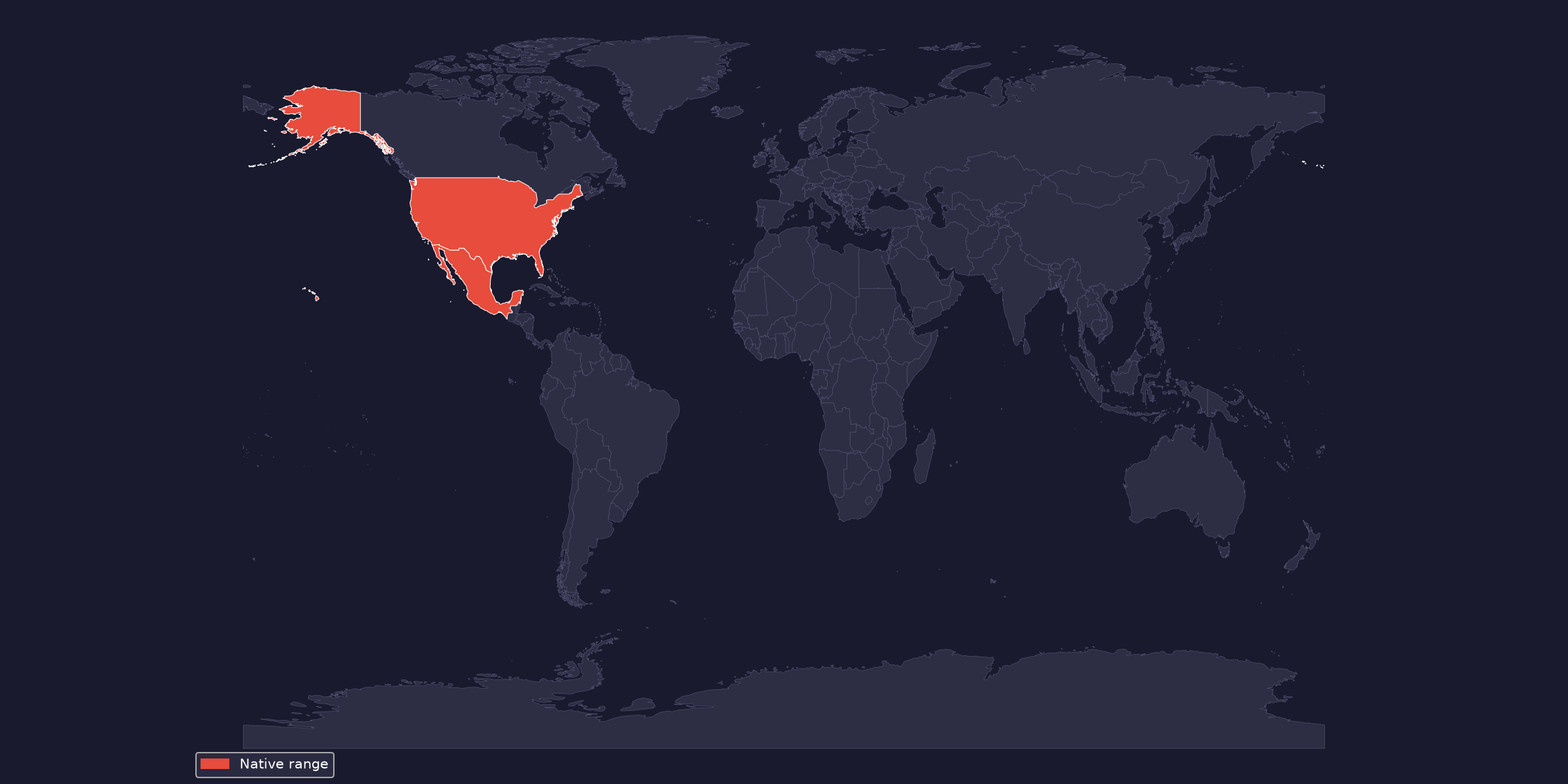
C. cerastes occurs in the United States in southeastern California, southern Nevada, southwestern Arizona and southwestern Utah, and in Mexico in northeastern Baja California and northwestern Sonora. Subspecies boundaries are described across the Mojave, Sonoran and Colorado desert regions but should not replace exact locality data.
A two-country map greatly overstates occupancy. It cannot show desert basins, elevation limits, mountain barriers, sandy washes, the narrow Mexican range or locality boundaries. The reviewed California occurrence is identified as C. c. laterorepens in the Colorado Desert; its climate is not a substitute for Mojave or Sonoran provenance.
🌡 Climate across the native range
WorldClim v2.1 climate normals for 1970–2000 from a reviewed Colorado Desert sidewinder occurrence:
Colorado Desert, California — USA (reviewed C. c. laterorepens occurrence)
| Month | Min °C | Mean °C | Max °C | RH % |
|---|---|---|---|---|
| January | 5.9 | 13.7 | 21.6 | 45 |
| February | 7.5 | 15.6 | 23.7 | 44 |
| March | 9.5 | 17.8 | 26 | 41 |
| April | 11.9 | 21.1 | 30.2 | 35 |
| May | 15.9 | 25.1 | 34.2 | 33 |
| June | 19.9 | 29.7 | 39.5 | 28 |
| July | 23.7 | 33.1 | 42.5 | 30 |
| August | 24.5 | 33.2 | 41.9 | 32 |
| September | 21.3 | 30.4 | 39.4 | 33 |
| October | 15.7 | 24.8 | 33.9 | 33 |
| November | 9.1 | 18 | 26.9 | 38 |
| December | 5.7 | 14.1 | 22.5 | 42 |
Weather data by WorldClim v2.1 · Climate-normal period: 1970–2000. Monthly normals queried by Herpeton Academy from raster values; relative humidity is derived from vapor pressure and mean temperature.
Location references use GBIF.org occurrence data where available; original occurrence records retain their source dataset licenses.
⚖️ Legal status
As checked on 17 August 2026, Crotalus cerastes is not listed in the CITES Appendices or EU wildlife-trade annexes, and the Bern Convention is not relevant to its North American range. That does not make collection, possession or transport unrestricted.
US federal, state, county, municipal and protected-area rules may restrict native-wildlife collection, venomous-snake ownership, permits and interstate transport. Mexican wildlife and export law also applies. Confirm possession, registration, transport, breeding, sale and import requirements in writing with every origin, transit and destination authority; retain permits, lawful-origin proof, invoices, locality and parentage records, photographs and the check date.
🤌 Husbandry
House one snake in a controlled-access venomous room with secondary containment and a written door protocol. Provide two positively lockable shift hides so every occupied section can be isolated before a door opens. Because the snake can disappear under shallow sand, a visible tail or rattle never counts as a complete location check.
Quarantine for at least 90 days on paper or a thin disposable mineral layer, with dedicated tools and simple hides. Record weight, meals, sheds, faeces, mouth and respiration, and arrange veterinary parasite testing when origin or condition warrants it.
Keep singly. Captive reproductive reports describe cannibalism risk among young, and routine cohabitation complicates confirmation and separation. Protected contact is a physical system, not a response to apparent calmness.
💡 Lighting
Provide 10-14 hours of bright visible light adjusted gradually by season and complete darkness at night. Shade the shift hides and use low cover that produces usable dawn and dusk edges. All lamps and wiring belong outside primary containment or behind locked guards.
Low-output UVB may be offered as a Ferguson Zone 1 opportunity. Measure it at the substrate surface and preserve a fully shaded route. Bright light must not turn the entire enclosure into a hot, exposed surface.
🌡 Heating and temperature
Maintain ambient air at 24-29°C, a limited basking surface at 33-36°C, a cool hide at 21-24°C and nights around 17-22°C. Measure sand surface and air separately. Thermostat and guard every heater, use an independent high-temperature alarm and keep the cool retreat available even during summer.
Desert field records include extreme surface temperatures, but sidewinders avoid them through timing, burial and shade. Do not heat all the substrate or copy outdoor maxima. A carefully controlled seasonal cool period is relevant only to healthy, established, locality-documented adults; it is not for juveniles, thin, sick or newly acquired snakes.
💧 Humidity and water
Maintain strong cross-ventilation and roughly 25-45% ambient humidity. Offer one small ventilated shift hide at 45-60% during shedding rather than spraying the entire enclosure. The substrate surface should remain dry; condensation and persistent dampness indicate a ventilation or temperature problem.
Provide a small, stable clean-water bowl through protected access. Desert adaptation does not justify withholding water. Monitor drinking, weight, urates and shed quality, and correct recurrent dehydration by reviewing microclimates and health rather than saturating sand.
🌿 Enclosure and decoration
An adult needs at least 120 x 60 x 60 cm. Install two lockable shift hides, an open inspection lane, anchored low cover and a protected service port. Every track, vent and cable opening must exclude a neonate; use two-step mechanical locks and a secondary room barrier.
Provide 10-15 cm of washed, low-dust fine-to-medium sand blended with mineral soil. Include a looser burying zone and a slightly firmer route so the snake can choose footing. Avoid calcium sand, sharp crushed stone, unstable rock stacks, very dusty powders, aromatic wood and permanently damp substrate.
Design the enclosure so water and waste can be serviced without excavating for the animal. Never probe blindly through sand.
🐁 Feeding
Field studies show a size-related diet shift: juveniles take many lizards, while larger animals increasingly use small mammals. Established captives can receive appropriately sized frozen-thawed mice every 10-21 days, adjusted to weight and condition. Avoid large meals in an animal adapted to small prey.
Feed through a protected port with long tongs, then confirm the snake before retrieving anything. Do not use live rodents. Whole vertebrate prey needs no routine supplementation. Track weight because low activity and frequent feeding cause obesity quickly.
🛡 Operational safety and emergencies
Never free-handle, pin, neck or manually restrain a sidewinder during routine work. Use lockable shifts, appropriate hooks, transparent shields and protected ports. Two trained adults attend every primary opening. Veterinary procedures require a pre-arranged professional anaesthetic and containment plan.
Before acquisition, contact the receiving hospital or poison centre with the exact species and locality. Confirm which regional North American crotalid antivenom and monitoring pathway the hospital would use; ownership of antivenom by the keeper is not a treatment plan and private administration is unsafe.
After a bite, move away, call emergency services, remove constricting items, keep the patient still with the limb neutrally supported and follow poison-centre instructions. Do not use a tourniquet, cut, suck, ice, shock or massage the site. Do not delay transport to catch or kill the snake.
Maintain a written escape plan covering room isolation, public exclusion, accountability, search zones, secure containers and named decision-makers. A buried or unconfirmed snake stops all servicing.
🥚 Breeding notes
C. cerastes is viviparous. Published long-term captive work recorded repeated litters and also undeveloped ova, stillbirths and deformed young; roughly 3-12 live young is a conservative planning range. One successful pair does not establish a universal temperature or reproductive schedule for all localities.
Pair only healthy, locality-compatible adults through shift compartments. Prepare individual neonate-proof housing and lawful placements before introduction. Neonates require the same venom protocol as adults and must never be group-housed merely for convenience.
🩺 Common problems
- Obesity: prevent with small measured prey, long feeding intervals and weight records.
- Dehydration or retained shed: review water, the local humid hide, temperature and illness.
- Respiratory disease: nasal bubbles, wheezing or open-mouth breathing need prompt veterinary care.
- Sand abrasion or impaction: investigate dusty or sharp substrate, dehydration, low heat and prey coated heavily in sand.
- Burns and overheating: prevent with guarded thermostatic heat, alarms and an accessible cool hide.
- Mites, parasites and stomatitis: especially important in wild-caught or poorly documented animals.
- Regurgitation: review prey size, heat, disturbance, infection and parasites.
Hands-on home treatment is unsafe. Secure the animal in a shift compartment and use an experienced reptile veterinarian.
📌 Conclusion
The sidewinder suits only a licensed facility that can provide deep but inspectable desert substrate, a genuine thermal escape, two lockable compartments and a hospital-ready rattlesnake protocol. Its small size and spectacular locomotion do not reduce the containment standard.
📚 Sources and further reading
- ReptiFiles — checked first on 17 August 2026; no species-specific care guide was found.
- The Reptile Database: Crotalus cerastes
- GBIF species record: Crotalus cerastes
- California Department of Fish and Wildlife sidewinder life-history account
- Webber et al. — feeding ecology of sidewinders
- Schuett et al. — fifteen consecutive years of captive reproduction
- British Herpetological Society — captive spatial use study
- Baines et al. — UV lighting guidance
- Northern Ireland government venomous-reptile guidance
- CITES Appendices
- EU wildlife-trade annexes, Commission Regulation (EU) 2026/1383
- Bern Convention appendices