Share

Mexican west-coast rattlesnake
🔤 Taxonomy
Crotalus basiliscus is the Mexican west-coast or basilisk rattlesnake, a monotypic species in the current Reptile Database. It belongs to the C. molossus complex but is not a subspecies of C. molossus. Preserve Mexican state, locality, parentage and photographs because populations cover different elevations and seasonal climates.
📌 Description
One of the largest rattlesnakes, this heavy-bodied species commonly reaches 120-180 cm and exceptional animals approach 200 cm. Adults often become olive, greenish or brown with a dark tail, while young can retain a stronger dorsal pattern. It uses tropical deciduous forest, thorn scrub, foothills and rocky drainage systems and can climb low trees and shrubs.
Its size, reach and medically significant venom make it unsuitable for private casual keeping. Juveniles are not safer: recent research found age-related venom changes and high activity in venom from smaller C. basiliscus in a mouse model. Every life stage requires the full containment and bite-response standard.
📋 Quick reference
| Care point | Practical target |
|---|---|
| Adult size and lifespan | 120-200 cm; approximately 18-25 years |
| Adult enclosure | At least 200 x 100 x 100 cm with two large lockable shifts |
| Temperature | Ambient 25-30°C; basking surface 32-35°C; cool zone 22-25°C |
| Night | 20-24°C |
| Humidity | 45-65%; local 60-75% shedding support |
| Habitat | Strong floor space, anchored low climbing structure and shaded retreats |
| Feeding | Frozen-thawed rodents or other appropriate whole prey every 14-28 days |
| Safety | Licensed facility, double containment, protected contact, trained backup |
☠️ Venom
This species is venomous. Venom exposure can cause pain, swelling or other systemic effects, and severity varies with species, locality, bite site and the amount delivered. A small wound or apparently dry bite is not proof of safety; every bite or sting requires urgent medical assessment.
If an incident occurs, move away, call emergency services or a poison centre, keep the patient still, remove rings and other constricting items, and follow dispatcher instructions. Do not use a tourniquet, cut or suck the wound, apply ice or electricity, give alcohol or medicines as a home treatment, or attempt to catch the animal. Antivenom choice and dosing are hospital decisions; verify the relevant product and local availability in advance. Sources: WHO snakebite guidance and appropriate species-specific toxinology or medical references listed below.
🌍 Distribution
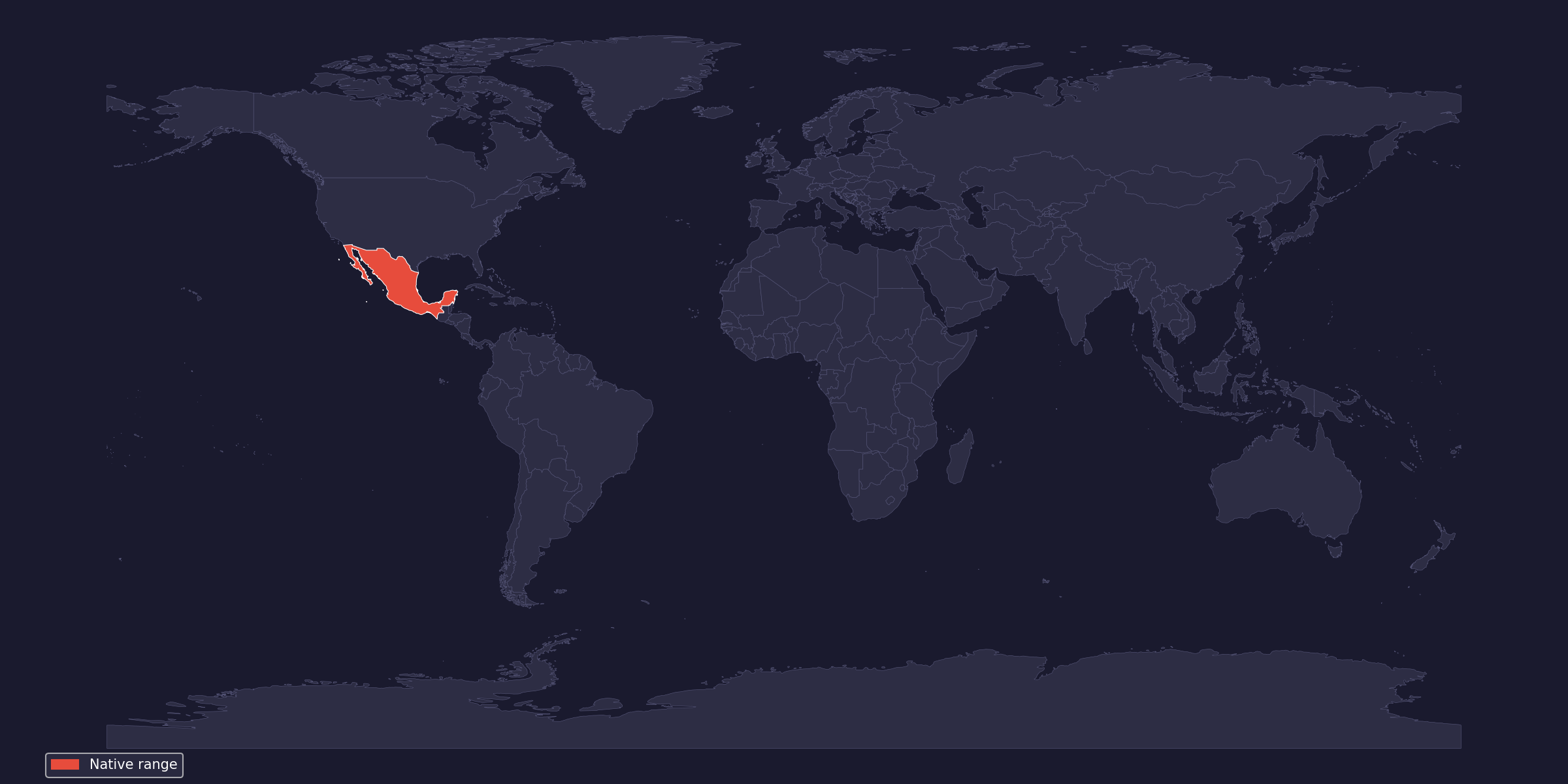
This species is endemic to western Mexico. Current records run mainly along the Pacific slope and adjacent uplands from southern Sonora and Chihuahua through Sinaloa, Nayarit, Jalisco and Colima into Michoacán, with records in Zacatecas and Aguascalientes. It is associated with a mosaic of tropical dry forest, thorn scrub, river valleys and foothill or canyon habitat.
A state-level map does not describe elevation, wet-season timing or the transition between coastal and upland climates. Husbandry must therefore follow documented provenance, not the broad label “western Mexico”.
⚖️ Legal status
Checked on 21 August 2026: C. basiliscus is not listed in CITES, but the whole genus Crotalus is listed in EU Annex D under Regulation (EU) 2026/1383; Bern is not relevant to its Mexican range. Mexico identifies it as endemic and lists it as Pr (subject to special protection) under NOM-059-SEMARNAT-2010. That status and the General Wildlife Law control lawful collection, possession, transport and use.
Outside Mexico, dangerous-wild-animal and venomous-reptile rules may require a licence, inspected premises, liability cover, notification and specific transport conditions. Confirm origin, transit and destination requirements in writing before acquisition. Accept only correctly identified stock with invoice, lawful-origin or export/import documents, locality and parentage.
🤌 Husbandry
House singly in a restricted venomous room behind a locked secondary barrier. The primary enclosure must have two full-size, positively lockable shift compartments and protected service access. Use a written sequence for every opening and visually confirm the entire animal behind a locked barrier first.
Quarantine for at least 90 days in a robust, simple enclosure with dedicated tools. Record weight, meals, sheds, faeces, respiration and oral health; arrange veterinary parasite assessment according to provenance. A large calm-looking individual can cross distance quickly, and behaviour never replaces engineering controls.
💡 Lighting
Provide 11-13 hours of bright visible light with gentle seasonal adjustment and full darkness at night. Offer light over one stable shelf and deep shade in both shift retreats. Lamps, cables and guards stay outside the primary enclosure or behind a locked barrier.
Low-output UVB can be provided as a measured Ferguson Zone 1 opportunity. Measure at the highest usable shelf and preserve complete shade. Ensure the snake cannot press against a hot lamp guard.
🌡 Heating and temperature
Maintain ambient air at 25-30°C, a limited basking surface at 32-35°C, a cool retreat at 22-25°C and nights around 20-24°C. Thermostat and guard all heating, measure both air and elevated surfaces, and install an independent high-temperature alarm.
Do not make the entire large enclosure hot. Coastal and upland animals can experience different night temperatures, and seasonal dry forest does not equal winter brumation. There is no safe generic brumation prescription for stock without precise locality; seasonal changes should remain conservative and evidence-led.
💧 Humidity and water
Use 45-65% ambient humidity as a working range with strong ventilation. A modest wet-season rise and a ventilated 60-75% shedding retreat are preferable to a permanently damp enclosure. Allow surfaces to dry and investigate condensation, mould or respiratory signs promptly.
Provide a heavy, clean water bowl serviceable through protected access. Track drinking, body mass, urates and sheds. Repeated soaking may indicate heat, dehydration, mites or disease and warrants investigation.
🌿 Enclosure and decoration
An adult needs at least 200 x 100 x 100 cm; larger animals require more. Fit two full-size lockable shifts, a protected service port, clear inspection lanes and strong low shelves or branches. Bolt structural items to the enclosure, support heavy décor from the base and remove all crush, fall and keeper-entrapment hazards.
Use 8-10 cm of low-dust mineral soil, coarse sand and leaf litter, adjusted to locality. Provide shaded cork or artificial-rock retreats that can be inspected without reaching inside. Door tracks, vents and cable openings must contain neonates. Design drainage so seasonal humidity never creates stagnant wet substrate.
🐁 Feeding
Wild prey includes mammals, birds and reptiles. Captive adults can be maintained on appropriately sized frozen-thawed rodents, with occasional other responsibly sourced whole vertebrate prey only where the institution has a nutritional reason. Offer a moderate meal every 14-28 days according to size, season and body condition.
Avoid “power feeding”; a large rattlesnake can carry excessive fat without appearing obviously obese. Feed through a protected port using long tongs, never offer live rodents, and lock the snake away before recovering refused prey.
🛡 Operational safety and emergencies
Never free-handle, pin, neck or manually restrain this species for routine work. Use full-size lockable shifts, appropriate hooks, transparent shields and protected ports. Two trained adults attend every primary opening, with roles agreed in advance. Veterinary procedures require a pre-arranged professional anaesthetic and containment plan.
Before acquisition, provide the receiving hospital or poison centre with the exact species, locality, estimated adult size and facility address. Confirm the hospital pathway and relevant Mexican/North American crotalid antivenom access. Venom and neutralisation vary across the molossus complex; private antivenom possession and home administration are unsafe.
After a bite, withdraw, call emergency services, remove constricting items, keep the patient still with the limb neutrally supported and follow poison-centre instructions. Never cut, suck, ice, shock, massage or apply a tourniquet. Maintain a written escape plan for room isolation, public exclusion, accountability, search zones, secure capture containers and named decision-makers.
🥚 Breeding notes
C. basiliscus is viviparous and large females can produce very large litters; published records support planning for approximately 10-60 young. Prepare individual, labelled, neonate-proof enclosures and lawful placements before pairing. Introduce only documented compatible adults through shift compartments and do not create hybrids within the molossus complex.
🩺 Common problems
- Obesity, fatty-liver risk and reduced fitness after frequent large meals.
- Burns or chronic overheating when a large body cannot leave the heated zone.
- Respiratory disease from stagnant humidity, cold wet substrate or poor ventilation.
- Retained shed or dehydration where the wet-season microclimate is missing.
- Falls, crush injuries and abrasions from weak or sharp décor.
- Mites, internal parasites and stomatitis, especially with wild-origin stock.
- Keeper near-misses caused by inadequate shift size or blind service areas.
Hands-on home treatment is unsafe. Secure the animal in a shift and use an experienced reptile veterinarian.
📌 Conclusion
The Mexican west-coast rattlesnake is a large institutional display animal, not a private handling species. Success means generous secure space, provenance-led seasonal choices, two full-size shifts and a rehearsed hospital and escape response.
📚 Sources and further reading
- ReptiFiles — checked first on 21 August 2026; no species-specific care guide was found.
- The Reptile Database: Crotalus basiliscus
- GBIF species record: Crotalus basiliscus
- Borja et al. 2025 — venom variation in the C. molossus complex
- Carbajal-Márquez et al. — arboreal habitat use and litter size
- Carbajal-Márquez et al. 2023 — new dietary records in the complex
- Mexico NOM-059-SEMARNAT-2010, 2019 amended list
- Baines et al. — UV lighting guidance
- CDC/NIOSH — venomous-snake first aid
- Northern Ireland government venomous-reptile guidance
- CITES Appendices
- EU wildlife-trade annexes, Commission Regulation (EU) 2026/1383
- Bern Convention appendices