Share

Eastern Diamondback Rattlesnake
🔤 Taxonomy
Crotalus adamanteus is the accepted name of the eastern diamondback rattlesnake. It has no recognised subspecies. Do not confuse it with the western diamondback, C. atrox: the two require separate origin records, range interpretation, and emergency identification. The proposed alternative genus name Hoserea has not been accepted in current mainstream taxonomy.
📌 Description
The eastern diamondback is the largest rattlesnake and one of the heaviest venomous snakes. Adults are often 1.0-1.8 m and 2.2-7 kg; rare historical animals reached about 2.4 m. Dark diamonds with pale borders, a facial stripe, and bold black-and-white tail bands precede the rattle.
Its venom can cause pain, rapidly progressive swelling, bleeding disturbance, shock, tissue injury, and death. The rattle is a warning mechanism, not a promise: some snakes stay silent. Its mass, speed, long strike, and conservation value make it an institutional expert species.
📋 Quick reference
| Care point | Practical target |
|---|---|
| Adult enclosure | At least 240 x 120 x 120 cm for one adult, with external-closing shift |
| Day temperatures | 24-28°C ambient; 31-33°C basking surface; 21-24°C cool retreat |
| Night temperatures | 18-22°C |
| Humidity | 45-65%, with humid shed retreat and strong ventilation |
| Lighting | Seasonal 10-14 hours; measured Ferguson Zone 2 UVB recommended |
| Feeding | Frozen-thawed rats or rabbits by size; adults commonly every 14-28 days |
| Housing | Solitary |
| Safety | Large medically significant rattlesnake; protected contact only |
☠️ Venom
This species is venomous. Venom exposure can cause pain, swelling or other systemic effects, and severity varies with species, locality, bite site and the amount delivered. A small wound or apparently dry bite is not proof of safety; every bite or sting requires urgent medical assessment.
If an incident occurs, move away, call emergency services or a poison centre, keep the patient still, remove rings and other constricting items, and follow dispatcher instructions. Do not use a tourniquet, cut or suck the wound, apply ice or electricity, give alcohol or medicines as a home treatment, or attempt to catch the animal. Antivenom choice and dosing are hospital decisions; verify the relevant product and local availability in advance. Sources: WHO snakebite guidance and appropriate species-specific toxinology or medical references listed below.
🌍 Distribution
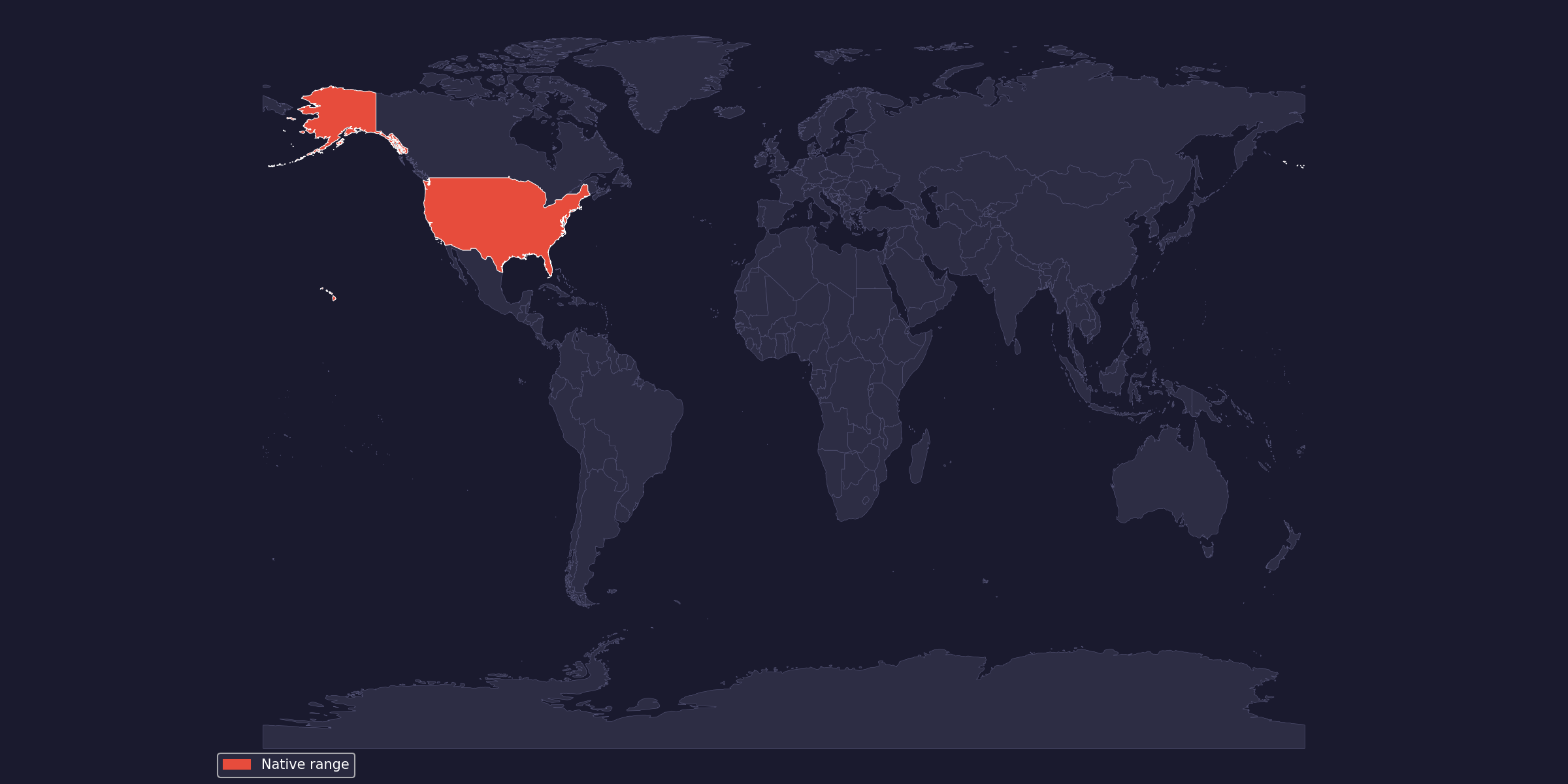
This species is endemic to the southeastern United States Coastal Plain: southeastern North Carolina, eastern and southern South Carolina, southern Georgia, Florida, southern Alabama, southern Mississippi, and extreme southeastern Louisiana. It uses longleaf-pine and wiregrass communities, pine flatwoods, sandhills, scrub, maritime forest, palmetto thickets, wetlands edges, and islands. Gopher-tortoise burrows, stump holes, and mammal burrows provide important refuge.
The map can colour only the whole United States. It does not imply occurrence outside the seven southeastern range states, throughout each state, or in developed and unsuitable interior habitat. State-level and locality data are essential; do not use a country fill to support collection or provenance claims.
🌡 Climate across the native range
Monthly climate normals from a verified occurrence in the humid coastal plain of Georgia:
Coastal Georgia — United States (verified occurrence)
| Month | Min °C | Mean °C | Max °C | RH % |
|---|---|---|---|---|
| January | 8.9 | 11.9 | 15.6 | 75 |
| February | 10.1 | 13.1 | 16.8 | 76 |
| March | 12.7 | 15.7 | 19.4 | 74 |
| April | 16.4 | 19.4 | 22.9 | 73 |
| May | 20.6 | 23.5 | 26.6 | 73 |
| June | 23.8 | 26.2 | 29 | 79 |
| July | 25.3 | 27.6 | 30.5 | 79 |
| August | 25.1 | 27.2 | 29.7 | 81 |
| September | 23.6 | 25.6 | 28 | 79 |
| October | 19.4 | 21.8 | 24.6 | 75 |
| November | 14.2 | 17 | 20.3 | 75 |
| December | 10.8 | 13.5 | 17 | 78 |
Weather data by Open-Meteo.com · CC BY 4.0 · Monthly normals calculated by Herpeton Academy from daily archive values.
Location references use GBIF.org occurrence data where available; original occurrence records retain their source dataset licenses.
⚖️ Legal status
As checked on 21 August 2026, Crotalus adamanteus is not listed in CITES Appendices I-III. Commission Regulation (EU) 2026/1383 includes the genus Crotalus in EU Annex D, requiring current EU import-reporting procedures to be checked. It is not native to Europe, so the Bern Convention is not relevant.
The species was under review by the U.S. Fish and Wildlife Service but was not federally listed under the Endangered Species Act at the check date. State rules are separate: North Carolina lists it as endangered, while Florida requires a permit for possession of any venomous reptile, documented experience, references, and a facility inspection. Collection, sale, transport, and possession rules differ across the seven range states and abroad. Verify both conservation and dangerous-animal law, and keep permits, lawful-origin documents, locality, invoice, photographs, and the legal-check date.
🤌 Husbandry
Prepare a locked room, locked enclosure, hazard labels, dedicated tools, and an adult-sized shift that closes from outside. House singly. A 2 m rattlesnake must never be forced past a keeper at a door: the route, barrier, and closure need to work without entering its strike radius.
Quarantine for at least 90 days on paper with simple hides and separate airspace and tools where possible. Record weight, meals, sheds, faeces, respiration, mouth, skin, and rattle condition. Wild-origin animals carry conservation, parasite, and snake-fungal-disease concerns and require veterinary evaluation.
💡 Lighting
Provide a seasonal 10-14-hour day with intense visible light and shaded cover. A measured low-to-moderate UVB zone around Ferguson Zone 2 is recommended over part of the warm side, with complete shade available. Guard lamps, tubes, cables, and probes from a large powerful snake.
Night is dark. Schedule lights and measure rather than using coloured night bulbs. Natural activity shifts with temperature and season; visibility for the keeper must not eliminate shelter for the snake.
🌡 Heating and temperature
Maintain 24-28°C daytime air, a 31-33°C basking surface large enough for the coil, a 21-24°C cool retreat, and 18-22°C nights. Use multiple guarded, thermostatically controlled sources rather than one intense hot spot. Measure surface temperatures in every major refuge.
Healthy established adults of known origin may receive gradual winter cycling in a managed breeding programme, with a protected 12-16°C dormant phase. North and south Florida animals should not be treated as climatically identical. Do not cool juveniles, underweight or ill snakes, recent arrivals, or any animal without veterinary and operational planning.
💧 Humidity and water
Provide 45-65% general humidity, normal daily fluctuation, and a humid retreat around shedding. Coastal habitat does not mean a permanently wet floor. Keep one deeper zone slightly moist while preserving dry litter, free drainage, and strong ventilation.
Use a stable water bowl large enough for drinking and occasional partial soaking, positioned for external service. Persistent soaking, wet ventral scales, condensation, or a sour enclosure needs investigation for heat, mites, disease, and drainage failure.
🌿 Enclosure and decoration
Provide at least 240 x 120 x 120 cm for one adult; more space is appropriate for a large active male. Use 10-15 cm of packed soil-and-sand mix with dry leaf and pine litter, multiple tight ground hides, stable logs, low platforms, and robust visual barriers. Do not use wild-collected substrate from protected habitat.
Fit redundant keyed or tool-operated locks, pinned tracks, secured vents, blocked cable gaps, and a full-body shift. Keep a clear sight line and working lane. No unsecured rock, sharp wire, heavy decor that can trap the snake, or planting that prevents a complete visual count.
🐁 Feeding
Wild adults take rabbits, rodents, and other mammals; younger snakes take smaller mammals and birds. Offer appropriately sized frozen-thawed rats and, for very large adults, responsibly sourced rabbit prey. Use prey that produces only a modest body contour and feed through protected procedure.
Juveniles commonly eat every 7-10 days, growing animals every 10-14 days, and adults every 14-28 days according to weight, sex, activity, and season. Whole prey needs no supplement. Large rattlesnakes can become obese while still feeding eagerly; maintain a weight and body-condition graph.
🥚 Breeding
The species is viviparous. Field and institutional sources report litters commonly near 12-14, with a broader range around 7-29 young; females may reproduce only every two or three years. Maternal attendance of neonates for several days has been documented.
Pairing large adults, winter cycling, pregnancy, birth, and neonatal separation require an experienced team and multiple secure holding areas. Every neonate has functional venom and needs an individual labelled container. Breeding is inappropriate without legal placement, genetic/locality records, and capacity for a large litter.
🛡️ Handling and emergency planning
Never free-handle, tail, pin, neck, or manually restrain this snake. Use protected shifts, long species-appropriate hooks and shields, and two trained staff for high-risk work. A rattle that stops is not a safety signal, and gloves are not bite protection.
Before acquisition, coordinate a written response with emergency services, poison control, a medical toxicologist, and the receiving hospital. Include the accepted name, exact location, access instructions, contacts, bite time, and current antivenom plan. Stocking or giving antivenom outside coordinated medical governance creates additional risk.
Any bite needs immediate emergency care. Keep the patient still, immobilize the limb in a neutral position, remove rings and tight items, and call emergency services or U.S. Poison Control at 1-800-222-1222 where applicable. Do not cut, suck, ice, shock, use chemicals, apply an arterial tourniquet, or delay transport to photograph or kill the snake.
🩺 Common problems
- Obesity: extend feeding intervals and follow serial weight rather than appetite.
- Regurgitation: review prey size, temperatures, disturbance, and underlying disease.
- Dysecdysis: correct hydration and humid-hide access without manually peeling an unsecured animal.
- Respiratory disease: wheeze, bubbles, gaping, or abnormal head elevation needs prompt veterinary assessment.
- Snake fungal disease or dermatitis: crusts, nodules, facial lesions, and abnormal scales require isolation and diagnosis.
- Mites and internal parasites: quarantine and test; never improvise pesticide dosing.
- Rattle injury: keep substrate and furnishings clean and non-catching; a damaged rattle does not reduce venom risk.
- Unsafe scale: if the adult cannot turn, shift, and be fully located without staff entering reach, the enclosure is too small or poorly designed.
📌 Conclusion
The eastern diamondback requires room-scale planning: a large seasonal Coastal Plain enclosure, whole-coil thermal choices, dry and humid retreats, restrained feeding, and an external shift built for a powerful long-striking snake. It belongs only in an authorised expert programme that respects state conservation law and has a rehearsed hospital response.
📚 Sources and further reading
- ReptiFiles was searched; no species-specific care guide was located: https://reptifiles.com/
- The Reptile Database: https://reptile-database.reptarium.cz/Crotalus/adamanteus
- GBIF: https://www.gbif.org/species/2444432
- Smithsonian’s National Zoo species account: https://nationalzoo.si.edu/animals/eastern-diamondback-rattlesnake
- NatureServe Explorer: https://explorer.natureserve.org/Taxon/ELEMENT_GLOBAL.2.101938/Crotalus_adamanteus
- Florida Fish and Wildlife Conservation Commission species profile: https://myfwc.com/wildlifehabitats/profiles/reptiles/snakes/eastern-diamondback/
- Florida venomous-reptile licensing: https://myfwc.com/license/captive-wildlife/venomous/
- U.S. Fish and Wildlife Service species page: https://www.fws.gov/species/eastern-diamondback-rattlesnake-crotalus-adamanteus
- Baines et al., UV-Tool: https://doi.org/10.19227/jzar.v4i1.150
- CITES Appendices: https://cites.org/eng/app/appendices.php and https://checklist.cites.org/
- Commission Regulation (EU) 2026/1383: https://eur-lex.europa.eu/eli/reg/2026/1383/oj/eng
- Bern Convention appendices: https://www.coe.int/en/web/bern-convention/appendices