Share

Emerald Tree Boa Care Guide
🔤 Taxonomy
Corallus caninus is the northern emerald tree boa from the Guiana Shield and nearby northern South America. Keep this article separate from Amazon Basin emerald tree boas, which are now usually treated as Corallus batesii, and from Amazon tree boas such as Corallus hortulana.
Common names used in the hobby:
- Emerald tree boa
- Northern emerald tree boa
Sales labels should be checked carefully. A useful seller can identify the animal, explain whether it is captive-bred or imported, give feeding and shed history, and state any locality information conservatively.
📌 Description
The emerald tree boa is a muscular arboreal boa for experienced keepers. It is not difficult because it is large; it is difficult because it needs stable humidity, fresh air, secure horizontal perches, careful feeding, and very low-stress maintenance.
Adults usually reach 120-180 cm. Well-kept animals can live 15-25 years, so the adult enclosure, quarantine plan, legal paperwork, and long-term maintenance cost should be solved before purchase.
A healthy animal should have firm muscle, a smooth spine line, clear eyes after shed, clean nostrils, a closed mouth, and quiet breathing. Repeated soaking, noisy breathing, sudden weight loss, retained shed, or refusal after a stable feeding pattern should trigger a review of humidity, ventilation, heat, security, parasites, and veterinary support.
📋 Quick reference
| Care point | Practical target |
|---|---|
| Adult size and lifespan | 120-180 cm; often 15-25 years |
| Adult enclosure | At least 180 x 60 x 120 cm, with several fixed horizontal perches |
| Heat | Basking branch 30-32°C; ambient gradient about 24-28°C |
| Night | 22-24°C; no brumation for routine keeping |
| Humidity | 70-85%, with brief shed support around 80-90% and strong airflow |
| UVB | Low-output UVB, Ferguson Zone 1, with shaded retreats |
| Feeding | Frozen-thawed rodents; adults commonly every 21-28 days |
| Handling | Display-first species; use removable perches or shift boxes |
| Quarantine | At least 90 days, longer for imports or unclear history |
🌍 Distribution
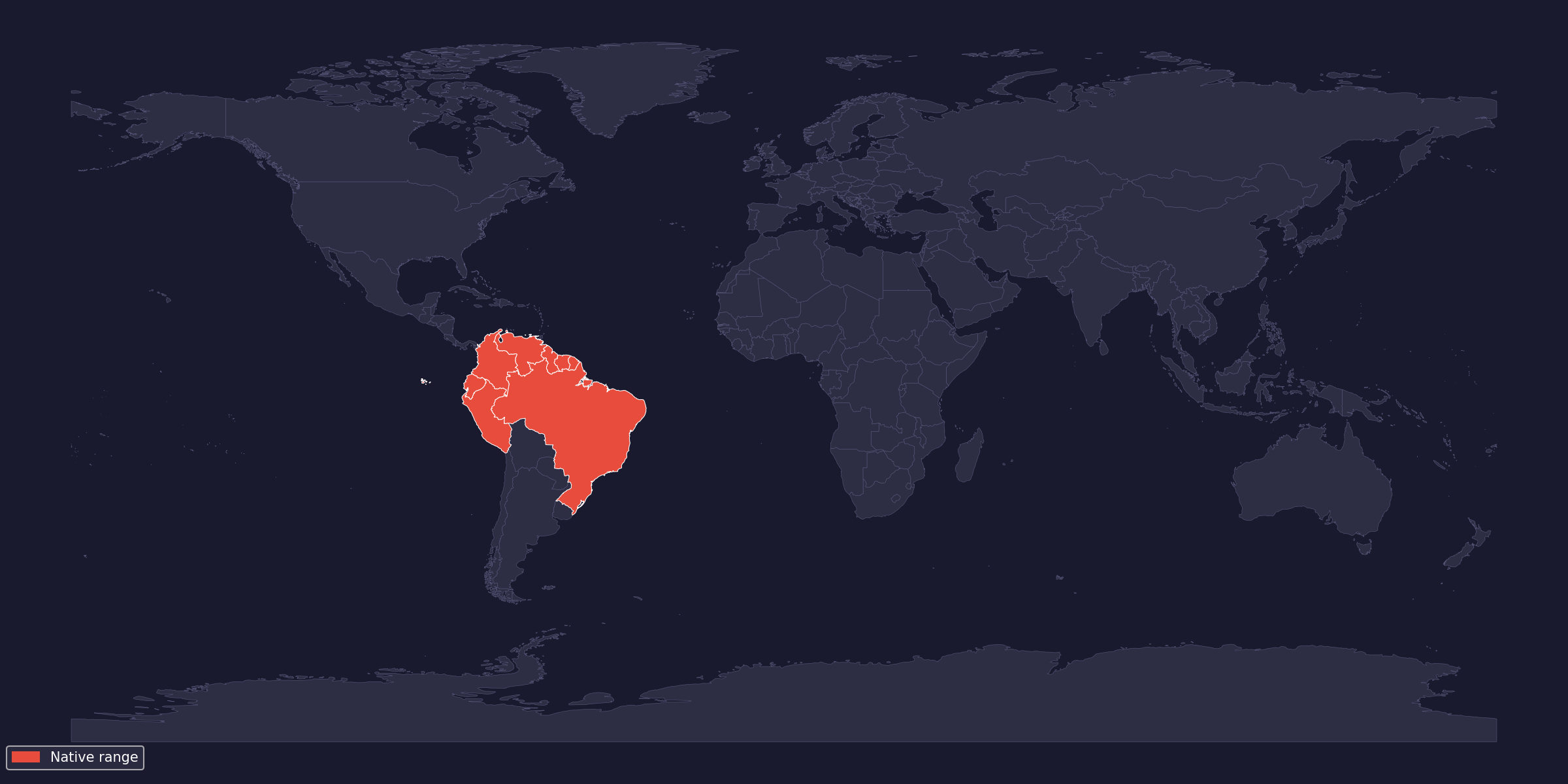
Corallus caninus occurs in northern South America, especially Guyana, Suriname, French Guiana, eastern and southern Venezuela, and northeastern Brazil north of the Amazon and Rio Negro. It is associated with lowland rainforest, forest edges, riverine vegetation, swamp forest, and canopy or sub-canopy perches.
The useful husbandry lesson is not “keep it wet.” The snake needs humid air, dry resting surfaces, clean water, shaded security, and enough ventilation that the enclosure never becomes stale.
🌡 Climate across the native range
Monthly climate normals from reviewed GBIF occurrence locations:
Saint-Laurent-du-Maroni — French Guiana
| Month | Min °C | Mean °C | Max °C | RH % |
|---|---|---|---|---|
| January | 21.7 | 25.2 | 28.8 | 85 |
| February | 21.6 | 25.3 | 28.9 | 83 |
| March | 21.9 | 25.6 | 29.4 | 82 |
| April | 22.4 | 26 | 29.6 | 84 |
| May | 22.3 | 25.9 | 29.6 | 86 |
| June | 21.8 | 25.8 | 29.7 | 86 |
| July | 21.5 | 26 | 30.4 | 83 |
| August | 21.7 | 26.5 | 31.4 | 80 |
| September | 21.7 | 26.9 | 32.1 | 77 |
| October | 21.8 | 26.9 | 32 | 78 |
| November | 21.8 | 26.5 | 31.2 | 80 |
| December | 21.8 | 25.7 | 29.6 | 85 |
Cayenne — French Guiana
| Month | Min °C | Mean °C | Max °C | RH % |
|---|---|---|---|---|
| January | 21.8 | 24.8 | 27.9 | 88 |
| February | 21.8 | 24.9 | 28 | 86 |
| March | 22.2 | 25.4 | 28.5 | 84 |
| April | 22.5 | 25.7 | 28.9 | 86 |
| May | 22.2 | 25.5 | 28.8 | 88 |
| June | 21.6 | 25.2 | 28.9 | 89 |
| July | 21.1 | 25.3 | 29.5 | 86 |
| August | 21.2 | 25.8 | 30.5 | 84 |
| September | 21.2 | 26.2 | 31.1 | 81 |
| October | 21 | 26.1 | 31.1 | 82 |
| November | 21.3 | 25.8 | 30.3 | 84 |
| December | 21.6 | 25.1 | 28.6 | 88 |
Sipaliwini — Suriname
| Month | Min °C | Mean °C | Max °C | RH % |
|---|---|---|---|---|
| January | 21.4 | 25.4 | 29.4 | 82 |
| February | 21.4 | 25.4 | 29.4 | 81 |
| March | 21.6 | 25.8 | 29.9 | 80 |
| April | 21.9 | 26 | 30.1 | 81 |
| May | 22.1 | 26 | 30 | 83 |
| June | 21.8 | 25.9 | 30 | 82 |
| July | 21.6 | 26.2 | 30.8 | 78 |
| August | 21.8 | 26.8 | 31.8 | 76 |
| September | 21.8 | 27.3 | 32.9 | 72 |
| October | 21.9 | 27.5 | 33 | 71 |
| November | 21.9 | 27 | 32.1 | 74 |
| December | 21.6 | 26 | 30.3 | 80 |
Weather data by WorldClim v2.1 · Monthly normals queried by Herpeton Academy from raster values; relative humidity is derived from vapor pressure and mean temperature.
Location references use GBIF.org occurrence data where available; original occurrence records retain their source dataset licenses.
⚖️ Legal status
Boidae are covered by CITES Appendix II, and emerald tree boas are normally treated as EU Annex B animals in wildlife-trade rules. These listings regulate trade and documentation; they do not guarantee that local ownership, transport, tenancy, public-display, or dangerous-animal rules allow the species.
The Bern Convention is not relevant because this South American species is not native to Europe.
Keep invoices, breeder or importer details, transfer records, photographs of the animal, feeding records, and the legal-check date. Check current rules before buying, selling, breeding, importing, or exporting.
🤌 Husbandry
For an adult, plan at least 180 x 60 x 120 cm. Height matters only if it is usable: provide several rigid horizontal perches at different heights, foliage or visual cover, a water bowl, and service access that does not force the keeper to pull the snake from a perch.
Perches should be fixed securely and sized so the snake can grip without balancing on a narrow dowel. Removable perch sections are useful because they let you move the snake without peeling it off a branch. Avoid bare glass boxes with one branch; they make the animal exposed and make maintenance more stressful.
New arrivals can start in a simpler quarantine enclosure with paper or easily changed substrate, a stable perch, water, hides or foliage, and measured heat. Keep quarantine tools separate, record weight, meals, sheds, feces, and breathing, and consider fecal parasite testing before the snake joins a main room.
💡 Lighting
Use a predictable 10-12 hour photoperiod. Low-output UVB is recommended rather than required, and should be arranged as a choice: overlap it with the warm perch, provide shade, and avoid forcing the snake to sit under UVB to thermoregulate.
Ferguson Zone 1 is the practical reference. Measure with a Solarmeter 6.5 when possible, or use conservative lamp distances and replace lamps on schedule. Do not use colored night bulbs; darkness is part of a normal rhythm.
🌡 Heating and temperature
- basking branch: 30-32°C
- ambient gradient: 24-28°C
- cool retreat: 22-24°C
- night: 22-24°C
Use a thermostat on every heat source and confirm temperatures with independent digital probes and an infrared thermometer. Warm the perch the snake actually uses, not just the air near the lamp.
Do not brumate emerald tree boas. Minor seasonal changes in photoperiod, rainfall pattern, and night temperature are enough for routine care; deliberate cooling belongs only in expert breeding plans with established, healthy adults.
💧 Humidity and water
Aim for 70-85% humidity with short peaks around 80-90% during shed. The enclosure should dry on surfaces between misting cycles, while the air remains humid. Constantly wet perches, sour substrate, condensation-heavy glass, or stagnant air increase respiratory and skin risk.
Use a moisture-retentive substrate, live or artificial foliage, a clean water bowl, and misting or an automated system if the room is dry. Track humidity at more than one height because arboreal snakes live above the substrate, not at the floor gauge.
Retained shed, or dysecdysis, is usually a sign that hydration, airflow, shed support, or enclosure security needs correction. Do not make repeated forced soaking the normal solution.
🥗 Feeding
Feed appropriately sized frozen-thawed rodents. Adults commonly do well on a meal every 21-28 days; juveniles and growing animals need smaller meals more often. Prey should usually be no wider than the snake’s widest body section, and overlarge meals raise regurgitation risk.
Emerald tree boas have slower metabolisms than many active colubrids. Feed for muscle and steady condition, not maximum appetite. Keep records for prey size, date, shed stage, defecation, body weight, and refusals.
Routine supplements are not needed when the diet is whole vertebrate prey. Avoid routine live feeding because rodent bites and perch panic are preventable.
🥚 Breeding notes
The species is viviparous. Litters are often 5-20 young, and neonates can be delicate. Breeding should wait until adults are unrelated where possible, legally documented, parasite-free, established on food, and in excellent body condition.
Do not sell uncertain animals under precise locality names. Keep conservative labels, photos, pairing records, birth records, and feeding records for every young animal.
🧍 Handling and safety
This is a display-first snake. It is non-venomous, but it has long teeth, strong perching behavior, and a stress response that can turn routine handling into a welfare and bite problem.
Avoid pulling the snake from a perch. Use removable perches, a shift box, or calm hook work for enclosure service. If handling is necessary, support the body, keep the session short, stay close to a surface, and avoid handling during shed, quarantine, immediately after feeding, or during repeated hiding attempts.
🐍 Enclosure security and behavior
Check doors, vents, cable ports, misting-line holes, and lid seams from the perspective of a persistent snake. Arboreal snakes also exploit gaps high in the enclosure, not just floor-level openings.
Behavior must be read in context. Nose rubbing, repeated striking, constant relocation, refusal to perch, soaking, or open-mouth breathing are not personality quirks. Check heat, airflow, humidity, cover, handling pressure, and disease risk.
🐁 Feeding routine
Offer prey from tongs at night or dusk, when the snake is alert but not being startled awake. Do not make repeated offerings after a refusal; wait, check husbandry, and try again at the next appropriate interval.
Use a separate feeding log rather than memory. The log should show whether the animal is maintaining weight, passing meals normally, and shedding cleanly.
🩺 Common problems
Common issues include dysecdysis, dehydration, respiratory infection, mites, mouth inflammation, regurgitation from excessive prey size or poor temperatures, perch injuries, and stress-related refusal.
Quarantine new animals for at least 90 days. Imports or animals with vague origin should be treated as higher risk and may need a longer quarantine, fecal testing, and veterinary screening.
🧾 Keeper checklist
Before buying, confirm the exact animal, origin, feeding record, last shed, approximate age, sex if known, and legal paperwork. Have the adult enclosure plan ready before the juvenile outgrows quarantine.
Review the setup each season. Lamps age, misting nozzles clog, perches loosen, room humidity changes, and thermostats drift. The goal is a snake that perches securely, sheds cleanly, maintains weight, breathes quietly, and can be serviced without repeated defensive escalation.
✅ Conclusion
Emerald tree boas suit keepers who want a display animal and are willing to build a stable arboreal climate. The most common failures are buying before the adult enclosure is ready, keeping the setup wet but poorly ventilated, feeding too heavily, and handling too much.
📚 Selected sources
- https://reptile-database.reptarium.cz/Corallus/caninus
- https://www.gbif.org/species/2464991
- https://animaldiversity.org/accounts/Corallus_caninus/
- https://reptifiles.com/northern-emerald-tree-boa-care-sheet/
- https://cites.org/eng/app/appendices.php
- https://checklist.cites.org/
- https://jzar.org/jzar/article/view/150