Share

Arabian Horned Viper
🔤 Taxonomy
Cerastes gasperettii is the accepted name for the Arabian horned viper. It was long treated as Cerastes cerastes gasperettii, and that combination remains common in papers and zoo records. C. gasperettii mendelssohni has been used for hornless Arava populations; subspecies treatment is not uniform, so preserve exact locality rather than relying on horn development.
📌 Description
This stout desert viper usually reaches 50-70 cm and can approach 85 cm. Some individuals have prominent supraocular horns and others do not. It moves by sidewinding on loose sand, buries with only the eyes exposed and can strike explosively from concealment. A buried snake must be located positively before any door opens.
The species is of high medical importance; envenomation may cause serious local and systemic effects. It is a display-only animal for legally authorized experts with purpose-built double containment, protected-contact training and a hospital-coordinated bite plan. Plan for approximately 12-18 years.
| Quick reference | Practical target |
|---|---|
| Adult size | Usually 50-70 cm; allow for about 85 cm |
| Adult enclosure | At least 90 x 45 x 45 cm with a lockable shift compartment |
| Temperature | Air 24-29°C; small warm surface 32-35°C; cool hide 21-24°C |
| Night | 18-23°C; locality-based winter cooling only in breeding programmes |
| Humidity | 25-45%; localized 45-60% humid retreat during shedding |
| Feeding | Moderate frozen-thawed rodents every 10-21 days by condition |
| Safety | Double containment, protected service, bite and escape plans |
☠️ Venom
This species is venomous. Venom exposure can cause pain, swelling or other systemic effects, and severity varies with species, locality, bite site and the amount delivered. A small wound or apparently dry bite is not proof of safety; every bite or sting requires urgent medical assessment.
If an incident occurs, move away, call emergency services or a poison centre, keep the patient still, remove rings and other constricting items, and follow dispatcher instructions. Do not use a tourniquet, cut or suck the wound, apply ice or electricity, give alcohol or medicines as a home treatment, or attempt to catch the animal. Antivenom choice and dosing are hospital decisions; verify the relevant product and local availability in advance. Sources: WHO snakebite guidance and appropriate species-specific toxinology or medical references listed below.
🌍 Distribution
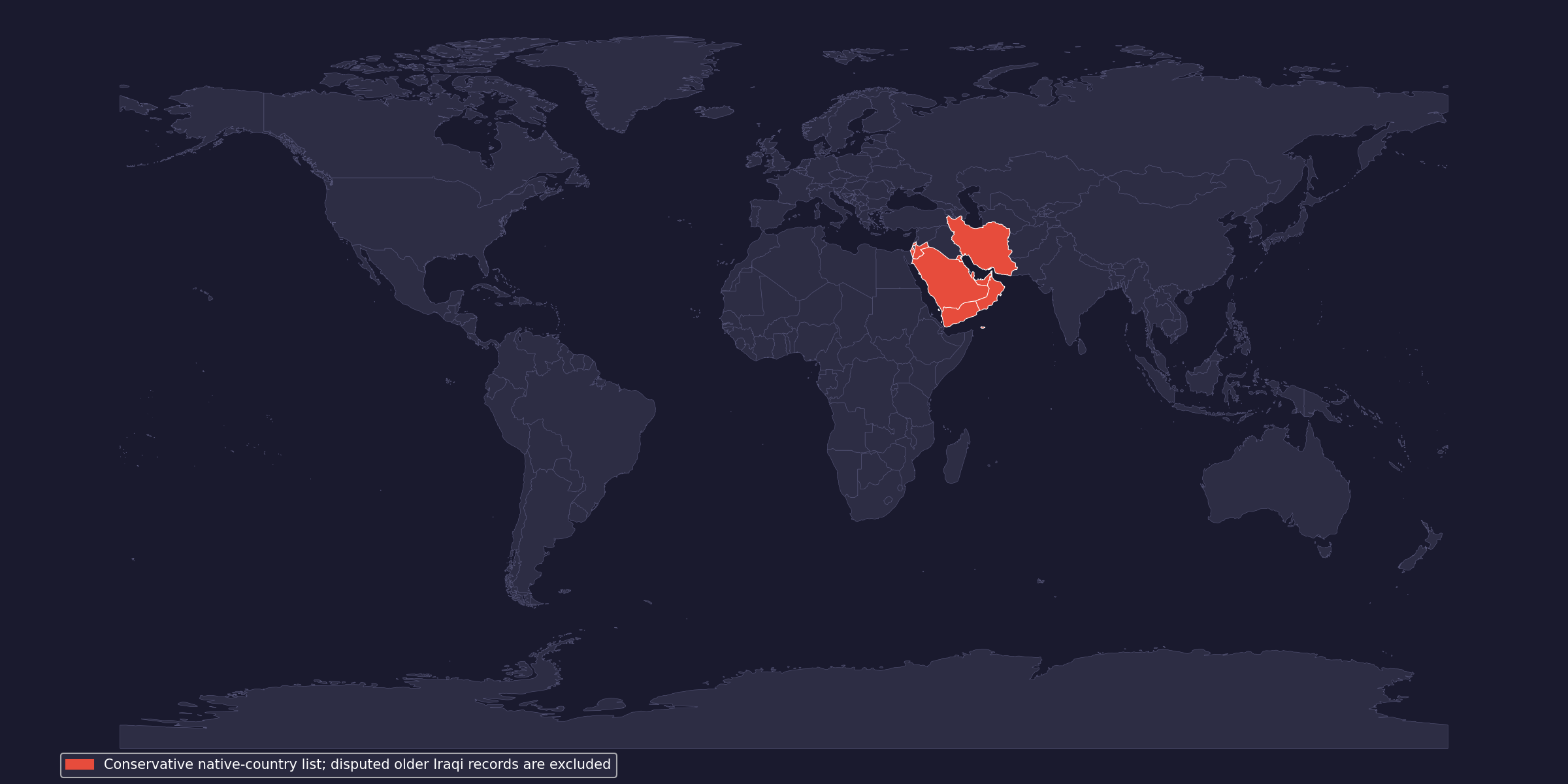
The native range spans the Arabian Peninsula—Saudi Arabia, Yemen, Oman, the United Arab Emirates, Qatar and Kuwait—and continues north into Jordan, Israel and south-western Iran. Published treatment of Iraq is inconsistent; recent taxonomic summaries question older Iraqi records, so Iraq is excluded from the conservative map list.
The snake inhabits sand seas, stabilized dunes, sandy plains and gravelly desert with enough loose material to bury. The range includes major climatic differences; locality and seasonal records must accompany every breeding line.
⚖️ Legal status
Checked on 29 August 2026: Cerastes gasperettii is not listed in the current CITES Appendices or Annexes A-D of Commission Regulation (EU) 2026/1383. The Bern Convention is not the relevant instrument for its Arabian and Middle Eastern native range.
This does not create a right to collect, export or keep it. Range-state wildlife laws and destination-country dangerous-animal rules may prohibit possession or require permits, inspected premises, insurance, transport approval and a bite plan. Verify every step in writing and keep invoice, breeder/importer identity, legal-origin and export/import papers, locality, parentage, photographs and transfers.
🤌 Husbandry
Keep one snake per enclosure in a restricted, locked and escape-resistant room. The primary enclosure needs independent mechanical locks, protected ventilation and cable ports, and a lockable shift hide accessible without hands entering the occupied compartment. A written visual-count procedure is essential because the snake can disappear beneath the substrate.
Quarantine for at least 90 days on paper or a shallow auditable substrate with dedicated equipment. Record weight, meals, sheds, faeces and breathing, and arrange veterinary examination and parasite testing for imports. Never cohabit for display; position and feeding become dangerously ambiguous.
💡 Lighting
Provide 10-13 hours of broad visible daylight with gradual seasonal adjustment for known locality and complete darkness at night. Low-output UVB in Ferguson Zone 1 may be offered across one open area with a fully shaded hide; it is optional for a whole-prey snake.
Every lamp and heater must be outside the enclosure or behind a robust guard. Light from one side helps preserve shade and makes the surface easier to inspect for the snake’s outline.
🌡 Heating and temperature
Maintain daytime air at 24-29°C, a small surface patch at 32-35°C and a cool hide at 21-24°C. Allow night temperatures around 18-23°C. Desert does not mean uniform heat: a buried snake must be able to escape the warm patch completely.
Control every heater with a thermostat and measure the sand surface and several depths, as well as air. A breeding-related winter reduction toward 12-16°C is only for healthy, established adults of an appropriate locality under redundant monitoring. Never cool juveniles, thin, sick, gravid or newly imported animals.
💧 Humidity and water
Keep general RH around 25-45% with strong ventilation and a dry surface. Provide one small humid hide at approximately 45-60% during shedding; do not spray the entire sand bed. Damp sand at depth can remain deceptively cold and promote skin disease.
A small stable bowl of clean water remains available even for a desert snake. Place it where it can be exchanged after positive shifting. Check for spills promptly without reaching into an occupied enclosure.
🌿 Enclosure and decoration
For one adult, use at least 90 x 45 x 45 cm. Provide 10-15 cm of a compactable washed-sand and mineral-soil mix that permits shallow burial without collapsing into dust. Add two snug shift-capable hides, one partly buried, plus a low anchored stone or cork shelter and an open sidewinding lane.
Avoid pure powdery sand, calcium sand, sharp gravel, unstable stone stacks and décor that prevents visual confirmation. In quarantine use paper with a shallow removable sand tray if behavioural opportunity is needed. Every gap must exclude neonates; label species, individual, count, venom hazard and emergency contacts.
🐁 Feeding
Natural diets are dominated by small desert rodents, with lizards and birds also recorded. Offer appropriately sized frozen-thawed rodents every 10-21 days, using age, weight and body condition to choose the interval. This sedentary ambush predator becomes obese readily.
Present food with long tongs only after positively locating the snake. Never probe the substrate by hand, hand-feed, or leave a live rodent unattended. Balanced whole prey requires no routine vitamin or mineral dusting.
🛡 Operational safety and emergencies
Routine service must use protected contact and positive shifting. Never rake, dig or replace substrate while the snake could remain buried in the main compartment. Non-routine access requires two trained adults, barriers, appropriate tools and a written door sequence.
Before acquisition, coordinate a species-specific bite plan with a poison centre or receiving hospital, including transport, emergency contacts and current venom information. Appropriate antivenom may not be locally stocked and must be selected and administered by clinicians.
Any bite is an immediate emergency. Call emergency services, keep the patient still, remove constricting objects, immobilize the limb and follow poison-centre advice. Do not cut, suck, ice, shock or tightly tourniquet the wound and do not delay transport to catch the snake.
🥚 Breeding notes
The species lays eggs. Saudi Arabian research describes a short spring reproductive season, oviposition around mid-July and hatching later in the warm season. The structured target of 8-20 eggs incubated at 28-30°C for roughly 50-70 days is conservative; exact results vary with locality and method. Secure incubator work and neonate containment must be planned before pairing.
🩺 Common problems
Wet substrate causes ventral dermatitis and respiratory disease; extremely dry housing without a humid retreat causes dysecdysis. Burns develop when a buried snake cannot escape overheated substrate. Obesity and regurgitation follow oversized or frequent meals, disturbance or poor digestive temperatures. Rostral injury suggests repeated escape attempts or abrasive décor.
Secure the animal before investigating. Record temperatures at several depths, humidity, weight and feeding history, and arrange a protected examination with a veterinarian experienced in venomous reptiles.
📌 Conclusion
The Arabian horned viper needs more than heat and sand: it requires measurable thermal escape, safe burial substrate and a service procedure that assumes the snake is hidden. Only a legal expert facility with hospital preparation can meet that standard.
📚 Sources and further reading
- The Reptile Database — Cerastes gasperettii
- Al-Sadoon & Kandeal (2015), reproductive biology
- Mochales-Riaño et al. (2025), reference genome and medical importance
- GBIF species record
- WHO snakebite-envenoming resources
- CITES Appendices
- Commission Regulation (EU) 2026/1383