Share

Saharan Horned Viper
🔤 Taxonomy
Cerastes cerastes is the Saharan or desert horned viper. Hornless individuals occur naturally, so the absence of supraocular “horns” does not rule out the species. Older literature may use Cerastes cornutus, while records from Arabia have often been confused with Cerastes gasperettii. Locality and parental records are therefore important for captive animals.
📌 Description
This is a small, heavy-bodied desert viper that buries in loose sand and ambushes prey from concealment. Adults are commonly 45–70 cm long, although exceptional animals can approach 85 cm. Captive longevity of 14–18 years is realistic, and longer records exist.
Small size does not make this a manageable first venomous snake. A bite can cause severe local injury, coagulopathy, kidney injury, and other systemic effects. The species belongs only in a legal, purpose-built venomous-animal facility operated by trained personnel. It is a display animal and must never be free-handled.
| Quick reference | Adult target |
|---|---|
| Enclosure | At least 90 × 45 × 45 cm, plus secure shift box |
| Basking surface | 32–35 °C |
| Cool retreat | 21–24 °C |
| Night | 18–22 °C |
| General humidity | 30–45%, with a slightly humid shed refuge |
| Substrate | 10–15 cm of clean, diggable desert mix |
| Feeding | Appropriately sized thawed rodents every 10–21 days |
| Handling | None; protected-contact maintenance only |
☠️ Venom
This species is venomous. Venom exposure can cause pain, swelling or other systemic effects, and severity varies with species, locality, bite site and the amount delivered. A small wound or apparently dry bite is not proof of safety; every bite or sting requires urgent medical assessment.
If an incident occurs, move away, call emergency services or a poison centre, keep the patient still, remove rings and other constricting items, and follow dispatcher instructions. Do not use a tourniquet, cut or suck the wound, apply ice or electricity, give alcohol or medicines as a home treatment, or attempt to catch the animal. Antivenom choice and dosing are hospital decisions; verify the relevant product and local availability in advance. Sources: WHO snakebite guidance and appropriate species-specific toxinology or medical references listed below.
🌍 Distribution
The core range crosses the Sahara and adjoining arid zones of North Africa, from Morocco and Western Sahara east through Algeria, Tunisia, Libya and Egypt, and south through parts of Mauritania, Mali, Niger, Chad and Sudan. It also reaches the Sinai–Negev region. Some records from Jordan and the Arabian Peninsula are taxonomically uncertain or may represent C. gasperettii.
The species uses fine sand, gravelly desert, wadis and sparse scrub where it can bury and still reach protected retreats. Wild desert weather is not a terrarium setting: the enclosure must offer a safe thermal gradient, shade, a secure hide and limited access to moisture rather than continuous extreme heat and dryness.
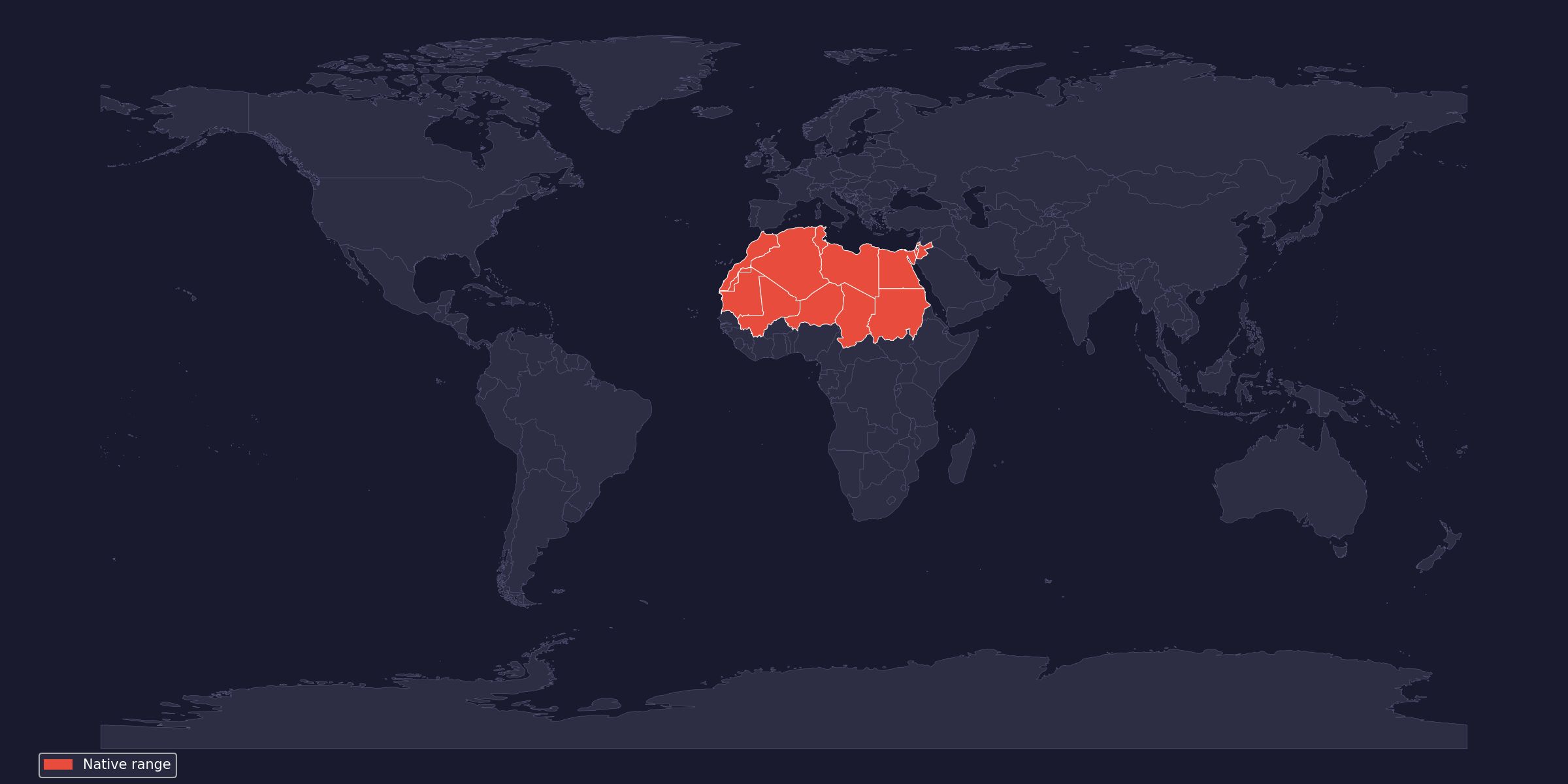
🌡 Climate across the native range
Monthly climate normals from a verified occurrence in the western part of the native range:
Guelmim–Oued Noun — Morocco (verified occurrence)
| Month | Min °C | Mean °C | Max °C | RH % |
|---|---|---|---|---|
| January | 9.2 | 14.5 | 20.4 | 51 |
| February | 10.6 | 16.3 | 22.7 | 52 |
| March | 12.7 | 19 | 26.1 | 49 |
| April | 13.7 | 20.2 | 28 | 54 |
| May | 15.6 | 22.4 | 30.5 | 53 |
| June | 17.6 | 24.7 | 33.4 | 55 |
| July | 20.6 | 29 | 38.9 | 46 |
| August | 21.5 | 29.5 | 39 | 46 |
| September | 19.1 | 25.8 | 34.2 | 54 |
| October | 17.3 | 23.3 | 30.3 | 54 |
| November | 13.6 | 19.1 | 25.3 | 53 |
| December | 10.6 | 15.6 | 21.2 | 54 |
Weather data by Open-Meteo.com · CC BY 4.0 · Monthly normals calculated by Herpeton Academy from daily archive values.
Location references use GBIF.org occurrence data where available; original occurrence records retain their source dataset licenses.
⚖️ Legal status
The official CITES Appendices and EU wildlife-trade Annexes were checked on 14 August 2026; no specific listing for Cerastes cerastes was found. The Bern Convention is not relevant because the species is not native to Europe. These trade listings do not grant permission to own it.
Venomous-animal licensing, facility inspection, transport restrictions, notification duties and outright ownership bans vary by country and municipality. Verify the rules at the place of keeping and every transit jurisdiction before acquisition. Keep the invoice, breeder identity, locality or parentage data, import documents and transfer records. Wild collection and export may be prohibited by range-state law even when CITES does not list the species.
🤌 Husbandry
Use a dedicated, access-controlled room that provides a second containment barrier. The front-opening enclosure needs keyed locks, protected ventilation and sealed cable routes. Install a lockable shift box that can be closed from outside the animal’s space; routine water changes and cleaning should be planned around protected contact, not restraint.
No task should depend on pinning, necking or touching the snake. Only personnel trained under an established venomous-snake protocol should work in the room, with another competent person available under the facility’s rules. Label the enclosure with the scientific name, animal count and emergency information.
Before the snake arrives, agree a written emergency plan with the responsible medical and poison-information services. It should identify the nearest suitable hospital, transport arrangements and the medically appropriate route for locating antivenom. Private purchase or self-administration of antivenom is not a substitute for hospital treatment. Any suspected bite is an emergency; secure the animal, call emergency services and follow professional instructions rather than attempting home treatment.
House animals separately except for a controlled breeding introduction. Quarantine new arrivals in a separate containment area with dedicated tools. Record weight, meals, sheds, faeces and behaviour, and arrange examination and parasite testing with a veterinarian experienced in venomous reptiles when origin or health is uncertain.
💡 Lighting
Provide a clear 10–12 hour day and complete darkness at night. Bright visible light over part of the enclosure helps establish a usable day–night cycle. Low-level UVB can be offered above the basking zone, with shade and buried retreats available; UVB must not cover the entire floor.
All lamps and heat emitters must sit outside the occupied space or behind robust guards. Control heat with a thermostat and verify it using fixed digital probes plus an infrared thermometer.
🌡 Heating and temperature
Create a basking surface of 32–35 °C over one end, an air temperature around 25–29 °C on the warm side, and a cool retreat of 21–24 °C. Allow nights to fall to roughly 18–22 °C. The entire enclosure must never be held at basking temperature.
Buried vipers experience much lower temperatures than an exposed desert surface. Measure temperature at the surface and within the substrate. Overheating is a greater captive risk than a modest nighttime drop, especially when the snake cannot escape heat below ground. Seasonal changes used for breeding are an expert programme, not a reason to expose a feeding, underweight or newly acquired snake to abrupt cooling.
💧 Humidity and water
Maintain dry, well-ventilated air at roughly 30–45% relative humidity. Provide a small, stable water bowl at all times even if drinking is rarely observed. “Desert species” is not a justification for withholding water.
For shedding, offer a small hide with slightly damp material or lightly moisten one protected corner so the animal can choose it. Do not wet the entire sand bed. Persistent dampness, stale air and wet sand against the body promote dermatitis, scale damage and respiratory disease; extreme dryness can contribute to dehydration and retained shed.
🌿 Enclosure and decoration
Provide 10–15 cm of a stable, diggable desert substrate. A washed sand–soil–clay blend holds shallow burrows better than pure, dusty play sand. It should be dry on the surface, free of sharp stone and fine enough for natural burial without collapsing into a compact block. Use paper during quarantine when faecal monitoring is more important than natural behaviour.
Add two low, secure hides, cork or flat rock structures that cannot collapse, sparse cover and an open sandy ambush area. Heavy furnishings must rest on the enclosure floor before substrate is added. Keep the front service area uncluttered so the snake’s position can be confirmed before any lock is opened.
🪳 Feeding
Offer appropriately sized thawed rodents with long feeding tools, following the facility’s protected-contact procedure. Juveniles may take small mice every 7–10 days; established adults generally need a modest meal every 14–21 days. Adjust to body condition, temperature and reproductive state rather than feeding whenever the snake responds.
Obesity is easy to create in an ambush predator and increases reproductive and hepatic risk. Do not feed wild-caught rodents or lizards, and do not leave live prey in the enclosure. Whole vertebrate prey requires no routine calcium or vitamin powder.
🥚 Breeding
Breeding is appropriate only for institutions or expert keepers with documented lineage, surplus capacity and a legal placement plan. Published records commonly report 8–23 eggs. Incubation varies with conditions; successful captive reports include approximately 29–30 °C and about 43–61 days. Thin-shelled eggs require stable, lightly moist incubation media, not contact with free water.
Pairing multiplies risk because two venomous animals must be tracked and separated. Females need suitable laying cover and close remote observation. Hatchlings are fully venomous and each requires individual secure housing before eggs are set up.
🩺 Common problems
Important problems include dehydration, retained shed, respiratory infection, dermatitis from damp or contaminated substrate, mouth injury from abrasive material, internal parasites, obesity and thermal burns. Imports may arrive dehydrated or parasitized and should not be placed directly into a collection.
Watch for open-mouth breathing, nasal bubbles, prolonged exposure rather than burial, repeated rubbing, incomplete shed, swelling, regurgitation, rapid weight change or unusual inability to right the body. Do not attempt close examination by hand. Isolate the enclosure operationally and consult a veterinarian equipped and trained to receive a venomous reptile.
📌 Conclusion
Cerastes cerastes can express normal burial and ambush behaviour in a relatively compact enclosure, but safe care depends on a professional containment system rather than the snake’s size. If double containment, protected-contact servicing and a medically coordinated emergency plan are not already in place, the facility is not ready for this species.
📚 Sources and further reading
- Reptile Database: Cerastes cerastes
- GBIF species record
- Animal Diversity Web: Cerastes cerastes
- WHO guidelines for snakebite management in Africa
- UK advisory standards for reptile housing and care
- CITES Appendices, checked 2026-08-14
- European Commission wildlife-trade guidance, checked 2026-08-14