Share

Malayan Pit Viper
🔤 Taxonomy
Calloselasma rhodostoma is the accepted name of the Malayan pit viper and the sole currently recognised species in Calloselasma. Older material often uses Agkistrodon rhodostoma or Ancistrodon rhodostoma. The name Ancistrodon annamensis belongs in its synonymy rather than identifying a separate Vietnamese husbandry form.
📌 Description
The Malayan pit viper is a stout, sharply triangular-headed terrestrial viper, usually 50-80 cm and occasionally near 1 m. Its brown triangular markings break up the outline among dry leaves. The venom can produce severe pain, swelling, tissue injury, bleeding disturbance, shock, and lasting disability; a motionless animal can strike rapidly without first retreating.
Its husbandry challenge is not extreme tropical heat. It is maintaining a clean, ventilated seasonal floor while safely locating an immobile snake before every service. This article is for licensed expert facilities using protected contact.
📋 Quick reference
| Care point | Practical target |
|---|---|
| Adult enclosure | At least 120 x 60 x 60 cm with externally operated shift box |
| Day temperatures | 24-28°C ambient; 29-31°C limited warm patch; 22-24°C cool hide |
| Night temperatures | 21-24°C |
| Humidity | 60-75%, with wet-season peaks but a dry accessible surface |
| Lighting | 11-13 hours; optional measured low-level UVB and shade |
| Feeding | Frozen-thawed rodents; adults commonly every 14-21 days |
| Reproduction | Oviparous; published clutches 17-29 eggs, 37-46 days in one programme |
| Safety | Medically significant cytotoxic/haemotoxic venom; protected contact only |
☠️ Venom
This species is venomous. Venom exposure can cause pain, swelling or other systemic effects, and severity varies with species, locality, bite site and the amount delivered. A small wound or apparently dry bite is not proof of safety; every bite or sting requires urgent medical assessment.
If an incident occurs, move away, call emergency services or a poison centre, keep the patient still, remove rings and other constricting items, and follow dispatcher instructions. Do not use a tourniquet, cut or suck the wound, apply ice or electricity, give alcohol or medicines as a home treatment, or attempt to catch the animal. Antivenom choice and dosing are hospital decisions; verify the relevant product and local availability in advance. Sources: WHO snakebite guidance and appropriate species-specific toxinology or medical references listed below.
🌍 Distribution
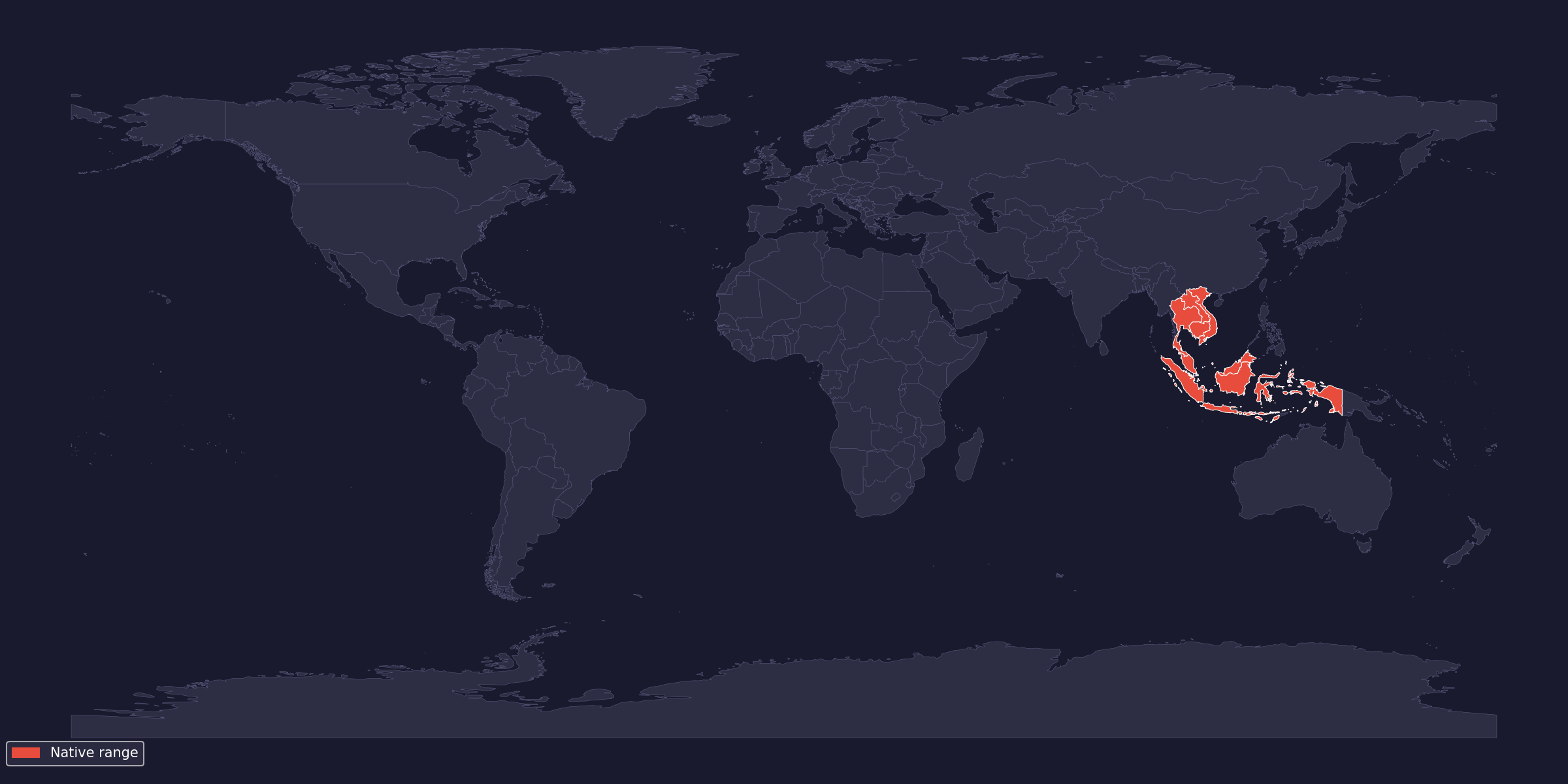
The confirmed range includes southern Vietnam, Cambodia, Thailand, Laos, western Peninsular Malaysia, and Java in Indonesia. It occurs mainly in lowland seasonal forest, scrub, plantations, and disturbed agricultural mosaics, often where dry leaf cover persists between rains.
The Reptile Database lists Borneo only as a possibility based on unverified social-media observations. Treat Bornean claims as doubtful until supported by voucher-backed work. The country map necessarily colours all Malaysia and Indonesia: it therefore overstates the species’ limited peninsular Malaysian and Javan occurrence and must not be read as evidence from Sumatra, Sulawesi, most of Borneo, or every highlighted province.
🌡 Climate across the native range
Monthly climate normals from a verified occurrence in the seasonal lowlands of eastern Thailand:
Chon Buri — Thailand (verified occurrence)
| Month | Min °C | Mean °C | Max °C | RH % |
|---|---|---|---|---|
| January | 21.2 | 25.2 | 29.6 | 69 |
| February | 22.5 | 26 | 30.2 | 73 |
| March | 24 | 27 | 30.8 | 77 |
| April | 25.1 | 27.8 | 31.3 | 78 |
| May | 25.3 | 27.6 | 30.4 | 81 |
| June | 25.2 | 27.1 | 29.6 | 81 |
| July | 24.9 | 26.7 | 29.1 | 81 |
| August | 24.8 | 26.6 | 28.9 | 81 |
| September | 24.2 | 26.1 | 28.6 | 84 |
| October | 23.3 | 25.6 | 28.7 | 84 |
| November | 22.5 | 25.5 | 29.2 | 74 |
| December | 21 | 24.9 | 29.2 | 65 |
Weather data by Open-Meteo.com · CC BY 4.0 · Monthly normals calculated by Herpeton Academy from daily archive values.
Location references use GBIF.org occurrence data where available; original occurrence records retain their source dataset licenses.
⚖️ Legal status
As checked on 17 August 2026, Calloselasma rhodostoma is not listed in CITES Appendices I-III and no species-specific listing was found in EU wildlife-trade Annexes A-D. The Bern Convention is not relevant because the species is not native to Europe.
That does not make collection, export, import, or possession unrestricted. Local and national native-wildlife, protected-area, veterinary-import, animal-welfare, and dangerous-animal rules differ across Thailand, Malaysia, Vietnam, Cambodia, Laos, and Indonesia. European jurisdictions may require a dangerous-animal permit, inspected secure room, insurance, and emergency plan. Obtain only traceable lawful stock and keep the invoice, breeder, origin, transfer/import documents, photographs, and this legal-check date.
🤌 Husbandry
Prepare locked primary and secondary containment, warning labels, dedicated tools, and an external-closing shift box before arrival. House singly. The animal must be visibly inside the closed shift before hands or cleaning equipment enter the main enclosure; camouflage is never proof that it is in the usual hide.
Quarantine for at least 90 days on paper with tight disposable hides and separate equipment. Record weight, meals, sheds, faeces, skin, mouth, and respiration. Imports and animals with uncertain histories warrant reptile-veterinary examination, faecal testing, and mite surveillance.
💡 Lighting
Provide 11-13 hours of bright visible light with shaded hides and litter cover. Optional low-output UVB can create a small Ferguson Zone 1 exposure, but the snake must withdraw completely. Guard every lamp and cable.
Switch visible and UV light off at night. A lightless thermostatic source may maintain the minimum if the room cools excessively; red or blue night lamps are unnecessary.
🌡 Heating and temperature
Maintain 24-28°C daytime ambient air, a small 29-31°C warm surface, a 22-24°C cool hide, and 21-24°C nights. A Thai captive-breeding programme held breeding pairs at 26-27°C, supporting moderate rather than continuously hot care. Thermostat all heating and measure at snake level under litter and inside hides.
Use seasonal rainfall, photoperiod, and modest night changes only when provenance and a managed breeding programme justify them. Do not impose cold “brumation” on a tropical lowland animal, and do not cycle juveniles, thin animals, or new arrivals.
💧 Humidity and water
Aim for 60-75% relative humidity, with temporary rises to 75-85% during shedding or a simulated wet phase. Moisten one lower substrate zone and let the surface partly dry between applications. Cross-ventilation and drainage are essential; constant saturation causes dermatitis and microbial growth.
Provide a heavy, shallow bowl placed for protected replacement. A snake soaking repeatedly, a sour smell, persistent condensation, or reddened ventral scales requires a husbandry and veterinary review.
🌿 Enclosure and decoration
One adult needs at least 120 x 60 x 60 cm. Use 6-10 cm of well-drained soil/coco-and-leaf substrate, abundant leaf litter, snug warm and cool hides, low cork, and stable cover. Keep a clear inspection lane and a direct unobstructed route to the shift box.
Secure vents, tracks, cable ports, probes, and guards with keyed or tool-operated locks. Avoid unstable rock, sharp edges, deep opaque planting, and decor that must be moved by hand. The snake’s habit of remaining in place makes a well-designed shift more important than an elaborate display.
🐁 Feeding
Wild prey includes rodents, frogs, lizards, and occasionally birds. Established captive adults can be maintained on appropriately sized frozen-thawed rodents. Offer prey no wider than the broadest body section with long tongs; never leave a live rodent with a concealed viper.
Juveniles may feed every 7-10 days, subadults every 10-14 days, and adults usually every 14-21 days. Adjust to serial weight and body condition. Whole prey requires no routine supplement. Persistent refusal after quarantine checks calls for veterinary assessment, not manual feeding.
🥚 Breeding
This unusual pit viper is oviparous and lays thin-shelled eggs. A published Thai programme recorded clutches of 17-29 eggs and hatching after 37-46 days; other embryo work reports 32-39 days at 25-29°C. The structured 26-28°C and 37-46-day range is a conservative reference for an experienced monitored incubator, not a guarantee.
Provide a secure damp laying hide and use remote observation. Egg separation, candling, and neonatal work expose staff to the female and fully venomous hatchlings. Breed only with confirmed sex, health, legal placement capacity, individual neonatal containers, and an experienced veterinary team.
🛡️ Handling and emergency planning
Do not free-handle, tail, pin, neck, or manually restrain this species. Use protected shifts, species-appropriate hooks, shields, and a second trained adult. Tongs do not turn an open enclosure into safe contact.
Before acquisition, agree a written bite plan with emergency services, poison centre or toxicologist, and receiving hospital. Provide the accepted name, origin, keeper contact, time of bite, route, and regional antivenom pathway. Antivenom choice and management of coagulopathy and local injury belong to clinicians.
After any bite, call emergency services, keep the patient still, immobilize the limb, and remove rings or tight objects. Because this venom can cause major local tissue injury, do not apply a pressure-immobilisation wrap unless the regional poison centre specifically directs it. Never cut, suck, ice, shock, use chemicals, or apply an arterial tourniquet.
🩺 Common problems
- Dermatitis and scale damage: wet dirty substrate and poor ventilation are common causes.
- Dysecdysis: provide hydration and a humid refuge; do not pull retained skin from an unsecured snake.
- Respiratory disease: bubbles, wheeze, gaping, or abnormal posture needs prompt veterinary assessment.
- Obesity and regurgitation: ambush vipers need restrained meals, correct heat, and undisturbed digestion.
- Parasites: imported animals require quarantine and diagnosis rather than blind medication.
- Egg retention: a restless or persistently swollen female after oviposition needs imaging by an experienced veterinarian.
- Unsafe routine: if water or waste cannot be serviced with the snake shifted, redesign the enclosure.
📌 Conclusion
The Malayan pit viper needs moderate tropical warmth, adjustable seasonal moisture, a dry usable surface, restrained feeding, and absolute visual confirmation during shifting. Its cryptic posture and tissue-damaging venom limit it to authorised expert facilities with hospital coordination and capacity for venomous hatchlings.
📚 Sources and further reading
- ReptiFiles was searched; no species-specific care guide was located: https://reptifiles.com/
- The Reptile Database: https://reptile-database.reptarium.cz/Calloselasma/rhodostoma
- GBIF: https://www.gbif.org/species/2443815
- Chanhome et al., venomous-snake husbandry and captive breeding in Thailand: https://doi.org/10.1580/1080-6032%282001%29012%5B0017%3AVSHIT%5D2.0.CO%3B2
- Khannoon et al., developmental timing at controlled temperatures: https://doi.org/10.1371/journal.pone.0116410
- WHO South-East Asia snakebite guidelines: https://iris.who.int/handle/10665/249547
- Baines et al., UV-Tool: https://doi.org/10.19227/jzar.v4i1.150
- CITES Appendices: https://cites.org/eng/app/appendices.php and https://checklist.cites.org/
- Commission Regulation (EU) 2026/1383: https://eur-lex.europa.eu/eli/reg/2026/1383/oj/eng
- Bern Convention appendices: https://www.coe.int/en/web/bern-convention/appendices