Share

Many-banded Krait
🔤 Taxonomy
Bungarus multicinctus is the many-banded krait, but the multicinctus–wanghaotingi group still needs revision. Boundaries among B. multicinctus, B. wanghaotingi and the Malayan krait B. candidus are particularly obscure in southern China and northern Myanmar, and band number or colour alone is insufficient.
Retain exact locality, full-body and head-scale photographs, parent records and the identifier’s name. Yunnan reports are specifically questioned in current references. This guide must not be assigned automatically to any black-and-white krait from mainland Southeast Asia.
📌 Description
This slender, mainly terrestrial krait is commonly 90-150 cm. It is strongly nocturnal, often sheltering under debris, in rodent burrows, field margins and wet lowland mosaics by day. A managed lifespan of roughly 12-18 years is a reasonable planning range.
Daytime stillness, head-hiding or reluctance to move is not tameness and is never proof that the snake is safe to approach. Activity and defensive response can change abruptly after dusk or disturbance. A bite may cause little initial pain or swelling while neuroparalysis quietly progresses to ptosis, bulbar dysfunction and respiratory failure.
📋 Quick reference
| Care point | Practical target |
|---|---|
| Adult enclosure | At least 150 x 75 x 60 cm with two externally lockable shift hides |
| Temperature | Ambient 23-27°C; warm refuge 29-31°C; cool refuge 21-23°C |
| Night | 20-23°C; observe without bright disturbance |
| Humidity | 55-75% with local 75-85% shed support |
| Feeding | Captive-produced snake prey or transitioned frozen-thawed rodents every 7-14 days |
| Safety | Locate and shift before work; ventilation-ready hospital plan |
| Quarantine | At least 90 days with separate tools and parasite screening |
☠️ Venom
This species is venomous. Venom exposure can cause pain, swelling or other systemic effects, and severity varies with species, locality, bite site and the amount delivered. A small wound or apparently dry bite is not proof of safety; every bite or sting requires urgent medical assessment.
If an incident occurs, move away, call emergency services or a poison centre, keep the patient still, remove rings and other constricting items, and follow dispatcher instructions. Do not use a tourniquet, cut or suck the wound, apply ice or electricity, give alcohol or medicines as a home treatment, or attempt to catch the animal. Antivenom choice and dosing are hospital decisions; verify the relevant product and local availability in advance. Sources: WHO snakebite guidance and appropriate species-specific toxinology or medical references listed below.
🌍 Distribution
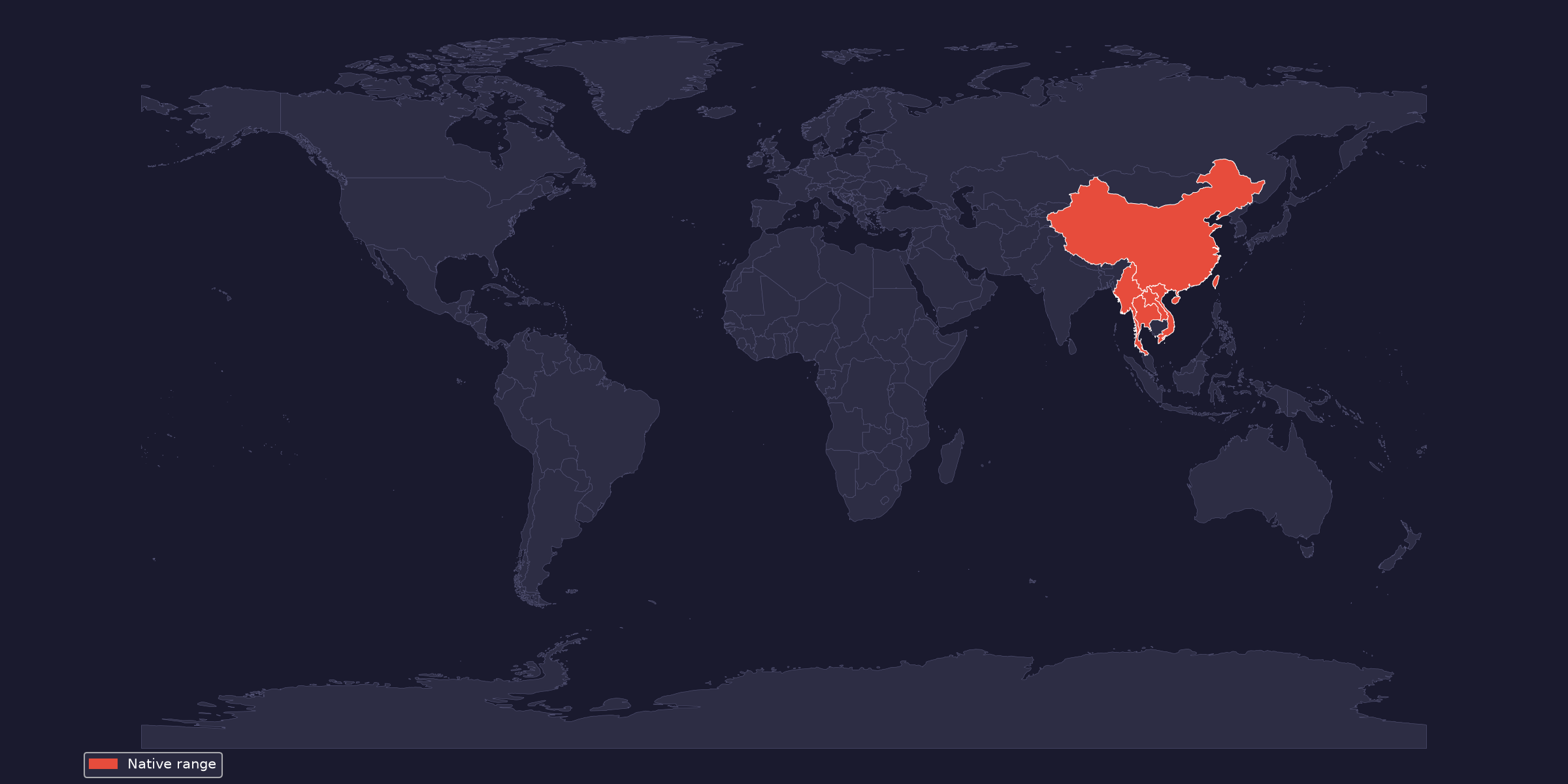
Confirmed distribution includes Taiwan and southern China including Hong Kong and Hainan, with records from Myanmar, Laos, northern Vietnam and Thailand. The exact boundaries with B. candidus and B. wanghaotingi remain unresolved in parts of the mainland. Reports from Yunnan are questioned and should not be accepted without specimen-level review.
Habitats range from subtropical forest edge and rice-country wetlands to agricultural and peri-urban cover, across continental, island and elevational climates. The map colours whole countries: it therefore exaggerates the range in China, Myanmar, Thailand and Vietnam, cannot show the northern-Vietnam restriction or identity boundaries, and must not be read as endorsing the Yunnan reports. The reviewed Kaohsiung occurrence supplies one lowland Taiwan context, not a continental climate mean.
🌡 Climate across the native range
Monthly normals from one reviewed occurrence in southwestern Taiwan; this point does not represent continental, island-wide or highland populations:
Kaohsiung — Taiwan (reviewed many-banded krait occurrence)
| Month | Min °C | Mean °C | Max °C | RH % |
|---|---|---|---|---|
| January | 13.3 | 17 | 20.7 | 79 |
| February | 14.3 | 17.9 | 21.6 | 79 |
| March | 17 | 20.7 | 24.4 | 78 |
| April | 20.3 | 23.8 | 27.2 | 77 |
| May | 22.8 | 26 | 29.1 | 79 |
| June | 24.4 | 27.2 | 30 | 81 |
| July | 24.7 | 27.8 | 30.8 | 81 |
| August | 24.4 | 27.3 | 30.2 | 83 |
| September | 23.7 | 26.7 | 29.7 | 81 |
| October | 21.8 | 24.9 | 28 | 79 |
| November | 18.4 | 21.8 | 25.1 | 78 |
| December | 14.8 | 18.4 | 22.1 | 77 |
Weather data by WorldClim v2.1 · Monthly normals queried by Herpeton Academy from raster values; relative humidity is derived from vapor pressure and mean temperature.
Location references use GBIF.org occurrence data where available; original occurrence records retain their source dataset licenses.
⚖️ Legal status
No species-specific entry for B. multicinctus was found in the CITES Appendices, EU wildlife-trade annexes or Bern Convention appendices on 17 August 2026. Range-state protection and export controls and domestic dangerous-animal laws still apply independently.
Local and national rules for possession, registration, transport, breeding, sale and import may require permits, inspected containment, insurance or a named emergency plan. Verify them in writing before acquisition or transfer. Keep invoices, lawful-origin papers, exact locality, parent and identification records and dated authority advice; uncertain identification can also invalidate a permit or antivenom plan.
🤌 Husbandry
House singly in a locked venomous room with room-level secondary containment. Connect the enclosure to two tight full-body shift hides that close and lock externally. Locate the entire snake and positively secure it in the other compartment before servicing water, substrate, heat or furnishings. Protected contact is mandatory; daytime immobility never justifies hand contact.
Quarantine for at least 90 days on paper with separate tools and preferably separate air. Record weight, meals, faeces, sheds, mouth and respiration. Wild-origin and poorly documented animals need repeated parasite testing and a taxonomic review, especially near the candidus–multicinctus–wanghaotingi contact region.
💡 Lighting
Provide diffuse visible light for 10-13 hours according to locality and season, complete darkness at night and multiple fully opaque retreats. Guard every lamp. Low-output UVB over part of the warm end may offer Ferguson Zone 1 exposure, while the animal must be able to avoid it completely.
Use dim red-free monitoring or infrared cameras to observe nocturnal activity without repeatedly opening the room or disrupting darkness. Camera confirmation supplements, but never replaces, direct positive location before a lock is opened.
🌡 Heating and temperature
Maintain 23-27°C ambient air, a local 29-31°C warm refuge, a measured 21-23°C cool refuge and nights around 20-23°C. Thermostat each source and measure surface as well as air temperature inside both hides.
The broad, uncertain range precludes one automatic winter programme. Only a healthy adult of documented subtropical origin may receive a modest gradual seasonal reduction. Never cool juveniles, thin animals, new arrivals or snakes with respiratory or neurological signs.
💧 Humidity and water
Use a ventilated 55-75% baseline and a local 75-85% humid hide during shedding. Let most surface dry between localized wetting. Taiwan lowlands, southern Chinese hills and mainland monsoon sites should not be managed from a single humidity reading.
Provide a low, heavy bowl through protected access. Persistent saturation and stale warm air promote skin and respiratory disease. Track drinking, urates, mass and sheds; a damp retreat is safer than a permanently wet enclosure.
🌿 Enclosure and decoration
An adult baseline of 150 x 75 x 60 cm is an operational minimum. Provide deep packed soil-leaf substrate, several tight opaque hides, flat cork or stone-like cover fixed against shifting and clear routes into both shift hides. Low, firmly anchored branches add choice without creating inaccessible voids.
Seal narrow cable openings, shield vents and use redundant tamper-resistant locks. Avoid deep loose piles in which the animal cannot be positively located. All hides, bowls and substrate trays must be removable from the safe side after the occupied section is locked.
🐁 Feeding
Many-banded kraits naturally eat snakes and other elongate vertebrates; some managed animals accept rodents, while others require legally sourced, captive-produced snake prey. Establish the diet before acquisition. Never use wild-caught prey, and do not create live-prey encounters inside an occupied enclosure.
Offer killed or frozen-thawed prey remotely, usually every 7-10 days for growing animals and 10-14 days for adults according to body condition. Feed only after positive isolation. Record prey species, mass, refusal and regurgitation; repeated problems require specialist nutritional and veterinary review rather than force-feeding by routine staff.
🛡 Operational safety and emergencies
The facility needs named trained staff, controlled access, a two-person rule, inventory and lock logs, species cards, escape equipment and rehearsed bite and escape plans that work at night. Before acquisition, the receiving hospital and poison service must confirm the current locally appropriate antivenom pathway, transport time and 24-hour ability to intubate, mechanically ventilate and provide intensive care. Products and species coverage differ by country; keeper-held antivenom is not a medical plan.
Schedule servicing when staffing is strongest, not merely when the snake appears quiet. Illuminate externally, locate the head and full body, guide the animal remotely into a shift and positively lock it before opening anything. Never touch, lift a hide over or work beside an unlocated krait. Daytime coiling or immobility can end instantly, and nighttime emergencies need the same two-person response.
After any suspected bite, leave and secure the room, call emergency services, keep the patient still and transport urgently with the species card. Do not wait for local pain, fang marks, ptosis or weakness; do not cut, suck, ice, shock, use a tourniquet or recapture the snake. Delayed descending paralysis can make speaking and breathing fail after deceptively mild early findings, so serial respiratory assessment and ventilation capacity are essential under the pre-agreed clinician-led protocol.
🥚 Breeding notes
Published captive and reproductive data remain limited; reported clutches fall roughly within 3-15 eggs. Experimental work used constant 24, 27 and 30°C and a fluctuating naturalistic regime, demonstrating that incubation temperature changes development time and some hatchling traits. A conservative 27-29°C and about 55-70 days is a monitored planning window, not a universal recipe.
Breeding requires verified compatible identities, remote introduction and separation, an accessible lockable laying box and individual secure neonate units. Record calibrated egg-level temperatures and hatch outcomes. Confirm permits, nocturnal staffing and qualified placements before pairing; never manually restrain a gravid female or improvise treatment of retention.
🩺 Common problems
- Hidden-animal servicing: redesign cover and shifts so the full body can be positively located.
- Regurgitation or refusal: review prey type, security, night schedule, temperature and disease.
- Obesity: weigh prey, lengthen adult intervals and trend mass without hand restraint.
- Burns or overheating: guard and thermostat heat and preserve a measured cool hide.
- Dermatitis or respiratory disease: correct saturated, stale conditions and seek reptile-veterinary diagnosis.
- Parasites and stomatitis: especially important in wild-origin or uncertain-history animals.
- Egg retention: prolonged restlessness or straining requires a remote veterinary plan, not manual examination.
📌 Conclusion
The many-banded krait is an expert-only nocturnal elapid whose quiet daytime posture must never be mistaken for safety. Reliable identity, two lockable shift compartments and a hospital plan ready for delayed paralysis and prolonged mechanical ventilation are core care requirements.
📚 Sources and further reading
- ReptiFiles — checked first on 17 August 2026; no species-specific care guide was found.
- The Reptile Database: Bungarus multicinctus
- GBIF: Bungarus multicinctus
- Ji, Gao & Han: incubation temperature and many-banded krait hatchlings
- Mao et al.: B. multicinctus snakebite and respiratory failure in Taiwan
- Hung et al.: antivenom treatment of B. multicinctus neuroparalysis in Vietnam
- Chinese guideline for management of snakebites
- WHO: Guidelines for management of snakebites
- Baines et al. — UV lighting guidance
- CITES Appendices
- EU annexes, Regulation (EU) 2026/1383
- Bern Convention appendices