Share

Banded Krait
🔤 Taxonomy
Bungarus fasciatus remains the accepted name for the banded krait in broad databases, with older combinations including Pseudoboa fasciata and Bungarus annularis. The familiar black-and-yellow banding does not resolve geographic identity.
A 2023 molecular and morphological study recovered three divergent lineages: Indo-Myanmar, Sundaic and eastern Asian. It restricted B. fasciatus sensu stricto to the Indo-Myanmar lineage but did not formally name the other two. Until a full revision is adopted, archive country, coordinates, photographs and parentage and describe non-Indo-Myanmar animals as B. fasciatus sensu lato rather than claiming strict-sense identity.
📌 Description
This is a large, triangular-bodied krait, commonly 150-180 cm and sometimes exceeding 200 cm. Broad dark and yellow bands encircle the body. It often remains hidden and comparatively still by day but becomes purposeful and difficult to redirect after dark. Daytime stillness is not evidence that an open enclosure is safe.
The bite may initially cause little pain or swelling. Neurotoxicity can then progress to ptosis, bulbar weakness, loss of airway protection and respiratory paralysis. Delayed signs and prolonged ventilation are central planning hazards. Only licensed institutional teams using protected contact should keep this taxon.
📋 Quick reference
| Care point | Practical target |
|---|---|
| Adult size and lifespan | Usually 150-180 cm, sometimes over 200 cm; approximately 15-20 years |
| Adult enclosure | At least 180 x 90 x 75 cm with two lockable shift compartments |
| Temperature | Ambient 24-28°C; basking 30-32°C; cool hide 22-24°C |
| Night | 21-24°C |
| Humidity | 60-80%; local 70-85% shedding retreat |
| Feeding | Varied lawful whole prey every 7-14 days, adjusted to condition |
| Safety | No open-door hook work; two-person rule and rapid ventilation pathway |
| Quarantine | At least 90 days with separate airspace and parasite screening |
☠️ Venom
This species is venomous. Venom exposure can cause pain, swelling or other systemic effects, and severity varies with species, locality, bite site and the amount delivered. A small wound or apparently dry bite is not proof of safety; every bite or sting requires urgent medical assessment.
If an incident occurs, move away, call emergency services or a poison centre, keep the patient still, remove rings and other constricting items, and follow dispatcher instructions. Do not use a tourniquet, cut or suck the wound, apply ice or electricity, give alcohol or medicines as a home treatment, or attempt to catch the animal. Antivenom choice and dosing are hospital decisions; verify the relevant product and local availability in advance. Sources: WHO snakebite guidance and appropriate species-specific toxinology or medical references listed below.
🌍 Distribution
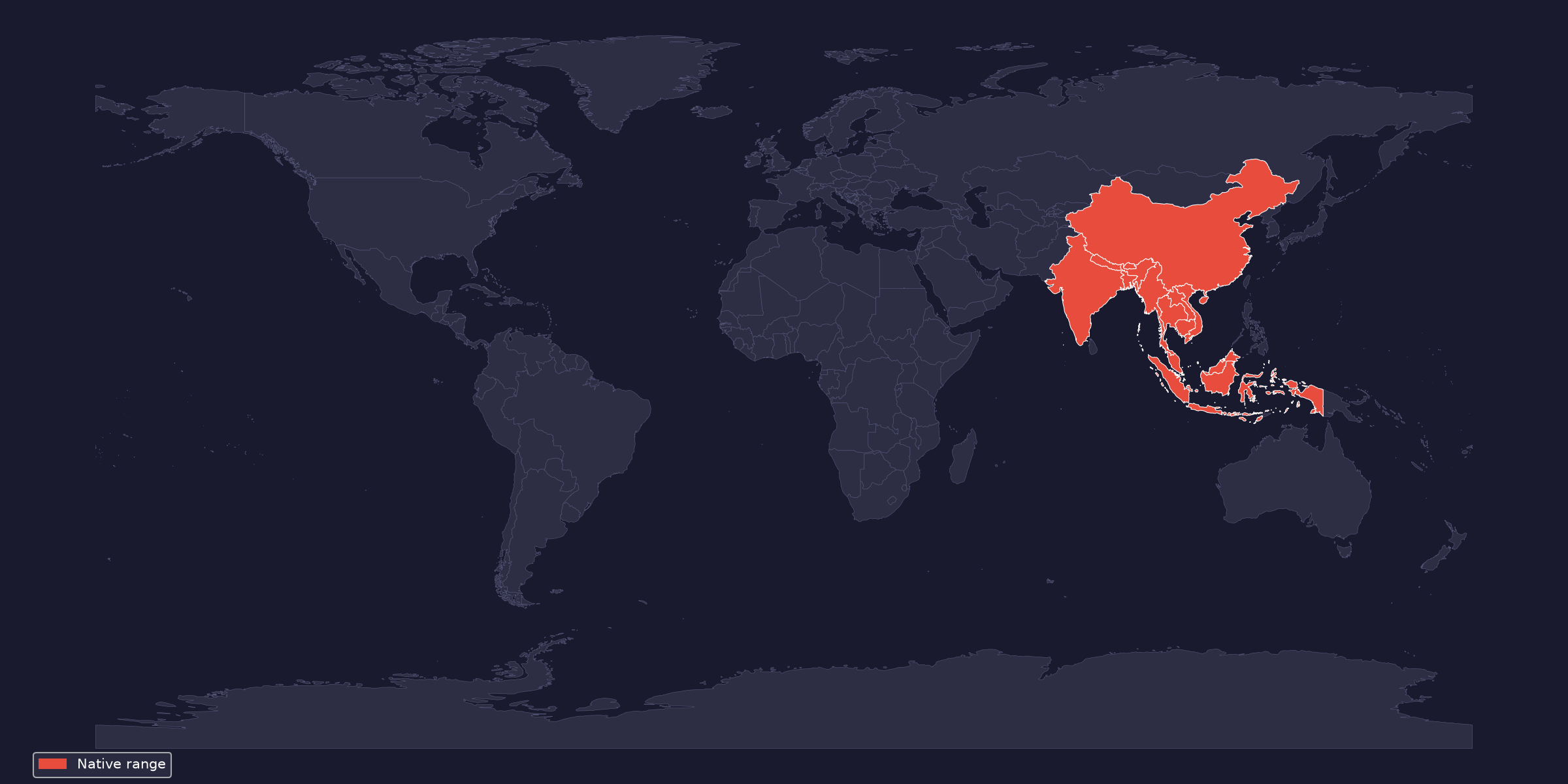
The broad historical concept extends from northeastern and parts of peninsular India, Nepal, Bhutan and Bangladesh through Myanmar, southern China, Laos, Thailand, Cambodia and Vietnam to Malaysia, Singapore, Brunei and the Sunda islands of Indonesia. It occupies humid lowlands, forest edges, rice landscapes, village margins and sites near ponds or streams.
That range combines at least three reported lineages. The broad country map is therefore a sensu-lato overview, not a strict species delimitation, and it overstates occupation within every large country. The reviewed Chiang Rai occurrence belongs to northern Thailand and supplies only one seasonal mainland climate example.
🌡 Climate across the native range
Monthly normals from a reviewed northern Thailand occurrence within the broad sensu-lato range:
Chiang Rai — Thailand (reviewed sensu-lato occurrence)
| Month | Min °C | Mean °C | Max °C | RH % |
|---|---|---|---|---|
| January | 12.9 | 20.9 | 28.8 | 67 |
| February | 14.6 | 23.3 | 32.1 | 57 |
| March | 17.3 | 25.8 | 34.3 | 54 |
| April | 21.3 | 28.4 | 35.5 | 58 |
| May | 23 | 28.4 | 33.7 | 69 |
| June | 23.7 | 27.9 | 32.2 | 75 |
| July | 23.6 | 27.5 | 31.4 | 78 |
| August | 23.2 | 27 | 30.9 | 80 |
| September | 22.7 | 26.8 | 31 | 81 |
| October | 21.1 | 25.9 | 30.6 | 78 |
| November | 17.4 | 23.3 | 29.2 | 75 |
| December | 13.8 | 20.8 | 27.8 | 72 |
Weather data by WorldClim v2.1, 1970–2000 · Monthly normals queried by Herpeton Academy from raster values; relative humidity is derived from vapor pressure and mean temperature.
Location references use GBIF.org occurrence data where available; original occurrence records retain their source dataset licenses.
⚖️ Legal status
No species-specific entry for Bungarus fasciatus was found in the CITES Appendices, EU wildlife-trade annexes or Bern Convention appendices on 17 August 2026. Non-listing is not permission to collect, export, import or keep it.
Range states and destination jurisdictions may protect native snakes or regulate dangerous animals, transport, registration, breeding and sale. The unresolved species complex makes origin evidence especially important. Obtain written authority decisions and retain export and import papers, invoice, breeder, precise locality, photographs, parentage and the check date.
🤌 Husbandry
House one krait in a controlled-access venomous room with secondary containment, sealed service penetrations and a written door protocol. Provide two positively lockable shift compartments. Move and visually confirm the animal behind a locked barrier before opening any primary door.
Quarantine for at least 90 days with paper, removable hides, dedicated tools and preferably separate airspace. Monitor weight, meals, sheds, faeces, skin, mouth and respiration. Wild-origin animals require veterinary screening for dehydration, mites, internal parasites, stomatitis and respiratory disease.
Do not cohabit except for brief, controlled breeding introductions. The species eats other snakes and can exploit water drains and narrow service gaps. Schedule non-urgent tasks in daylight, but never rely on the animal being inactive.
💡 Lighting
Provide 10-13 hours of diffuse visible light and full darkness at night. Adjust photoperiod gradually to documented provenance. Shade both shift retreats and avoid intense open illumination that removes secure daytime cover.
Low-output UVB may be provided as a Ferguson Zone 1 opportunity. Measure at the animal’s level and preserve a fully shaded route. Lamps and cables must remain outside primary containment or behind locked guards.
🌡 Heating and temperature
Maintain ambient air at 24-28°C, a basking surface at 30-32°C, a cool hide at 22-24°C and nights around 21-24°C. Thermostat and guard every source; measure surfaces and air and alarm overheating.
The sensu-lato range spans monsoonal mainland and equatorial Sundaic climates. Do not impose a northern dry-season cycle on Indonesian stock or permanent equatorial heat on an Indo-Myanmar animal. Use modest seasonal changes only when provenance and body condition support them; do not brumate.
💧 Humidity and water
Keep relative humidity around 60-80% with strong ventilation and a surface that dries between local moistening. One shift hide may reach 70-85% for shedding. A wet enclosure is not a substitute for humid choice and can promote skin and respiratory disease.
Provide a stable clean bowl through a protected port. The species may enter shallow water but does not need an aquarium. Prevent drains, filters or plumbing from becoming escape routes, and track hydration through weight, urates, drinking and shed quality.
🌿 Enclosure and decoration
An adult needs at least 180 x 90 x 75 cm, with more length for very large specimens. Fit two lockable shift boxes, low anchored cover and an unobstructed viewing lane. Use independent two-step locks and close every gap to juvenile standard.
Provide 8-10 cm of compactable soil with leaf litter, a dry retreat and a locally humid retreat. Paper is safer during quarantine. Avoid deep loose substrate that conceals the snake, unstable rock, aromatic chips and furnishings that require hands to enter hidden spaces.
🐁 Feeding
Wild banded kraits take snakes, eels, amphibians and other vertebrates. Captive diet should reflect actual provenance and feeding history. Some established animals accept frozen-thawed rodents or fish, but a varied lawful whole-prey programme may be necessary; do not claim a rodent-only ration is adequate for every lineage.
Offer small, appropriately sized prey every 7-14 days through a protected port, adjusting for condition and digestion. Use previously frozen, disease-screened lawful prey and never wild-caught reptiles or amphibians. Avoid live prey and retrieve refusals only after a confirmed shift. Whole prey needs no routine powder supplement.
🛡 Operational safety and emergencies
Never free-handle, pin, neck or perform open-door hook work. Use lockable shifts, protected ports, transparent shields and species-appropriate tubes under a written protocol. Two trained adults attend each primary opening; night work is restricted to genuine emergencies with full lighting and accountability.
Before acquisition, consult the receiving hospital or poison centre with exact lineage and origin. Confirm a clinically appropriate, in-date antivenom pathway and, critically, rapid intubation and multi-day ventilation capability. A cobra antivenom or antivenom for another krait must not be assumed effective.
After a bite, move away, call emergency services, remove constricting items, keep still and support the limb neutrally. Follow the poison centre’s regional immobilisation advice; do not apply a tourniquet, cut, suck, ice, shock or massage. Never wait for ptosis or breathing difficulty before transport, and never delay to capture the snake.
Maintain a written escape plan with room isolation, public exclusion, positive animal counts, search zones and secure containers. Stop work whenever the krait is not positively located.
🥚 Breeding notes
The banded-krait complex is oviparous. Published observations include females attending clutches of 8-19 eggs. One documented Indo-Myanmar clutch was incubated at 27.6°C, but it was found after development had begun, so it does not establish a complete incubation duration.
For institutional planning, 27-29°C and approximately 45-70 days are conservative starting ranges that require validation against the complete breeding record and lineage. Pair only identified, lawful stock. Prepare individual neonate shifts first and document parentage; unresolved lineages should not be crossed.
🩺 Common problems
- Obesity: use measured prey and routine weight and condition records.
- Food refusal or nutritional imbalance: review provenance, prey history, temperature and disease rather than repeatedly offering live food.
- Dehydration or dysecdysis: check clean water, humid retreat, ventilation and temperature.
- Respiratory disease: wheeze, bubbles, open-mouth breathing or head elevation need urgent veterinary assessment.
- Dermatitis: investigate wet dirty substrate, mites and abrasion.
- Parasites or stomatitis: weight loss, abnormal faeces and oral swelling are major import concerns.
- Burns and overheating: prevent with guarded thermostatic heat, alarms and a verified cool hide.
Secure the animal behind a locked shift and use a preplanned veterinary anaesthesia and containment team. Do not attempt hands-on home treatment.
📌 Conclusion
Bungarus fasciatus sensu lato demands documented origin, lineage-aware climate and diet, a two-compartment protected-contact system and a hospital prepared for delayed, prolonged respiratory paralysis. Its daytime stillness and conspicuous bands make it recognisable, not manageable.
📚 Sources and further reading
- ReptiFiles — checked first on 17 August 2026; no species-specific care guide was found.
- The Reptile Database: Bungarus fasciatus
- GBIF species record: Bungarus fasciatus
- Biakzuala et al. — three evolutionary lineages in the banded-krait complex
- Chanhome et al. — venomous-snake husbandry in Thailand
- Pe et al. — Bungarus envenoming in Myanmar
- Tongpoo et al. — krait envenomation in Thailand
- Ranawaka et al. — urgent antivenom after proven Southeast Asian krait bite
- WHO South-East Asia snakebite management guidelines
- Baines et al. — UV lighting guidance
- Northern Ireland government venomous-reptile guidance
- CITES Appendices
- EU wildlife-trade annexes, Commission Regulation (EU) 2026/1383
- Bern Convention appendices