Share

Malayan Krait
🔤 Taxonomy
Bungarus candidus is the accepted name for the Malayan or blue krait. It belongs to the difficult B. candidus–multicinctus–wanghaotingi complex, and published records outside the core range require careful review. The black-and-white pattern is also imitated by harmless Lycodon wolf snakes.
Keep locality, scale photographs and parent records. A trade label or colour pattern alone is not enough for medical or breeding identification.
📌 Description
The Malayan krait is a glossy, banded, mostly nocturnal elapid, commonly 90-140 cm and occasionally near 160 cm. By day it often remains tightly coiled beneath cover, hiding its head; at night it can become rapid and exploratory. A 10-15-year institutional commitment is reasonable.
Bites may be initially painless yet progress to ptosis, generalized paralysis and respiratory failure. Presynaptic neurotoxicity can require prolonged mechanical ventilation. Apparent daytime passivity must never be interpreted as safe handling.
📋 Quick reference
| Care point | Practical target |
|---|---|
| Adult enclosure | At least 180 x 90 x 75 cm with two low lockable shift hides |
| Temperature | Ambient 24-28°C; warm surface 29-31°C; cool hide 22-24°C |
| Night | 22-25°C |
| Humidity | 60-80%; local 75-90% shed support with ventilation |
| Feeding | Suitable whole prey every 10-18 days; establish diet before acquisition |
| Safety | Protected contact, two trained staff, nocturnal bite and escape plans |
| Quarantine | At least 90 days with separate tools and veterinary screening |
☠️ Venom
This species is venomous. Venom exposure can cause pain, swelling or other systemic effects, and severity varies with species, locality, bite site and the amount delivered. A small wound or apparently dry bite is not proof of safety; every bite or sting requires urgent medical assessment.
If an incident occurs, move away, call emergency services or a poison centre, keep the patient still, remove rings and other constricting items, and follow dispatcher instructions. Do not use a tourniquet, cut or suck the wound, apply ice or electricity, give alcohol or medicines as a home treatment, or attempt to catch the animal. Antivenom choice and dosing are hospital decisions; verify the relevant product and local availability in advance. Sources: WHO snakebite guidance and appropriate species-specific toxinology or medical references listed below.
🌍 Distribution
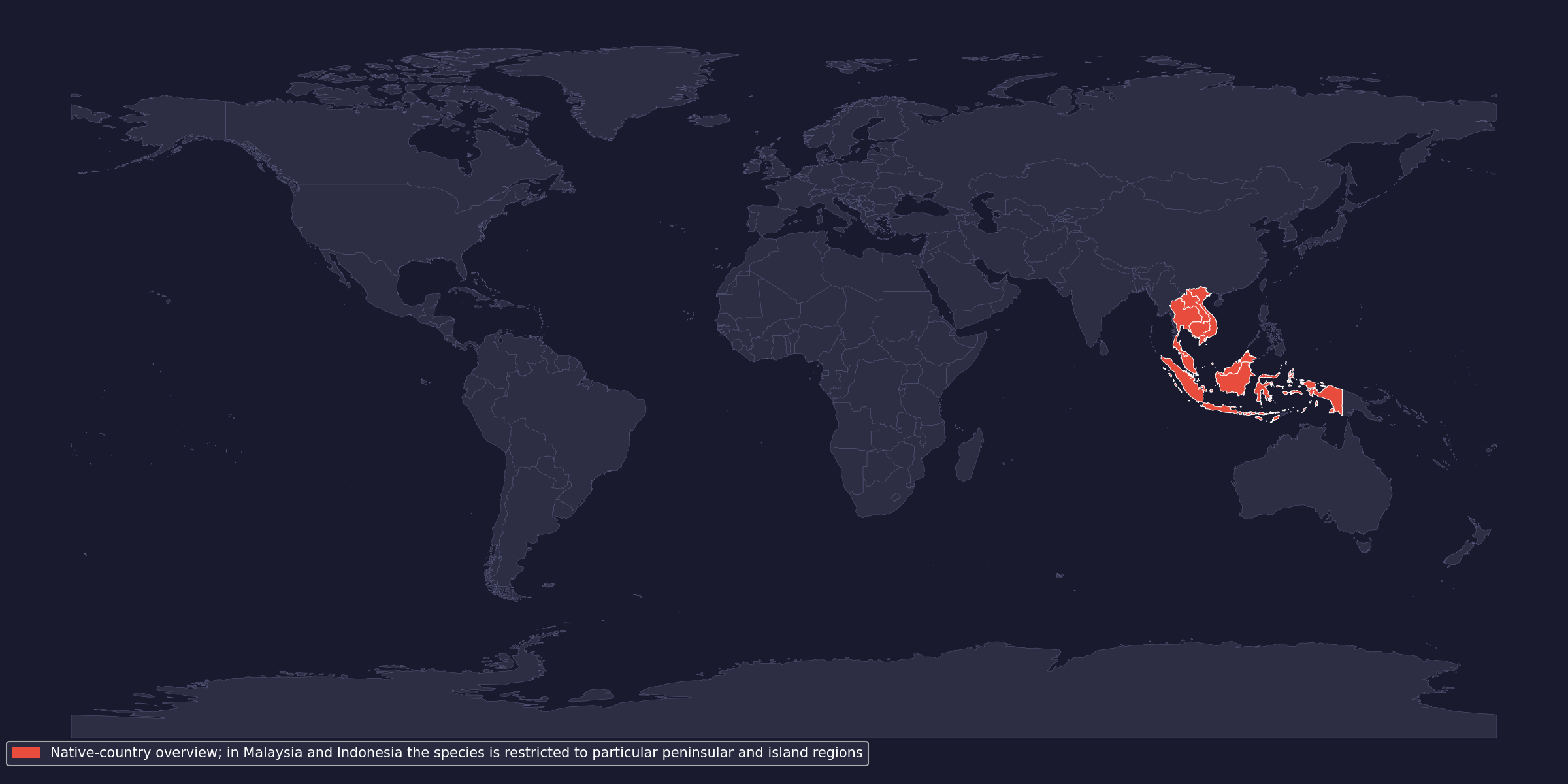
The accepted range includes Cambodia, Laos, Thailand, central and southern Vietnam, Peninsular Malaysia, and the Indonesian islands of Java, Sumatra and Bali. Old Sulawesi records are doubtful, and the species is not treated as established in Singapore. Country shading cannot show these island and regional limits precisely.
Malayan kraits use lowland forest, scrub, rice-growing landscapes, plantation edges, drainage corridors and buildings with abundant shelter and prey. Field research in Thailand documents repeated use of anthropogenic structures, which is relevant to escape prevention but not an argument for barren housing.
⚖️ Legal status
No species-specific entry for B. candidus was found in the CITES Appendices, EU wildlife-trade annexes or Bern Convention appendices when checked on 29 August 2026. Range states regulate wildlife collection and export, and uncertain identity within the complex can invalidate paperwork or medical assumptions.
Dangerous-animal rules may require licences, inspected rooms, competence evidence, insurance and written emergency plans. Keep invoices, breeder and locality records, photographs, import and transfer papers and authority correspondence. Treaty non-listing does not authorize possession or transport.
🤌 Husbandry
House one animal alone in a locked venomous room with secondary containment. Provide two low, tight shift compartments with remotely closable doors and duplicate hides so every task follows positive isolation. Kraits can enter surprisingly narrow gaps; vent mesh, tracks, drains and cable routes require careful inspection.
Quarantine for at least 90 days with dedicated tools, simple flooring and preferably separate air. Record weight, feeding, regurgitation, shedding, faeces and respiration. Wild-origin and uncertain animals need reptile-veterinary parasite assessment and verified taxonomy.
💡 Lighting
Provide a clear 10-12-hour day/night cycle with subdued, diffuse daytime light and complete darkness at night. Use opaque shelters and visual barriers throughout. Night work should use dim external red light only when staff can still positively locate the head and entire body.
Routine UVB is not required. If offered as optional low-level enrichment, keep it within a shaded Ferguson Zone 1 opportunity and never compromise secure cover.
🌡 Heating and temperature
Maintain ambient air at 24-28°C, a small warm surface at 29-31°C, a cool hide at 22-24°C and nights around 22-25°C. Measure inside both shift hides and under cover; surface readings in the open do not reveal the microclimate where the snake spends the day.
Thermostat and guard every heater. Avoid both cool saturation and constant high heat. Seasonal adjustments should be modest, based on documented origin and restricted to healthy adults in a formal breeding programme.
💧 Humidity and water
Maintain 60-80% relative humidity with air exchange and regular drying of the top layer. Supply a local retreat at 75-90% during shedding. Permanently wet substrate and stale air encourage dermatitis and respiratory disease.
Provide a stable clean water bowl accessible through protected service. Inspect around and beneath it from outside before shifting or removal; a coiled krait can disappear under very small objects.
🌿 Enclosure and decoration
An adult needs at least 180 x 90 x 75 cm. Use two low shift hides, snug additional retreats, anchored cork, leaf litter, visual barriers and clear service sightlines. Avoid decorative voids in which the full animal cannot be located.
Use 6-10 cm of compactable soil, coco fibre and leaf litter over drainage, or paper during quarantine. The lower layer may remain slightly moist while the surface dries. Doors need two independent locks, and the room needs an airlock or equivalent secondary barrier.
🐁 Feeding
Wild Malayan kraits consume other snakes and elongate vertebrates; some managed animals accept rodents, while others need legally sourced, captive-produced reptile prey. Establish an ethical, reliable diet before acquisition. Never use wild-caught prey.
Offer killed or frozen-thawed prey remotely, usually every 10-14 days for growing animals and 12-18 days for adults according to condition. Feed only after positive isolation and record prey species and mass. Repeated refusal or regurgitation requires specialist veterinary and nutrition review, not routine force-feeding.
🛡 Operational safety and emergencies
The facility needs controlled access, two trained staff for every opening, inventory and lock logs and rehearsed bite and escape plans that work at night. Locate the head and full body, guide the snake remotely into a shift and positively lock it before touching any service item. Never lift a hide over an unlocated krait.
Before acquisition, the receiving hospital and poison service must confirm the antivenom pathway, transport time and 24-hour capacity for intubation, mechanical ventilation and intensive care. Products and coverage vary by country; keeper-held antivenom alone is not a plan.
After any suspected bite, secure the room, call emergency services, keep the patient still and transport urgently with the species card. Do not wait for pain, fang marks, ptosis or weakness; do not cut, suck, ice, shock, tourniquet or recapture the snake.
🥚 Breeding notes
Published reproductive data are limited. The species is oviparous, with clutches broadly reported around 4-10 eggs. A conservative monitored planning window is 27-29°C and roughly 60-70 days, adjusted to egg development and the documented line.
Pairing creates cannibalism and containment risks. Use remote introduction and separation, an accessible laying box and individual secure neonate units. Confirm permits, qualified placements and a safe first-food supply before breeding.
🩺 Common problems
- Hidden-animal servicing: redesign cover and shifts so the whole body can be positively located.
- Refusal or regurgitation: review prey type, security, night schedule, temperature and disease.
- Obesity: weigh prey and trend mass; a snake-based natural diet does not justify large frequent rodents.
- Burns and overheating: guard and thermostat heat and check beneath every daytime retreat.
- Dermatitis or respiratory disease: correct saturated, stagnant conditions and seek veterinary diagnosis.
- Parasites and stomatitis: especially important in wild-origin or uncertain-history animals.
📌 Conclusion
The Malayan krait is an expert-only nocturnal elapid whose quiet daytime posture conceals a severe neurotoxic risk. Positive shifting, a sustainable specialist diet and a hospital plan ready for prolonged ventilation are core care requirements.
📚 Sources and further reading
- ReptiFiles — checked first on 29 August 2026; no species-specific care guide was found.
- The Reptile Database: Bungarus candidus
- GBIF species record: Bungarus candidus
- Chen et al. 2021 — the B. candidus–multicinctus–wanghaotingi complex
- Hodges et al. — habitat selection by Malayan kraits
- Krait envenomation in Thailand
- WHO: Guidelines for the management of snakebites
- CITES Appendices
- EU wildlife-trade annexes, Commission Regulation (EU) 2026/1383
- Bern Convention appendices