Share

Common Krait
🔤 Taxonomy
Bungarus caeruleus is the accepted name for the common or Indian krait. The name Bungarus romulusi was proposed for Karnataka animals in 2021, but subsequent nomenclatural review rejected it as unavailable; The Reptile Database currently retains those animals in B. caeruleus. Provenance remains important because several similar Bungarus species occur around the range.
📌 Description
The common krait is a glossy, often dark and narrowly banded South Asian elapid, usually 90-150 cm. It is strongly nocturnal: an animal that appears quiet or hides its head by day may become an active, capable predator after lights-out. Lifespan in managed care is commonly estimated at 12-18 years.
Envenomation can produce delayed but severe neuromuscular paralysis and respiratory failure, sometimes with little local pain or swelling. Lack of dramatic bite-site signs is never reassurance. This species is for licensed institutions with protected contact and a prearranged respiratory-emergency pathway.
📋 Quick reference
| Care point | Practical target |
|---|---|
| Adult enclosure | At least 150 x 75 x 60 cm with two lockable shift hides |
| Temperature | Ambient 24-28°C; warm surface 30-32°C; cool hide 22-24°C |
| Night | 21-24°C |
| Humidity | 50-70%; local 70-80% shed support |
| Feeding | Moderate frozen-thawed prey every 10-21 days |
| Safety | Protected contact, two-person rule, airway-capable hospital plan |
| Quarantine | At least 90 days with separate equipment and veterinary screening |
☠️ Venom
This species is venomous. Venom exposure can cause pain, swelling or other systemic effects, and severity varies with species, locality, bite site and the amount delivered. A small wound or apparently dry bite is not proof of safety; every bite or sting requires urgent medical assessment.
If an incident occurs, move away, call emergency services or a poison centre, keep the patient still, remove rings and other constricting items, and follow dispatcher instructions. Do not use a tourniquet, cut or suck the wound, apply ice or electricity, give alcohol or medicines as a home treatment, or attempt to catch the animal. Antivenom choice and dosing are hospital decisions; verify the relevant product and local availability in advance. Sources: WHO snakebite guidance and appropriate species-specific toxinology or medical references listed below.
🌍 Distribution
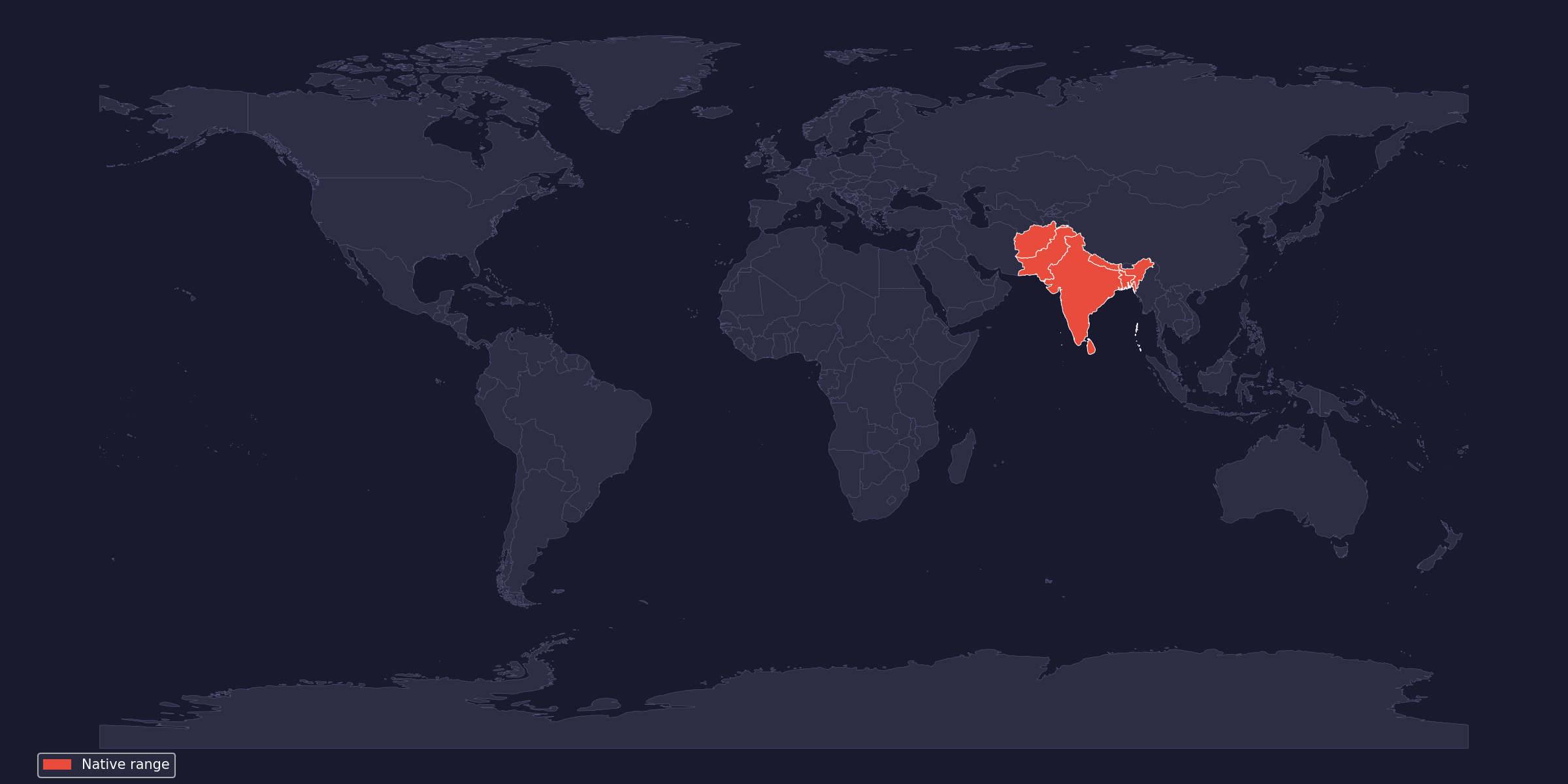
The confirmed range covers Afghanistan, Pakistan, India, Sri Lanka, Bangladesh and Nepal. Bhutan is sometimes suggested but remains insufficiently certain and is not highlighted on the country map. Within this broad area, records occupy lowlands and lower hills; species boundaries and identification are complicated where other kraits occur.
Common kraits use open woodland, scrub, grassland, farms, village edges and rodent-rich structures, often sheltering in burrows, debris or cracks by day. The whole-country map cannot show gaps or distinguish verified B. caeruleus from historical records of similar kraits. The climate point represents central India only.
🌡 Climate across the native range
Monthly normals from a reviewed occurrence in central India:
Chhattisgarh — India (reviewed common krait occurrence)
| Month | Min °C | Mean °C | Max °C | RH % |
|---|---|---|---|---|
| January | 12.7 | 19 | 25.2 | 55 |
| February | 15.8 | 22.5 | 28.9 | 47 |
| March | 20.1 | 27.2 | 33.9 | 37 |
| April | 24.4 | 31.3 | 37.9 | 33 |
| May | 27.4 | 33.7 | 39.8 | 34 |
| June | 25.8 | 29.7 | 34.1 | 62 |
| July | 23.5 | 25.7 | 28.8 | 83 |
| August | 23 | 25.1 | 28.1 | 85 |
| September | 22.6 | 25.4 | 29 | 83 |
| October | 20.2 | 24.4 | 28.9 | 73 |
| November | 16.2 | 21.7 | 27.1 | 63 |
| December | 12.9 | 19 | 25 | 58 |
Weather data by Open-Meteo.com · CC BY 4.0 · Monthly normals calculated by Herpeton Academy from daily archive values.
Location references use GBIF.org occurrence data where available; original occurrence records retain their source dataset licenses.
⚖️ Legal status
No species-specific listing for B. caeruleus was found in CITES, the EU wildlife-trade annexes or the Bern Convention appendices when checked on 17 August 2026. Trade status does not override national wildlife protection or dangerous-animal law. Range states may prohibit capture and possession, while other countries may require licensing, inspection, insurance and emergency planning.
Retain invoices, breeder/importer data, origin and identification records, photographs, permits and transport documents. Confirm the exact species and current rules in writing before acquisition or transfer.
🤌 Husbandry
House singly: wild diet includes other snakes, and cohabitation adds predation and separation hazards. Use a locked venomous room, secondary containment and two tight shift hides linked by a closable passage. Complete routine service during the day only after the krait is visibly secured; darkness and low activity must never substitute for a barrier.
Quarantine for at least 90 days in simple housing with separate tools and preferably separate air. Record weight, feeding, sheds, faeces and respiratory behaviour. Imports need veterinary parasite and hydration assessment.
💡 Lighting
Provide 10-12 hours of visible daytime light and complete darkness at night. Use deep shaded hides, leaf cover and dim observation methods rather than illuminating the active animal continuously. Guard all fixtures.
Low-level UVB may be offered over part of the warm zone as a Ferguson Zone 1 opportunity. Shade must remain available, and UVB is not a replacement for balanced whole prey.
🌡 Heating and temperature
Maintain 24-28°C ambient air, a local warm surface at 30-32°C, a 22-24°C cool hide and nights around 21-24°C. Thermostat every heat source and verify surface and air readings in both shift hides.
The range crosses dry and monsoonal climates. Do not turn a seasonal pattern into constant heat and dampness. A stable daily gradient is the priority; seasonal cycling is for locality-informed breeding programmes and healthy established animals only.
💧 Humidity and water
Use 50-70% relative humidity with good airflow and a localized 70-80% humid hide during shedding. Let the upper substrate dry while a deeper covered zone retains some moisture. Persistent wetness encourages dermatitis and respiratory disease.
Provide clean water in a stable bowl serviced through protected access. Watch hydration carefully after transport, feeding refusal or incomplete shedding.
🌿 Enclosure and decoration
An adult requires at least 150 x 75 x 60 cm. Provide two snug shift hides, layered ground cover, fixed low cork, a few secure low branches and an unobstructed inspection route. A slender krait can exploit very small gaps, so vents, tracks and cable ports require special attention.
Use 8-12 cm of compactable soil, washed sand and leaf material, or paper in quarantine. Avoid aromatic wood, coarse chips, unstable stone, adhesive tape and deep clutter. Doors need two independent mechanical locks and the room needs a secondary barrier.
🐁 Feeding
Wild common kraits eat snakes, lizards, frogs and small mammals. Managed adults that reliably accept frozen-thawed rodents can be fed a moderate meal every 10-21 days. Some individuals or juveniles need carefully planned scenting or ethically sourced alternative whole prey under veterinary and institutional oversight.
Do not offer feeder snakes of unknown health: they can transmit parasites and create origin or welfare problems. Feed with long tongs from a protected port and secure the krait before retrieving food. Routine supplements are unnecessary with balanced whole prey.
🛡 Operational safety and emergencies
Never free-handle, pin or manually restrain a krait for routine work. Use shift boxes, transparent barriers and appropriately sized hooks or tubes only within a trained professional protocol. Two trained adults attend every opening of primary containment.
The hospital plan must emphasize that neuroparalysis may progress despite modest local signs and may require prolonged ventilatory support. Provide exact species, locality, photographs, transport and expert antivenom contacts. Antivenom is geographically and product specific.
For any bite, withdraw, call emergency services, remove tight items, keep the patient still, immobilize the limb and follow poison-centre directions. Do not cut, suck, ice, shock, apply a tight tourniquet or wait for symptoms.
🥚 Breeding notes
Common kraits are oviparous, with reported clutches commonly around 5-15 eggs. Institutional incubation is generally near 27-29°C for approximately 55-70 days, with close monitoring of moisture, egg condition and development.
Breeding produces small, secretive and highly dangerous neonates. Verify parent provenance, permission and placements before pairing. Prepare individual escape-proof rearing units and complete origin records before hatch.
🩺 Common problems
- Feeding refusal: investigate temperature, cover, nocturnal timing, stress, parasites and prey recognition before changing prey type.
- Obesity: avoid frequent large rodents and track weight and body profile.
- Dysecdysis and dehydration: review water, humid hide and systemic health; do not restrain at home.
- Dermatitis or respiratory disease: correct wet, dirty or poorly ventilated conditions and seek veterinary care.
- Mites, internal parasites and stomatitis: especially likely in imports and poorly documented animals.
- Escape opportunities: small gaps and unsecured tracks are a husbandry emergency, not a maintenance detail.
📌 Conclusion
The common krait’s subdued daytime posture and sometimes inconspicuous bite site can mislead people in exactly the moments when discipline matters most. It requires a licensed institution that treats every service operation as protected contact and has immediate access to respiratory-capable emergency care.
📚 Sources and further reading
- ReptiFiles — checked first on 17 August 2026; no species-specific care guide was found.
- The Reptile Database: Bungarus caeruleus
- GBIF species record: Bungarus caeruleus
- WHO South-East Asia: Guidelines for the management of snakebites
- Wüster & Kaiser — nomenclatural review of proposed krait names
- Baines et al. — UV lighting guidance for captive reptiles
- Northern Ireland government guidance on keeping venomous snakes and lizards
- CITES Appendices
- EU wildlife-trade annexes, Commission Regulation (EU) 2026/1383
- Bern Convention appendices