Share

Jararaca
🔤 Taxonomy
Bothrops jararaca is the accepted name for the jararaca. Some literature from the 2009 genus split used Bothropoides jararaca, but later analyses returned it to Bothrops. The spelling Bothrops jaracara is an error.
Use the species in its strict Atlantic Forest sense. It is not interchangeable with B. jararacussu, B. moojeni, members of the B. neuwiedi group, or the island endemics B. insularis, B. alcatraz and B. otavioi. Colour pattern overlaps among lanceheads; require traceable locality and expert identification.
📌 Description
The jararaca is a moderately slender lancehead, commonly 70-120 cm and occasionally approaching 150 cm. It is mainly nocturnal or crepuscular. Juveniles climb readily and use caudal luring; adults remain primarily terrestrial but still use raised cover. Managed longevity may reach 15-25 years.
Envenomation is typically dominated by pain, progressive swelling, bruising, bleeding, coagulopathy and local tissue injury, with systemic complications possible. This pattern makes delay, constricting first aid and unsafe manual work especially consequential.
📋 Quick reference
| Care point | Practical target |
|---|---|
| Adult enclosure | At least 150 x 75 x 100 cm with two lockable shift hides |
| Temperature | Ambient 23-27°C; basking 29-31°C; cool retreat 21-24°C |
| Night | 20-23°C |
| Humidity | 65-80% with ventilation; local 80-90% shed retreat |
| Feeding | Moderate frozen-thawed rodents every 14-28 days |
| Safety | Protected contact, two-person rule, Bothrops-capable hospital plan |
| Quarantine | At least 90 days with separate tools and parasite screening |
☠️ Venom
This species is venomous. Venom exposure can cause pain, swelling or other systemic effects, and severity varies with species, locality, bite site and the amount delivered. A small wound or apparently dry bite is not proof of safety; every bite or sting requires urgent medical assessment.
If an incident occurs, move away, call emergency services or a poison centre, keep the patient still, remove rings and other constricting items, and follow dispatcher instructions. Do not use a tourniquet, cut or suck the wound, apply ice or electricity, give alcohol or medicines as a home treatment, or attempt to catch the animal. Antivenom choice and dosing are hospital decisions; verify the relevant product and local availability in advance. Sources: WHO snakebite guidance and appropriate species-specific toxinology or medical references listed below.
🌍 Distribution
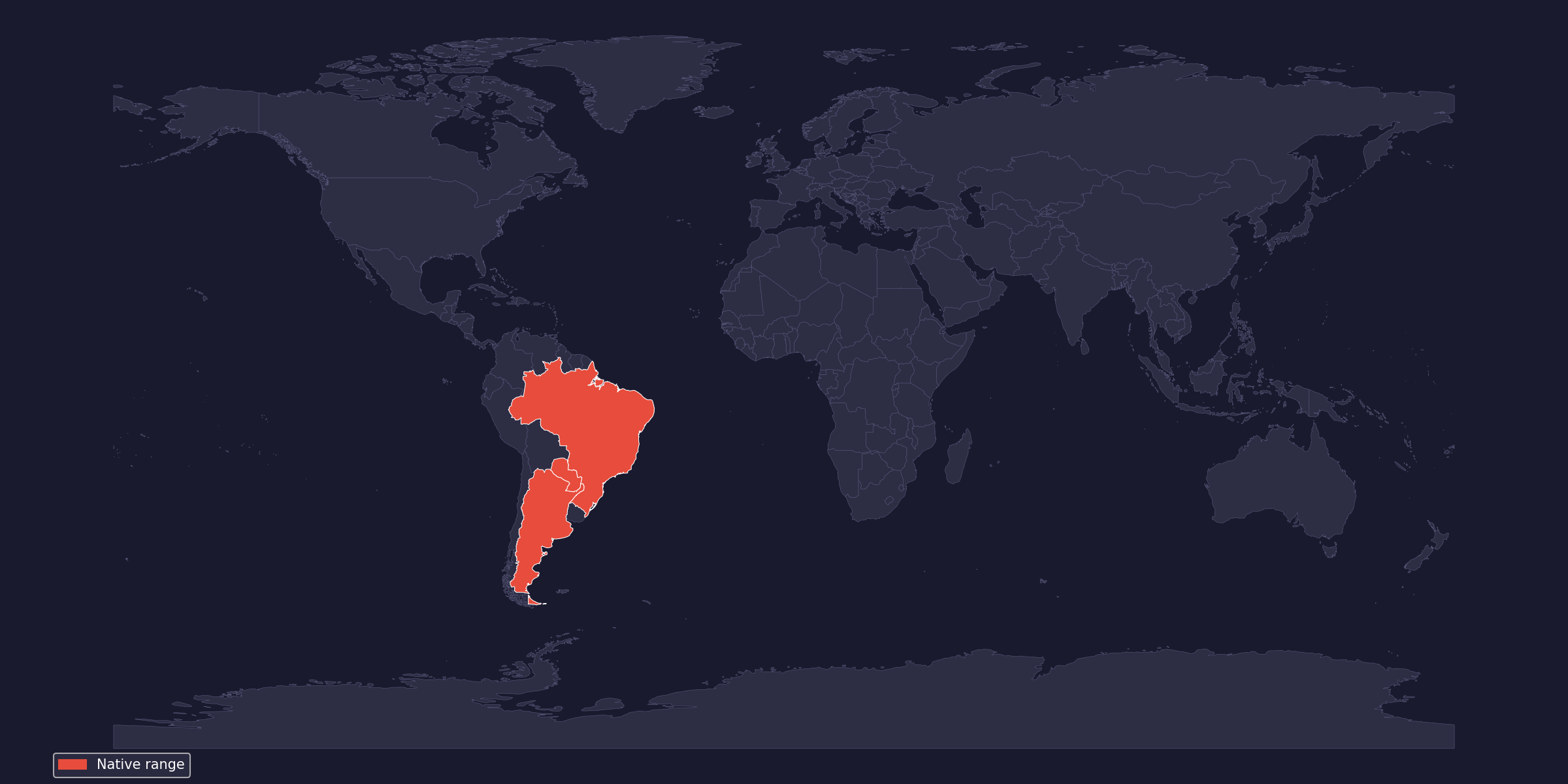
In the strict sense, B. jararaca follows the Atlantic Forest and adjacent landscapes of southeastern and southern Brazil, from southern Bahia through Espírito Santo, Rio de Janeiro, Minas Gerais, São Paulo, Paraná, Santa Catarina and Rio Grande do Sul, with records in eastern Mato Grosso; it also reaches northeastern Paraguay and Misiones in Argentina. Within each country the occupied area is much smaller than a national outline.
It uses humid forest, forest edge, secondary growth, stream valleys, plantations and rural mosaics. The map colours all Brazil, Paraguay and Argentina and therefore greatly overstates the Atlantic-facing range, especially in the Amazon, central Brazil, western Paraguay and most of Argentina. The reviewed São Paulo climate point represents one southeastern Atlantic Forest locality, not a full-range average.
🌡 Climate across the native range
Monthly normals from a reviewed occurrence in the southeastern Brazilian Atlantic Forest region:
São Paulo — Brazil (reviewed jararaca occurrence)
| Month | Min °C | Mean °C | Max °C | RH % |
|---|---|---|---|---|
| January | 18.1 | 21.6 | 26 | 83 |
| February | 18 | 21.7 | 26.4 | 82 |
| March | 17.3 | 20.8 | 25.4 | 84 |
| April | 15.7 | 19.5 | 24.2 | 82 |
| May | 12.9 | 16.9 | 21.8 | 81 |
| June | 11.3 | 15.8 | 21.4 | 79 |
| July | 10.7 | 15.5 | 21.3 | 77 |
| August | 11.6 | 16.7 | 22.8 | 74 |
| September | 13.9 | 18.5 | 24.3 | 76 |
| October | 15.6 | 19.7 | 25 | 80 |
| November | 16.2 | 20 | 24.7 | 82 |
| December | 17.5 | 21.1 | 25.7 | 83 |
Weather data by Open-Meteo.com · CC BY 4.0 · Monthly normals calculated by Herpeton Academy from daily archive values.
Location references use GBIF.org occurrence data where available; original occurrence records retain their source dataset licenses.
⚖️ Legal status
No species-specific listing was found in CITES, the EU wildlife-trade annexes or the Bern Convention appendices on 17 August 2026. That does not make jararacas ordinary private pets. Brazilian IBAMA guidance states that venomous snakes may be maintained only in qualified facilities such as research centres or pharmaceutical institutions; fauna enterprises and transfers require the appropriate environmental authorization and traceable origin. Paraguay and Argentina apply their own wildlife and provincial rules.
Retain institutional authorizations, invoices, origin and transfer papers, individual records, photographs and legal-check dates. Local and national rules governing possession, transport, breeding, sale and import may apply throughout the range and destination country even without CITES listing.
🤌 Husbandry
House singly. Use a locked venomous room, secondary containment and an enclosure divided by two externally controlled shift hides. All water, cleaning and inspection work follows positive visual confirmation that the snake is secured behind a closed door. Juveniles are small, fast and willing to climb, so overhead space and ports require the same security as the floor.
Quarantine for at least 90 days on paper with separate tools and preferably separate air. Record weight, meals, sheds, faeces, oral condition and respiration. Wild-origin or poorly documented animals warrant veterinary examination, repeated faecal testing and ectoparasite control before naturalistic substrate is installed.
💡 Lighting
Provide 11-13 hours of visible daylight, complete night darkness and dense shade. Guard every fitting. Low-level UVB over part of the warm zone may offer a Ferguson Zone 1 opportunity; it must not heat or dry the entire upper enclosure.
🌡 Heating and temperature
Maintain 23-27°C ambient air, a local 29-31°C basking surface, a 21-24°C cool refuge and nights around 20-23°C. Avoid sustained temperatures above 30°C outside the small basking site. Thermostat heat independently and measure at resting height on the ground and on raised branches.
The range has seasonal and elevational variation, but jararacas do not require a cold temperate brumation. A gentle seasonal change in photoperiod, rain pattern and night temperature may be used for documented breeding stock; never chill new, thin or sick animals.
💧 Humidity and water
Maintain 65-80% relative humidity with strong cross-ventilation and a surface that partially dries between watering. Provide an 80-90% humid refuge during shedding. Constantly saturated substrate and stagnant air cause skin damage and respiratory disease; excessively dry heat promotes dehydration.
Provide a stable bowl of clean water through protected access. Drainage is essential: mist foliage and part of the substrate, not every surface, and remove standing water that is not inside the bowl.
🌿 Enclosure and decoration
An adult needs at least 150 x 75 x 100 cm; large females benefit from 180 cm length. Supply two snug shift hides, low visual cover, cork or fixed shelters, sturdy sloping branches and foliage. Keep a clear observation lane and eliminate blind cavities.
Use 10-15 cm of well-drained forest soil, fine bark and leaf litter over drainage, or paper in quarantine. Avoid aromatic wood, sharp coarse chips, unstable branches, exposed mesh edges and adhesive tape. Two independent locks, guarded ventilation, room-level containment and an escape plan are mandatory.
🐁 Feeding
Juveniles take frogs, lizards and small ectothermic prey; adults increasingly take rodents and other small vertebrates. Established animals usually accept appropriate frozen-thawed mice or rats. Feed juveniles about every 10-14 days and adults a modest meal every 14-28 days, adjusted for body condition and season.
Use long tongs through a protected port. Shift before retrieving refused prey. Do not use live rodents or enter to reposition food. Whole prey needs no routine supplement, and this ambush viper should remain lean rather than continuously heavy.
🛡 Operational safety and emergencies
Never free-handle, pin, neck or manually restrain. Use protected contact, lockable shifts, shields and purpose-selected tools under a written two-person procedure. Rehearse escape and bite drills without a live snake.
Before acquisition, confirm a hospital and poison-centre pathway with experience treating Bothrops envenomation and access to appropriate antivenom. Store current identity, locality, photographs, route and contact information at the room entrance.
Every bite is an immediate emergency. Withdraw, call emergency services, keep the patient calm and still, remove rings and tight clothing, and follow regional medical guidance. Because local tissue injury can be severe, do not apply pressure immobilisation or constricting wraps unless the responsible poison centre explicitly directs them. Do not cut, suck, ice, shock, use a tourniquet, apply chemicals or wait for symptoms.
🐍 Breeding notes
The species is viviparous. Litters vary widely, approximately 3-30 young, with maternal size and condition important. Pairing follows documented seasonal cues and must occur only through remotely closable compartments. Monitor females without excessive feeding; reproductive females are not made safer by obesity.
Prepare individual locked neonatal units, legal authorization, lineage records, trained staff and placements before pairing. Newborns may prefer frogs or lizards and require a controlled institutional feeding strategy rather than risky ad hoc live feeding.
🩺 Common problems
- Obesity: ambush feeding ecology requires conservative meals and serial weights.
- Dehydration or dysecdysis: review airflow, water and localized humidity rather than saturating the enclosure.
- Scale rot and respiratory disease: correct wet stagnant substrate promptly and seek veterinary diagnosis.
- Burns or overheating: guard and thermostat heat; retain a measured cool refuge.
- Rostral trauma: improve cover, reflections, sightlines and shift routine.
- Parasites and stomatitis: quarantine and reptile-veterinary diagnostics are essential for uncertain-origin stock.
📌 Conclusion
The jararaca requires humid but ventilated protected-contact housing and a hospital plan designed for rapid Bothrops tissue injury and coagulopathy. Correct strict-species and Atlantic Forest provenance are prerequisites for care, breeding and lawful institutional transfer.
📚 Sources and further reading
- ReptiFiles — checked first on 17 August 2026; no species-specific care guide was found.
- The Reptile Database: Bothrops jararaca
- GBIF species record: Bothrops jararaca
- Brazil Ministry of Health: snakebite clinical guidance
- Brazil Ministry of Health: Bothrops accidents
- IBAMA: rules for keeping wild animals
- IBAMA: authorized wildlife enterprises
- Baines et al. — UV lighting guidance
- CITES Appendices
- EU wildlife-trade annexes, Commission Regulation (EU) 2026/1383
- Bern Convention appendices