Share

Golden Lancehead
🔤 Taxonomy
Bothrops insularis is the accepted golden lancehead or jararaca-ilhoa. It was described as Lachesis insularis and was briefly placed in Bothropoides, but current Reptile Database and GBIF treatments retain Bothrops.
This species is endemic to Ilha da Queimada Grande, São Paulo, Brazil. It is not the similarly named Trimeresurus insularis of Indonesia, nor another Brazilian island lancehead such as B. alcatraz or B. otavioi. Institutional records must connect each living animal to authorised Brazilian provenance and a managed pedigree.
📌 Description
The golden lancehead is a relatively slender pit viper, usually 60-90 cm and sometimes near 100 cm. Its yellow-brown pattern blends into island vegetation. It climbs shrubs and trees to use bird routes but also rests on the ground; enclosure height must therefore remain serviceable through protected contact.
No legitimate private-pet pathway should be inferred from this guide. The species is critically endangered and Brazilian conservation breeding is managed by authorised institutions. Its venom can cause the inflammatory, haemorrhagic, coagulopathic and tissue effects associated with Bothrops. Any institutional holding requires full dangerous-snake and hospital capability.
📋 Quick reference
| Care point | Practical target |
|---|---|
| Adult size and lifespan | Usually 60-90 cm, up to about 100 cm; approximately 15-20 years |
| Adult enclosure | At least 150 x 75 x 120 cm with two elevated lockable shifts |
| Temperature | Ambient 22-27°C; basking 29-31°C; cool hide 20-23°C |
| Night | 18-22°C with measured seasonal change |
| Humidity | 70-90% with strong cross-ventilation and dryable perches |
| Feeding | Managed varied whole prey every 10-21 days according to condition |
| Safety | Institutional protected contact, two-person rule, Bothrops hospital plan |
| Provenance | Authorised conservation programme and complete pedigree only |
☠️ Venom
This species is venomous. Venom exposure can cause pain, swelling or other systemic effects, and severity varies with species, locality, bite site and the amount delivered. A small wound or apparently dry bite is not proof of safety; every bite or sting requires urgent medical assessment.
If an incident occurs, move away, call emergency services or a poison centre, keep the patient still, remove rings and other constricting items, and follow dispatcher instructions. Do not use a tourniquet, cut or suck the wound, apply ice or electricity, give alcohol or medicines as a home treatment, or attempt to catch the animal. Antivenom choice and dosing are hospital decisions; verify the relevant product and local availability in advance. Sources: WHO snakebite guidance and appropriate species-specific toxinology or medical references listed below.
🌍 Distribution
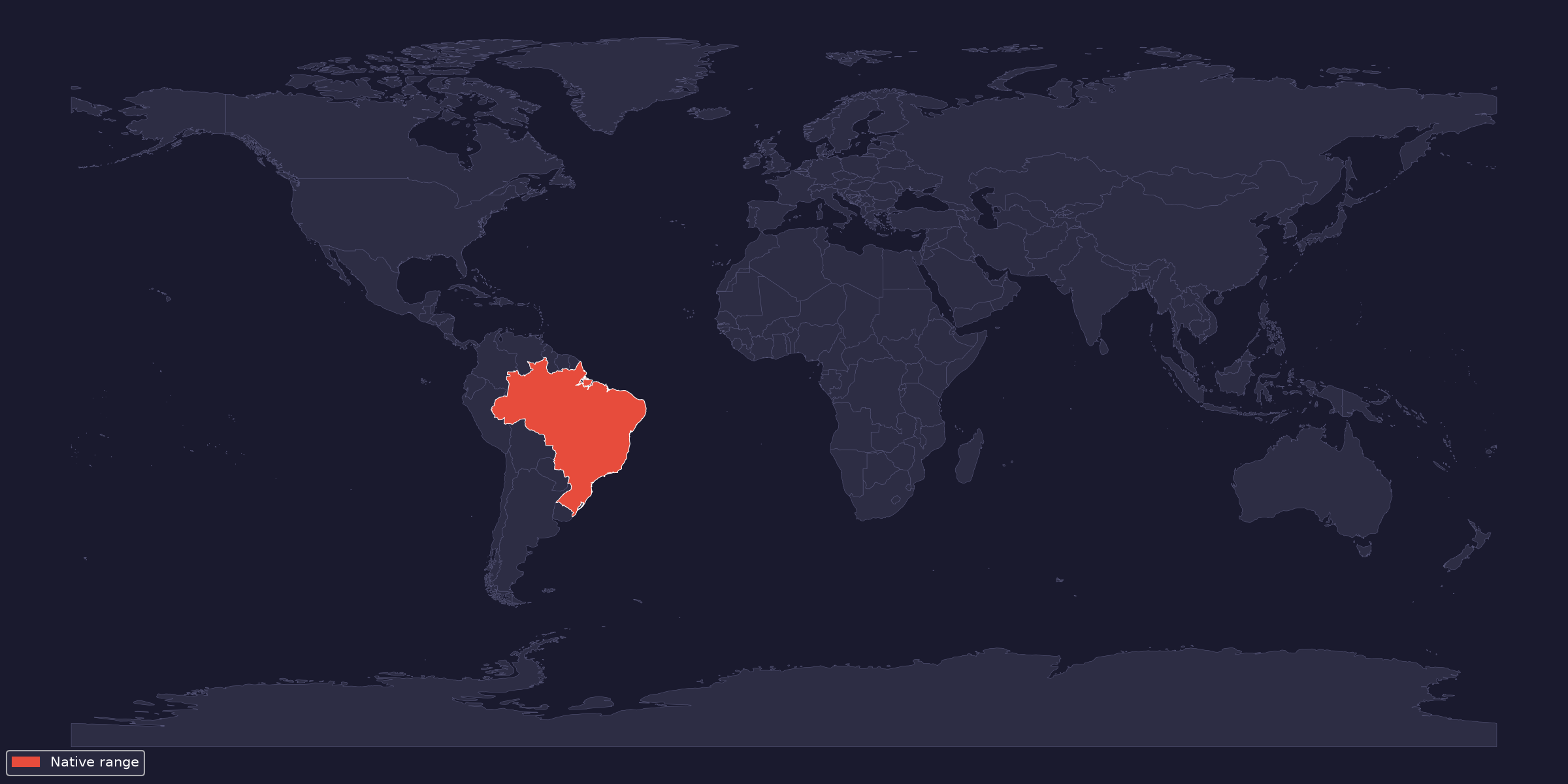
The entire natural range is Ilha da Queimada Grande, a small Atlantic island off the southern coast of São Paulo state, Brazil. Forest and shrub patches, open rocky ground and seasonal bird movements shape the species’ ecology. It does not occur on the Brazilian mainland.
A Brazil-level map exaggerates the range by many orders of magnitude and must not be read as distribution evidence. The reviewed GBIF preserved-specimen record from the island has approximately 1.36 km coordinate uncertainty but is traceable and lies at Queimada Grande. Its climate table represents the island cell, not coastal São Paulo generally.
🌡 Climate across the native range
Monthly normals from a traceable preserved-specimen record on Ilha da Queimada Grande:
Ilha da Queimada Grande — Brazil (traceable island specimen)
| Month | Min °C | Mean °C | Max °C | RH % |
|---|---|---|---|---|
| January | 22.3 | 25.9 | 29.6 | 79 |
| February | 22.4 | 26.1 | 29.8 | 79 |
| March | 21.8 | 25.4 | 29.1 | 79 |
| April | 19.7 | 23.4 | 27.1 | 80 |
| May | 17.3 | 21.3 | 25.3 | 79 |
| June | 15.6 | 19.9 | 24.3 | 76 |
| July | 14.9 | 19.2 | 23.6 | 76 |
| August | 15.9 | 20.1 | 24.3 | 76 |
| September | 17.3 | 21.1 | 24.8 | 77 |
| October | 18.6 | 22.3 | 26 | 79 |
| November | 20 | 23.6 | 27.2 | 77 |
| December | 21.3 | 24.9 | 28.5 | 78 |
Weather data by WorldClim v2.1, 1970–2000 · Monthly normals queried by Herpeton Academy from raster values; relative humidity is derived from vapor pressure and mean temperature.
Location references use GBIF.org occurrence data where available; original occurrence records retain their source dataset licenses.
⚖️ Legal status
No species-specific CITES or EU wildlife-trade annex entry was found for Bothrops insularis on 17 August 2026, and the Bern Convention is not relevant. This treaty non-listing does not create a private trade route.
Brazil lists the species as Critically Endangered and controls native-fauna collection, capture, captive maintenance, transport, research and transfer through competent federal and state authorities, including ICMBio/SISBio and IBAMA frameworks as applicable. Queimada Grande is a protected federal area; access and collection require authorisation. Only institutions with explicit written authority, lawful transfer records and a conservation purpose should hold the species. Preserve every permit, animal identifier, pedigree, medical record, photograph and transfer decision. Reject anonymous, privately offered or allegedly “captive-bred” animals without a complete authorised chain.
National and local rules in every origin, transit and destination jurisdiction may impose further dangerous-animal, ownership, registration, transport, breeding, sale, import and veterinary-health controls. Confirm them directly with each competent authority; they cannot weaken the Brazilian institutional-only restrictions or repair an unlawful origin.
🤌 Husbandry
These parameters are for authorised conservation institutions, not acquisition advice. House one snake in a controlled-access venomous room with secondary containment and a documented door protocol. Provide two positively lockable, elevated shift compartments connected by remotely operated gates. Shift, lock and visually confirm before any main door opens.
Quarantine an authorised transfer for at least 90 days with dedicated tools and separate airspace, while maintaining its genetic and identifier records. Track weight, meals, sheds, faeces, mouth, skin and respiration. Coordinate parasite or pathogen screening with the conservation programme so treatment and sampling do not compromise welfare or biosecurity.
Do not cohabit outside a managed reproductive event. Semi-arboreal posture creates strike lines above floor level; all water, feeding and waste service must be possible behind a closed barrier.
💡 Lighting
Provide 10-13 hours of broad visible light with a gradual seasonal cycle and complete darkness at night. Create leaf-filtered illumination, deep shade and secure elevated and ground retreats. Mount lamps outside primary containment or behind locked mesh guards.
Low-output UVB may be offered as a Ferguson Zone 1 opportunity. Measure at upper perches and preserve full shade at every level. Lighting must support observation without turning branches into exposed service hazards.
🌡 Heating and temperature
Maintain ambient air at 22-27°C, a local basking surface at 29-31°C, a cool retreat at 20-23°C and nights around 18-22°C. Thermostat and guard every source, measure temperatures at ground and perch height and alarm high values.
Queimada Grande is subtropical, maritime and seasonal. Preserve modest seasonal night and photoperiod changes, but do not copy exposed weather or force prolonged chilling. Reproductive cycling is set by the conservation programme and individual health, not by an automatic calendar.
💧 Humidity and water
Maintain 70-90% humidity with strong cross-ventilation, dryable branches and several moisture levels. Rain and maritime humidity do not mean continuously wet skin or substrate. Use drainage and allow exposed surfaces to dry while retreats retain humidity.
Provide a stable clean bowl through a protected port. Monitor weight, urates, drinking and shed quality. Persistent dehydration or oedema warrants measured environmental review and veterinary assessment, not indiscriminate spraying.
🌿 Enclosure and decoration
An adult needs at least 150 x 75 x 120 cm, with more usable height and floor area where the shift design permits. Install two elevated lockable shifts, anchored diagonal branches, sheltered ground cover, visual barriers and clear sight lines for positive location.
Use 6-8 cm of organic soil and leaf litter over drainage, with paper during quarantine when compatible with programme biosecurity. All branches and plants must be removable from outside or after a confirmed shift. Avoid unstable perches, abrasive mesh, hidden voids and dense décor that defeats visual counts.
🐁 Feeding
Wild adults specialise heavily on migratory and resident birds, while young also take ectothermic prey and invertebrates. An authorised ex situ programme should use its established nutritional protocol, potentially combining appropriately sized frozen-thawed rodents and avian whole prey. Diet is a conservation and veterinary decision, not a reason to acquire wild birds.
Feed every 10-21 days according to mass and condition through a protected port. Use lawful, quarantined or frozen disease-screened prey. Never offer live birds or rodents. Retrieve refusals only after a confirmed shift; balanced whole prey needs no routine powder supplement.
🛡 Operational safety and emergencies
Never free-handle, pin, neck or manually restrain this snake in routine work. Use lockable shifts, protected ports, hooks, shields and species-appropriate tubes under an institutional protocol. Two trained adults attend all primary openings. Veterinary procedures require planned anaesthesia, identification control and a professional containment team.
Before any transfer, the receiving hospital or poison centre must review the exact species and Brazilian origin. Experimental work shows cross-neutralisation by Brazilian polyspecific Bothrops antivenom, but this does not substitute for a clinician-approved product and protocol. Plan for coagulation, renal, shock and tissue monitoring; antivenom belongs in hospital care.
After a bite, move away, call emergency services, remove constricting items, keep still and support the limb neutrally. Do not use a tourniquet or tight pressure bandage, cut, suck, ice, shock or massage. Do not delay transport for identification or capture.
Maintain an escape plan integrated with conservation authorities: isolate the room, exclude the public, reconcile animal identifiers, search defined zones and use secure labelled containers. Immediately notify the programme’s responsible officers when an animal is missing or injured.
🥚 Breeding notes
B. insularis is viviparous. Authorised programmes report small litters; 2-10 neonates is a prudent capacity range. A monitored female collected while reproductively active gave birth to five young after about eight months in captivity, illustrating that estimated gestation depends on when ovulation occurred.
Pairing is a genetic-management decision. Use pedigree and kinship data, veterinary reproductive monitoring and barrier-controlled introductions. Prepare individual neonate-proof shifts, identifiers and authorised placements in advance. Breeding without programme approval can harm genetic management and is not conservation.
🩺 Common problems
- Obesity: island feeding ecology does not justify frequent rich captive meals; use weights and condition scores.
- Dehydration or dysecdysis: review clean water, humid retreats, ventilation and thermal layers.
- Respiratory disease: bubbles, wheeze, open-mouth breathing or head elevation require urgent veterinary assessment.
- Dermatitis: investigate constantly wet surfaces, poor airflow, mites and perch abrasion.
- Reproductive disease: abnormal follicles, prolonged gestation or undeveloped ova require imaging and specialist care.
- Burns and overheating: prevent with guarded thermostatic sources, vertical measurements and alarms.
- Regurgitation: evaluate prey, temperature, disturbance, infection and parasites.
Secure the animal behind a shift and use the programme’s veterinary and biosecurity team. Never attempt informal hands-on treatment.
📌 Conclusion
Bothrops insularis is not a prestige pet. It belongs in authorised Brazilian-linked conservation programmes able to prove every animal’s origin, manage genetics, reproduce the island’s seasonal semi-arboreal choices, work entirely behind locks and maintain a clinician-approved Bothrops emergency pathway.
📚 Sources and further reading
- ReptiFiles — checked first on 17 August 2026; no species-specific care guide was found.
- The Reptile Database: Bothrops insularis
- GBIF species record: Bothrops insularis
- Abrahão et al. — extinction risk and population estimate
- Duarte et al. — biological survey of Bothrops insularis
- Bovo et al. — thermoregulation on Queimada Grande
- Garcia et al. — gestation in ex situ conservation programmes
- Instituto Butantan — authorised ex situ conservation programme
- ICMBio — threatened-herpetofauna conservation planning
- IBAMA — SISBio authorisation rules
- de Oliveira et al. — B. insularis venom and antivenom neutralisation
- WHO guidelines for snakebite management
- Baines et al. — UV lighting guidance
- CITES Appendices
- EU wildlife-trade annexes, Commission Regulation (EU) 2026/1383
- Bern Convention appendices