Share

Common Lancehead
🔤 Taxonomy
Bothrops atrox is the accepted common lancehead. Older combinations include Coluber atrox, Lachesis atrox and Trimeresurus atrox. The trade name “fer-de-lance” is imprecise and is also applied to other lanceheads.
Bothrops asper is a separate species, principally west of the Andes and through Central America; B. atrox is primarily Amazonian and east of the Andes. Species limits within the wider atrox group remain imperfectly resolved. Some Venezuelan populations have been called B. colombiensis or B. isabelae, but current treatments differ. Preserve exact locality and do not expand a specimen’s identity from appearance alone.
📌 Description
Adults are commonly 100-150 cm, with large females approaching 180 cm. The triangular markings and postocular stripe provide camouflage among leaves, but overlap with related species. Juveniles may climb and use a contrasting tail tip; heavy adults are mainly terrestrial yet remain capable climbers.
Envenomation produces rapidly progressive pain and swelling, local bleeding, blistering and tissue injury, together with venom-induced consumption coagulopathy and systemic haemorrhage. Shock and acute kidney injury can follow. This is an expert-only institutional species requiring protected contact and a regionally competent hospital.
📋 Quick reference
| Care point | Practical target |
|---|---|
| Adult size and lifespan | Usually 100-150 cm, up to about 180 cm; approximately 15-20 years |
| Adult enclosure | At least 180 x 90 x 90 cm with two lockable shift compartments |
| Temperature | Ambient 24-28°C; basking 30-32°C; cool hide 22-24°C |
| Night | 22-25°C |
| Humidity | 70-90% with strong airflow and a dryable surface |
| Feeding | Frozen-thawed rodents every 10-21 days according to condition |
| Safety | Protected contact, two-person rule, bleeding/tissue-injury plan |
| Quarantine | At least 90 days with dedicated tools and parasite screening |
☠️ Venom
This species is venomous. Venom exposure can cause pain, swelling or other systemic effects, and severity varies with species, locality, bite site and the amount delivered. A small wound or apparently dry bite is not proof of safety; every bite or sting requires urgent medical assessment.
If an incident occurs, move away, call emergency services or a poison centre, keep the patient still, remove rings and other constricting items, and follow dispatcher instructions. Do not use a tourniquet, cut or suck the wound, apply ice or electricity, give alcohol or medicines as a home treatment, or attempt to catch the animal. Antivenom choice and dosing are hospital decisions; verify the relevant product and local availability in advance. Sources: WHO snakebite guidance and appropriate species-specific toxinology or medical references listed below.
🌍 Distribution
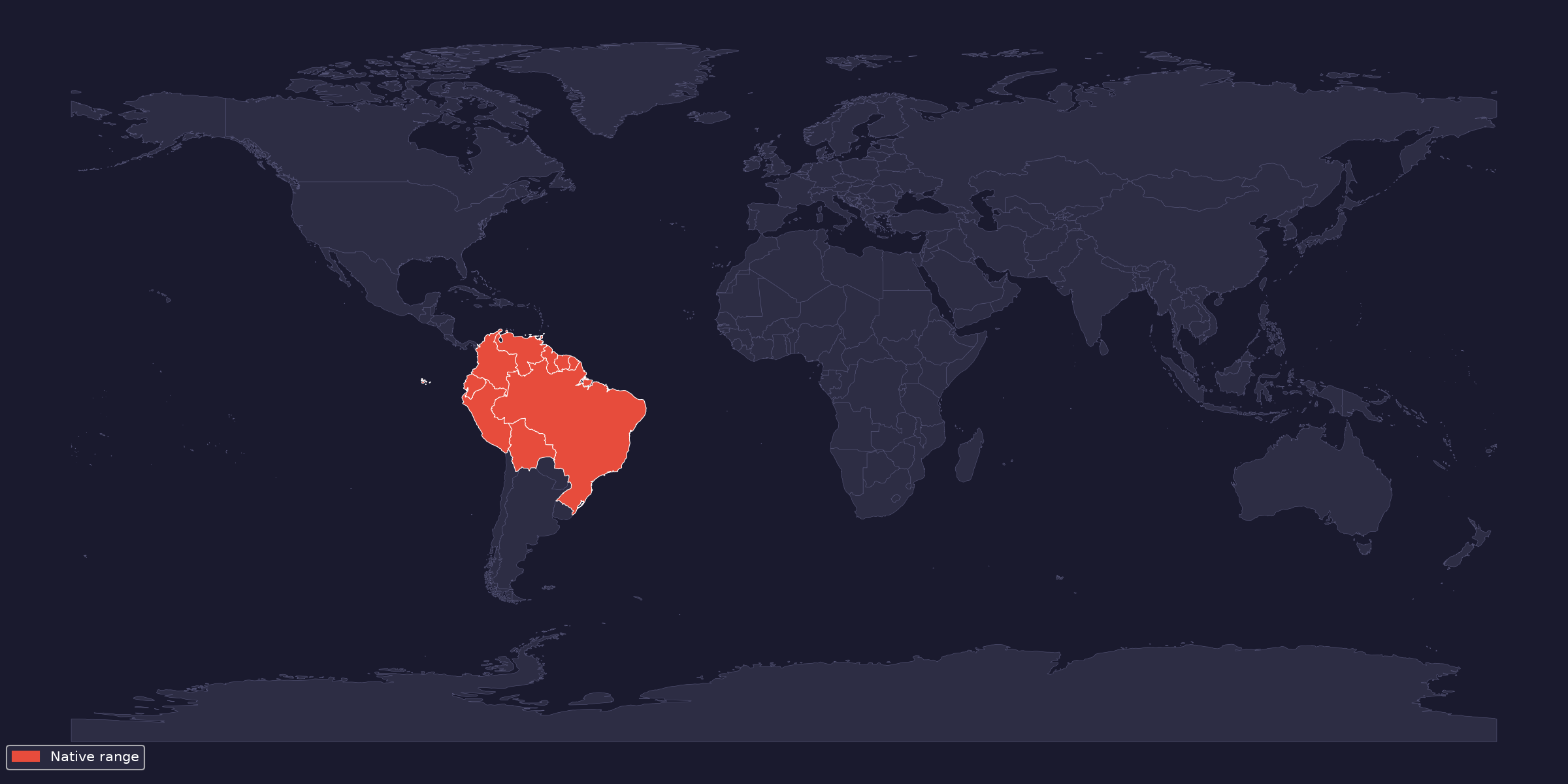
The current broad concept occurs across Amazonian and Guianan South America: Brazil, the Guianas, southern and eastern Venezuela, eastern Colombia and Ecuador, northeastern and eastern Peru, northern Bolivia and Trinidad. It occupies lowland rainforest, river margins, seasonally flooded forest, plantations and disturbed clearings.
Country shading cannot show the east-of-Andes pattern, unsuitable highlands, debated Venezuelan populations or local contact with related lanceheads. Natural Earth can shade French Guiana separately, but its small polygon and internal range gaps remain invisible at world-map scale. The reviewed Amazonas GBIF occurrence near Manaus provides one lowland Brazilian climate reference, not the limits for every provenance.
🌡 Climate across the native range
Monthly normals from a reviewed lowland occurrence in central Amazonia:
Amazonas near Manaus — Brazil (reviewed lowland occurrence)
| Month | Min °C | Mean °C | Max °C | RH % |
|---|---|---|---|---|
| January | 22.7 | 26.4 | 30 | 84 |
| February | 22.6 | 26.3 | 29.9 | 85 |
| March | 22.7 | 26.4 | 30 | 85 |
| April | 22.9 | 26.4 | 30 | 86 |
| May | 22.8 | 26.6 | 30.3 | 86 |
| June | 22.6 | 26.6 | 30.6 | 83 |
| July | 22.3 | 26.6 | 31 | 81 |
| August | 22.6 | 27.3 | 31.9 | 79 |
| September | 22.9 | 27.6 | 32.3 | 78 |
| October | 23.2 | 27.7 | 32.3 | 78 |
| November | 23.2 | 27.5 | 31.8 | 79 |
| December | 23 | 27 | 31 | 81 |
Weather data by WorldClim v2.1, 1970–2000 · Monthly normals queried by Herpeton Academy from raster values; relative humidity is derived from vapor pressure and mean temperature.
Location references use GBIF.org occurrence data where available; original occurrence records retain their source dataset licenses.
⚖️ Legal status
No species-specific entry for Bothrops atrox was found in the CITES Appendices, EU wildlife-trade annexes or Bern Convention appendices on 17 August 2026. That absence does not authorise collection or movement.
Amazonian range states may regulate native-wildlife collection, export, possession and research, while destination states often license dangerous snakes. Ownership, registration, transport, breeding, sale, import and veterinary-health rules must all be checked in writing. Retain permits, lawful-origin documents, invoice, breeder, locality, photographs, parentage and the check date; vague B. asper/atrox paperwork is insufficient.
🤌 Husbandry
House one snake in a controlled-access venomous room with secondary containment, sealed penetrations and a written door protocol. The enclosure needs two positively lockable shift compartments. Confirm the snake behind a locked barrier before opening any service door; camouflage makes a visual count essential.
Quarantine for at least 90 days on paper with removable furnishings, dedicated tools and preferably separate airspace. Record weight, meals, sheds, faeces, skin, mouth and respiration. Wild-origin animals need veterinary assessment for dehydration, mites, internal parasites, stomatitis and respiratory disease.
Never free-handle or cohabit for display. A stationary coil can strike rapidly and juveniles may climb above the expected working line. Design water, waste and feeding service through protected ports or after a verified shift.
💡 Lighting
Provide 11-13 hours of diffuse visible light and full night darkness. Use gradual seasonal changes rather than abrupt cycling. Dense low shade and both shift hides must remain available, and all electrical equipment belongs beyond the primary containment boundary.
Low-output UVB can be offered as a Ferguson Zone 1 opportunity. Measure at the highest accessible perch and preserve full shade. UVB does not justify reducing cover or entering the enclosure.
🌡 Heating and temperature
Maintain ambient air at 24-28°C, a basking surface at 30-32°C, a cool hide at 22-24°C and nights at 22-25°C. Thermostat and guard all heat sources, measure surfaces and air separately and alarm high values.
Amazonian field temperatures do not support a uniformly hot box. The animal must choose among warm, cool, drier and more humid refuges. Use only modest seasonal variation matched to locality; do not brumate this tropical species.
💧 Humidity and water
Maintain 70-90% relative humidity with vigorous air exchange and surfaces that can dry. Provide one consistently humid retreat, but avoid stagnant wet substrate. High outdoor humidity is compatible with ventilation; it is not a reason to keep the floor swampy.
Offer a heavy clean water bowl through a protected port and replace it promptly after fouling. Use drainage beneath planted or naturalistic sections. Track hydration, urates, weight and shed quality, and correct persistent problems with environmental measurements and veterinary assessment.
🌿 Enclosure and decoration
An adult requires at least 180 x 90 x 90 cm, with more floor area for large females. Provide two lockable shift boxes, anchored cork, low sturdy branches for juveniles, visual barriers and a clear inspection lane. Fit independent two-step locks and juvenile-proof every vent and track.
Use 8-12 cm of compactable organic soil with leaf litter over drainage, keeping one portion less moist. Paper is safer in quarantine. Avoid unstable logs, sharp mesh, aromatic chips and deep clutter that conceals the snake or requires hand entry.
🐁 Feeding
Wild prey includes rodents, frogs, lizards, birds and other small vertebrates, with juveniles taking more ectothermic prey. Established adults usually accept appropriately sized frozen-thawed rodents every 10-21 days. Use weight and body condition rather than strike intensity to set frequency.
Feed through a protected port with long tongs and shift before recovering refusals. Live rodents create avoidable injury and retrieval risks. Balanced whole prey requires no routine supplements.
🛡 Operational safety and emergencies
Never free-handle, pin, neck or manually restrain this snake during routine work. Use lockable shifts, protected ports, hooks, transparent shields and appropriately selected tubes under a written protocol. Two trained adults attend every primary opening; veterinary procedures require a preplanned professional anaesthesia and containment team.
Before acquisition, consult the receiving hospital or poison centre using the exact taxon and locality. Antivenom selection and dose are regional clinical decisions; a product for a different Bothrops or another country must not be presumed suitable. The plan must cover serial coagulation, renal monitoring, tissue assessment and shock treatment.
A bite is an immediate emergency. Move away, call emergency services, remove rings and other constricting items, keep still and support the limb neutrally. Do not apply a tourniquet or tight pressure bandage, cut, suck, ice, shock or massage. Do not delay transport to capture the snake.
Maintain a written escape plan with room isolation, public exclusion, accountability, search zones and secure containers. Stop work whenever the animal cannot be positively located.
🥚 Breeding notes
Bothrops atrox is viviparous and can produce litters ranging from several to several dozen young; 5-40 is a practical planning span. Reproductive timing varies across the equatorial range. Facultative parthenogenesis has been genetically confirmed, so an isolated female can still produce young after years without a male.
Breeding belongs in a lawful programme with recorded locality and placements. Use barrier-controlled introductions, continuous observation and a separate shift for each adult. Prepare individual, escape-proof neonate enclosures before parturition; newborns are fully venomous.
🩺 Common problems
- Obesity: common in sedentary adults; use measured prey and condition records.
- Dehydration or dysecdysis: review clean water, humid retreat, ventilation and temperatures.
- Respiratory disease: bubbles, wheeze, open-mouth breathing or head elevation require urgent veterinary care.
- Dermatitis: investigate persistently wet dirty substrate, mites and abrasion.
- Parasites and stomatitis: weight loss, abnormal faeces or oral swelling are important in imports.
- Burns and overheating: prevent with guarded thermostatic heat, alarms and a verified cool hide.
- Regurgitation: assess prey size, temperature, disturbance, infection and parasites.
Do not improvise hands-on treatment. Secure the animal behind a shift door and use an experienced reptile veterinary team.
📌 Conclusion
Bothrops atrox is appropriate only for licensed facilities able to document east-of-Andes provenance, distinguish it from B. asper and debated atrox-complex names, maintain humid but ventilated protected-contact housing and secure a regionally valid bleeding and tissue-injury plan.
📚 Sources and further reading
- ReptiFiles — checked first on 17 August 2026; no species-specific care guide was found.
- The Reptile Database: Bothrops atrox
- GBIF species record: Bothrops atrox
- Monteiro et al. — taxonomy, venom and clinical importance of B. atrox
- Calvete et al. — B. colombiensis and the unresolved atrox-asper complex
- Colombian National Health Institute — B. asper/atrox distribution and identification
- Silva et al. — reproductive cycle of B. atrox
- Cubides-Cubillos et al. — facultative parthenogenesis in the atrox group
- WHO guidelines for snakebite management
- Baines et al. — UV lighting guidance
- Northern Ireland government venomous-reptile guidance
- CITES Appendices
- EU wildlife-trade annexes, Commission Regulation (EU) 2026/1383
- Bern Convention appendices