Share

Terciopelo
🔤 Taxonomy
This guide applies Bothrops asper to the terciopelo, also called fer-de-lance. It is not the Amazonian common lancehead Bothrops atrox. Older sources and regional checklists disagree at the northern South American margin, and some treatments recognize B. colombiensis for populations otherwise assigned to northern B. asper. Provenance and current local taxonomy must accompany any captive animal.
📌 Description
The terciopelo is a large, muscular, mostly nocturnal pit viper with heat-sensing pits, hinged front fangs, strong camouflage, and medically important venom causing severe local tissue injury, bleeding and coagulation disturbance, shock, and systemic complications. Females are much larger than males. Adults commonly reach 120-180 cm; exceptional females may approach 250 cm.
It is fast, alert, and capable of long strikes and rapid direction changes. Juveniles climb readily and use caudal luring; large adults are mainly terrestrial. Captive records support a possible 15-21 year life, so the enclosure, staff capability, and emergency plan must be sustainable for decades.
📋 Quick reference
| Care point | Practical target |
|---|---|
| Adult enclosure | At least 200 x 100 x 100 cm for a typical adult female, with two shift options |
| Day temperatures | 24-28°C ambient; 29-31°C limited warm surface; 22-24°C cool hide |
| Night temperatures | 21-24°C |
| Humidity | 65-85%, with moist retreat, dry surface choices, and strong ventilation |
| Lighting | 11-13 hours; optional measured low-level UVB with shade |
| Feeding | Moderate frozen-thawed rodents; adults usually every 14-21 days |
| Housing | Solitary |
| Safety | Medically significant venom, speed, and reach; protected contact only |
☠️ Venom
This species is venomous. Venom exposure can cause pain, swelling or other systemic effects, and severity varies with species, locality, bite site and the amount delivered. A small wound or apparently dry bite is not proof of safety; every bite or sting requires urgent medical assessment.
If an incident occurs, move away, call emergency services or a poison centre, keep the patient still, remove rings and other constricting items, and follow dispatcher instructions. Do not use a tourniquet, cut or suck the wound, apply ice or electricity, give alcohol or medicines as a home treatment, or attempt to catch the animal. Antivenom choice and dosing are hospital decisions; verify the relevant product and local availability in advance. Sources: WHO snakebite guidance and appropriate species-specific toxinology or medical references listed below.
🌍 Distribution
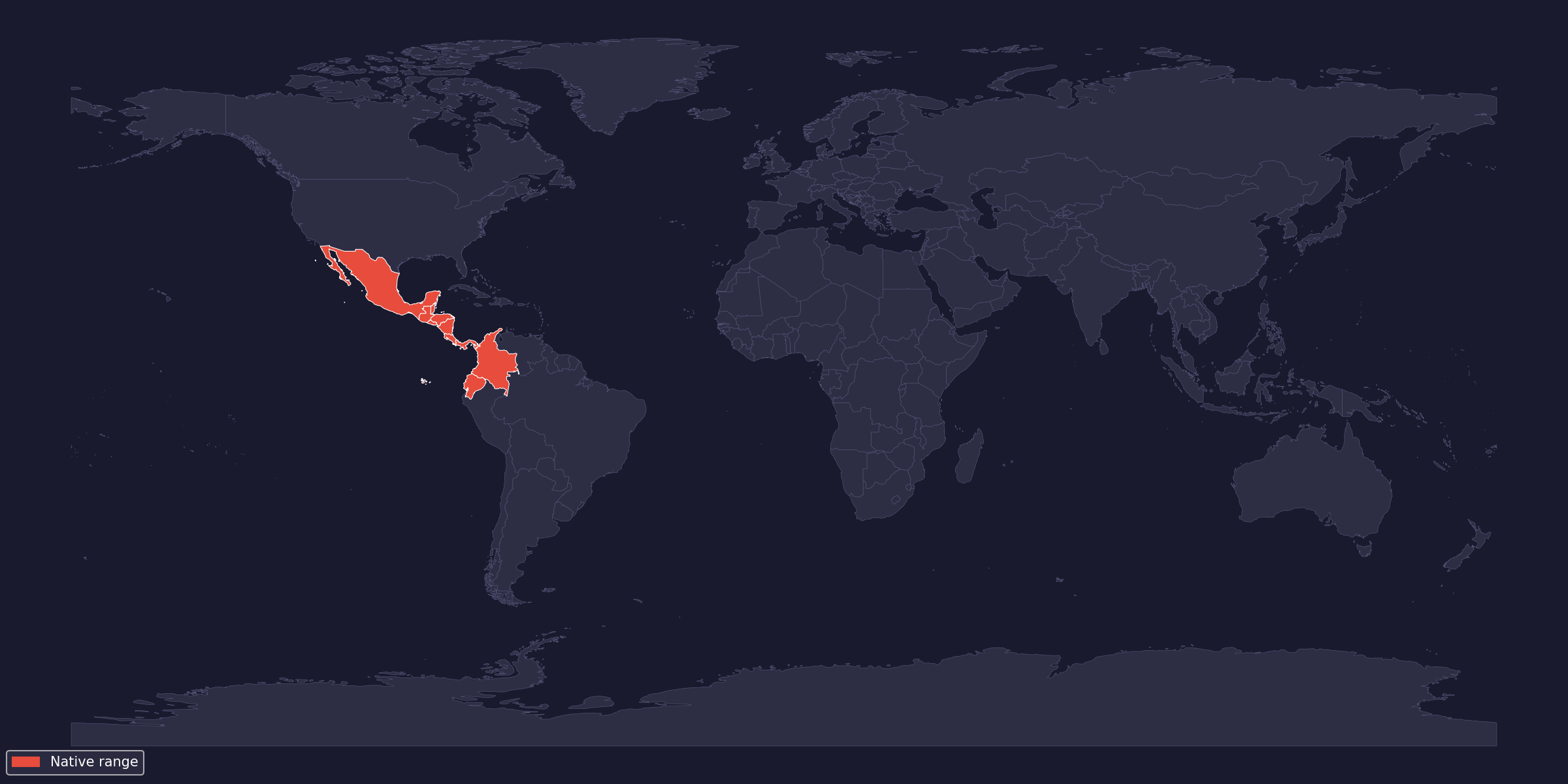
Strict-sense B. asper occurs from eastern and southern Mexico through Belize, Guatemala, Honduras, El Salvador, Nicaragua, Costa Rica, and Panama, then into western/northern Colombia and the Pacific lowlands of Ecuador. It occupies humid lowland forest, premontane forest, forest edge, plantations, river corridors, and altered rural landscapes. It can occur in seasonally drier areas where cover and moisture remain available.
Do not extend this range uncritically into the Amazon basin, where B. atrox is the relevant widespread species. Northern South American assignments remain disputed in some literature, including the use of B. colombiensis for certain Colombian and Venezuelan populations. This guide does not present Venezuela as unambiguous strict-sense B. asper. The country-level map includes Pacific Colombia and Ecuador and should be read with these taxonomic and within-country limits.
🌡 Climate across the native range
Monthly climate normals from a verified Caribbean-slope occurrence in Costa Rica:
Limón — Costa Rica (verified occurrence)
| Month | Min °C | Mean °C | Max °C | RH % |
|---|---|---|---|---|
| January | 17.5 | 20.3 | 24 | 88 |
| February | 17.4 | 20.6 | 24.6 | 86 |
| March | 17.8 | 21.2 | 25.3 | 86 |
| April | 18.8 | 22.1 | 26.2 | 86 |
| May | 19.9 | 22.5 | 25.9 | 91 |
| June | 20 | 22.4 | 25.7 | 92 |
| July | 19.6 | 22 | 25.3 | 92 |
| August | 19.6 | 22.2 | 25.7 | 91 |
| September | 19.6 | 22.3 | 25.9 | 91 |
| October | 19.6 | 22.1 | 25.5 | 92 |
| November | 19.2 | 21.4 | 24.4 | 92 |
| December | 18.3 | 20.7 | 24 | 91 |
Weather data by Open-Meteo.com · CC BY 4.0 · Monthly normals calculated by Herpeton Academy from daily archive values.
Location references use GBIF.org occurrence data where available; original occurrence records retain their source dataset licenses.
⚖️ Legal status
As checked on 16 August 2026, Bothrops asper is not listed in CITES Appendices I-III and no species-specific entry was found in EU wildlife-trade Annexes A-D. The Bern Convention is not relevant because the species is not native to Europe.
National dangerous-animal rules may require licensing, inspection, insurance, transport approval, double containment, a hospital-linked bite plan, or prohibit possession. Verify the accepted name and any older or regional name with the authority. Keep invoices, breeder and exact provenance records, import/transfer papers, photographs, and legal-check dates.
🤌 Husbandry
Complete and test the protected-contact system before arrival: locked primary enclosure, secure secondary room, hazard labels, dedicated tools, and two external-closing shift positions. House singly. The system, not an assumed temperament, must control risk during every water change, cleaning, feeding, and inspection.
Quarantine for at least 90 days on paper with simple hides and separate tools and airspace where practical. Record weight, prey, sheds, faeces, skin, oral condition, and respiration. Imports or poorly documented animals need reptile-veterinary examination, faecal testing, and mite surveillance.
💡 Lighting
Provide 11-13 hours of bright visible light with dense shade. Low-output UVB can cover part of the enclosure within Ferguson Zone 1, but is not a substitute for whole prey or a reason to expose the snake. Guard or externalize lamps, cables, and probes.
Night is dark. If the room is too cool, use a lightless thermostatic source. Seasonal day length can follow provenance, but abrupt cycling is unnecessary for routine welfare.
🌡 Heating and temperature
Maintain 24-28°C ambient air, a restricted 29-31°C warm surface, a 22-24°C cool hide, and 21-24°C nights. Colombian serpentarium observations fall close to the mid-20s Celsius and illustrate why this tropical snake should not be kept continuously hot.
Measure at floor level, inside hides, and at both shift positions. Thermostat every heater and secure probes. The large body must fit entirely within warm and cool options; a small hot spot under only one coil is not a complete gradient.
💧 Humidity and water
Use a 65-85% range, with a humid retreat and short rises to 80-90% during shedding. Keep lower substrate lightly moist while offering dry surface choices. Strong cross-ventilation, drainage, and prompt removal of contaminated material prevent dermatitis and respiratory disease.
Provide a large, stable bowl of clean water positioned for protected-access changing. Constant soaking, fouling, or unusually frequent drinking can signal heat, mites, dehydration, or illness and deserves investigation.
🌿 Enclosure and decoration
Provide at least 200 x 100 x 100 cm for a typical adult female and increase it for an exceptionally large animal. Use 8-12 cm of drainage-aware forest soil/coco/leaf-litter substrate, snug hides at both thermal ends, low fixed shelves or broad branches, visual barriers, and clear shift routes. Juveniles need secure climbing opportunities without creating inaccessible overhead corners.
Use keyed or tool-operated locks, secured vents, guarded heat, blocked cable gaps, and a secure room. Furnishings must permit a complete visual check before any barrier opens. Avoid unstable rock, sharp decor, aromatic wood, and clutter that prevents safe shifting.
🐁 Feeding
Wild diet changes from frogs, lizards, and small prey in juveniles to rodents and other mammals in adults. Captive animals can be maintained on appropriately sized frozen-thawed rodents. Offer moderate prey no wider than the snake’s broadest section; large females can gain excessive weight rapidly.
Juveniles commonly eat every 7-10 days; adults every 14-21 days, longer for inactive or heavy individuals. Whole prey needs no supplementation. Avoid routine live prey, record prey mass and body weight, and investigate repeated refusals rather than escalating prey size or using unsafe force-feeding.
🥚 Breeding
The species is viviparous. Gestation varies geographically and is commonly reported around 6-8 months. Litter size rises with female size and ranges roughly from 5 to 86; Colombian captive records report 5-42. Every neonate is venomous and needs individual secure housing and a lawful destination.
Breeding and maternal servicing are institutional operations. Confirm locality and sex, prepare separation, dozens of containers, food, records, and recipients before pairing. Do not breed an animal whose identity is obscured by the asper/atrox/colombiensis boundary.
🛡️ Handling and emergency planning
Treat every individual as display-only. Do not free-handle, tail, pin, neck, or manually restrain it. Use external-closing shifts, appropriate hooks and barriers, and two trained adults for open-primary-barrier work. This guide does not provide procedural restraint instruction.
Before acquisition, coordinate a written plan with emergency services, a poison centre or toxicologist, and a receiving hospital. Include exact provenance and taxonomic uncertainty, clinical risks, address, contacts, and route. Antivenom selection, supply, dosing, and management of local tissue injury are clinical decisions.
Any bite requires immediate emergency assessment. Keep the person still, immobilize the limb, remove rings and tight objects, and call emergency services. Do not cut, suck, ice, use electricity or chemicals, apply an arterial tourniquet, or wait for swelling, bleeding, or collapse.
🩺 Common problems
- Overheating and dehydration: restless exposed movement, repeated soaking, or poor shed may indicate a lost cool retreat or water problem.
- Respiratory disease: bubbles, wheeze, gaping, or abnormal head elevation requires prompt veterinary assessment.
- Dermatitis and dysecdysis: correct wet dirty substrate, low ventilation, hydration, and heat; do not peel the snake.
- Obesity and regurgitation: control prey mass and interval, verify heat, and avoid disturbance after meals.
- Parasites: imports require quarantine, faecal testing, and mite monitoring.
- Rostral injury and escape attempts: review cover, temperature, door exposure, and enclosure geometry.
- Unsafe routine: inability to shift this fast snake is an enclosure failure, not a cue to attempt manual control.
📌 Conclusion
The terciopelo combines large adult size, speed, reach, medically severe venom, and potentially enormous litters. It belongs only in a legally authorized expert facility with spacious redundant containment, protected-contact skills, restrained feeding, verified provenance, and a hospital-coordinated bite plan.
📚 Sources and further reading
- ReptiFiles was searched; no species-specific care guide was located: https://reptifiles.com/
- The Reptile Database, Bothrops asper: https://reptile-database.reptarium.cz/Bothrops/asper
- GBIF: https://www.gbif.org/species/5220796
- Instituto Nacional de Salud Colombia, species sheet: https://serpientes.ins.gov.co/FichasEN/01B%20asper_ENG_Final.pdf
- INS Colombia, lessons from venomous snakes in captivity: https://serpientes.ins.gov.co/en/Paginas/8.aspx
- Animal Diversity Web: https://animaldiversity.org/accounts/Bothrops_asper/
- Reproductive biology in Costa Rica: https://eurekamag.com/research/007/747/007747128.php
- Reproduction in Honduras: https://www.kerwa.ucr.ac.cr/items/493f3271-c3f2-4aa6-800b-1895824020e7/full
- WHO Americas snakebite resources: https://www.paho.org/en/topics/snakebites
- Baines et al., UV-Tool: https://doi.org/10.19227/jzar.v4i1.150
- CITES: https://cites.org/eng/app/appendices.php and https://checklist.cites.org/
- Commission Regulation (EU) 2026/1383: https://eur-lex.europa.eu/eli/reg/2026/1383/oj/eng
- Bern Convention: https://www.coe.int/en/web/bern-convention/appendices