Share

Urutu Lancehead
🔤 Taxonomy
Bothrops alternatus is the accepted name for the urutu or crossed pit viper. Rhinocerophis alternatus appears in influential papers and older collection records following a proposed genus split; current major databases again place the species in Bothrops. Keep both names on medical and provenance searches.
📌 Description
This is a large, heavy-bodied South American lancehead, commonly 100-150 cm and exceptionally close to 170 cm. Females are substantially larger than males. The bold, alternating kidney-shaped side markings explain several regional names, but pattern does not make an undocumented animal a reliable locality specimen.
The venom can cause severe swelling, tissue injury, bleeding and coagulation disturbance. The snake can strike rapidly from a compact coil and must never be free-handled. It is an expert-only display species for a purpose-built venomous facility; plan for roughly 15-20 years.
| Quick reference | Practical target |
|---|---|
| Adult size | Commonly 100-150 cm; large females may approach 170 cm |
| Adult enclosure | At least 150 x 75 x 60 cm; larger for a heavy female |
| Temperature | Air 22-27°C; warm area 29-31°C; cool retreat 19-23°C |
| Night | 17-22°C; avoid continuous tropical heat |
| Humidity | 60-75%, with a dry contact surface and strong ventilation |
| Feeding | Moderate frozen-thawed rodents every 14-21 days by condition |
| Safety | Double containment, lockable shift system, bite and escape plans |
☠️ Venom
This species is venomous. Venom exposure can cause pain, swelling or other systemic effects, and severity varies with species, locality, bite site and the amount delivered. A small wound or apparently dry bite is not proof of safety; every bite or sting requires urgent medical assessment.
If an incident occurs, move away, call emergency services or a poison centre, keep the patient still, remove rings and other constricting items, and follow dispatcher instructions. Do not use a tourniquet, cut or suck the wound, apply ice or electricity, give alcohol or medicines as a home treatment, or attempt to catch the animal. Antivenom choice and dosing are hospital decisions; verify the relevant product and local availability in advance. Sources: WHO snakebite guidance and appropriate species-specific toxinology or medical references listed below.
🌍 Distribution
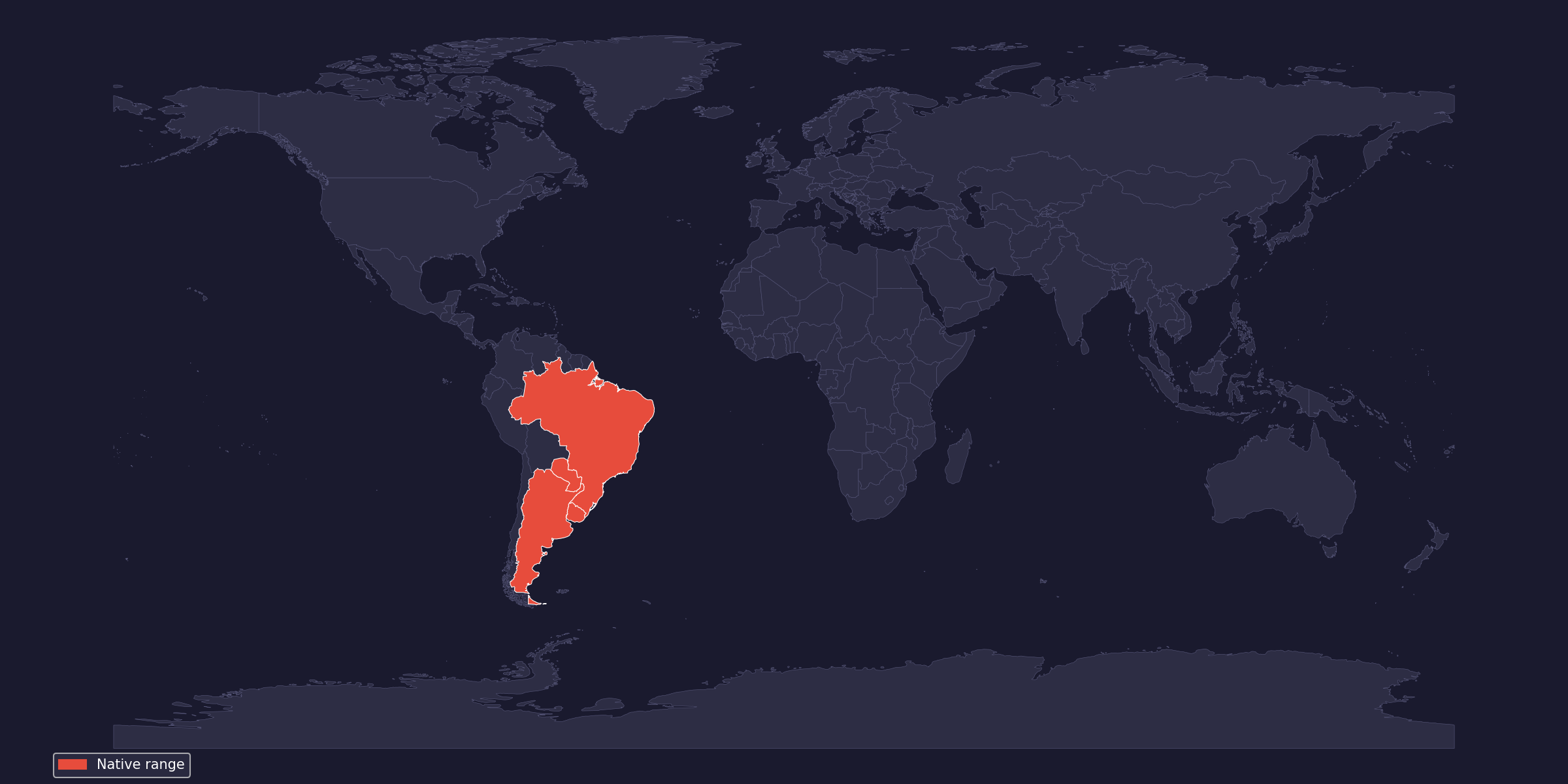
The native range covers southern and south-eastern Brazil, Paraguay, Uruguay and northern to central Argentina. The species uses subtropical grassland, marsh margins, gallery forest, agricultural mosaics and other comparatively humid open habitats. It is generally absent from the driest landscapes.
Northern Brazilian and subtropical Argentine localities do not have identical seasonal cycles. Keep exact origin with every animal; it informs temperature, photoperiod and any breeding-related cooling better than a generic country average.
⚖️ Legal status
Checked on 29 August 2026: Bothrops alternatus is not listed in the current CITES Appendices or Annexes A-D of Commission Regulation (EU) 2026/1383. The Bern Convention is not applicable to its native South American range.
Dangerous-animal and native-wildlife laws remain decisive. Ownership, breeding, transport, public display, collection and export may require different permits or may be prohibited. Before acquisition, obtain written confirmation from the competent authorities and keep the invoice, breeder/importer identity, legal-origin and export papers, locality, photographs and full transfer history.
🤌 Husbandry
Keep one snake per enclosure. Use a restricted, locked and escape-resistant room as secondary containment. The enclosure needs independent locks, protected vents and cable openings, and a lockable shift compartment that permits water changes and cleaning without hands entering occupied space. Large females require wide, unobstructed protected-transfer routes.
Quarantine every arrival for at least 90 days with separate tools and simple surfaces. Record weight, meals, sheds, faeces and respiration; imported or wild-origin animals require veterinary examination and parasite testing. Cohabitation makes counting, feeding and emergency control needlessly uncertain.
💡 Lighting
Provide 10-13 hours of visible daylight, adjusted gradually for a documented locality, and darkness at night. Low-output UVB in Ferguson Zone 1 may be offered over part of the enclosure with full shaded alternatives; whole prey remains the nutritional basis. All fittings must be guarded or external.
Dense cover should shade the snake without preventing a controlled visual count before opening a door.
🌡 Heating and temperature
Use general daytime air of 22-27°C, a localized warm surface of 29-31°C and a cool retreat of 19-23°C. Nights can fall to 17-22°C. Measure at the snake’s body level and control every heater with a thermostat. Continuous high heat can impair this subtropical species even when feeding remains strong.
A winter decline to about 14-18°C is only for a deliberate, locality-informed breeding programme with healthy established adults. It is not routine display care and must not be applied to juveniles, thin, sick, gravid or newly acquired animals.
💧 Humidity and water
Maintain approximately 60-75% RH with moving air and mostly dry resting surfaces. A humid hide at 70-85% helps during shedding, but saturated substrate and persistent condensation invite dermatitis and respiratory infection. Provide a stable bowl of clean water at all times.
Service the bowl only after positive confirmation that the snake is locked in the other compartment. Repeated poor sheds require a review of hydration, cover, temperature and health, not indiscriminate flooding.
🌿 Enclosure and decoration
One adult needs at least 150 x 75 x 60 cm, with more floor area for a large female. Use 6-10 cm of compactable soil, fine bark and leaf litter over drainage where needed. Provide two snug shift-capable hides, anchored low cork or logs, dense visual cover and clear routes for protected movement.
Avoid unstable stones, aromatic wood, wet mulch, deep loose material that clings to prey and décor that hides the snake during service. Paper is appropriate during quarantine. Secure every track and port against neonates and label the enclosure with species, individual identity, count, venom hazard and emergency contacts.
🐁 Feeding
Published gut-content work shows a strongly mammal-based diet, especially rodents and small marsupials. Feed appropriately sized frozen-thawed rodents; established adults usually need a moderate meal every 14-21 days. Large Bothrops become obese easily, so use weight and body condition rather than willingness to strike food.
Present prey with long tongs after the snake is positioned safely. Do not hand-feed, leave live rodents unattended or retrieve refused prey from beside an unsecured animal. Whole prey requires no routine vitamin or mineral dusting.
🛡 Operational safety and emergencies
Routine work must be contact-free through a shift system. Any essential opening of primary containment needs a second trained operator, barriers, appropriate hooks and a written door sequence. Veterinary restraint must be planned with a professional team; it is not an improvised keeper procedure.
Before the animal arrives, agree a written bite response with the receiving hospital or poison centre, confirm the route and emergency contacts, and maintain a current species and venom information sheet. Regional antivenoms and clinical protocols are not interchangeable; administration belongs in hospital.
Treat every bite as an immediate medical emergency. Call emergency services, keep the patient still, remove constricting items, immobilize the limb and follow poison-centre instructions. Do not cut, suck, ice, shock or tightly tourniquet the bite and do not delay transport to capture the snake.
🥚 Breeding notes
The species is viviparous. A detailed subtropical Brazilian study recorded litters of 5-20 young, averaging 12, and showed a seasonal reproductive cycle with long-term sperm storage. No eggs are incubated by the keeper. Pairing and birth require separate secured compartments and a neonate-counting plan before introduction.
🩺 Common problems
Obesity is common when a heavy-bodied ambush predator is fed on response alone. Regurgitation can follow oversized meals, low digestive temperatures or disturbance. Retained shed and dehydration show as dull skin, retained spectacles, sunken eyes or hard urates. Damp, dirty substrate promotes scale rot; wheezing, mucus and open-mouth breathing require urgent veterinary assessment.
For any illness, first secure the animal and document temperatures, weight and recent events. Arrange a protected, pre-planned examination with a reptile veterinarian experienced in venomous species.
📌 Conclusion
The urutu requires generous floor space, subtropical thermal relief and disciplined protected contact. It belongs only with a legally authorized team whose containment and hospital plan are ready before the snake enters the building.
📚 Sources and further reading
- The Reptile Database — Bothrops alternatus
- Nunes et al. (2010), reproductive and feeding biology
- GBIF species record
- WHO snakebite-envenoming resources
- CITES Appendices
- Commission Regulation (EU) 2026/1383