Share

Side-striped Palm Pit Viper
🔤 Taxonomy
Bothriechis lateralis is the accepted name for the side-striped palm pit viper. Older literature may list Bothrops lateralis or Lachesis lateralis. No subspecies are currently recognized, but exact locality remains important because the species spans separated Costa Rican and western Panamanian mountain systems.
📌 Description
This slender, prehensile-tailed pit viper is usually 60-80 cm; large adults can exceed 100 cm. Adults are green to blue-green with a pale yellow lateral stripe, while juveniles are commonly brown before changing colour over their first two years. A blue captive animal is not automatically a separate locality or taxon.
It is a medically significant venomous snake capable of striking rapidly from an elevated coil. The article is for licensed institutions and legally authorized specialists with protected-contact training, a secure venomous facility and an agreed hospital plan. It is never a handling animal; plan for about 12-18 years.
| Quick reference | Practical target |
|---|---|
| Adult size | Usually 60-80 cm; large animals may exceed 100 cm |
| Adult enclosure | At least 90 x 60 x 120 cm with an elevated shift box |
| Temperature | Air 20-25°C; small warm perch 26-28°C; cool zone 17-21°C |
| Night | 15-20°C; reliable nocturnal relief is essential |
| Humidity | 70-85%, with leaves and perches drying between misting cycles |
| Feeding | Appropriate frozen-thawed rodents every 10-21 days by age and condition |
| Safety | Double containment, contact-free service, bite and escape plans |
☠️ Venom
This species is venomous. Venom exposure can cause pain, swelling or other systemic effects, and severity varies with species, locality, bite site and the amount delivered. A small wound or apparently dry bite is not proof of safety; every bite or sting requires urgent medical assessment.
If an incident occurs, move away, call emergency services or a poison centre, keep the patient still, remove rings and other constricting items, and follow dispatcher instructions. Do not use a tourniquet, cut or suck the wound, apply ice or electricity, give alcohol or medicines as a home treatment, or attempt to catch the animal. Antivenom choice and dosing are hospital decisions; verify the relevant product and local availability in advance. Sources: WHO snakebite guidance and appropriate species-specific toxinology or medical references listed below.
🌍 Distribution
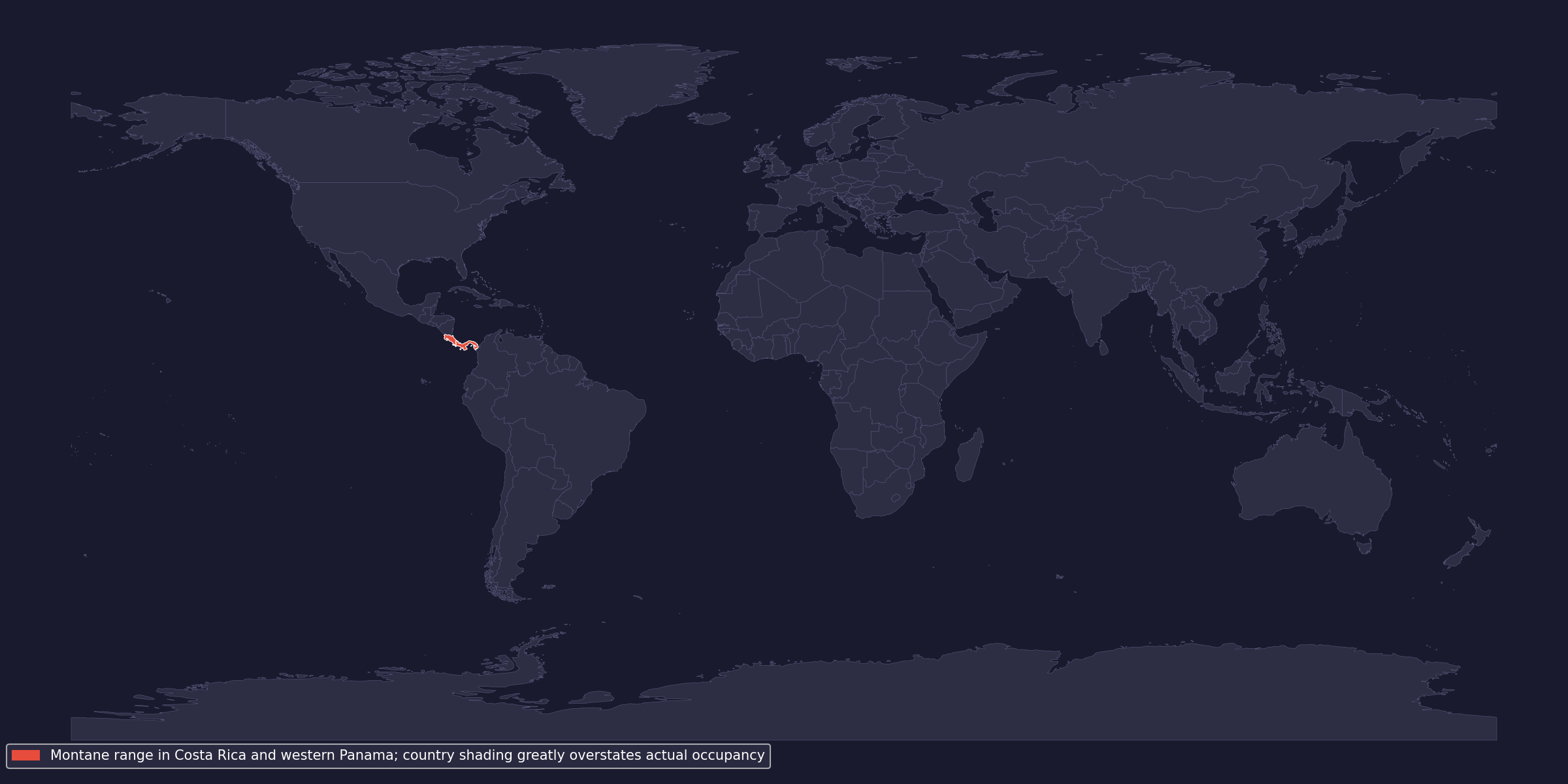
The species is native to the mountains of Costa Rica and western Panama, especially the Cordilleras de Tilarán, Central and Talamanca and their continuation into Chiriquí and Veraguas. It is not native to Nicaragua. Records centre on lower montane wet and rain forest, often above roughly 800 m, although published elevation limits vary.
Cool nights, high atmospheric moisture and moving air define the useful captive lesson. A warm lowland “rainforest” setup with saturated substrate is not an adequate substitute for a ventilated cloud-forest gradient.
⚖️ Legal status
Checked on 29 August 2026: Bothriechis lateralis is not listed in the current CITES Appendices or Annexes A-D of Commission Regulation (EU) 2026/1383. The Bern Convention does not apply to its Central American native range.
Costa Rican and Panamanian wildlife rules, export controls and the destination country’s dangerous-animal laws still apply. Private possession may be prohibited or require permits, inspected premises, transport approval and emergency arrangements. Confirm legal origin and every permit in writing; retain invoice, breeder/importer, locality and parentage, export/import documents, photographs and transfers.
🤌 Husbandry
House one snake in a locked arboreal enclosure within a locked, restricted and escape-resistant room. Use independent mechanical locks, neonate-proof ventilation and cable routes, and an elevated shift hide behind a tool-operated door. Water, waste and routine maintenance must be accessible only after positive shifting.
Quarantine for at least 90 days in a separate airspace where possible, with paper, simple perches and dedicated tools. Record weight, meals, sheds, faeces and respiration and arrange parasite testing for imported or uncertain-origin animals. Solitary housing preserves safe identification and control.
💡 Lighting
Provide 10-12 hours of broad visible daylight and complete night darkness. Low-output UVB in Ferguson Zone 1 may be offered over one upper section, but every warm perch needs a shaded equivalent. Measure where the coil rests, not only beneath the lamp.
Mount all electrical fittings externally or behind rigid guards. Foliage should break sightlines and provide shade while leaving a controlled route to locate and shift the animal.
🌡 Heating and temperature
Maintain daytime air at 20-25°C, one small warm perch at 26-28°C and a shaded cool zone at 17-21°C. Let nights fall to approximately 15-20°C. This mountain species is far more vulnerable to continuous heat than a generic tropical-viper label suggests.
Use several probes at different heights, a thermostat on every heater and an independent high-temperature alarm. Do not heat the whole roof. Exposed lamps, ceramic emitters within reach and hot rocks create severe burn risk. Breeding cycles must be based on known locality and healthy established adults, not harsher unmeasured cooling.
💧 Humidity and water
Aim for 70-85% RH, with brief evening misting and strong cross-ventilation. Leaves, branches and the upper enclosure should dry between cycles while deeper substrate buffers moisture. Raise a sheltered microclimate toward 80-90% during shedding without keeping the animal’s contact surfaces wet.
Provide clean bowl water even when droplets are offered. Persistent condensation, mould, sour substrate or wet ventral scales signal inadequate airflow. Repeated incomplete sheds require a health and hydration review rather than constant spraying.
🌿 Enclosure and decoration
One adult needs at least 90 x 60 x 120 cm. Install stable horizontal and diagonal branches at warm and cool heights, an elevated shift hide, a sheltered lower retreat and dense live or artificial foliage. Branches should support the whole coil without flexing and remain accessible to visual inspection.
Use 5-8 cm of soil and fine bark over drainage, with leaf litter on top. Paper is preferable during quarantine. Avoid unstable perches, adhesive décor, sharp mesh, permanently wet moss and plant pots that conceal the animal or obstruct the protected-transfer route.
🐁 Feeding
Offer appropriately sized frozen-thawed rodents. Juveniles generally need smaller meals every 10-14 days; adults often do well at 14-21 days, adjusted by weight and muscle condition. Arboreal ambush vipers can become overweight even while appearing slender under foliage.
Use long tongs after confirming a safe feeding position. Never hand-feed, leave a live rodent unattended or reach through branches for refused prey. Balanced whole prey needs no routine dusting.
🛡 Operational safety and emergencies
Routine work must be contact-free through the elevated shift system. Non-routine access requires two trained adults, suitable barriers and a written door sequence. A snake on a branch has reach in several directions; never use visual calmness as permission to put hands nearby.
Before acquisition, coordinate a species-specific bite plan with the poison centre or receiving hospital, including transport, contacts and a current venom information sheet. Antivenom decisions are regional clinical decisions and administration belongs in hospital.
After any bite, call emergency services, keep the patient still, remove constricting items, immobilize the limb and follow poison-centre instructions. Do not cut, suck, ice, shock or tightly tourniquet the wound and do not delay transport to catch the snake.
🥚 Breeding notes
The species is viviparous, so the keeper does not incubate eggs. Published species-specific litter data are limited and should not be replaced with confident genus-level numbers. Breeding requires documented origin, separate secured compartments, veterinary oversight of females and a neonate containment and counting plan before any pairing.
🩺 Common problems
Chronic warmth can lead to poor feeding, stress and rapid decline. Stagnant wet air encourages respiratory infection and scale disease, while inadequate drinking and local humidity cause dysecdysis. Rostral rubbing and repeated movement may indicate excess heat, exposure or an unsafe perch layout. Regurgitation requires review of meal size, disturbance and digestive temperatures.
Secure the snake before investigation, document readings at each perch and arrange a protected examination with an experienced reptile veterinarian. Do not attempt home restraint of a compromised arboreal viper.
📌 Conclusion
Bothriechis lateralis is a cool, humid, highly ventilated mountain specialist. It belongs only in a legal expert programme able to combine an arboreal shift system with reliable night cooling and hospital-ready emergency planning.
📚 Sources and further reading
- The Reptile Database — Bothriechis lateralis
- Lomonte et al. (2008), B. lateralis venom and distribution context
- GBIF species record
- WHO snakebite-envenoming resources
- CITES Appendices
- Commission Regulation (EU) 2026/1383