Share

Mangrove Snake
🔤 Taxonomy
Boiga dendrophila is the accepted scientific name for the mangrove snake. It is a rear-fanged colubrid, and legal or veterinary notes should follow the scientific name on the animal’s paperwork because common names are used loosely in the trade.
Common names used in the hobby:
- Mangrove snake
- Gold-ringed cat snake
📌 Description
This is a large, nocturnal, visually striking display snake for advanced keepers. It is not a handling species: bites can be painful, prolonged chewing increases venom exposure, and the enclosure must be serviceable without free-hand wrestling.
Adults typically reach 150-240 cm and can live 15-20 years with stable long-term care.
☠️ Venom
This species is venomous. Venom exposure can cause pain, swelling or other systemic effects, and severity varies with species, locality, bite site and the amount delivered. A small wound or apparently dry bite is not proof of safety; every bite or sting requires urgent medical assessment.
If an incident occurs, move away, call emergency services or a poison centre, keep the patient still, remove rings and other constricting items, and follow dispatcher instructions. Do not use a tourniquet, cut or suck the wound, apply ice or electricity, give alcohol or medicines as a home treatment, or attempt to catch the animal. Antivenom choice and dosing are hospital decisions; verify the relevant product and local availability in advance. Sources: WHO snakebite guidance and appropriate species-specific toxinology or medical references listed below.
🌍 Distribution
The species complex is associated with Southeast Asian lowland forest, mangrove edges, swamp forest, riparian vegetation, plantations, and dense vertical cover. Trade animals may come from different islands or lineages, so locality labels should be treated conservatively unless documented.
For care, the useful lesson is not wet substrate everywhere; it is vertical security with clean water, high but ventilated humidity, shaded retreats, and branches that can hold an adult animal safely.
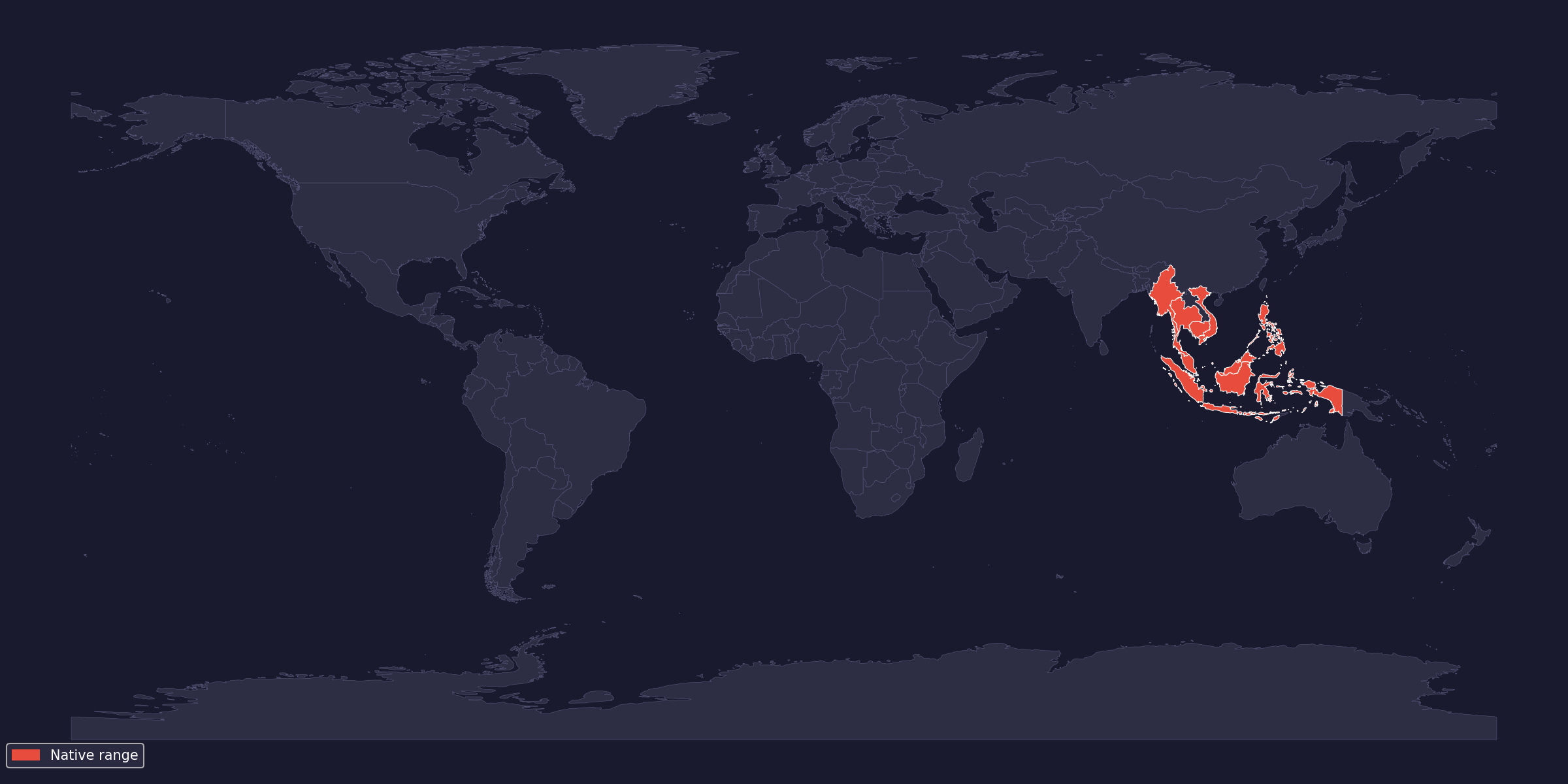
🌡 Climate across the native range
Monthly climate normals from reviewed GBIF occurrence locations:
Palawan — Philippines
| Month | Min °C | Mean °C | Max °C | RH % |
|---|---|---|---|---|
| January | 21.9 | 25.3 | 28.8 | 84 |
| February | 21.8 | 25.4 | 29.1 | 83 |
| March | 22.4 | 26.2 | 30 | 82 |
| April | 23.4 | 27.1 | 30.9 | 81 |
| May | 23.5 | 27.2 | 30.8 | 84 |
| June | 22.9 | 26.3 | 29.7 | 88 |
| July | 22.5 | 25.9 | 29.2 | 90 |
| August | 22.6 | 25.9 | 29.3 | 89 |
| September | 22.4 | 25.8 | 29.2 | 89 |
| October | 22.6 | 25.9 | 29.2 | 88 |
| November | 22.6 | 25.8 | 29.1 | 88 |
| December | 22.3 | 25.6 | 28.8 | 86 |
Bali — Indonesia
| Month | Min °C | Mean °C | Max °C | RH % |
|---|---|---|---|---|
| January | 23.4 | 26.9 | 30.4 | 81 |
| February | 23.4 | 27 | 30.6 | 80 |
| March | 23.1 | 26.9 | 30.7 | 80 |
| April | 23.1 | 27.1 | 31.1 | 79 |
| May | 22.9 | 26.7 | 30.6 | 79 |
| June | 22.3 | 26 | 29.8 | 78 |
| July | 21.8 | 25.3 | 28.9 | 78 |
| August | 21.8 | 25.3 | 28.9 | 76 |
| September | 22.3 | 26 | 29.8 | 76 |
| October | 22.9 | 26.8 | 30.8 | 76 |
| November | 23.4 | 27.2 | 31 | 79 |
| December | 23.5 | 27 | 30.4 | 80 |
Kalimantan Utara — Indonesia
| Month | Min °C | Mean °C | Max °C | RH % |
|---|---|---|---|---|
| January | 22.9 | 26.3 | 29.7 | 85 |
| February | 23 | 26.4 | 29.8 | 84 |
| March | 23.2 | 26.8 | 30.5 | 83 |
| April | 23.5 | 27.2 | 30.9 | 84 |
| May | 23.7 | 27.4 | 31.1 | 84 |
| June | 23.5 | 27.1 | 30.7 | 83 |
| July | 23.2 | 26.8 | 30.4 | 83 |
| August | 23.3 | 27 | 30.6 | 83 |
| September | 23.3 | 27 | 30.7 | 82 |
| October | 23.3 | 27 | 30.7 | 83 |
| November | 23.3 | 26.9 | 30.6 | 84 |
| December | 23.1 | 26.5 | 29.9 | 85 |
Weather data by WorldClim v2.1 · Monthly normals queried by Herpeton Academy from raster values; relative humidity is derived from vapor pressure and mean temperature.
Location references use GBIF.org occurrence data where available; original occurrence records retain their source dataset licenses.
⚖️ Legal status
Boiga dendrophila is not currently listed in CITES, and the older EU Annex D import-monitoring entry was deleted by Commission Regulation (EC) No 834/2004. The Bern Convention is not relevant because the species is not native to Europe. Local dangerous-animal, venomous/rear-fanged, transport, import, tenancy, and public-display rules may still apply and can be stricter than wildlife-trade status.
Keep invoices, breeder or seller details, transfer/import documents where relevant, photographs, and the date of your legal check with the animal’s records.
🤌 Husbandry
Plan the adult enclosure around at least 120 x 60 x 120 cm of secure arboreal space. Height matters only when branches, elevated hides, water, ventilation, locks, and shift-box access are all safe and serviceable. Quarantine new arrivals, weigh them, confirm feeding and shedding, and keep tools separate until mites, respiratory signs, wounds, abnormal feces, and persistent refusal have been ruled out.
💡 Lighting
Use a regular 10-12 hour day-night cycle. Low-level UVB can be offered as an option, but the animal must be able to leave both light and UV exposure without leaving the correct heat range.
🌡 Heating and temperature
- ambient air: 26-30°C
- basking surface: 31-33°C
- cool retreat: 24-26°C
- night: 22-25°C
Use thermostats on every heat source and verify the warm hide, basking surface, cool retreat, and night temperature with independent instruments. Do not run the whole enclosure at one average temperature.
💧 Humidity and water
Baseline humidity: 70-90%. Temporary shed support: 80-95%.
Manage humidity with microclimates: a dry retreat, a more humid shed hide, fresh water, and ventilation. Retained shed should lead to checks of hydration, heat, and airflow rather than repeated forced soaking.
🌿 Enclosure and decoration
Use sturdy branches, elevated cork tubes or dark hides, dense visual barriers, a water bowl that can be removed safely, and locks on every opening. Design the enclosure so routine cleaning can happen with the snake shifted away from the door.
🥗 Feeding
Use appropriately sized frozen-thawed prey whenever possible. Rodents maintain many animals, but some imports or juveniles may need patient scenting or chick-based transitions. Avoid live prey as routine care, and never respond to defensive strikes by free-hand restraint.
🥚 Breeding notes
The species is oviparous. Reported clutches are commonly around 5-15 eggs, with incubation often managed near 28-30°C for about 80-100 days. Breeding is a difficult project because correct identification, import history, feeding consistency, adult security, and secure offspring placement all matter.
🧍 Handling and safety
Treat this as a display-only snake. Use hooks, shields, shift boxes, and a second adult helper for risky maintenance. A bite should be washed, monitored for swelling or systemic signs, and assessed by a medical professional if symptoms progress or the bite involved prolonged chewing.
🩺 Common problems
Common problems include escape attempts, defensive striking, imported-animal parasites, dehydration, retained shed, respiratory disease from stagnant wet air, mouth injuries, refusal during acclimation, and injuries from live prey. Secure servicing routines prevent many of these problems.
📌 Conclusion
Mangrove snakes are realistic only for keepers who want a display animal and already have secure arboreal housing, shift-box routines, legal clarity, and a plan for veterinary care. The main risks are escape, unsafe handling, imported-animal health problems, and stagnant wet air.
📚 Sources and further reading
- Smithsonian National Zoo, Mangrove snake: https://nationalzoo.si.edu/animals/mangrove-snake
- Reptile Apartment, Venom in the Vivarium: Mangrove Snake Captive Care: https://reptileapartment.com/venom-in-the-vivarium-mangrove-snake-captive-care/
- The Reptile Database, Boiga dendrophila: https://reptile-database.reptarium.cz/Boiga/dendrophila
- GBIF Backbone Taxonomy, Boiga dendrophila: https://www.gbif.org/species/9792907
- Commission Regulation (EC) No 834/2004: https://eur-lex.europa.eu/eli/reg/2004/834/oj/eng
- CITES Appendices: https://cites.org/eng/app/appendices.php
- European Commission wildlife trade overview: https://environment.ec.europa.eu/topics/nature-and-biodiversity/wildlife-trade_en
- Council of Europe, Bern Convention appendices: https://www.coe.int/en/web/bern-convention/appendices