Share

Boaedon fuliginosus Care Guide
🔤 Taxonomy
Boaedon fuliginosus is used here for the brown African house snake, but the house-snake group has been revised repeatedly. Many animals in the hobby are sold as African house snakes without precise species or locality confirmation.
English common names used in the hobby:
- Brown African house snake
- African house snake
Older names and trade labels to know:
- Lamprophis fuliginosus
📌 Description
The African house snake (Boaedon fuliginosus) is a hardy, mostly nocturnal colubrid often kept for breeding projects and simple observation. Its modest size keeps housing manageable, but secure lids, correct prey size, and dry hides with a small humid retreat still matter.
🌍 Distribution
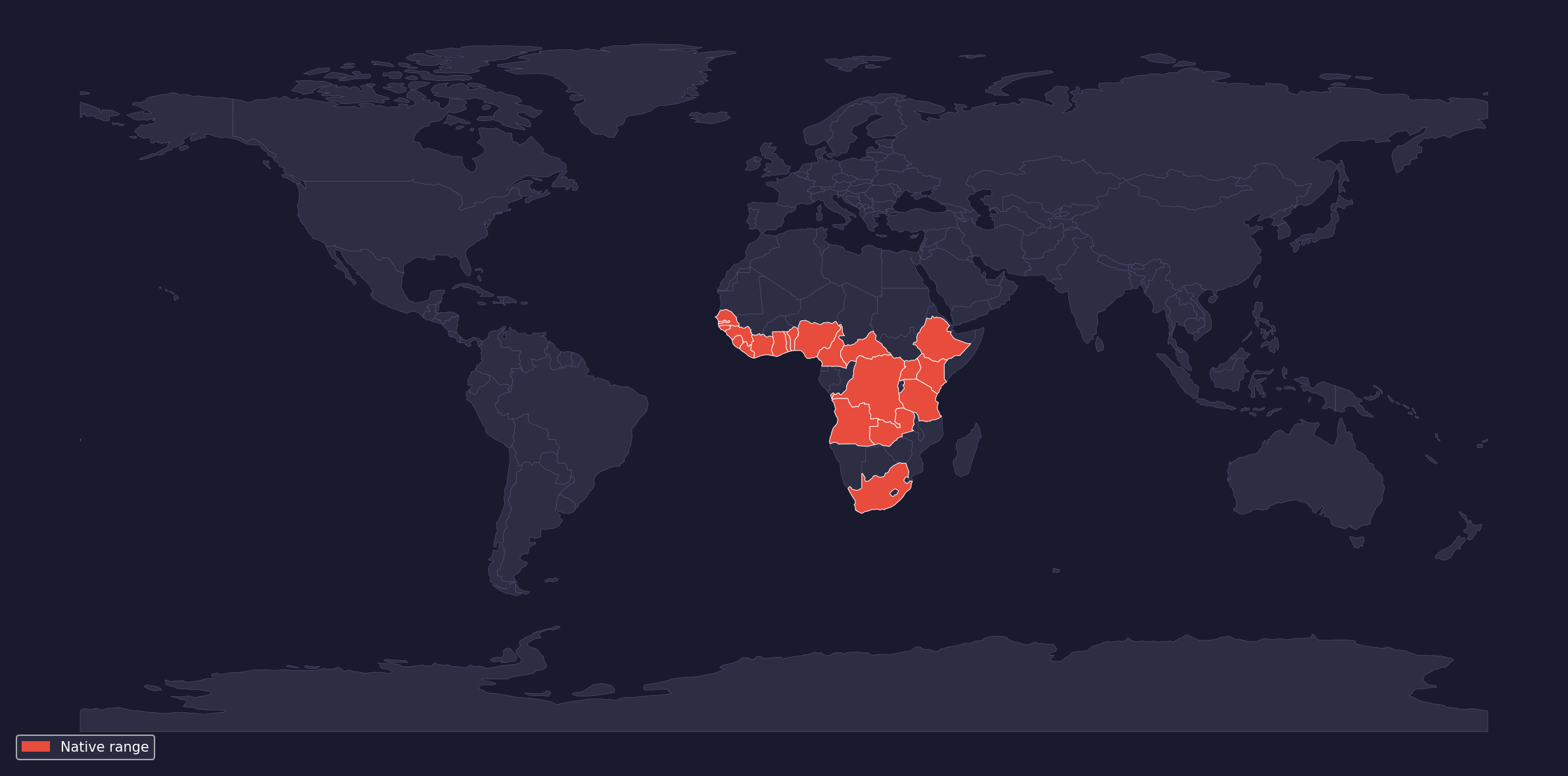
Broadly associated with sub-Saharan Africa, although the exact identity of many trade animals is complicated by the African house snake species complex.
For captive care the lesson is simple but important: dry secure shelter, a modest humidity cycle, and excellent escape prevention. These snakes exploit rodent shelters in the wild and can squeeze through tiny gaps.
Range information should be used as a care clue, not copied into unstable enclosure weather. The useful question is how the animal finds shelter, warmth, water, and seasonal security.
🌡 Climate across the native range
Monthly climate normals from reviewed GBIF occurrence locations:
Zanzibar North — Tanzania
| Month | Min °C | Mean °C | Max °C | RH % |
|---|---|---|---|---|
| January | 23.4 | 27.6 | 31.7 | 78 |
| February | 23.4 | 27.8 | 32.2 | 77 |
| March | 23.4 | 27.6 | 31.7 | 81 |
| April | 23.2 | 26.6 | 30 | 86 |
| May | 22.4 | 25.9 | 29.3 | 83 |
| June | 21.2 | 25 | 28.8 | 80 |
| July | 20.2 | 24.2 | 28.2 | 79 |
| August | 19.8 | 24.1 | 28.5 | 80 |
| September | 20 | 24.8 | 29.6 | 78 |
| October | 20.8 | 25.5 | 30.3 | 80 |
| November | 22.1 | 26.4 | 30.7 | 82 |
| December | 23.1 | 27.3 | 31.5 | 80 |
Nairobi — Kenya
| Month | Min °C | Mean °C | Max °C | RH % |
|---|---|---|---|---|
| January | 12.5 | 19.4 | 26.2 | 62 |
| February | 12.6 | 20 | 27.3 | 58 |
| March | 13.5 | 20.2 | 26.9 | 62 |
| April | 14.5 | 19.7 | 24.8 | 71 |
| May | 14 | 18.6 | 23.2 | 74 |
| June | 12.2 | 17.2 | 22.2 | 74 |
| July | 11.3 | 16.3 | 21.4 | 72 |
| August | 11.4 | 16.7 | 21.9 | 70 |
| September | 11.6 | 17.8 | 24 | 64 |
| October | 13 | 19.2 | 25.3 | 62 |
| November | 13.4 | 18.9 | 24.4 | 69 |
| December | 12.8 | 18.7 | 24.6 | 69 |
Zanzibar South and Central — Tanzania
| Month | Min °C | Mean °C | Max °C | RH % |
|---|---|---|---|---|
| January | 23.6 | 27.5 | 31.4 | 80 |
| February | 23.6 | 27.7 | 31.8 | 79 |
| March | 23.4 | 27.4 | 31.4 | 83 |
| April | 23.1 | 26.4 | 29.8 | 87 |
| May | 22.4 | 25.8 | 29.1 | 84 |
| June | 21.2 | 24.8 | 28.4 | 81 |
| July | 20.3 | 24.2 | 28 | 80 |
| August | 19.9 | 24.1 | 28.3 | 80 |
| September | 20 | 24.7 | 29.4 | 79 |
| October | 20.9 | 25.5 | 30.2 | 81 |
| November | 22.1 | 26.4 | 30.6 | 83 |
| December | 23.1 | 27.2 | 31.2 | 82 |
Weather data by WorldClim v2.1 · Monthly normals queried by Herpeton Academy from raster values; relative humidity is derived from vapor pressure and mean temperature.
Location references use GBIF.org occurrence data where available; original occurrence records retain their source dataset licenses.
⚖️ Legal status
As checked against current official sources in April 2026, Boaedon fuliginosus is not currently listed in the CITES Appendices, and no species-specific EU wildlife-trade Annex listing was found. It is not relevant to the Bern Convention unless a country applies separate native-wildlife rules. Local rules on ownership, import, sale, transport, breeding, invasive-species control, dangerous-animal licensing, and proof of lawful origin may still apply; keep purchase and breeding records.
🧭 Life stage differences
Hatchlings should start in smaller secure enclosures such as 25 x 15 x 15 cm or a small rack tub for hatchlings, secured carefully. Smaller starter housing makes feeding, shedding, hydration, and waste easier to monitor. Adults need the full planned enclosure, stronger locks or lids, and more stable environmental zones. Do not buy a young animal unless the adult housing, food supply, and legal responsibilities are already realistic.
House snakes are forgiving only when the enclosure is secure and not too exposed. A hatchling that refuses meals often needs tighter hides, more cover, and a smaller feeding space rather than higher heat or repeated handling.
Because the house-snake complex is taxonomically messy, avoid presenting unverified animals as pure locality stock. For ordinary keeping this rarely changes basic care, but it matters for breeding records and honest sale descriptions.
This species can be an excellent small snake, but it is not a reason to skip quarantine. Mites, internal parasites in imports, and dehydration after transport are more important to check than colour or feeding excitement on arrival.
🤌 Husbandry
House one animal per enclosure. A practical adult enclosure is 75 x 45 x 45 cm minimum for one adult; 90 x 45 x 45 cm gives better usable space. Larger is useful when it creates more usable movement, better gradients, and safer maintenance. Use secure ventilation, stable furnishings, and a written log for feeding, sheds, weight changes, and behaviour. Quarantine new animals and avoid mixing species or uncertain locality lines.
Use at least 90 days of quarantine for a well-documented captive-bred animal and extend it when origin or health history is uncertain. Keep dedicated tongs, bowl, and cleaning tools, ideally in a separate room. Record arrival weight, every meal, feces, and sheds. Imports and animals with mites, diarrhea, dehydration, or poor body condition should be examined and fecally tested by a reptile veterinarian before their equipment enters the main collection.
💡 Lighting
Use a simple 10-12 hour day cycle. UVB is optional; if offered, keep it measured and provide shaded hides so this small, secretive house snake can avoid exposure. Do not use visible night lights. Avoid lamps that dry small enclosures or overheat retreats.
🌡 Heating and temperature
Practical target range: basking 31-33 °C, warm side 26-29 °C, cool side 22-24 °C, night 20-23 °C. Measure with digital probes and, for basking or warm surfaces, an infrared thermometer. All heat sources must be controlled by thermostats or suitable dimming controllers and guarded so the snake cannot burn itself.
💧 Humidity and water
Target humidity and water: 40-60% with a humid hide during shedding. Fresh water should always be available in a stable dish appropriate to the animal’s size. Avoid stagnant wet air. Chronic dryness causes bad sheds or dehydration; chronic wet substrate causes skin, scale, mold, or respiratory problems depending on the animal.
🌿 Enclosure and decoration
Provide a warm retreat, cooler retreat, water, safe rough surfaces for shedding, and enough cover that the snake can move without feeling exposed. Juvenile setups should be simple enough to inspect but not bare. Adult enclosures must be built for strength, stable furniture, secure doors or lids, and safe cleaning access. All cable ports, sliding doors, lid corners, and ventilation gaps must be escape-proof. Heavy furnishings should be stable and unable to shift onto the snake.
Provide about 5-8 cm of aspen, lignocel, cypress-based bedding, or a well-drained soil mix. The main floor should remain dry, with a small humid hide available for shedding. Paper towel is useful during quarantine and treatment, but established house snakes benefit from loose cover, cork tubes, leaf litter, and firmly anchored low branches. Avoid aromatic cedar or pine, dusty substrate, and a permanently wet floor.
House snakes investigate edges relentlessly. Test ventilation slots, cable holes, lid clips, and sliding-door overlaps with the smallest juvenile in mind. Place heavy hides directly on the enclosure base before adding substrate so burrowing cannot make them shift.
🪳 Feeding
Feed frozen-thawed mice; hatchlings may need very small pinkies or scenting at first. Size meals to the animal, not to appetite alone. Hatchlings eat smaller meals more often; adults usually eat less often and should be kept in lean, muscular condition. Offer appropriately sized prey, remove uneaten prey promptly, and avoid handling snakes for at least 48 hours after meals.
Offer hatchlings a very small mouse every 5-7 days, growing juveniles every 7-10 days, and most adults every 10-14 days. Females are often larger and may need a different prey size from males of the same age. Use monthly weights and the tail-base taper to adjust the schedule; a strong feeding response is not evidence that another meal is needed.
Warm thawed prey in a sealed bag, present it with tongs, and never leave a live rodent unattended. If a hatchling refuses, first reduce exposure, verify the warm hide, and confirm prey is genuinely small enough. Repeatedly handling or offering food every day tends to prolong stress.
🧤 Handling and seasonal management
Allow a new house snake to establish several consecutive meals before routine handling. Scoop it from below, support the body, and work over a clear surface because juveniles can accelerate suddenly. Wash prey odor from hands and use a predictable opening routine to reduce feeding mistakes. A lockable temporary tub is essential during full enclosure cleaning.
This tropical complex does not require cold brumation for normal care. A modest shift in day length, nighttime temperature, or watering may reflect seasonality, but the warm hide and drinking water must remain available. Deliberate cycling for breeding should use healthy mature animals of documented identity; never cool a juvenile, thin, dehydrated, newly imported, parasitized, or unwell snake.
Because many trade animals are labeled only “African house snake,” keep the breeder’s name, hatch date, locality claim, photographs, and parentage with the animal’s records. Do not turn an uncertain identification into a confident locality label when selling offspring.
🥚 Breeding
This species is readily captive bred. Females lay eggs; avoid overbreeding small females and separate hatchlings because they can be nervous and opportunistic feeders. Breeding should use healthy mature animals with known identity and lawful origin. Keep dates, pairings, offspring numbers, and transfer records, and do not produce more young than can be housed and placed responsibly.
🩺 Common problems
Common problems include dehydration, dysecdysis, thermal burns, overheating, mites, internal parasites in imports, respiratory infection, escape injuries, and obesity from frequent feeding. Regurgitation can follow oversized prey, inadequate digestive heat, handling too soon after a meal, or disease. Warning signs include wheezing, bubbles at the nostrils, open-mouth breathing, repeated regurgitation, retained shed, swelling, twisting posture, sudden lethargy, or repeated escape attempts. Consult a reptile- or exotic-animal veterinarian for severe weakness, injury, breathing signs, swelling, repeated regurgitation, retained shed, or prolonged refusal to feed.
📌 Conclusion
Boaedon fuliginosus does best when the keeper plans for the adult animal and not only the attractive juvenile. Secure housing, measured conditions, appropriate feeding, and honest records are the foundation of responsible care.
📚 Sources and further reading
- ReptiFiles species search completed August 2026; no species-specific Boaedon fuliginosus care guide was available
- Hallermann et al. (2020), review of the Boaedon fuliginosus species complex
- Leibniz Institute project on the Boaedon lineatus-fuliginosus complex
- GBIF species backbone entry for taxonomy and distribution context
- Merck Veterinary Manual, reptile husbandry, quarantine, and recordkeeping
- CITES Appendices, checked April 2026
- European Commission wildlife-trade guidance, checked April 2026
💬 Feedback
For questions, corrections, or practical notes, leave us a message in the forum thread.