Share

Boa Imperator Care Guide
📌 Description
The boa imperator (Boa imperator) is a large, muscular, non-venomous constrictor from Central America and nearby regions. It is one of the most common large snakes in captivity and is often sold under hobby names such as common boa or Colombian boa, even though those labels are not always taxonomically precise.
Adults vary by sex and locality. Many males remain more moderate in size, while large females can become substantial snakes that require serious space and handling awareness. Boa imperators are usually somewhat smaller and lighter than the largest Boa constrictor animals, but they are still powerful, long-lived snakes.
With good care, boa imperators often live 20-30 years or more. They are usually calmer than their reputation suggests, but they are still heavy-bodied predators and should be respected as such.
🌍 Distribution
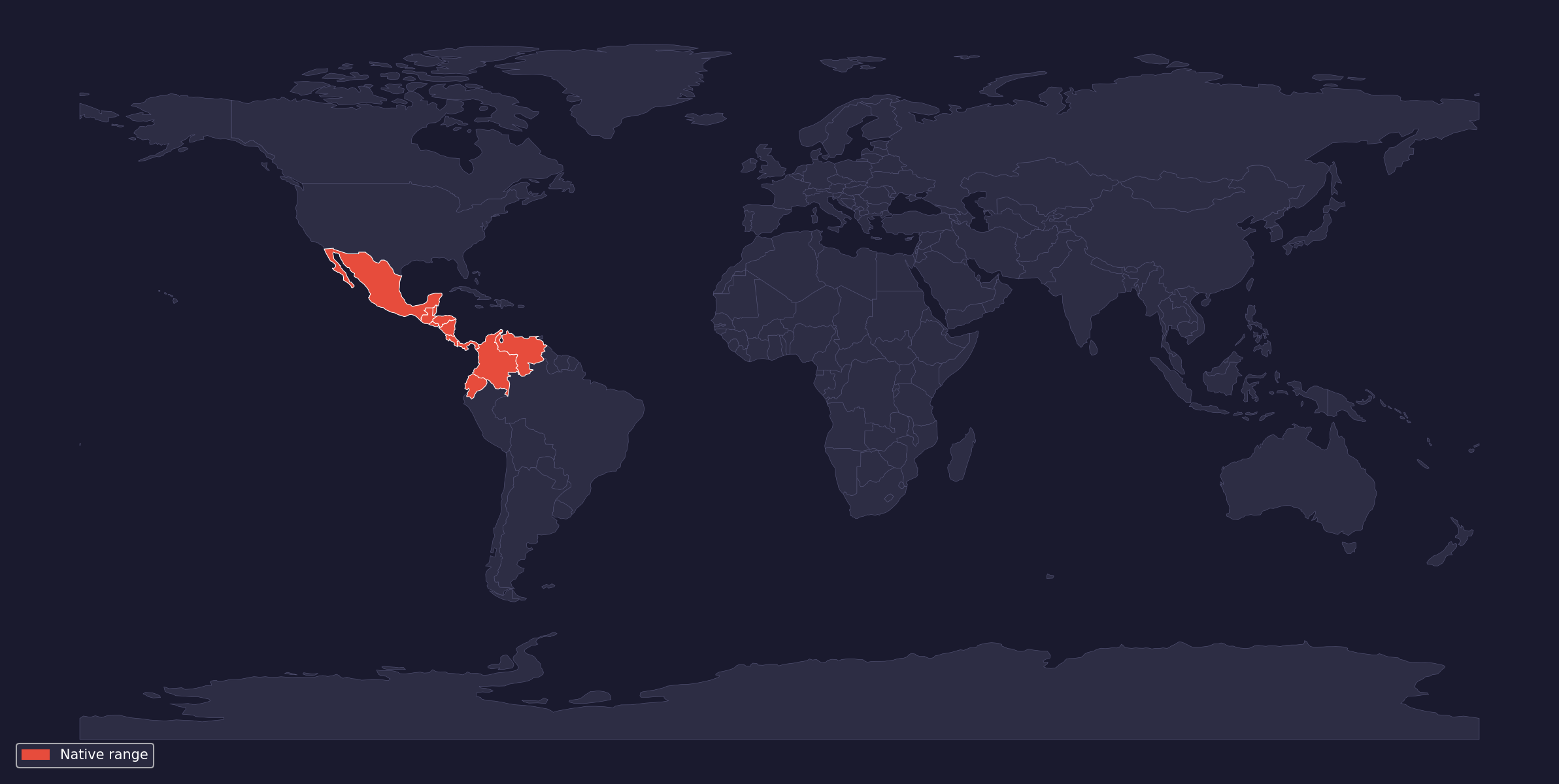
Boa imperator is native to Mexico, Central America and northwestern South America, with strong locality variation. In the wild it is associated with rainforest edge, dry forest, scrub, river corridors, plantations and other human-modified habitats with cover.
In the enclosure, that means:
- secure hides in both warm and cool parts of the enclosure
- a clear thermal gradient instead of one uniform temperature
- substrate and cover that match the species’ natural shelter use
- humidity managed by microclimates, not by keeping the whole enclosure wet
- space and enrichment that support normal movement and hunting behaviour
🌡 Climate across the native range
Monthly climate normals from reviewed GBIF occurrence locations:
Petén — Guatemala
| Month | Min °C | Mean °C | Max °C | RH % |
|---|---|---|---|---|
| January | 19.7 | 23.2 | 27.9 | 78 |
| February | 20.5 | 24.8 | 30.6 | 70 |
| March | 21.7 | 26.9 | 33.6 | 61 |
| April | 23.6 | 29.1 | 35.9 | 59 |
| May | 24.5 | 29.1 | 35.3 | 65 |
| June | 24 | 27.4 | 32.5 | 80 |
| July | 23.6 | 27.2 | 32.5 | 78 |
| August | 23.6 | 27.1 | 32.5 | 80 |
| September | 23.4 | 26.3 | 31.1 | 86 |
| October | 22.5 | 25.3 | 29.4 | 86 |
| November | 20.9 | 23.9 | 28.1 | 83 |
| December | 20 | 23.3 | 27.7 | 81 |
Islas de la Bahía — Honduras
| Month | Min °C | Mean °C | Max °C | RH % |
|---|---|---|---|---|
| January | 22.3 | 24.1 | 26.3 | 84 |
| February | 22.5 | 24.5 | 26.9 | 83 |
| March | 23.1 | 25.3 | 27.8 | 81 |
| April | 24.4 | 26.7 | 29.2 | 81 |
| May | 25.3 | 27.3 | 29.7 | 82 |
| June | 25.7 | 27.6 | 29.9 | 83 |
| July | 25.1 | 27.1 | 29.4 | 84 |
| August | 25.3 | 27.3 | 29.6 | 84 |
| September | 25.5 | 27.4 | 29.7 | 84 |
| October | 24.8 | 26.5 | 28.5 | 85 |
| November | 23.7 | 25.2 | 27.1 | 85 |
| December | 22.8 | 24.5 | 26.4 | 85 |
Chiriquí — Panama
| Month | Min °C | Mean °C | Max °C | RH % |
|---|---|---|---|---|
| January | 11.7 | 14.4 | 18.2 | 83 |
| February | 11.8 | 14.7 | 18.9 | 81 |
| March | 12.2 | 15.2 | 19.6 | 80 |
| April | 12.9 | 15.7 | 19.9 | 83 |
| May | 13.6 | 15.8 | 19.4 | 90 |
| June | 13.7 | 15.8 | 19.1 | 92 |
| July | 13.3 | 15.4 | 18.8 | 91 |
| August | 13.3 | 15.5 | 18.9 | 91 |
| September | 13.3 | 15.5 | 19 | 92 |
| October | 13.1 | 15.2 | 18.5 | 93 |
| November | 12.8 | 14.8 | 18 | 92 |
| December | 12.2 | 14.4 | 17.9 | 88 |
Weather data by Open-Meteo.com · CC BY 4.0 · Monthly normals calculated by Herpeton Academy from daily archive values.
Location references use GBIF.org occurrence data where available; original occurrence records retain their source dataset licenses.
⚖️ Legal status
As checked on April 21, 2026, Boa imperator is associated with regulated CITES trade through its treatment within the broader Boa constrictor complex and related case-study documentation. This is an area where taxonomy and paperwork can be confusing, so animals should always be bought and sold with clear origin records and current trade documents where required.
Within the European Union, trade controls may still apply through the EU wildlife trade framework, and national or local rules may apply to ownership, sale, breeding, transport, import, export, and proof of origin.
Buy only captive-bred animals from reliable breeders or shops with clear paperwork. Do not rely on hobby nicknames alone when identifying the legal paperwork for a snake.
The Bern Convention is not usually relevant unless a species is native to Europe or covered by local conservation rules; check current national guidance for the country where the animal is kept.
🤌 Husbandry
Boa imperators are large snakes that need enclosure planning based on adult size, not hatchling size. Babies can begin in smaller secure setups, but adults need room to stretch, thermoregulate, and hide securely.
Practical adult enclosure sizes often begin around:
- Adult males: about 150-180 × 75 × 75 cm or larger
- Adult females: about 180-240 × 90 × 90 cm or larger
Some localities stay smaller, and others become more robust. Floor space matters most, but boas also use low branches, shelves, and elevated resting spots.
The enclosure should have:
- A warm hide and a cool hide
- Strong branches or shelves
- A large water bowl
- Good visual cover
- Good ventilation
- Secure locks
Boa imperators are solitary and should normally be housed alone except during deliberate, supervised breeding.
💡 Lighting
Boa imperators do not need intense lighting, but they benefit from a reliable day-night cycle. Provide roughly 10-12 hours of light per day.
Low-output UVB can be used if installed correctly and paired with shaded areas. If UVB is used, the snake must be able to avoid it fully. If UVB is not used, supplementation should still be conservative and prey-centered rather than random.
Strong light without cover can create stress, so lighting should support visibility without removing security.
For UV planning, treat this species as Ferguson Zone 1. Aim for about UVI 0.5-1.0 in the upper exposed area, while leaving retreats and a gradient down to shaded areas near zero UVI. This usually points to a low-output UVB tube such as a ShadeDweller-style or 2-7% T5, chosen for the enclosure height; measure with a Solarmeter 6.5 when possible, because reflector, mesh, distance, and lamp age change the real exposure.
🌡 Heating and temperature
A proper temperature gradient is essential. Boa imperators need a warm area for digestion and a cooler retreat for safe thermoregulation.
Useful ranges:
- Warm side ambient: 29-31°C
- Warm hide or basking surface: around 31-33°C
- Cool side ambient: 24-27°C
- Night: slight drop is acceptable, but avoid prolonged chilling
Use thermostats for all heat sources. Overhead heating, guarded ceramic heat emitters, and radiant systems can work well when installed safely. Large boas should never have access to exposed hot elements.
Measure both air and surface temperatures. Many husbandry problems begin with guessed temperatures instead of measured ones.
💧 Humidity and water
Boa imperators usually do well with moderate humidity and access to a more humid retreat when needed. A practical target is often around 55-70%, adjusted by room conditions, locality, and shed quality.
Humidity should come from a balanced system rather than a permanently wet enclosure. Useful tools include:
- Moisture-friendly substrate
- A large water bowl
- Partial misting when needed
- A humid hide or moister retreat
- Good ventilation
Fresh water should always be available. Many boa imperators will soak occasionally, especially before shedding.
🌿 Enclosure and decoration
The enclosure should be secure, sturdy, and easy to maintain. Boa imperators are strong enough to shift weak furniture and test poor door seals.
Suitable substrate options include:
- Cypress mulch
- Coconut husk or fiber blends
- Aspen in drier, carefully managed setups
- Paper for quarantine or medical monitoring
Use stable hides, strong branches, cork bark, shelves, and fixed background structure. Every heavy item should be anchored so it cannot fall onto the snake.
Environmental complexity matters. Even calm boas benefit from multiple secure resting choices and some route variation within the enclosure.
🪳 Feeding
Boa imperators eat appropriately sized whole prey. Frozen-thawed prey is the safest standard in captivity.
Common prey includes:
- Mice for small juveniles
- Rats for juveniles and adults
- Other appropriate whole prey when necessary
Feeding frequency depends on age, prey size, body condition, and growth rate:
- Hatchlings and small juveniles: more often
- Larger juveniles: less often
- Adults: usually every few weeks, depending on prey size and condition
Avoid power-feeding. Boa imperators can become overweight easily, especially in sedentary adult setups.
🥚 Breeding
Breeding should be planned carefully. These are large, long-lived snakes, and pairing should not happen casually.
Adult males are usually smaller and slimmer, while females are typically bulkier and heavier. Sex is commonly confirmed by experienced keepers using accepted methods such as probing.
Sexual maturity depends on age, size, and condition, not only age. Females should not be bred too small or too young, because pregnancy is physically demanding.
Before breeding, prepare quarantine protocols, feeding plans, neonatal housing, records, veterinary support, and a lawful plan for placing or selling offspring.
🩺 Common problems
Most problems come from incorrect temperatures, poor humidity balance, obesity, poor airflow, dirty water, or chronic stress.
Watch for:
- Wheezing or excess mucus
- Stuck shed
- Regurgitation
- Refusal to eat with weight loss
- Burns
- Swelling or mouth problems
- Mites or skin irritation
- Obesity and fat folds
Check temperature, humidity, airflow, prey size, feeding interval, and enclosure security first. Persistent symptoms, breathing problems, repeated regurgitation, injuries, or parasites require a reptile veterinarian.
📌 Conclusion
The boa imperator is one of the most practical large snake species in captivity when housed correctly. It needs space, security, measured temperatures, moderate humidity, clean water, and disciplined feeding.
It is not a difficult snake because it is fragile. It becomes difficult when its adult size, lifespan, and strength are underestimated. Good housing and steady habits make this species much easier to keep well.
📚 Sources and further reading
- CITES Appendices, checked 2026-05-04
- EU wildlife trade regulations and annex references, checked April 2026
- GBIF species backbone and occurrence data for taxonomy and distribution context
- IUCN Red List and specialist husbandry references where applicable
💬 Feedback
For questions, corrections, or practical notes, leave us a message in the forum thread.