Share

Desert Mountain Adder
🔤 Taxonomy
Bitis xeropaga is the accepted desert mountain adder. Old records may have been filed as B. peringueyi or B. caudalis, and the subgeneric combination Bitis (Calechidna) xeropaga appears in phylogenetic literature. No subspecies are accepted. Preserve lawful locality and identification data because the species overlaps other dwarf adders and captive lines are scarce.
📌 Description
This is a robust dwarf adder of rocky desert mountains, normally 35-50 cm and exceptionally about 61 cm. Colour tracks local stone—grey, pink, yellow or brown—with paired dark dorsal blocks. It climbs broken rock readily, shelters in crevices and becomes active in cooler mornings, evenings and nights.
Only a few bites and limited species-specific venom data are published; pain, swelling and local tissue injury have occurred. Uncertainty is not low risk. The species is an expert-only display animal for a licensed specialist or institution.
📋 Quick reference
| Care point | Practical target |
|---|---|
| Adult enclosure | At least 120 x 60 x 60 cm, divided by a positively lockable shift |
| Day temperatures | 22-28°C air; 31-34°C basking surface; 18-23°C cool crevice |
| Night | 15-20°C, preserving a marked desert-mountain drop |
| Humidity | 25-45%; one ventilated 50-65% shed refuge |
| Lighting | Seasonal 10-14 hours; measured Ferguson Zone 2 UVB recommended |
| Feeding | Modest frozen-thawed rodents every 14-28 days for adults |
| Furnishing | Stable rock shelves and crevices, never loose piles |
| Safety | Double containment, protected contact, backup, bite and escape plans |
☠️ Venom
This species is venomous. Venom exposure can cause pain, swelling or other systemic effects, and severity varies with species, locality, bite site and the amount delivered. A small wound or apparently dry bite is not proof of safety; every bite or sting requires urgent medical assessment.
If an incident occurs, move away, call emergency services or a poison centre, keep the patient still, remove rings and other constricting items, and follow dispatcher instructions. Do not use a tourniquet, cut or suck the wound, apply ice or electricity, give alcohol or medicines as a home treatment, or attempt to catch the animal. Antivenom choice and dosing are hospital decisions; verify the relevant product and local availability in advance. Sources: WHO snakebite guidance and appropriate species-specific toxinology or medical references listed below.
🌍 Distribution
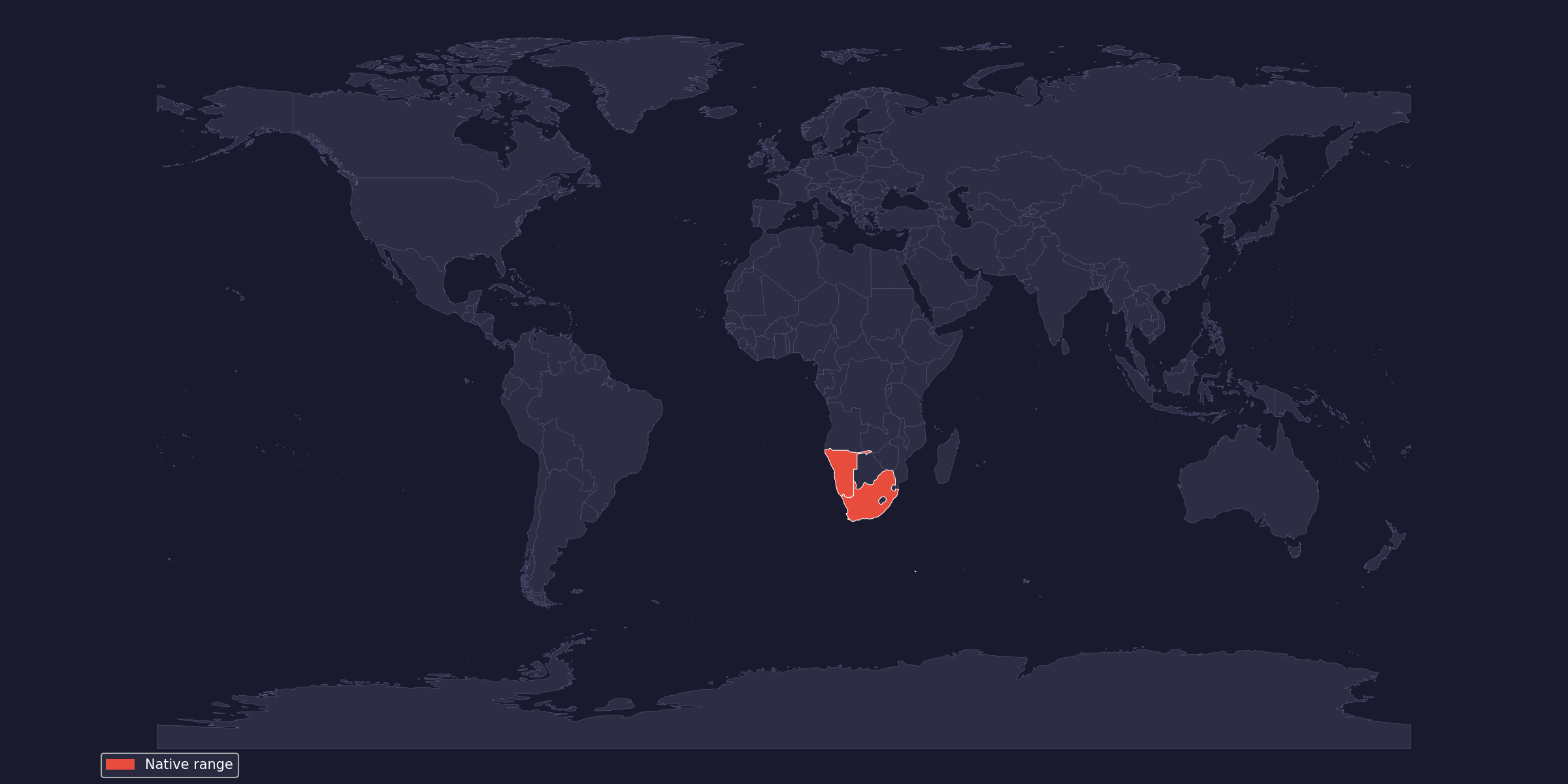
The range follows arid mountains and rocky hills around the lower Orange River, from the Northern Cape of South Africa into southern Namibia and north toward the Aus region. Occupancy is patchy; suitable crevices and slope structure matter more than a broad desert polygon.
Local colour and climate vary. Keep fine wild coordinates confidential and reject trade claims that use a named mountain without permits and parentage. Such precision can advertise collection sites rather than establish legality.
⚖️ Legal status
Checked on 21 August 2026: no B. xeropaga entry was found in CITES or the current EU wildlife-trade annexes; Bern is not relevant to its African range. It is not named in South Africa’s currently in-force national TOPS list. Provincial law still applies: the Northern Cape Nature Conservation Act regulates indigenous wildlife, and permits may be required for collection, possession, breeding, transport or trade.
Namibia’s Nature Conservation Ordinance and MEFT permitting system cover keeping reptiles and wildlife use. Lack of a CITES listing does not legalize export or wild collection. Acquire only documented captive-bred animals with permits, parentage and unbroken provenance. Claimed locality lines deserve more scrutiny, not less.
🤌 Husbandry
House singly in a locked primary enclosure inside an access-controlled escape-resistant room. Use two compartments or a full-body shift hide that closes from outside, and confirm the animal behind a barrier before servicing. Two trained adults attend every primary opening.
Quarantine for at least 90 days with dedicated tools, a shallow auditable substrate and serial weight, feed, shed and faecal records. Arrange veterinary and parasite work before acquisition. Routine free handling, tailing, pinning and manual restraint are unacceptable.
💡 Lighting
Provide bright white light for 10-14 hours, varied gradually with season, and full darkness at night. A measured Ferguson Zone 2 UVB opportunity over part of the warm rockwork is recommended, with complete shaded crevices.
Keep lamps outside primary containment or behind locked guards. Include lamp heat in all surface measurements.
🌡 Heating and temperature
Maintain 22-28°C daytime air, a limited rock surface at 31-34°C and an 18-23°C cool crevice; nights should fall to 15-20°C. The warm surface must never become a whole-enclosure desert oven.
Use overhead radiant heat controlled by a thermostat, independent probes and an alarm. Check stone surfaces with an infrared thermometer. Every rock must remain stable through heating cycles and cleaning.
💧 Humidity and water
Keep ambient humidity around 25-45% with strong ventilation. Provide one shaded ventilated refuge at 50-65% during pre-shed. A small localized damp patch is safer than spraying the entire rocky enclosure.
Offer a stable shallow water dish, even if rarely observed drinking, and exchange it through protected access. Persistent soaking is abnormal and warrants a review of heat, hydration, parasites and illness.
🌿 Enclosure and decoration
One adult needs at least 120 x 60 x 60 cm. Build anchored ledges, narrow accessible crevices, two shift-compatible hides and low dry cover. Provide modest climbing opportunity but prevent falls and any inaccessible gap behind heavy stone.
Use 6-10 cm of compacted mineral soil, sand and fine gravel, not loose sharp rubble. Quarantine on paper or a shallow disposable mineral layer. Secure all vents, tracks, cables and drains for newborns.
🐁 Feeding
Wild diet is poorly documented and likely includes small lizards and mammals. Established captives may take modest frozen-thawed mice. Adults commonly need one meal every 14-28 days; juveniles every 7-14 days if growing normally.
Demand an established feeding record before acquisition. Do not use live rodents, wild-caught prey, force-feeding or a loose feeding tub. Whole vertebrate prey requires no routine supplementation; use weight and muscle condition rather than appetite.
🛡 Operational safety and emergencies
Rehearse service, escape, bite, fire and power-failure procedures without a live snake. An escape plan must isolate the room, exclude the public, account for people and animals and define how rocky equipment is searched without bare hands.
Before acquisition, coordinate with poison control, a medical toxicologist, emergency services and the receiving hospital. Species-specific antivenom evidence is limited; never promise that a polyvalent product will work and never self-administer antivenom.
After a bite, move away, call emergency services, remove constricting items, keep still and support the limb neutrally. Do not cut, suck, ice, massage, shock or tourniquet. There is no home treatment.
🥚 Breeding notes
The species is viviparous. Sparse captive reports describe four to nine young, but environmental triggers and normal reproductive intervals are not sufficiently documented for a prescriptive recipe.
Breed only lawful, locality-compatible adults in a managed programme. Prepare secured neonate units and documented placements first. Avoid producing animals to create or disguise questionable “locality” stock.
🩺 Common problems
- Overheating: inadequate cool crevices or warm nights.
- Burns: unguarded lamps or overheated rock surfaces.
- Dehydration or retained shed: no localized humid refuge or inaccessible water.
- Obesity: rodent-heavy feeding in an efficient ambush predator.
- Parasites and stomatitis: especially with undocumented wild-origin animals.
- Crushing or escape: unstable rockwork and hidden service gaps.
Shift and secure before veterinary treatment. Do not attempt hands-on home care.
📌 Conclusion
Desert mountain adder care depends on stable rock structure, a sharp but escapable heat gradient, cool nights, dry ventilation and documented lawful origin. Scarcity is a reason for restraint, not acquisition.
📚 Sources and further reading
- ReptiFiles — checked first on 21 August 2026; no species-specific guide was found.
- The Reptile Database: Bitis xeropaga
- GBIF species record: Bitis xeropaga
- Barlow et al. 2019 — evolution and habitat shifts in Bitis
- SANBI Atlas and Red List of South African reptiles
- Northern Cape Department — provincial conservation legislation
- DFFE — current TOPS permits and legislation
- Namibia MEFT wildlife permits
- CITES Appendices
- EU wildlife-trade annexes, Commission Regulation (EU) 2026/1383
- CDC/NIOSH venomous-snake first aid
- Bern Convention appendices