Share

Kenya Horned Viper
🔤 Taxonomy
Bitis worthingtoni is the accepted Kenya horned viper and the sole species of the proposed subgenus Keniabitis. Bitis (Keniabitis) worthingtoni appears in phylogenetic papers, but Keniabitis worthingtoni should not replace the accepted permit name without authority guidance. No subspecies are recognized.
📌 Description
This small viper usually measures 20-35 cm and exceptionally about 50 cm. Raised scales above the eyes, a compact body and broken grey-brown pattern suit high Rift Valley grassland, scrub and rocky ground above about 1,500 m. It can use low shrubs and rock structure more readily than a flat enclosure suggests.
Its venom is medically significant, while species-specific bite and antivenom evidence is sparse. It is also a Kenyan endemic affected by habitat loss and illegal collection. This is an expert-only, display-only species for licensed conservation or institutional programmes.
📋 Quick reference
| Care point | Practical target |
|---|---|
| Adult enclosure | At least 120 x 60 x 75 cm, with external positively lockable shift |
| Day temperatures | 20-25°C air; 28-31°C basking surface; 16-21°C cool refuge |
| Night | 12-18°C; maintain the highland drop |
| Humidity | 45-65%; one ventilated 65-75% shed refuge |
| Lighting | Seasonal 10-14 hours; measured Ferguson Zone 2 UVB recommended |
| Feeding | Small frozen-thawed rodents every 14-21 days for adults |
| Origin | CITES Appendix-II paperwork plus complete Kenyan/legal provenance |
| Safety | Double containment, protected contact, backup, bite and escape plans |
☠️ Venom
This species is venomous. Venom exposure can cause pain, swelling or other systemic effects, and severity varies with species, locality, bite site and the amount delivered. A small wound or apparently dry bite is not proof of safety; every bite or sting requires urgent medical assessment.
If an incident occurs, move away, call emergency services or a poison centre, keep the patient still, remove rings and other constricting items, and follow dispatcher instructions. Do not use a tourniquet, cut or suck the wound, apply ice or electricity, give alcohol or medicines as a home treatment, or attempt to catch the animal. Antivenom choice and dosing are hospital decisions; verify the relevant product and local availability in advance. Sources: WHO snakebite guidance and appropriate species-specific toxinology or medical references listed below.
🌍 Distribution
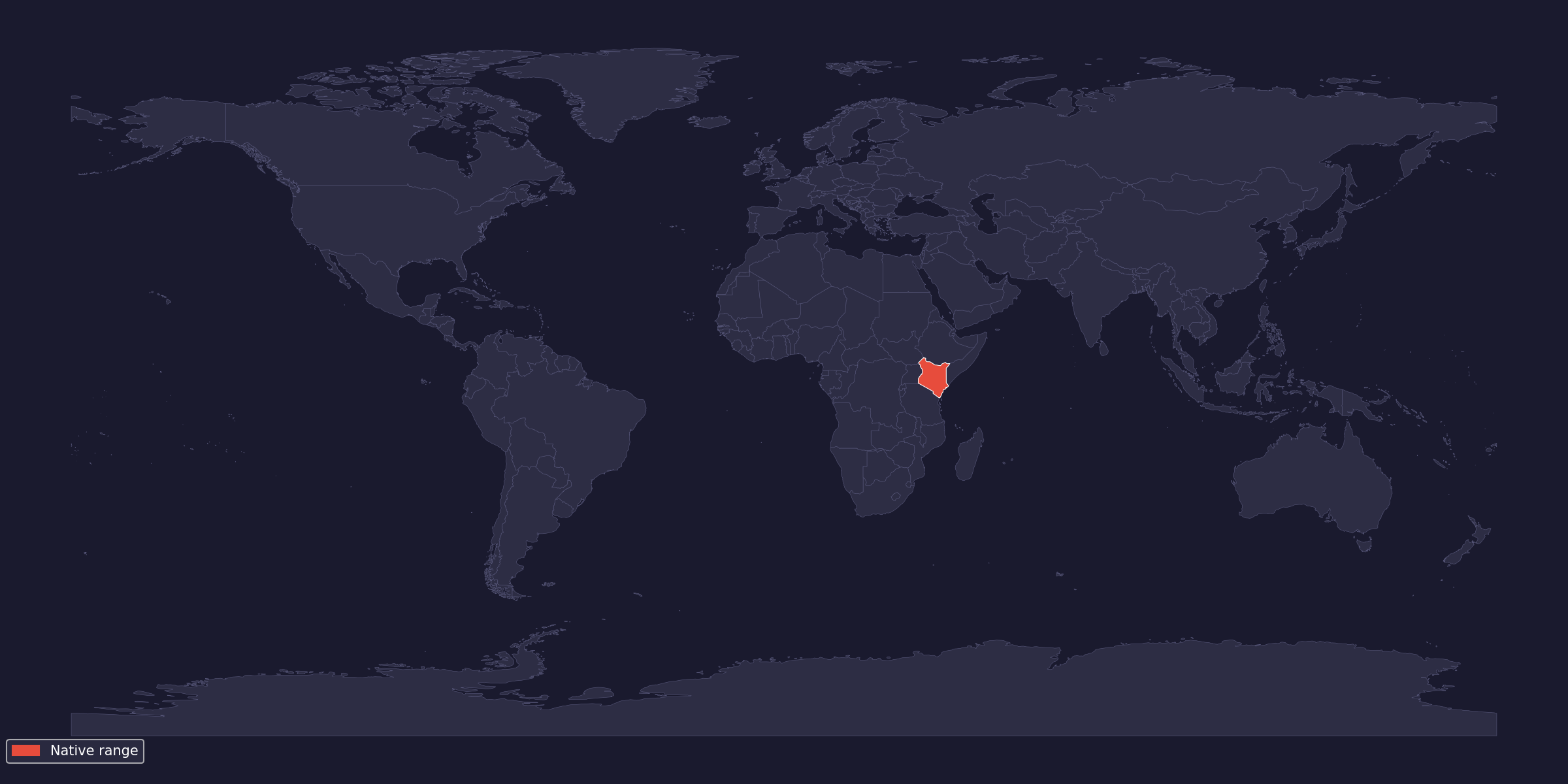
The species is endemic to Kenya’s central Rift Valley and adjoining plateaus, with a patchy range around Lake Naivasha, Gilgil, Elmenteita and Nakuru and historical records from other highland areas. It uses montane grassland, scrub and broken rocky country, much of it within farming landscapes.
Fine locality data can facilitate collection and should not accompany sales. Historic range reports do not prove a modern founder’s origin; require an individual permit and parentage trail.
⚖️ Legal status
Checked on 21 August 2026: B. worthingtoni is in CITES Appendix II and EU Annex B. International movement therefore requires the applicable CITES documents, and EU import/trade controls apply. Bern is not relevant to this Kenyan endemic.
Kenya has protected the species since 1989. Official CITES analysis states wild collection and export from Kenya are prohibited; Kenya’s current Wildlife Conservation and Management Act requires permits for wildlife trade and movement. Captive animals abroad must have a chain back to lawful founders. Reject unpermitted Kenyan locality stock, unexplained “farm bred” animals and paperwork issued for a different Bitis.
🤌 Husbandry
House singly in a locked primary enclosure inside an access-controlled escape-resistant room. Two compartments or a full-body shift hide must close from outside. Confirm the entire snake behind a barrier before service access; two trained adults attend every primary opening.
Quarantine for at least 90 days using simple, auditable furnishings and dedicated tools. Record gram weight, meals, sheds, faeces and respiration, and arrange veterinary parasite assessment. No routine free handling, tailing, pinning or manual restraint.
Studbook-quality CITES certificate, source code, parentage and individual identity records are part of husbandry, not optional administration.
💡 Lighting
Provide bright white light for 10-14 hours, changed gradually with season, and darkness at night. A measured Ferguson Zone 2 UVB opportunity over part of the warm zone is recommended, with full shade in grass cover and both thermal zones.
Guard all lamps and wiring outside primary containment. Inspect UV and heat at the actual surfaces used by the snake.
🌡 Heating and temperature
Maintain 20-25°C daytime air, a small 28-31°C basking surface and a 16-21°C cool refuge; nights should fall to 12-18°C. Do not erase the highland gradient with a warm snake room.
Use guarded overhead heat, a thermostat, independent probes and an alarm. Seasonal cooling for breeding belongs only to healthy locality-documented adults under a managed plan; never cool new, thin, gravid or ill animals.
💧 Humidity and water
Maintain roughly 45-65% ambient humidity with strong ventilation and provide one 65-75% refuge for shedding. Keep most surfaces dry; highland rainfall is not continuous enclosure saturation.
Supply a stable shallow bowl exchanged through protected access. Repeated soaking, retained shed or concentrated urates require a husbandry and veterinary review.
🌿 Enclosure and decoration
One adult needs at least 120 x 60 x 75 cm. Provide two shift-compatible hides, clumps of low cover, anchored broad branches or shelves, fixed stones and a clear inspection lane. Any climbing element must support the whole snake and allow safe shifting.
Use 6-10 cm of mineral soil and sand with dry grass or leaf-litter patches. Quarantine on paper. Avoid unstable stone, deep inaccessible tussocks and décor that defeats a full visual count.
🐁 Feeding
Wild diet remains incompletely documented; venom-activity research supports a mixed small-vertebrate ecology. Established captives can accept appropriately small frozen-thawed mice. Adults generally need a modest meal every 14-21 days; juveniles every 7-14 days.
Acquire established feeders and a detailed prey history. Do not use live rodents, wild prey, force-feeding or loose tubs. Whole prey requires no routine supplements. Track weight because small vipers can lose condition quickly and become obese just as easily.
🛡 Operational safety and emergencies
Rehearse servicing, escape, bite, transport, fire and power-failure procedures without a live snake. The escape plan must isolate the room, exclude the public, account for all animals and define a protected search of grass-like cover.
Before acquisition, coordinate with poison control, a medical toxicologist, emergency services and the receiving hospital. Species-specific clinical data and antivenom evidence are limited. Never promise coverage, stock or administer antivenom privately.
After a bite, move away, call emergency services, remove constricting items, remain still and support the limb neutrally. Do not cut, suck, ice, massage, shock or tourniquet. There is no home treatment.
🥚 Breeding notes
The species is viviparous. Official CITES material reports seven to twelve young per litter; an older captive report mentioned sixteen, but that outlier should not define routine planning.
Breeding must serve a lawful documented population, not demand for rare locality animals. Pair only compatible registered stock and prepare individual secure neonatal units, CITES paperwork and placements in advance.
🩺 Common problems
- Overheating: highland snakes denied cool retreats or night drops.
- Obesity or rapid weight loss: inappropriate prey size, interval or stress.
- Retained shed and dehydration: poor localized humidity or water access.
- Respiratory disease: damp stagnant conditions or inappropriate cold exposure.
- Parasites and stomatitis: important in animals with uncertain founder history.
- Broken CITES provenance: exposes laundering and removes conservation value.
Shift and secure before veterinary intervention. Hands-on home treatment is unsafe.
📌 Conclusion
Kenya horned viper care requires cool Rift-highland choices, safe low structure, conservative feeding, protected contact and impeccable CITES provenance. An attractive rarity is not an ethical acquisition without every link documented.
📚 Sources and further reading
- ReptiFiles — checked first on 21 August 2026; no species-specific guide was found.
- The Reptile Database: Bitis worthingtoni
- GBIF species record: Bitis worthingtoni
- CITES CoP17 proposal for B. worthingtoni
- Official IUCN/TRAFFIC analysis for CoP17
- Kenya Wildlife Conservation and Management Act
- Richards et al. 2021 — venom activity and inferred diet
- Barlow et al. 2019 — evolution and habitat shifts in Bitis
- CITES Appendices
- EU wildlife-trade annexes, Commission Regulation (EU) 2026/1383
- Baines et al. — UV lighting guidance for reptiles
- CDC/NIOSH venomous-snake first aid
- Bern Convention appendices